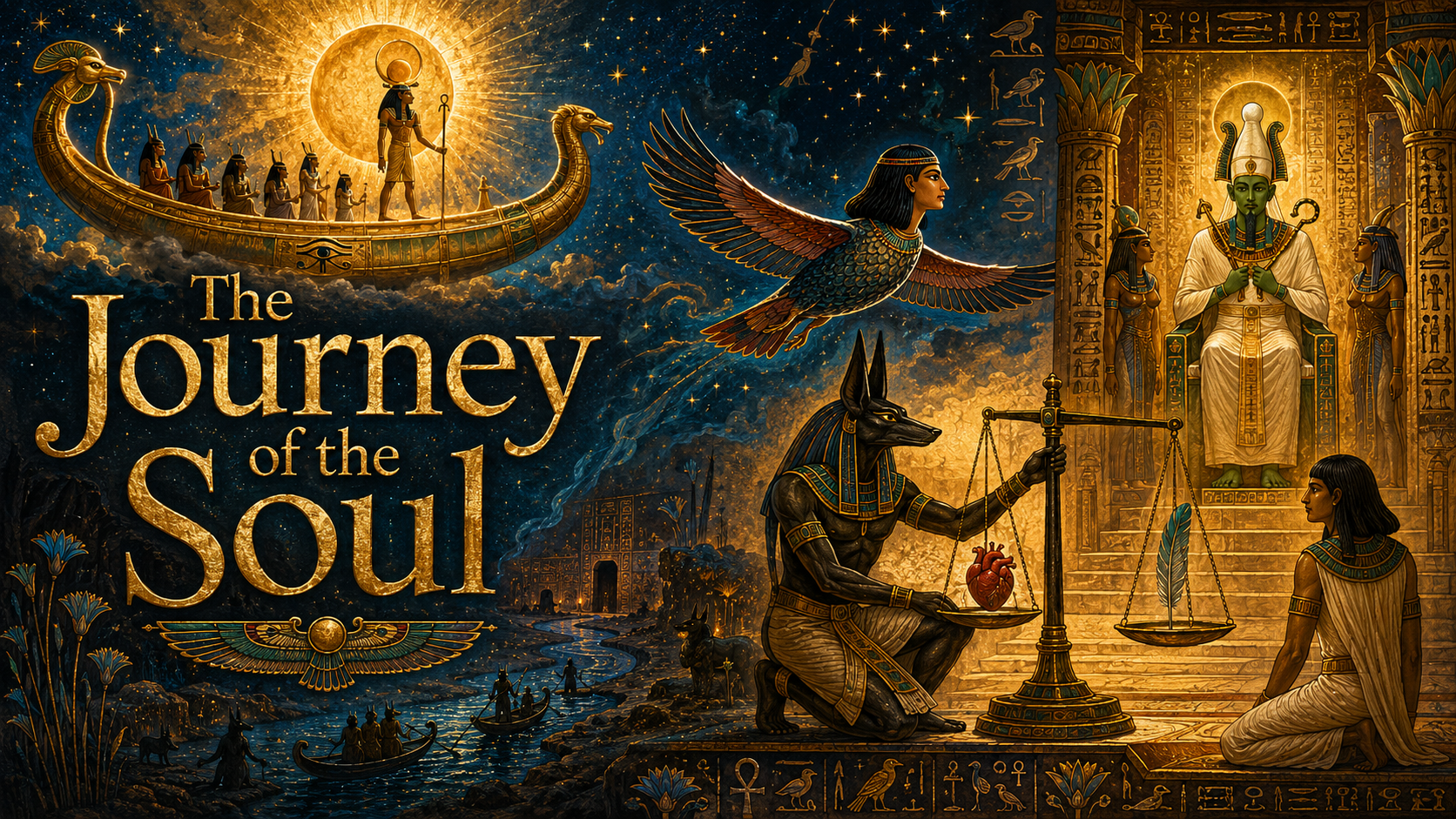
Each morning, the sun rose from the eastern horizon and began its journey across the sky.
At dawn, the Sun God appeared as Khepri, the scarab god who represented renewal and rebirth. He boarded the Day Boat and was carried through the heavens by a crew of gods and blessed spirits.
By midday, the sun blazed at the height of its power as Ra. As evening approached, it weakened and became Atum, the aged form of the setting sun.
When the sun disappeared beyond the western horizon, its journey was not over.
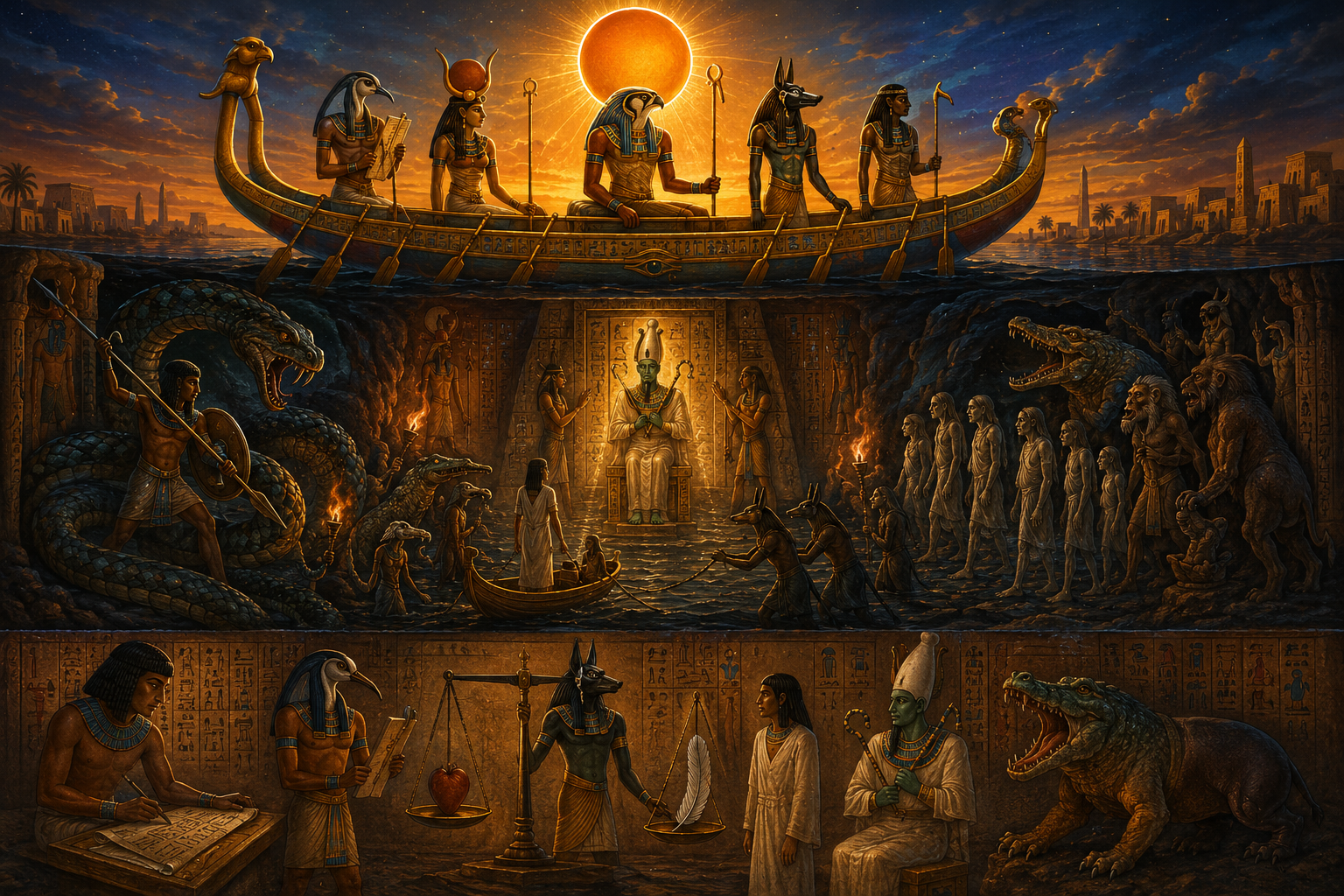
Ra entered the hidden world beneath the earth and boarded the Night Boat. There he traveled through the Duat, the mysterious realm of the dead, before rising again at dawn.
His passage through darkness was dangerous. Gods such as Thoth, Hathor, and Seth accompanied and protected him. The dead awakened as his light passed through the underworld, and Osiris, ruler of the Beautiful West, greeted the Sun God.
Ra and Osiris represented two parts of the same mystery. Ra descended into death each evening, while Osiris embodied resurrection and eternal life. Their nightly union renewed both the sun and the world.
Ra’s Journey Through the Underworld
The Night Sun faced many obstacles during his journey. The Duat was divided into regions guarded by gates, caverns, demons, and divine beings. Each guardian possessed a secret name and would not allow the Solar Boat to pass unless the proper words were spoken.
The forces of Chaos also gathered every night to stop the sun from returning. Their greatest champion was Apophis, the enormous serpent who sought to swallow Ra and plunge creation into eternal darkness.
Seth stood in the front of the Solar Boat and fought the serpent with his spear. Other gods used ropes, knives, fire, and powerful spells to restrain and destroy it. Yet Apophis could never be defeated forever. Each night the serpent returned, and each night the gods had to overcome it again.
Had Ra failed to escape the underworld, the sun would not have risen. Darkness would have covered the earth, the waters of Chaos would have overwhelmed creation, and the order established by the gods would have ended.
Every sunrise was therefore a new victory of light over darkness and Order over Chaos.
The King’s Journey After Death
The earliest elaborate Egyptian beliefs about the afterlife centered upon the king.
When a pharaoh died, he was believed to share the journey of the Night Sun. Like Ra, he entered darkness and faced the dangers of the underworld. His passage through death eventually led to rebirth and eternal life.
The dead king was also identified with Osiris.
Osiris had been murdered, restored, and transformed into ruler of the dead. His son Horus avenged him and inherited his throne.
Every royal death repeated this sacred pattern.
The dead king became Osiris, while his living successor became Horus. In this way, kingship continued without interruption. One ruler might die, but the divine office of the king endured.
These beliefs appear in the Pyramid Texts, a collection of spells carved inside the pyramids of kings and some queens near the end of the Old Kingdom.
The spells protected the royal dead, helped them overcome supernatural dangers, and guided them toward the gods. Some promised that the king would join Ra in the Solar Boat. Others described him rising into the sky and taking his place among the undying stars.
From the Pyramid Texts to the Book of the Dead
During the Middle Kingdom, many spells that had once appeared in royal pyramids were adapted for the burials of nonroyal people.
These funerary writings are now known as the Coffin Texts because they were frequently painted or carved upon coffins. They also appeared on tomb walls, masks, papyri, and other burial objects.
The Coffin Texts provided guidance for the underworld and included descriptions and maps of its dangerous regions. Those who could afford them hoped the spells would allow them to share the divine afterlife once reserved mainly for kings.
By the beginning of the New Kingdom, a new collection of funerary spells had developed.
The Egyptians called these writings the Book of Coming Forth by Day. Today, they are better known as the Book of the Dead.
It was not a single book with one fixed order. Nearly two hundred spells are known, but no surviving papyrus contains all of them. A family selected the spells it could afford or considered most useful, and scribes prepared a personalized copy for the dead.
Some papyri were beautifully illustrated and written for wealthy officials. Others were shorter, less elaborate, or produced in advance with blank spaces where the buyer’s name could later be added.
The spells helped the deceased leave the tomb, assume different forms, pass through gates, avoid monsters, receive food, join the gods, and survive judgment.
Owning an illustrated papyrus was both a religious preparation and a display of wealth.
Preparing the Body for Eternity
The ancient Egyptians believed that the preservation of the body was important to continued existence after death.
In the earliest periods, the dead were often placed in shallow graves in the desert. Direct contact with the hot, dry sand naturally preserved many bodies.
As burial customs became more elaborate, people began placing the dead in coffins and enclosed tombs. These conditions protected the body from animals and disturbance, but they also prevented the dry sand from preserving it.
The Egyptians gradually developed mummification to recreate that natural drying process.
Mummification changed considerably over thousands of years. Methods depended upon the period, the region, the skill of the embalmers, and the amount a family could afford.
When someone died, the family brought the body to specialists who prepared it for burial. A price was agreed upon, and the embalmers began their work.
In some forms of mummification, part of the brain was removed through the nostrils with a hooked instrument. The Egyptians did not understand the brain as the center of thought and emotion. They believed the heart performed those functions.
The embalmers made an incision in the side of the body and removed organs that would decay quickly. The liver, lungs, stomach, and intestines were dried separately.
The heart was usually left within the chest because it contained the person’s memory, intelligence, character, and moral identity. It would be needed when the deceased faced judgment.
The body was washed and covered or packed with natron, a naturally occurring salt mixture that absorbed moisture.
Drying commonly lasted around forty days, although the complete preparation and burial process traditionally took about seventy days.
After the body had dried, the embalmers filled its empty spaces with linen, resin, sawdust, mud, or other materials. This restored some of its shape and made it appear more lifelike.
The skin was anointed with oils and resins. The incision was closed, and the body was wrapped in many layers of linen.
Priests recited spells throughout the wrapping process. Protective amulets were placed between the bandages, each intended to guard a particular part of the body or provide a magical power.
A mask might be placed over the head and shoulders. The finished mummy was then enclosed within one or more coffins.
The Four Sons of Horus
The internal organs were also dried and protected. During many periods, they were placed in containers now called canopic jars. These jars became associated with the Four Sons of Horus, who protected the organs of the dead.
Imsety, shown with a human head, protected the liver. Hapy, shown with the head of a baboon, protected the lungs.
Duamutef, shown with the head of a jackal, protected the stomach. Qebehsenuef, shown with the head of a falcon, protected the intestines. Each son of Horus was also protected by a goddess.
Isis guarded Imsety, Nephthys guarded Hapy, Neith guarded Duamutef, and Selket guarded Qebehsenuef.
During some later periods, the preserved organs were returned to the body, but canopic jars or symbolic containers could still be included in the burial.
The Funeral Procession
When the preparations were complete, the mummy traveled to its tomb.
Because the western horizon was associated with sunset and the realm of the dead, many cemeteries stood upon the western side of the Nile.
The coffin might be placed on a sledge and pulled by oxen. Family members, priests, servants, and professional mourners followed behind.
The mourners beat their breasts, covered themselves with dust, and cried out for the dead as Isis and Nephthys had mourned Osiris.
Food, furniture, clothing, jewelry, tools, containers, and other burial goods accompanied the procession. Wealthy people might also receive statues, model servants, elaborate coffins, and richly illustrated papyri.
At the entrance to the tomb, priests performed the Opening of the Mouth ceremony.
A ritual instrument shaped like an adze was touched to the mouth and other parts of the mummy or its statue. Through spells and symbolic actions, the dead person’s senses were restored.
The deceased could once again see, hear, breathe, speak, eat, and drink.
The mummy was then placed inside the burial chamber, and the tomb was sealed.
The funeral had ended, but the dead person’s journey had only begun.
The Ka
The Egyptians believed that a human being consisted of several connected elements.
One of these was the ka, the life force that came into existence at birth and continued after death.
The ka required food and drink. Families therefore presented offerings at the tomb so the dead could continue to receive nourishment.
Bread, beer, meat, poultry, vegetables, fruit, wine, water, incense, and clothing might be placed before the deceased.
Of course, the physical food eventually spoiled or was removed. The ka was believed to consume its spiritual essence.
The Egyptians knew that descendants might neglect these offerings. To guard against this danger, tomb walls were painted or carved with images of food, drink, servants, fields, cattle, hunting, fishing, and banquets.
Through magical power, these images could provide what the dead required.
Offering formulas were also inscribed within tombs. They asked the gods to grant bread, beer, oxen, birds, alabaster, linen, incense, and every good and pure thing upon which a god lived.
The ka could remain connected with the mummy, but statues and images could also provide alternative places for the spirit if the body were damaged.
This was one reason Egyptian tombs might contain several statues of the deceased.
The Ba
Another spiritual element was the ba.
The ba is often translated as “soul,” though this does not fully capture its meaning. It represented a person’s identity, character, mobility, and individual personality.
Artists usually depicted the ba as a bird with a human head.
Unlike the body, the ba could move freely. It could leave the tomb, travel through the world of the living, visit places the deceased had loved, and return to the mummy.
The ba could also assume other forms. Funerary spells allowed it to become a falcon, swallow, heron, lotus, snake, crocodile, or divine being.
Yet its freedom was not guaranteed.
The ba needed spells to leave the tomb, avoid danger, and return safely. Without the preservation of the body, remembrance of the name, and performance of rituals, the parts of the deceased risked becoming separated.
Each night the ba returned to the body so that the person could be renewed.
The reunion of the ba and ka helped transform the deceased into an akh.
Becoming an Akh
An akh was a transfigured and effective spirit. The akh had successfully passed through death, survived the dangers of the underworld, and joined the divine order.
A blessed akh could live among the gods, shine as a star, travel with Ra, receive offerings, and intervene in the lives of the living.
The dead were not always viewed as distant or powerless. Egyptians sometimes wrote letters to deceased relatives, asking them to heal sickness, settle disputes, protect the household, or stop a spirit believed to be causing trouble.
A respected ancestor could become a powerful ally. A restless or angry dead person, however, might be feared.
Dangers in the Underworld
The journey of the ba through the Duat was filled with dangers.
The deceased might be attacked by snakes, crocodiles, demons, insects, or supernatural executioners. Spells protected against decapitation, drowning, burning, starvation, walking upside down, losing one’s shadow, or having one’s name erased.
Some monsters bore terrifying names, including the Ass-Eating Serpent and the Crocodiles of the Four Directions.
Fire and water both threatened the traveler.
The dead might encounter lakes of flame, rivers of darkness, caverns, islands, and regions where monstrous beings waited with knives.
Knowledge was the greatest defense.
The deceased needed to know the names of gates, guardians, ferrymen, boats, ropes, winds, and parts of the underworld. To know the secret name of a supernatural being was to gain power over it.
At one stage, the deceased had to cross a body of water in a divine boat. The ferryman could refuse passage unless the traveler correctly named him and every part of his vessel.
Farther on stood a series of guarded gates.
Their keepers had names such as Faceless One, Clawed One, Feeder on Carrion, Wallower in Slime, and Lord of Knives.
By naming them and speaking the correct spells, the deceased forced them to stand aside.
The final destination was the Hall of the Two Truths, where Osiris judged the dead.
The Forty-Two Judges
Within the Hall of the Two Truths, the deceased appeared before Osiris and a tribunal of forty-two divine judges.
Each judge was associated with a particular region and a particular offense.
The deceased addressed them individually and recited what is often called the Negative Confession or Declaration of Innocence.
The statements varied among different copies of the Book of the Dead, but they included declarations such as:
“I have done no evil.”
“I have not stolen.”
“I have not murdered.”
“I have not told lies.”
“I have not deprived the poor of their property.”
“I have not caused anyone to suffer.”
“I have not polluted the water.”
“I have not taken food from the hungry.”
The deceased also declared that they had lived according to Ma’at.
They had given bread to the hungry, water to the thirsty, clothing to the naked, and assistance to those in need. They had honored the gods and made offerings to the dead.
Yet words alone were not enough. The heart would reveal the truth.
The Weighing of the Heart
Anubis led the deceased to a great balance.
Upon one side of the scales he placed the person’s heart. Upon the other he placed the feather of Ma’at, the goddess and principle of truth, justice, balance, and cosmic order.
Thoth stood nearby and recorded the result.
The heart contained the memory of every action performed during life. It could speak independently and reveal wrongdoing.
For this reason, many people were buried with a heart scarab.
These large amulets were often inscribed with a version of Spell 30 from the Book of the Dead. The spell asked the heart not to oppose its owner, testify against them, or cause their name to be rejected before the judges.
If the heart balanced with the feather, the deceased had lived according to Ma’at.
Horus then led the justified person before the throne of Osiris.
But if the heart was heavy with wrongdoing, a terrifying creature waited nearby.
This was Ammit, the Devourer of the Dead. She possessed the head of a crocodile, the front of a lion, and the hindquarters of a hippopotamus, three of Egypt’s most dangerous animals.
Ammit consumed the guilty heart.
The condemned person did not enter a fiery hell. Instead, they suffered a second death and lost the possibility of eternal existence.
To the Egyptians, complete destruction and eternal nonexistence were among the worst fates imaginable.
The Field of Reeds
Those declared true of voice entered the blessed afterlife.
One possible destination was the Field of Reeds, an ideal version of Egypt where the crops grew tall, the water was plentiful, and hunger, sickness, and suffering did not exist.
The dead could live with their families, cultivate fields, sail upon canals, worship the gods, and enjoy everything they had valued in life.
Work still existed in this paradise, at least in some traditions.
To avoid performing agricultural labor personally, people placed small mummy-shaped figures called shabtis in their tombs.
A spell commanded the shabti to answer whenever the deceased was called to work. The figure would then irrigate fields, carry sand, and complete whatever task was required.
Wealthy burials sometimes contained hundreds of shabtis, including overseers to supervise them.
Other blessed spirits joined the crew of the Solar Boat and traveled eternally with Ra.
Some became stars in the northern sky. Because certain circumpolar stars never sank below the horizon, the Egyptians viewed them as undying.
The afterlife did not have only one form.
A blessed person could dwell in the tomb, travel through the living world as a ba, join Osiris in the Field of Reeds, become an imperishable star, and sail with Ra.
These possibilities could exist together.
The House of the Ka
The tomb was often called the house of the ka.
Its paintings and objects created an eternal world in which the deceased could continue to live.
Scenes showed farming, fishing, hunting, crafting, feasting, music, family gatherings, and religious ceremonies. These were not merely decorations or memories. Through ritual and magic, they became active sources of life.
Names and images were particularly important.
To speak the name of the dead was to renew their existence. To destroy the name or image threatened their survival.
This is why Egyptian monuments repeated the owner’s name and likeness so frequently.
A preserved body, an enduring name, a functioning tomb, food offerings, funerary spells, and the remembrance of the living all helped keep the person whole.
Egyptian beliefs about death can therefore appear complicated or even contradictory.
The dead remained in the tomb, yet traveled outside it. They joined Osiris, yet also accompanied Ra. They lived among the stars, yet cultivated fields in a heavenly Egypt.
The Egyptians rarely discarded an old religious idea when they adopted a new one. Instead, they placed different traditions beside one another.
Each described another aspect of the mystery of eternal life.
Did Every Egyptian Believe?
Not every surviving Egyptian text expresses complete confidence in the afterlife.
Some poems questioned whether tombs, offerings, spells, and monuments could truly preserve a person forever. They pointed out that even the tombs of ancient kings had fallen into ruin and that no dead person had returned to describe what followed.
These songs encouraged people to enjoy life while they could.
They advised their listeners to dress in fine linen, anoint themselves with fragrant oils, celebrate, and follow their hearts. Mourning could not prevent death, and no one could carry earthly possessions into the grave.
Such writings did not necessarily reject the gods or the afterlife completely. They expressed uncertainty about death and reminded people that earthly life was precious.
Other Egyptians trusted fully in the justice and mercy of the gods.
They believed the Beautiful West held no terror for a righteous person. Countless ancestors had already entered it, and every future generation would eventually follow.
Human life was brief, almost like a dream. Death was a journey all people had to make.
For those who lived according to Ma’at and successfully crossed the dangers of the underworld, Osiris waited at the end. The Lord of Eternity welcomed the justified dead in peace, while Ra’s return at dawn promised that life could rise again from darkness.