How Tall Were The Greek Gods? Were They Like Humans?
Greek mythology fascinates people because its gods often behaved like humans while possessing unimaginable divine powers. One question many readers ask is: How tall were the Greek gods? Did Zeus tower over mountains, or were the Olympians roughly human-sized?
The answer is surprisingly complicated. In Greek mythology, the gods could alter their appearance, change size, and even transform into animals or natural forces. As a result, there is no single height that can be assigned to the Greek gods.
How Tall Were the Greek Gods?
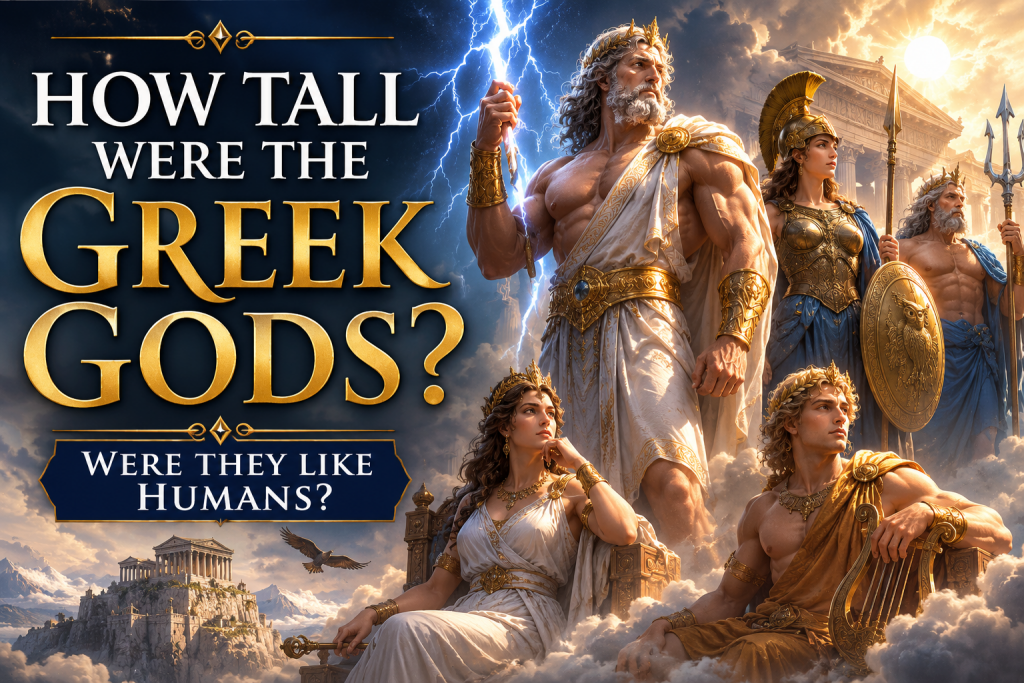
Ancient Greek myths rarely provide exact measurements for the Olympian gods. Unlike some mythologies that describe their deities in precise physical terms, Greek mythology usually focuses on a god’s power, personality, and actions rather than their size.
In art and sculpture, Greek gods were almost always depicted with idealized human proportions. Statues of Zeus, Athena, Apollo, and other Olympians show them as beautiful, athletic men and women with perfect bodies. This artistic style reflected the Greek belief that the gods represented the highest form of beauty and perfection.
However, mythology makes it clear that the gods could appear much larger than humans whenever they wished.
Could Greek Gods Change Their Size?
Yes. One of the defining characteristics of the Greek gods was their ability to change shape and appearance.
The Olympians frequently transformed themselves into different forms:
- Zeus transformed into a swan, bull, eagle, and even a shower of gold.
- Athena appeared in disguises when interacting with mortals.
- Poseidon could manifest as horses or enormous sea beings.
- Artemis and Apollo sometimes appeared in divine forms that overwhelmed mortals.
Because the gods possessed limitless supernatural power, they could appear as ordinary humans, gigantic divine beings, or even invisible spirits.
This ability makes it impossible to assign a fixed height to any Greek god.
How Tall Was Zeus?
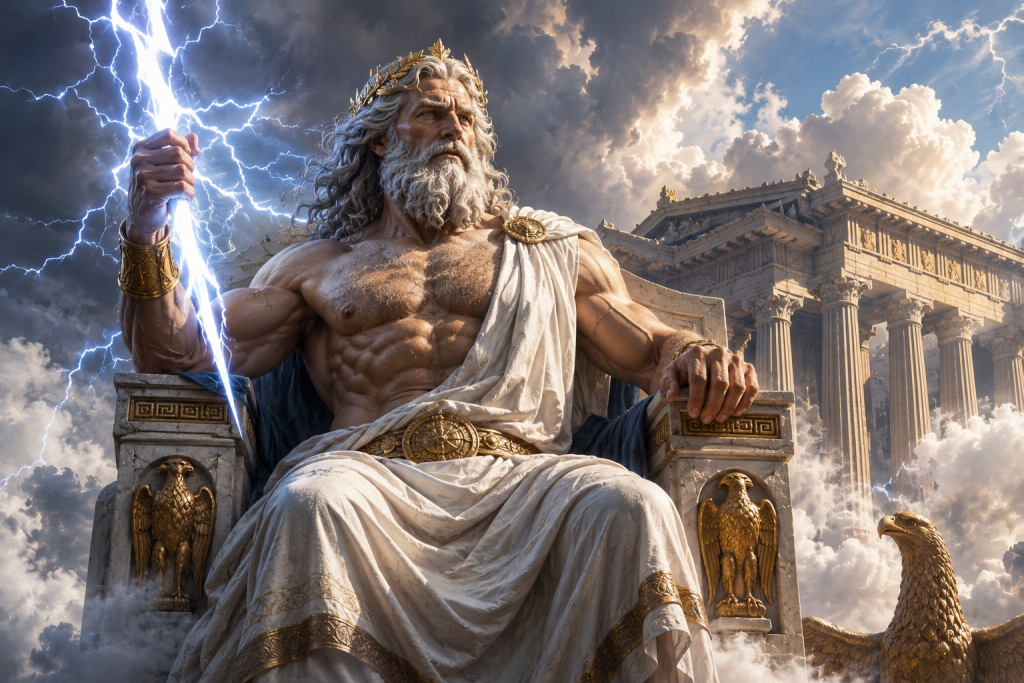
Zeus, king of the Olympian gods, is often imagined as the tallest and most imposing of the Olympians.
Ancient texts do not provide an exact measurement for Zeus. Modern estimates found online, such as claims that Zeus was 40 feet (12 meters) tall or even 24 meters tall, are speculative and are not based on surviving ancient Greek sources.
Many myths suggest that Zeus could appear in whatever form best suited the situation. When interacting with mortals, he often appeared as an ordinary man. During divine revelations, however, Zeus could manifest in a glorious form so powerful that mortals could barely endure looking upon him.
Some philosophical and later religious traditions even described Zeus as a cosmic being whose essence encompassed the entire universe, making any physical measurement meaningless.
Were Titans Larger Than Olympians?
The Titans, the older generation of deities who ruled before the Olympians, are often portrayed as enormous beings.
Cronus (Kronos), the father of Zeus, was a Titan, as were Oceanus, Hyperion, and Rhea. Ancient Greek artists sometimes depicted Titans as gigantic figures, and modern retellings frequently portray them as much larger than the Olympian gods.
Nevertheless, Greek mythology never establishes consistent heights for the Titans either. Like the Olympians, Titans were divine beings capable of changing their appearance.
Cosmic Gods and Their Enormous Sizes
Some primordial deities can be thought of as literally cosmic in scale.
For example:
- Gaia, the personification of Earth, was essentially the Earth itself.
- Uranus, the sky god, embodied the heavens.
- Pontus represented the sea.
- Helios personified the Sun.
- Selene embodied the Moon.
Since these deities were identified with natural and celestial bodies, they could be considered as large as the worlds or heavenly objects they represented. In this sense, Gaia would be as vast as the Earth itself, while Helios and Selene could be viewed as cosmic entities spanning the heavens.
Were Greek Gods Humans?
No. Although Greek gods often looked human, they were not human.
The Greeks deliberately portrayed their gods in human form, a concept known as anthropomorphism. This means attributing human characteristics to non-human beings.
Greek gods shared many human traits:
- They could feel love and desire.
- They experienced jealousy and anger.
- They argued, competed, and held grudges.
- They laughed, celebrated, and formed relationships.
Despite these similarities, the gods differed from humans in several important ways.
The Differences Between Gods and Humans
Greek gods were:
- Immortal and did not die of old age.
- Supernaturally powerful, controlling aspects of nature and human life.
- Shape-shifters capable of changing their appearance at will.
- Possessors of divine knowledge far beyond human understanding.
The gods also consumed nectar and ambrosia, divine substances that sustained their immortality.
Did Greek Gods Have Children With Humans?
Yes. Many myths describe relationships between gods and mortals.
The children born from these unions were known as demigods or heroes. Some famous examples include:
- Heracles (Hercules), son of Zeus.
- Perseus, son of Zeus and Danaë.
- Helen of Troy, daughter of Zeus and Leda.
- Achilles, son of the sea goddess Thetis and the mortal Peleus.
These heroes possessed extraordinary abilities but remained mortal, unlike their divine parents.
There is no definitive answer to the question, “How tall were the Greek gods?” Ancient Greek mythology does not provide exact measurements for most deities. The gods were supernatural beings who could change shape, alter their size, and appear in whatever form they desired.
Although Greek gods often appeared human in art and myth, they were fundamentally divine beings with immense powers, immortality, and the ability to transcend ordinary physical limitations.
Ultimately, the Greek gods were not confined by human dimensions, making their true size impossible to measure.
