King Tutankhamun DNA: What Genetic Tests Revealed About His Family and Health
Today, the concept of confirming identities and familial relationships with DNA tests is so common that we often take it for granted. But it’s only in recent history that this amazing technology has become available and, as a result, has provided us with insights and information we might not otherwise have.
King Tutankhamun’s DNA has been used to investigate some of the greatest mysteries surrounding the young Egyptian pharaoh.
Who were King Tut’s parents? Was he the child of a brother and sister? Did he suffer from inherited health problems? Was malaria responsible for his death?
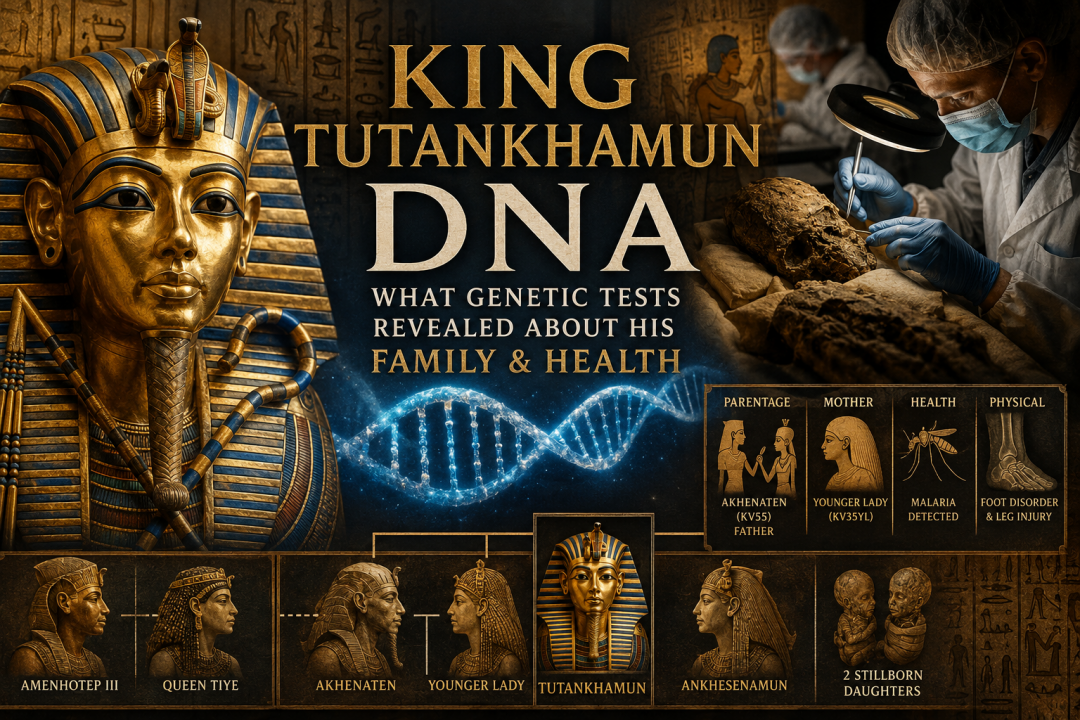
A major study published in 2010 attempted to answer these questions by examining Tutankhamun and several royal mummies believed to belong to his family. The researchers reconstructed a possible five-generation family tree and reported evidence of close-relative marriage, malaria, and a serious disorder affecting Tutankhamun’s left foot.
The findings transformed popular ideas about the boy king. Instead of the healthy young ruler often shown riding chariots and hunting, the study presented Tutankhamun as a young man whose health may have been compromised by disease, physical disability, and generations of royal intermarriage.
However, the story is not entirely settled. Ancient DNA is extremely difficult to recover and authenticate, particularly from Egyptian mummies. Some specialists have questioned the methods used in the 2010 investigation and cautioned that several of its conclusions should be treated as probable rather than proven.
What Did King Tutankhamun’s DNA Reveal?
The 2010 study reported four major findings about Tutankhamun:
- The mummy from tomb KV55 was probably his father.
- The mummy known as the Younger Lady was his mother.
- His parents were full siblings.
- Tutankhamun carried genetic evidence of Plasmodium falciparum, the parasite responsible for a severe form of malaria.
The researchers also examined CT scans and other medical evidence. They concluded that Tutankhamun suffered from a painful bone disorder in his left foot and may have required walking sticks.
The study proposed that malaria, poor health, and complications from a leg injury may have contributed to his death at approximately 18 or 19 years old.
These conclusions came from a combination of genetic analysis, CT imaging, archaeological evidence, and comparisons among royal mummies. The original research was published in JAMA under the title “Ancestry and Pathology in King Tutankhamun’s Family.”
When Was King Tutankhamun’s DNA Tested?
Tutankhamun and several related mummies were examined between 2007 and 2009 as part of the King Tutankhamun Family Project.
The researchers studied 11 royal mummies dating to Egypt’s New Kingdom. Some were already identified, while others were known only by the tombs or museum catalogs associated with them.
The project used:
- DNA fingerprinting
- Short tandem repeat analysis
- Y-chromosome markers
- Tests for disease-causing organisms
- CT scans
- Physical examinations of the mummies
The study did not produce a complete genome sequence for Tutankhamun. Instead, researchers examined selected genetic markers that could be compared across the group.
This distinction is important. A DNA profile based on selected markers can help identify close biological relationships, but it does not provide the same amount of information as a complete genome.
Who Was King Tutankhamun’s Father?
The 2010 DNA study identified the mummy found in tomb KV55 as Tutankhamun’s father.
The KV55 mummy had long been the subject of debate. Archaeological evidence connected the burial to the Amarna royal family, but scholars disagreed about whether the remains belonged to Akhenaten, Smenkhkare, or another male member of the dynasty.
According to the genetic reconstruction, the KV55 man was:
- A son of Amenhotep III
- A son of Queen Tiye
- The brother of Tutankhamun’s mother
- The biological father of Tutankhamun
The study’s authors concluded that the mummy was most likely Akhenaten.
Akhenaten was the controversial pharaoh who promoted the worship of the solar deity Aten and reduced the influence of Egypt’s traditional gods. Tutankhamun was born during or shortly after the upheaval associated with Akhenaten’s religious reforms.
The genetic relationship between KV55 and Tutankhamun is one of the study’s strongest claims. The historical identification of KV55 specifically as Akhenaten remains more controversial because DNA can establish biological relationships more readily than it can attach a historical name to unidentified remains.
Who Was King Tutankhamun’s Mother?
The DNA study identified Tutankhamun’s mother as the mummy known as the Younger Lady.
The Younger Lady was discovered in tomb KV35 alongside Queen Tiye and another unidentified individual.
Genetic comparisons indicated that the Younger Lady was:
- A daughter of Amenhotep III
- A daughter of Queen Tiye
- A full sister of the KV55 man
- The biological mother of Tutankhamun
Her personal name remains unknown.
Although several royal women have been suggested, researchers have not securely identified the Younger Lady as Nefertiti, Kiya, Nebetah, Beketaten, or any other named princess.
The genetic results therefore appear to tell us where Tutankhamun’s mother belonged within the royal family without revealing exactly who she was.
Were King Tutankhamun’s Parents Brother and Sister?
According to the 2010 genetic study, Tutankhamun’s parents were full siblings.
The researchers concluded that the KV55 mummy and the Younger Lady were both children of Amenhotep III and Queen Tiye.
Marriage between close relatives occurred within some Egyptian royal families. Kings could marry sisters, half-sisters, nieces, or other female relatives, although the frequency and practical meaning of these unions varied across Egyptian history.
Royal intermarriage may have served several purposes:
- Preserving dynastic legitimacy
- Strengthening claims to the throne
- Concentrating political power
- Associating the royal family with divine models
- Preventing rival families from gaining influence through marriage
The evidence does not show that all ancient Egyptians commonly married siblings. Such relationships were particularly associated with royalty and became more clearly documented in certain later periods.
Was King Tutankhamun Inbred?
The term “inbred” is frequently used in headlines about Tutankhamun, but it should be handled carefully.
If the proposed family tree is correct, Tutankhamun was the child of a brother and sister. He also belonged to a dynasty in which close-relative marriages may have occurred over several generations.
This would have increased the chance that he inherited identical copies of harmful recessive genes from both parents.
However, researchers did not establish that every medical condition attributed to Tutankhamun was directly caused by his parents’ relationship.
The 2010 study reported several abnormalities among the royal mummies, but it did not prove a single genetic syndrome responsible for all of Tutankhamun’s physical problems.
It is therefore more accurate to say that close-relative parentage may have increased his vulnerability to inherited disorders rather than claiming that DNA definitively proved every illness resulted from incest.
What Health Problems Did King Tutankhamun Have?
Medical examinations suggest that Tutankhamun experienced several health problems during his short life.
The most important findings included:
- A disorder affecting his left foot
- A possible clubfoot-like deformity
- Bone deterioration
- Malaria infection
- A fracture in his left leg
- Possible reduced mobility
The evidence does not support every dramatic reconstruction of Tutankhamun as severely deformed.
Some speculative depictions have given him an elongated skull, pronounced overbite, extremely feminine body shape, or numerous congenital abnormalities. Several of these interpretations are disputed or may reflect artistic conventions from the Amarna Period rather than Tutankhamun’s actual appearance.
The 2010 researchers reported no evidence supporting several previously suggested syndromes, including Marfan syndrome.
Did King Tutankhamun Have a Clubfoot?
CT scans revealed abnormalities in Tutankhamun’s left foot.
The 2010 study diagnosed a condition called Köhler disease II, also known as Freiberg disease, involving the death or deterioration of bone tissue in the foot.
The affected area was associated with one of the metatarsal bones. The condition may have caused pain, swelling, stiffness, and difficulty walking.
The researchers also described a deformity resembling a clubfoot. However, the precise interpretation of Tutankhamun’s foot remains debated.
More than 100 walking sticks and staffs were discovered in his tomb. Some showed signs of wear, suggesting that they may have been used rather than included solely as symbols of royal authority.
This supports the possibility that Tutankhamun required assistance while walking, although the number of staffs found in the tomb does not by itself prove the severity of his disability.
Could King Tutankhamun Ride a Chariot?
Popular documentaries sometimes claim that Tutankhamun could not have ridden a chariot because of his foot disorder.
That conclusion goes beyond what the physical evidence can prove.
A painful foot condition could have made standing, walking, mounting, and controlling a chariot difficult. It does not necessarily mean he never rode one.
Royal images show Tutankhamun hunting, fighting, and riding a chariot. These scenes were idealized representations of kingship and should not be treated as literal records of his daily activities.
At the same time, physical disability would not automatically have prevented him from participating in ceremonial or assisted chariot riding.
The safest conclusion is that Tutankhamun probably experienced mobility problems, but we cannot determine exactly how much they restricted his activities.
Did King Tutankhamun Have Malaria?
The 2010 research team reported finding DNA associated with Plasmodium falciparum in Tutankhamun’s remains.
Plasmodium falciparum is the parasite responsible for one of the most dangerous forms of malaria.
The study detected genetic material associated with more than one strain, which the researchers interpreted as evidence that Tutankhamun suffered repeated malaria infections.
At the time, this was described as the oldest molecular evidence of malaria found in a mummy.
Malaria could have caused:
- High fever
- Chills
- Severe weakness
- Anemia
- Organ complications
- Reduced resistance to other illnesses
- Delayed recovery from injury
The presence of malaria-related DNA does not automatically prove that malaria killed him. Many people survive malaria, and ancient pathogen DNA can be difficult to authenticate.
Nevertheless, the finding offered a plausible medical factor that may have contributed to Tutankhamun’s declining health.
How Did King Tutankhamun Die?
The exact cause of King Tutankhamun’s death remains unknown.
In 2010, researchers proposed that a combination of malaria and complications associated with his foot condition contributed to his death.
A fracture in his left leg has also been discussed as a possible factor. If the injury occurred shortly before death, infection or complications from the fracture could have been dangerous.
One proposed sequence is:
- Tutankhamun suffered a serious leg injury.
- His existing foot disorder reduced his mobility.
- Malaria weakened his body.
- Infection or other complications developed.
- The combined illnesses became fatal.
This is a plausible reconstruction, not a proven diagnosis.
There is no surviving medical report or eyewitness description of his death. Damage to the mummy also makes it difficult to determine whether some injuries occurred during life, during embalming, during Howard Carter’s examination, or later.
Was King Tutankhamun Murdered?
There is no convincing evidence that Tutankhamun was murdered.
Older theories suggested that a blow to the back of his head killed him. CT scans later showed that loose bone fragments within the skull were more likely associated with mummification or postmortem handling than a fatal head injury.
Other theories have blamed:
- A chariot accident
- Political assassination
- Poisoning
- A fatal fall
- An infected leg fracture
- Malaria
- Genetic illness
None has been conclusively demonstrated.
The available medical evidence makes disease and injury more credible than murder, but the precise cause of death cannot currently be established.
Who Were King Tutankhamun’s Grandparents?
The genetic family tree identified Amenhotep III and Queen Tiye as Tutankhamun’s paternal and maternal grandparents.
Because the study concluded that Tutankhamun’s parents were siblings, the same couple would have been his grandparents on both sides of the family.
Amenhotep III ruled Egypt during one of the wealthiest periods of the 18th Dynasty. His reign was marked by monumental construction, diplomacy, international trade, and a flourishing royal court.
Queen Tiye was his Great Royal Wife and one of the most influential queens of the New Kingdom.
The mummy called the Elder Lady was genetically identified as Tiye. Researchers compared the remains with a lock of hair found in a small coffin bearing Queen Tiye’s name from Tutankhamun’s tomb.
The Elder Lady produced exceptionally well-preserved genetic material during the project, according to members of the research team.
What Did DNA Reveal About Tutankhamun’s Children?
Two mummified fetuses were found in Tutankhamun’s tomb.
They are usually interpreted as stillborn daughters of Tutankhamun and his wife, Ankhesenamun.
The 2010 study obtained incomplete genetic profiles from the fetuses. The available results were consistent with Tutankhamun as their father, but the evidence was not sufficient to establish every relationship with certainty.
One fetus died relatively early in pregnancy. The other was more developed and may have survived until shortly before or around birth.
Their presence in the tomb suggests that they were considered members of the royal family and were intended to accompany Tutankhamun into the afterlife.
No surviving child of Tutankhamun is known. His death brought his direct royal line to an end.
Was Ankhesenamun Identified Through DNA?
The 2010 project suggested that an unidentified mummy designated KV21A might be Ankhesenamun.
Ankhesenamun was Tutankhamun’s principal wife and probably his half-sister. She was a daughter of Akhenaten and Nefertiti.
The proposed identification was based partly on incomplete genetic evidence linking KV21A to one or both of the fetuses buried with Tutankhamun.
However, the DNA recovered from KV21A was incomplete, and the identification remains uncertain.
It is therefore inaccurate to state that DNA conclusively identified Ankhesenamun’s mummy.
Did the Study Identify Akhenaten’s Mummy?
The 2010 team concluded that the KV55 mummy was most likely Akhenaten.
Their reasoning combined:
- Genetic evidence
- The mummy’s relationship to Amenhotep III and Tiye
- Its relationship to Tutankhamun
- Objects discovered in KV55
- The tomb’s connection to the Amarna royal family
The principal problem is the mummy’s estimated age at death.
Earlier examinations suggested that the KV55 man died in his twenties, which would make Akhenaten an unlikely candidate, as he probably ruled for approximately 17 years and had several children before becoming king.
Other examinations have placed the man’s age at 35 or older, which would be more consistent with Akhenaten.
The identity of the KV55 mummy is therefore widely accepted by some scholars and challenged by others.
DNA can indicate that the man was Tutankhamun’s father, but it cannot independently tell researchers whether his name was Akhenaten or that of another royal.
How Reliable Was King Tutankhamun’s DNA Study?
The 2010 study was groundbreaking but also controversial. Recovering ancient DNA from Egyptian mummies is exceptionally difficult because:
- Heat accelerates DNA decay.
- Humidity and environmental changes damage genetic material.
- Embalming substances may interfere with testing.
- Mummies have been handled by excavators, researchers, museum workers, and visitors.
- Modern human DNA can contaminate ancient samples.
- Microbial DNA can overwhelm surviving human material.
Critics noted that the Tutankhamun study relied on older-style short tandem repeat testing rather than the high-throughput sequencing and molecular authentication techniques now commonly used in ancient-DNA research.
Questions were also raised about contamination controls, replication, and whether the genetic profiles displayed patterns expected from authentically ancient DNA.
A 2011 discussion in Nature described the Tutankhamun findings as part of a wider debate over the reliability of DNA recovered from Egyptian mummies.
Can Reliable DNA Be Recovered From Egyptian Mummies?
Yes, but researchers must use strict laboratory and authentication methods.
A 2017 study successfully recovered mitochondrial genomes from numerous Egyptian mummies and nuclear genomic data from three individuals. The research used next-generation sequencing and methods designed to distinguish ancient DNA from modern contamination.
That study demonstrated that Egyptian mummies can preserve authentic ancient DNA under suitable conditions.
It did not retest Tutankhamun or independently verify the royal family tree proposed in 2010.
More recently, researchers produced whole-genome data from an Egyptian individual who lived during the Old Kingdom. This represented a major advance in the genetic study of ancient Egypt, but the individual was separated from Tutankhamun by more than a thousand years and cannot be used to confirm Tutankhamun’s ancestry or family relationships.
Was King Tutankhamun’s Entire Genome Sequenced?
No complete, authenticated genome sequence for Tutankhamun has been published in a peer-reviewed study.
The 2010 investigation used selected DNA markers to examine relationships and search for pathogens.
This means claims that scientists have completely decoded Tutankhamun’s genome, precisely reconstructed his appearance, or definitively determined his modern ethnic identity are misleading.
A complete genome would require extensive sequencing, authentication of characteristic ancient-DNA damage, careful contamination analysis, and independent replication.
Until such research is published, Tutankhamun’s available genetic profile remains limited.
Did DNA Reveal King Tutankhamun’s Race?
No.
The 2010 study was designed primarily to reconstruct family relationships and investigate disease. It was not a comprehensive population-genetics analysis of Tutankhamun’s ancestry.
Claims that the results prove Tutankhamun belonged to a particular modern race, nationality, or ethnic group usually rely on incomplete information, commercial interpretations, or unsupported comparisons.
Modern racial categories do not map neatly onto people who lived in the Nile Valley more than 3,000 years ago.
Tutankhamun was an ancient Egyptian king from the 18th Dynasty. A scientifically meaningful ancestry study would require authenticated genome-wide data and comparison with appropriate ancient populations, not just a few genetic markers.
Did Embalming Preserve King Tutankhamun’s DNA?
Members of the 2010 team suggested that royal embalming practices may have unintentionally helped preserve DNA.
The quality of some samples reportedly surprised the researchers. The Elder Lady, identified as Queen Tiye, produced particularly clear genetic results.
However, embalming does not always protect DNA.
Natron drying may help preserve tissue by removing moisture, but oils, resins, heat, microbial activity, and chemical treatments can also damage genetic material. Preservation varies greatly among mummies depending on burial conditions, treatment, age, and subsequent handling.
Researchers cannot assume that royal mummies contain better DNA simply because they received more elaborate embalming.
Why Is King Tutankhamun’s DNA Important?
Tutankhamun’s DNA study helped bring genetics, radiology, archaeology, and Egyptology together.
The project demonstrated how scientific techniques might help answer questions that inscriptions and artifacts cannot resolve by themselves.
Its most important contributions included:
- Proposing a biological family tree
- Identifying Tutankhamun’s probable parents
- Connecting unidentified mummies to the Amarna dynasty
- Reporting evidence of malaria
- Investigating inherited and physical disorders
- Encouraging further ancient-DNA research in Egypt
The controversy surrounding the results is also valuable. It reminds researchers and the public that scientific conclusions can change as methods improve.
Ancient DNA is not a magical source of absolute truth. It must be interpreted alongside archaeology, mummy studies, inscriptions, historical chronology, and burial context.
King Tutankhamun’s Proposed DNA Family Tree
Based on the 2010 study, Tutankhamun’s immediate family may be reconstructed as follows:
Amenhotep III and Queen Tiye
Their children included the KV55 man and the Younger Lady.
The KV55 man and the Younger Lady
The study identified them as full siblings and the parents of Tutankhamun.
Tutankhamun and probably Ankhesenamun
Two mummified fetuses found in Tutankhamun’s tomb were probably their daughters.
This reconstruction is widely repeated, but several historical identifications remain uncertain.
The strongest genetic conclusion is that KV55 and the Younger Lady were Tutankhamun’s parents and were closely related to one another.
The identification of KV55 as Akhenaten is probable but debated. The Younger Lady’s name remains unknown. The proposed identification of KV21A as Ankhesenamun is uncertain.
Frequently Asked Questions About King Tutankhamun’s DNA
What did King Tutankhamun’s DNA show?
The 2010 study indicated that his parents were siblings, the KV55 mummy was his father, the Younger Lady was his mother, and he carried genetic material associated with malaria.
Who was King Tut’s father?
Genetic tests identified the KV55 mummy as his father. Many researchers believe KV55 is Akhenaten, although that historical identification remains debated.
Who was King Tut’s mother?
His mother was the unidentified mummy known as the Younger Lady. DNA indicated that she was a daughter of Amenhotep III and Queen Tiye.
Was Nefertiti King Tutankhamun’s mother?
The DNA study did not identify Nefertiti as Tutankhamun’s mother. The Younger Lady has not been securely matched with any known royal woman.
Were King Tutankhamun’s parents related?
The 2010 researchers concluded that his parents were full brother and sister.
Did King Tut have genetic diseases?
Close-relative parentage may have increased his risk of inherited disorders, but no single genetic disease has been conclusively established as the cause of all his physical problems.
Did King Tut have malaria?
The study reported the presence of DNA from Plasmodium falciparum, suggesting that he had malaria infections.
Did malaria kill King Tut?
Malaria may have contributed to his death, especially alongside injury or poor health, but it has not been proven as the sole cause.
Did King Tut have a clubfoot?
He had significant abnormalities in his left foot, although specialists continue to debate the exact diagnosis and severity.
Was King Tutankhamun murdered?
There is no persuasive evidence of murder. Disease, injury, or a combination of medical complications is considered more likely.
Has King Tutankhamun’s full genome been sequenced?
No complete, authenticated genome sequence for Tutankhamun has been published.
Is the King Tut DNA study reliable?
It produced an influential family reconstruction, but specialists have raised concerns about the methods, contamination risks, and lack of modern genome-wide authentication. Its conclusions should be presented with appropriate caution.
King Tutankhamun’s DNA offered extraordinary clues about the young pharaoh’s family and health.
The evidence suggests that his parents were closely related and that the KV55 man and the Younger Lady were his father and mother. It also indicates that Tutankhamun suffered from a painful foot disorder and was infected with malaria.
These findings make it possible to imagine a more human boy king: not simply the golden pharaoh of popular culture, but a young ruler coping with illness, limited mobility, and the political consequences of a troubled dynasty.
Yet DNA has not solved every mystery.
Tutankhamun’s exact cause of death remains uncertain. His mother has not been identified by name. The identity of the KV55 mummy is still debated, and no complete authenticated genome for the pharaoh has been published.
The genetic evidence has changed our understanding of King Tutankhamun, but it has not delivered the final word. Like many discoveries in Egyptology, it has answered some questions while creating entirely new ones.