Sekhmet: The Egyptian Goddess of War, Healing, and Destruction
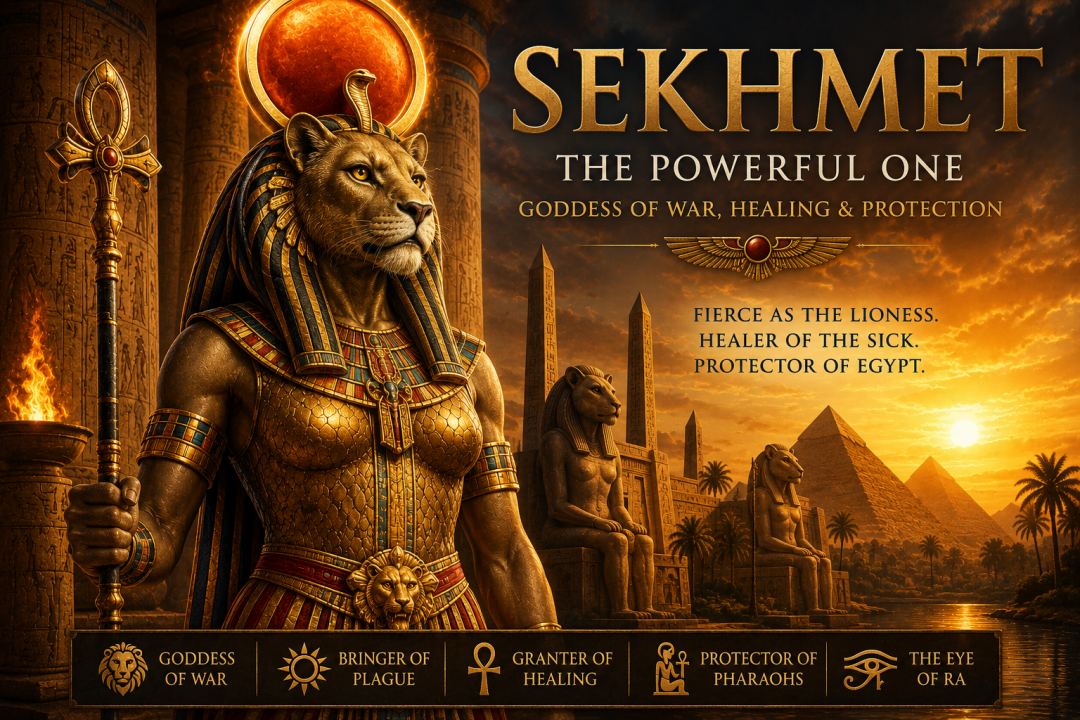
Sekhmet was one of the most powerful and feared goddesses in Ancient Egyptian mythology. She was the goddess of war, destruction, plague, healing, medicine, and divine vengeance. The ancient Egyptians both revered and feared Sekhmet because she possessed the power to bring disease and death, yet she also had the ability to cure illness and protect humanity.
Her name, Sekhmet, is usually translated as “The Powerful One” or “She Who Is Powerful.” True to her name, Sekhmet embodied immense strength and was considered one of the fiercest deities in the Egyptian pantheon.
Despite her destructive nature, Sekhmet was also viewed as a protector of the pharaoh, a guardian of cosmic order, and a patron goddess of physicians and healers.
Origins of Sekhmet
According to Egyptian mythology, Sekhmet was created by the sun god Ra.
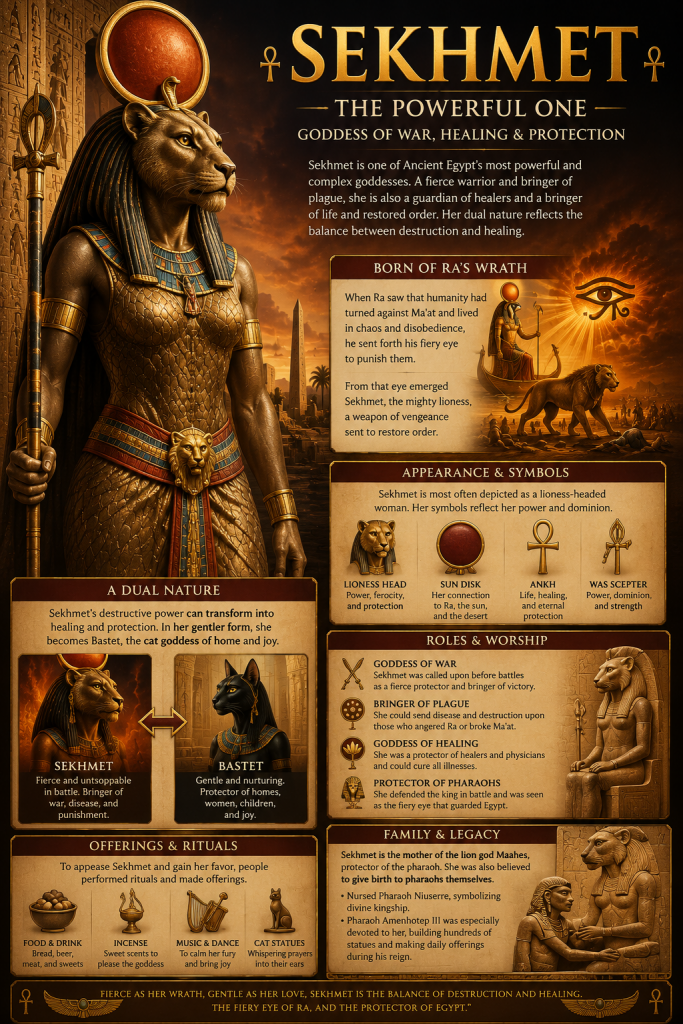
One of the most famous Egyptian myths tells how humanity rebelled against Ra after he grew old. Furious at mankind’s disobedience and refusal to live according to the principles of Ma’at, Ra sent his Eye to punish humanity.
From this divine Eye emerged Sekhmet, a lioness goddess of terrible power and fury.
Sekhmet descended upon humanity and slaughtered countless people. So great was her bloodlust that Ra eventually regretted unleashing her.
Fearing that she would destroy all of humanity, Ra devised a plan to stop her. He ordered thousands of jars of beer to be dyed red so that it resembled blood and spread across the land.
Mistaking the liquid for blood, Sekhmet drank it greedily. She became intoxicated, fell asleep, and awoke transformed into a gentler deity. In some traditions, this peaceful form became associated with the goddess Hathor, while in later periods Sekhmet and Bastet were also closely linked.
This myth illustrates the dual nature of Sekhmet as both destroyer and protector.
Family and Relationships
Sekhmet was usually regarded as a daughter of Ra and was often described as one of the manifestations of the Eye of Ra.
She was commonly associated with the creator god Ptah, and together they formed the Memphite Triad alongside their son Nefertem, the god of perfume, healing, and the lotus flower.
Some traditions also identify the lion god Maahes as Sekhmet’s son.
As a divine mother and protector, Sekhmet was closely connected to Egyptian kingship and the welfare of the pharaoh.
Appearance and Symbols
Sekhmet was almost always depicted as a woman with the head of a lioness.
In artistic representations, she usually wore:
- A solar disk upon her head
- The uraeus cobra symbolizes royal authority
- A long, tight-fitting dress
- An ankh, symbolizing life
- A papyrus scepter or was-scepter
The lioness symbolized power, ferocity, protection, and royal authority.
Other symbols associated with Sekhmet include:
- Lions and lionesses
- The sun disk
- Fire
- The Eye of Ra
- The color red
Because lions were among the most dangerous predators known to the Egyptians, the lioness perfectly represented Sekhmet’s immense strength and destructive potential.
Goddess of War and Protector of Pharaohs
Sekhmet served as the patron goddess of warfare.
Ancient Egyptian soldiers prayed to Sekhmet before battle, asking for her protection and assistance in defeating their enemies. Pharaohs frequently invoked her power and compared themselves to the fierce lioness goddess.
Egyptian kings often described themselves as being “mighty like Sekhmet” when celebrating military victories.
During warfare, Sekhmet was believed to breathe fire upon Egypt’s enemies and spread terror among opposing armies.
At the same time, she protected the king and defended Egypt from foreign threats.
Sekhmet as a Goddess of Disease and Healing
Although Sekhmet could unleash disease and plague upon humanity, she also possessed the power to cure illness.
Ancient Egyptians believed that the same goddess who caused sickness could remove it.
As a result, physicians and healers frequently worshipped Sekhmet and sought her favor. Priests dedicated to her often served as doctors, combining medical knowledge with religious rituals.
The priests of Sekhmet became famous throughout Egypt for their healing abilities.
People made offerings to Sekhmet in hopes of preventing epidemics, curing disease, or protecting themselves from misfortune.
Worship and Rituals
To appease Sekhmet and avoid her wrath, Egyptians presented offerings of food, beer, wine, incense, music, and dance.
Festivals honoring Sekhmet often included large quantities of beer, commemorating the myth in which the goddess was pacified through intoxication.
Many worshippers also dedicated statues, stelae, and prayers to Sekhmet in exchange for protection.
Ancient Egyptians believed that maintaining Sekhmet’s goodwill was essential for preserving health and social stability.
Amenhotep III and Sekhmet
No pharaoh appears to have been more devoted to Sekhmet than Amenhotep III.
During his reign in the 14th century BC, Amenhotep III commissioned hundreds of statues depicting Sekhmet. Many of these statues have been discovered at his mortuary temple at Kom el-Hettan near Thebes.
Scholars believe that the king may have erected these statues to invoke Sekhmet’s healing powers during periods of illness or political uncertainty.
Today, these statues remain among the most impressive surviving depictions of the goddess.
Temples of Sekhmet
Sekhmet was worshipped throughout Ancient Egypt, but her principal cult center was Memphis, where she was worshipped alongside Ptah and Nefertem.
She was also honored at numerous temples dedicated to other deities, particularly those associated with the sun god Ra.
Priests performed daily rituals to appease the goddess and ensure that her destructive powers remained under control.
Legacy of Sekhmet
Sekhmet remained one of Egypt’s most important goddesses for thousands of years.
Her unique combination of destruction and healing made her one of the most complex figures in Egyptian religion. She embodied both the terrifying and protective aspects of divine power.
Today, Sekhmet continues to fascinate historians, archaeologists, and mythology enthusiasts as the fierce lioness goddess who could both destroy humanity and save it.