The Sun Pharaoh
During the early fourteenth century BC, Egypt stood at the height of its wealth and power. Nubia was largely peaceful, while the city-states of Canaan and southern Syria had been brought under Egyptian control by generations of warrior kings.
When Amenhotep III inherited the throne, however, he preferred diplomacy, ceremony, and magnificent building projects to the hardships of military campaigning. Rather than personally leading armies into foreign lands, he maintained Egypt’s influence through gifts of gold, diplomatic marriages, and alliances with other royal courts.
Amenhotep III possessed a large royal household, but his most important wife was Queen Tiye. Although she was not born to a ruling royal family, Tiye held exceptional influence and appeared prominently beside her husband on monuments.
Their son Amenhotep IV succeeded his father and became one of the most extraordinary and controversial rulers in Egyptian history.
Amenhotep IV came to the throne around 1353 BC. During the first years of his reign, he still honored several traditional Egyptian gods. Gradually, however, his devotion became focused upon the Aten, the visible disc of the sun.
Around the fifth year of his reign, Amenhotep IV changed his name to Akhenaten. Amenhotep meant “Amun Is Satisfied,” while Akhenaten is usually translated as “Effective for the Aten” or “Beneficial to the Aten.”
The Rise of the Aten
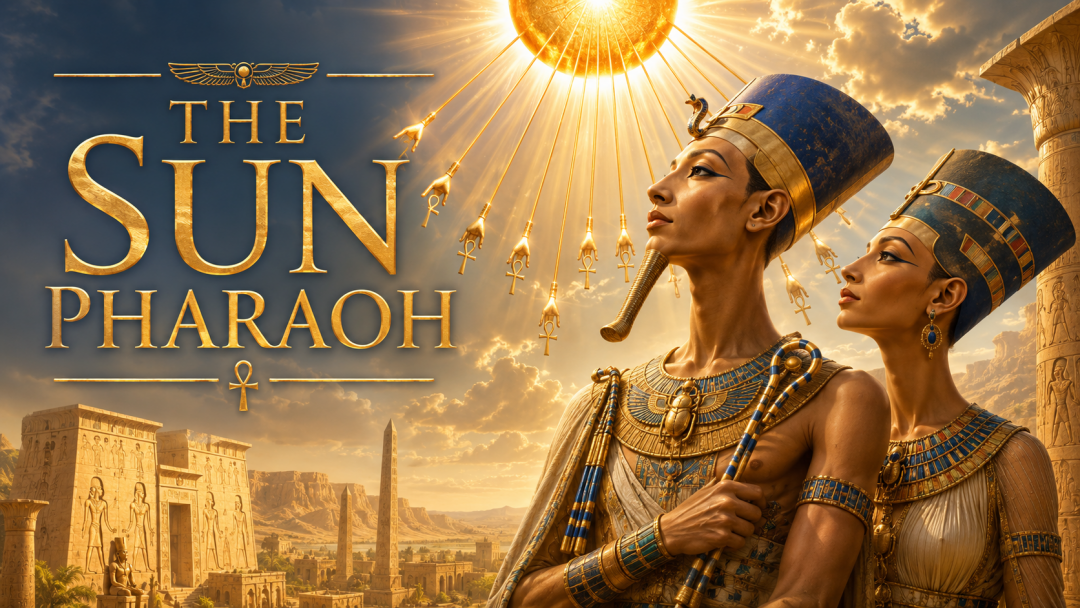
The Aten was represented as a radiant sun disc. Its rays extended downward like arms, ending in hands that offered the ankh, the sign of life, to Akhenaten and his chief wife, Queen Nefertiti.
Akhenaten presented the Aten as the supreme source of light, life, and creation. The king and queen occupied a unique position in this new religion because the blessings of the Aten were shown flowing through them to the rest of the world.
Scholars continue to debate whether Akhenaten’s beliefs should be described as true monotheism. He elevated the Aten above all other deities and eventually suppressed the worship of several traditional gods, especially Amun. However, the evidence does not prove that every divine being was immediately denied or that ordinary Egyptians suddenly abandoned all their older beliefs.
Whatever its exact nature, Akhenaten’s religious revolution was unlike anything Egypt had previously experienced.
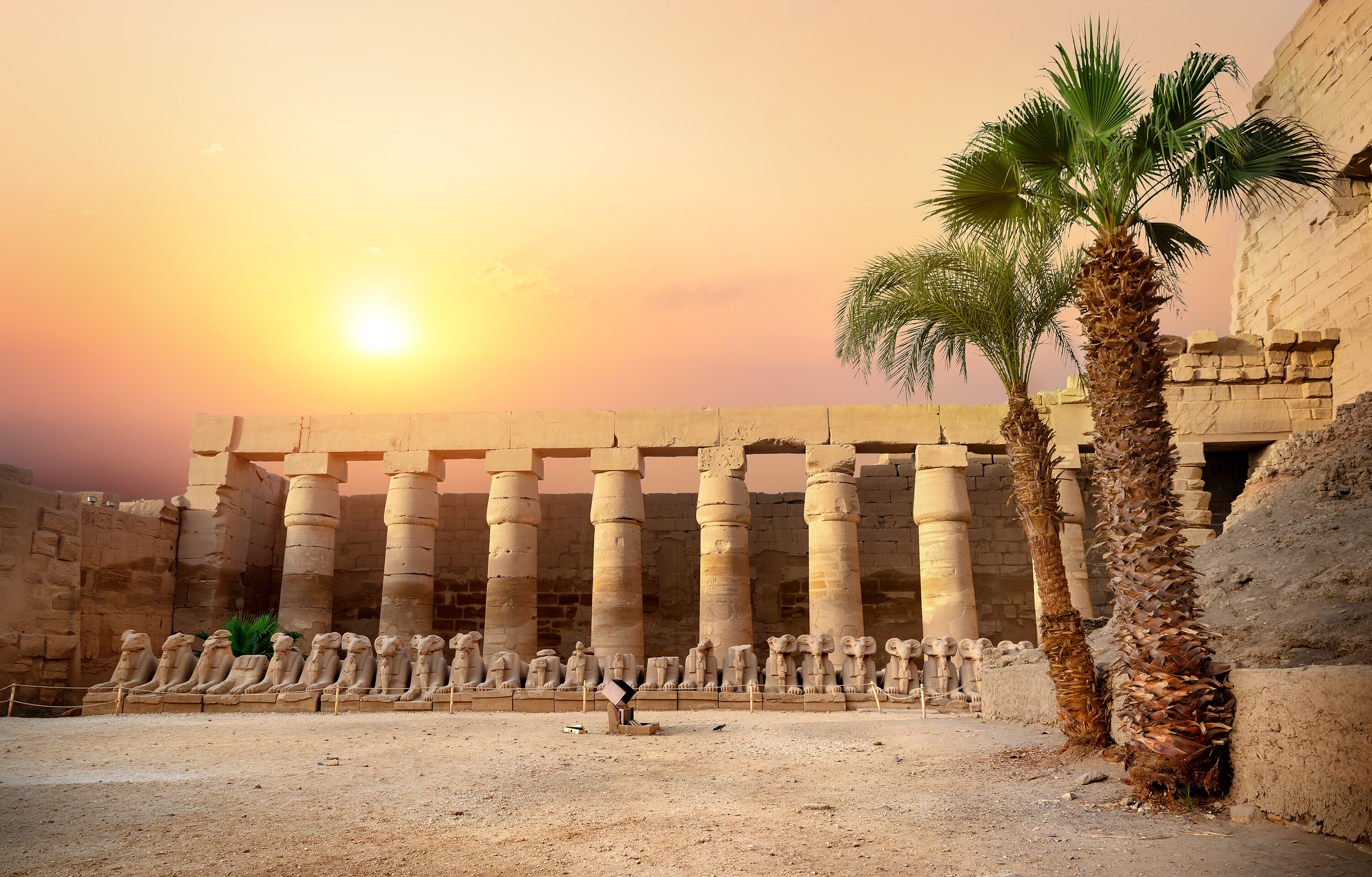
Early in his reign, the king built temples to the Aten at Karnak. Traditional Egyptian temples were mysterious places filled with enclosed halls and dark sanctuaries where a divine statue rested inside a shrine. Aten temples were very different. Their courtyards stood open beneath the sky, allowing sunlight to fall directly upon rows of altars heaped with offerings.
Akhenaten eventually abandoned the old royal centers of Thebes and Memphis and founded a new capital in Middle Egypt.
He called the city Akhetaten, meaning “Horizon of the Aten.” Today, the site is known as Amarna or Tell el-Amarna.
The City of Akhetaten
Akhetaten was built rapidly within a great bay of desert cliffs beside the Nile. Boundary inscriptions carved into the surrounding rocks declared that the Aten had chosen the location.
The new capital contained palaces, administrative buildings, workshops, houses, gardens, and enormous open-air temples. Akhenaten lived there with Nefertiti and their daughters, surrounded by courtiers, priests, officials, artists, and servants.
The art produced during his reign was strikingly different from the formal royal images of earlier periods.
Traditional portraits presented Egyptian kings as eternally youthful, physically perfect, and remote from ordinary life. Akhenaten was often portrayed with an elongated face, narrow eyes, full lips, a rounded stomach, broad hips, and slender limbs.
These unusual features may have been symbolic rather than realistic. Some scholars believe they expressed the king’s unique religious role or combined masculine and feminine characteristics associated with creation. There is no reliable evidence that they prove Akhenaten suffered from a particular medical condition.
Scenes from Akhetaten also showed the royal family in remarkably intimate moments. Akhenaten and Nefertiti appeared beneath the rays of the Aten while holding their daughters, eating together, riding in chariots, exchanging affection, and mourning a dead child.
Nefertiti played an unusually prominent role. She made offerings to the Aten, appeared beside the king in ceremonies, and was sometimes shown performing actions traditionally reserved for the pharaoh.
The Suppression of the Old Gods
As Akhenaten’s reign progressed, his religious policies became more extreme.
The name and images of Amun were attacked, and workers were sent to erase them from temples and monuments. In some inscriptions, even references to “the gods” in the plural were removed.
Traditional temples lost royal support, and their wealth and lands were redirected toward the Aten and the new capital. This weakened powerful priesthoods and disrupted institutions that had long played an important part in Egypt’s religious and economic life.
The new religion centered heavily upon the royal family. Ordinary people could worship the Aten, but Akhenaten and Nefertiti were presented as the principal intermediaries between humanity and the solar god.
Despite the king’s commands, traditional religion did not disappear. Archaeological discoveries at Amarna show that some inhabitants continued to keep household images and amulets connected with older gods and goddesses.
Akhenaten could change official worship, but he could not easily erase centuries of private belief.
Trouble Within the Empire
While Akhenaten concentrated upon his new religion and capital, Egypt faced growing difficulties abroad.
The famous Amarna Letters, written on clay tablets in Akkadian, preserve correspondence between the Egyptian court and rulers throughout the Near East. Many local princes begged for military assistance against rivals and expanding powers.
The letters reveal political instability, but they do not prove that Akhenaten completely ignored the empire. Egyptian officials and troops remained active in foreign territories. Nevertheless, Egypt’s influence in parts of Syria and Canaan weakened during or shortly after his reign.
Conditions within Egypt are also difficult to reconstruct. Akhenaten’s reforms almost certainly created resentment among priests, officials, and communities connected with the traditional temples. Yet many details of the opposition to him remain unknown.
Akhenaten died after ruling for approximately seventeen years.
There is no firm evidence that he was murdered. His cause of death remains uncertain, as do many events surrounding the final years of his reign.
The Mystery of Akhenaten’s Successors
The succession after Akhenaten is one of the most confusing periods in Egyptian history.
A ruler named Smenkhkare appears briefly in the surviving evidence. Smenkhkare was probably a male member of the royal family and may have been married to Akhenaten’s eldest daughter, Meritaten. His exact relationship to Akhenaten remains uncertain.
Another ruler used the name Neferneferuaten. Some scholars believe this sovereign may have been Nefertiti ruling under a royal name, although the identification remains debated.
Older theories sometimes treated Smenkhkare and Nefertiti as the same person. Most modern discussions distinguish Smenkhkare from the female ruler Neferneferuaten, while acknowledging that the evidence is incomplete.
Whoever ruled immediately after Akhenaten did not remain in power for long.
The throne eventually passed to a boy approximately eight or nine years old named Tutankhaten.
Tutankhaten was probably a son of Akhenaten, although the identity of his mother is uncertain. He married Ankhesenpaaten, one of the daughters of Akhenaten and Nefertiti.
Because the new king was still a child, experienced officials exercised enormous influence. Among the most powerful were Ay, a senior courtier, and Horemheb, the leading military commander.
The Return of Amun
Within a few years, the royal court abandoned Akhenaten’s religious revolution.
Tutankhaten changed his name to Tutankhamun, meaning “Living Image of Amun.” His wife changed her name from Ankhesenpaaten to Ankhesenamun.
The royal administration left Akhetaten, and Thebes and Memphis once again became important centers of power.
The temples of the old gods were reopened and restored. Their priesthoods recovered land, wealth, and influence. A royal proclamation issued during Tutankhamun’s reign described the temples as having fallen into ruin and declared that the gods had turned away from Egypt.
Amun once again became one of the kingdom’s most powerful deities, although the Aten did not vanish immediately from every monument.
The young king’s reign lasted approximately ten years.
Tutankhamun died at around age 18 or 19, without a surviving heir. His tomb contained the remains of two stillborn daughters, but no living child succeeded him.
The cause of Tutankhamun’s death remains uncertain. Modern examinations have produced several theories, including illness, injury, and complications from poor health, but none has been proven beyond dispute.
Ay and Horemheb
After Tutankhamun’s death, the elderly official Ay became pharaoh.
Evidence from Tutankhamun’s tomb shows Ay performing the ritual known as the Opening of the Mouth for the dead king, a role commonly associated with an heir or successor.
Ay may have married Tutankhamun’s widow, Ankhesenamun, but the evidence is uncertain. His reign lasted only a few years.
He was succeeded by General Horemheb.
Horemheb had served as a military commander and senior official under Tutankhamun. Once king, he continued restoring the old political and religious order.
He dismantled monuments built for the Aten and reused their stones in later construction. He also issued decrees intended to combat corruption and strengthen royal authority.
Horemheb had no surviving son. He selected a military official named Ramesses as his successor.
Ramesses I founded the Nineteenth Dynasty. His descendants, including Seti I and Ramesses II, restored Egypt’s military strength and renewed campaigns in Canaan and Syria.
Erasing the Amarna Kings
Later rulers treated Akhenaten as a dangerous heretic.
His monuments were dismantled, his images damaged, and his name removed from many official records. Akhenaten, Smenkhkare, Tutankhamun, and Ay were omitted from later king lists. Their reigns were sometimes absorbed into Horemheb’s official regnal years.
Akhenaten came to be remembered as the rebel or enemy of Akhetaten. The phrase “Great Criminal” is associated with later condemnation of the Amarna ruler, although the exact language and usage varied.
The attempt to erase Akhenaten was remarkably thorough, but it ultimately helped preserve important traces of his world.
Akhetaten was abandoned soon after his death. Because later generations did not build a major city over its ruins, archaeologists have been able to study its streets, houses, temples, workshops, and cemeteries.
The city was not left entirely untouched, and many buildings were dismantled for stone. Nevertheless, Amarna preserves an extraordinary picture of life in an ancient Egyptian capital.
Hundreds of clay tablets discovered in the royal Records Office proved to be diplomatic letters exchanged between Egypt and rulers across the Near East. These Amarna Letters transformed modern understanding of international politics during the Late Bronze Age.
A sculptor’s workshop also yielded unfinished statues, plaster casts, trial pieces, and portraits of the royal family.
Among them was the famous painted bust of Nefertiti, discovered in the sculptor Thutmose’s workshop. Its graceful features helped make Nefertiti one of the most recognizable women of the ancient world.
The Legacy of the Sun Pharaoh
Akhenaten’s revolution did not survive him.
Within a few years, the court had abandoned his city, restored the old gods, and begun dismantling his monuments. Later pharaohs tried to remove him and his family from history.
Yet Akhenaten was not forgotten.
The ruins of Amarna, the diplomatic letters buried there, the unusual works of art, and the treasures of Tutankhamun preserved the memory of the age its enemies tried to destroy.
Today, Akhenaten remains one of ancient Egypt’s most fascinating rulers. To some, he was a visionary who recognized a single divine power behind the sun. To others, he was an intolerant ruler whose religious obsession weakened established institutions and neglected the practical needs of his kingdom.
The surviving evidence does not provide a simple answer.
Akhenaten was a revolutionary, a religious reformer, a royal autocrat, and the creator of one of Egypt’s most remarkable cities.
The pharaohs who followed tried to erase his name, but their campaign ensured that the mystery of the Sun Pharaoh would endure for thousands of years.