The Princess of Bakhtan: How Khonsu Healed a Foreign Princess
The story of the Princess of Bakhtan is one of Ancient Egypt’s most fascinating tales of divine healing. Set during the reign of Ramesses II, it tells how an Egyptian god traveled far beyond the Nile Valley to rescue a foreign princess from a hostile spirit.
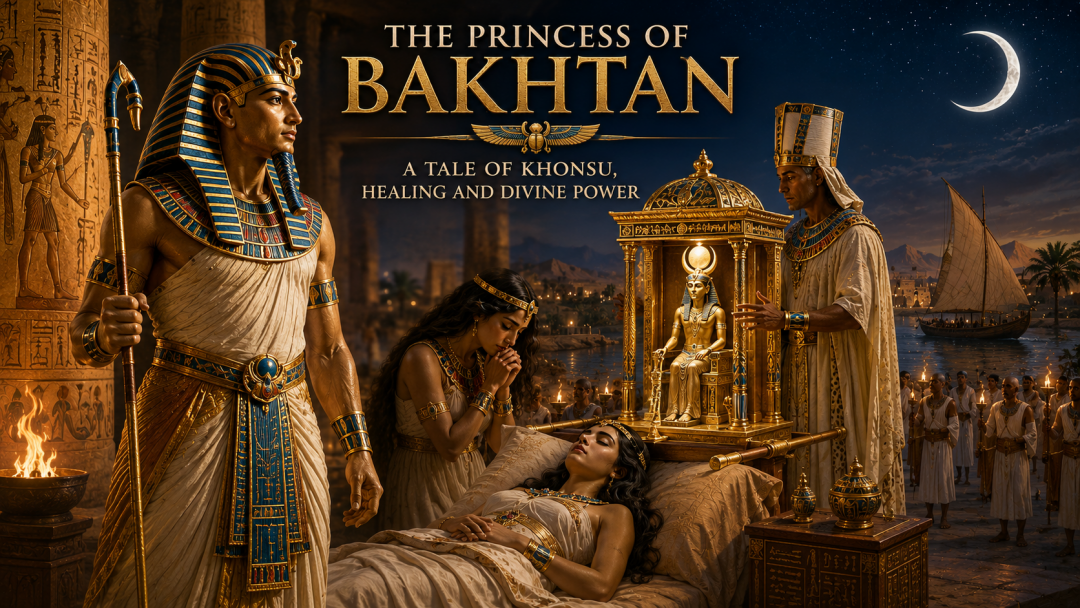
At the center of the story is Khonsu, the youthful moon god of Thebes. Khonsu was associated with healing, protection, and the defeat of dangerous supernatural forces. When Egyptian knowledge proved unable to save the princess, a sacred image of Khonsu was sent across foreign lands so the god himself could confront the being tormenting her.
The story survives on a monument known as the Bentresh Stela, or the Bakhtan Stela. Although its events are placed during the lifetime of Ramesses II, the inscription was created much later, probably during the Late or Ptolemaic Period.
It is therefore better understood as a religious legend than as a literal account of an event from the reign of Ramesses II.
Ramesses II and the World of the Story
Ramesses II ruled Egypt for approximately sixty-six years during the 13th century BC. He became one of Egypt’s most celebrated pharaohs, remembered for his military campaigns, enormous building projects, diplomatic marriages, and skill at presenting himself as an invincible ruler.
Early in his reign, Ramesses fought the Hittite Empire for control of Syria. His most famous confrontation occurred in his fifth regnal year at the Battle of Kadesh.
Egyptian inscriptions transformed the battle into a heroic account of Ramesses standing alone against overwhelming enemies. They describe the pharaoh charging into battle after much of his army had been scattered by a surprise Hittite attack.
The historical outcome was less decisive than the royal inscriptions suggest. Neither Egypt nor the Hittites achieved complete victory, and Kadesh remained beyond effective Egyptian control.
Years later, Ramesses II and the Hittite king Hattusili III concluded a formal peace treaty. The two rulers promised not to attack one another and agreed to provide mutual assistance against enemies and rebellions.
Ramesses later married a daughter of the Hittite king. She received the Egyptian name Maathorneferure and became one of his royal wives.
The story of the Princess of Bakhtan may preserve a distant and highly altered memory of these diplomatic marriages, but its characters and events should not be treated as a precise historical record.
Where Was Bakhtan?
The exact location of Bakhtan remains uncertain. The name has sometimes been connected with Bactria in Central Asia or with regions of western Asia involved in Egyptian diplomacy. However, no identification has been proved.
Within the story, Bakhtan functions primarily as a distant foreign kingdom beyond Egypt’s borders. Its remoteness makes Khonsu’s journey appear even more miraculous and emphasizes that the power of Egypt’s gods could reach far beyond the Nile Valley.
The Prince Offers His Daughter to Pharaoh
The story begins as Ramesses II travels through the foreign land of Naharin.
Local rulers approach the pharaoh with tribute, hoping to gain his favor. They present gold, silver, precious stones, livestock, and other costly gifts.
Among them is the Prince of Bakhtan.
Determined to surpass the other rulers, the prince offers Ramesses his eldest daughter. She is described as beautiful, dignified, and pleasing to the king.
Ramesses accepts her, gives her the Egyptian name Neferure, and raises her to the rank of Great Royal Wife.
The marriage creates a bond between Egypt and distant Bakhtan. It also provides the personal connection that later persuades Ramesses to help the princess’s family.
A Messenger Arrives from Bakhtan
Years pass.
Ramesses is in Thebes during an important festival when a messenger arrives from the Prince of Bakhtan. The envoy brings gifts and asks to speak with the pharaoh.
After bowing before the Egyptian king, the messenger explains that the queen’s younger sister, Bentresh, has become seriously ill.
No one in Bakhtan can cure her.
Egypt was renowned for the knowledge of its physicians, priests, scribes, and magicians. The prince therefore begs Ramesses to send a learned Egyptian who might understand the mysterious illness.
Ramesses agrees to help.
He summons the scholars of the palace and the specialists associated with the House of Life, the institution where religious, ritual, magical, and possibly medical texts were copied and studied.
After consulting them, Ramesses selects a learned royal scribe named Djehutyemheb and sends him to Bakhtan.
The Egyptian Scribe Examines Bentresh
The journey to Bakhtan is long and difficult.
When Djehutyemheb finally reaches the foreign court, he is taken immediately to the sick princess.
Bentresh lies motionless in her chamber. She does not recognize her family, and no ordinary treatment has relieved her suffering.
The Egyptian scribe examines her and realizes the illness is unnatural. A hostile spirit has taken possession of the princess.
Djehutyemheb possesses knowledge of medicine, ritual, and protective magic, but the being inside Bentresh is too powerful for him to overcome.
Only a god, he concludes, can save her.
The Prince of Bakhtan sends another messenger to Egypt, this time asking Ramesses to send divine assistance.
Ramesses Appeals to Khonsu
When the second request reaches Egypt, Ramesses goes to the temple of Khonsu at Thebes.
Khonsu was the son of Amun and Mut and a member of the Theban Triad. As a moon god, he traveled across the night sky, but he was also revered as a divine healer and protector against harmful spirits.
Different forms of Khonsu could represent different aspects of his power.
Ramesses approaches the great form of Khonsu and asks whether another sacred manifestation of the god should be sent to Bakhtan to heal Bentresh.
The god’s approval is revealed through an oracle.
Ramesses then asks Khonsu to transfer his protective and healing power into the sacred image that will travel abroad. The oracle again indicates divine consent.
The mission can now begin.
A God Leaves Egypt
The sacred image of Khonsu is prepared for the journey.
Priests place the divine statue inside a portable shrine. Incense is burned, offerings are presented, and protective ceremonies are performed.
Ramesses provides the god with an impressive escort of priests, soldiers, servants, chariots, horses, and ships.
This was not simply a statue being transported from one country to another. To the ancient Egyptians, a properly consecrated cult image could serve as the earthly dwelling of a god.
The divine presence of Khonsu traveled with the procession.
For seventeen months, the company makes its way toward Bakhtan.
Khonsu Arrives in Bakhtan
When news of the god’s arrival reaches the palace, the Prince of Bakhtan rushes out to meet him.
The prince falls face down before the sacred shrine and welcomes Khonsu with reverence.
At last, he believes, the power capable of saving his daughter has arrived.
The procession continues to the chamber where Bentresh lies near death. Priests carry the shrine inside and place it beside her bed.
The room falls silent.
The prince, his household, and the Egyptian priests wait as the god confronts the hostile being possessing the princess.
The Battle for Bentresh
Khonsu’s divine power surrounds Bentresh. The hostile spirit immediately recognizes that it cannot withstand the Egyptian god.
It leaves the princess and addresses Khonsu directly.
The spirit welcomes the god, acknowledges his authority, and declares that Bakhtan and its people belong to him. It promises to depart permanently but asks that a feast be held before it leaves.
Khonsu accepts the request.
The priests instruct the prince to prepare offerings. Food, drink, incense, and other gifts are placed before the god and the spirit.
Once the feast has been presented, the hostile being leaves Bakhtan.
Bentresh awakens restored to health. Her father embraces her, and the palace erupts in celebration.
The Egyptian god has succeeded where human knowledge and magic could not.
The Prince Refuses to Return the God
The Prince of Bakhtan is overwhelmed by gratitude.
He constructs a shrine for Khonsu and keeps the sacred image in his kingdom. Instead of returning the god to Thebes, he allows the divine visitor to remain in Bakhtan for three years and nine months.
The prince may believe that keeping Khonsu will ensure the continued protection of his family and kingdom.
However, an Egyptian god belongs within the sacred order of Egypt. By refusing to return the image, the prince disrupts that order.
Khonsu must eventually remind him that divine power cannot be possessed.
The Dream of the Golden Falcon
One night, the Prince of Bakhtan experiences a terrifying dream.
He sees Khonsu emerge from his shrine in the form of a golden falcon. The god rises into the sky, spreads his glittering wings, and flies eastward toward Egypt.
The prince awakens trembling.
He finally understands the meaning of the vision. Khonsu has chosen to return home, and keeping his image any longer would be a dangerous act of disrespect.
The next morning, the prince summons the Egyptian priests.
He orders them to prepare for the journey back to Thebes. Soldiers, chariots, servants, and rich gifts are provided to accompany the returning god.
After many months of travel, the sacred image arrives safely in Egypt.
The gifts from Bakhtan are presented at the temple, and Khonsu is restored to his sanctuary.
The divine order has been reestablished.
The Bentresh Stela
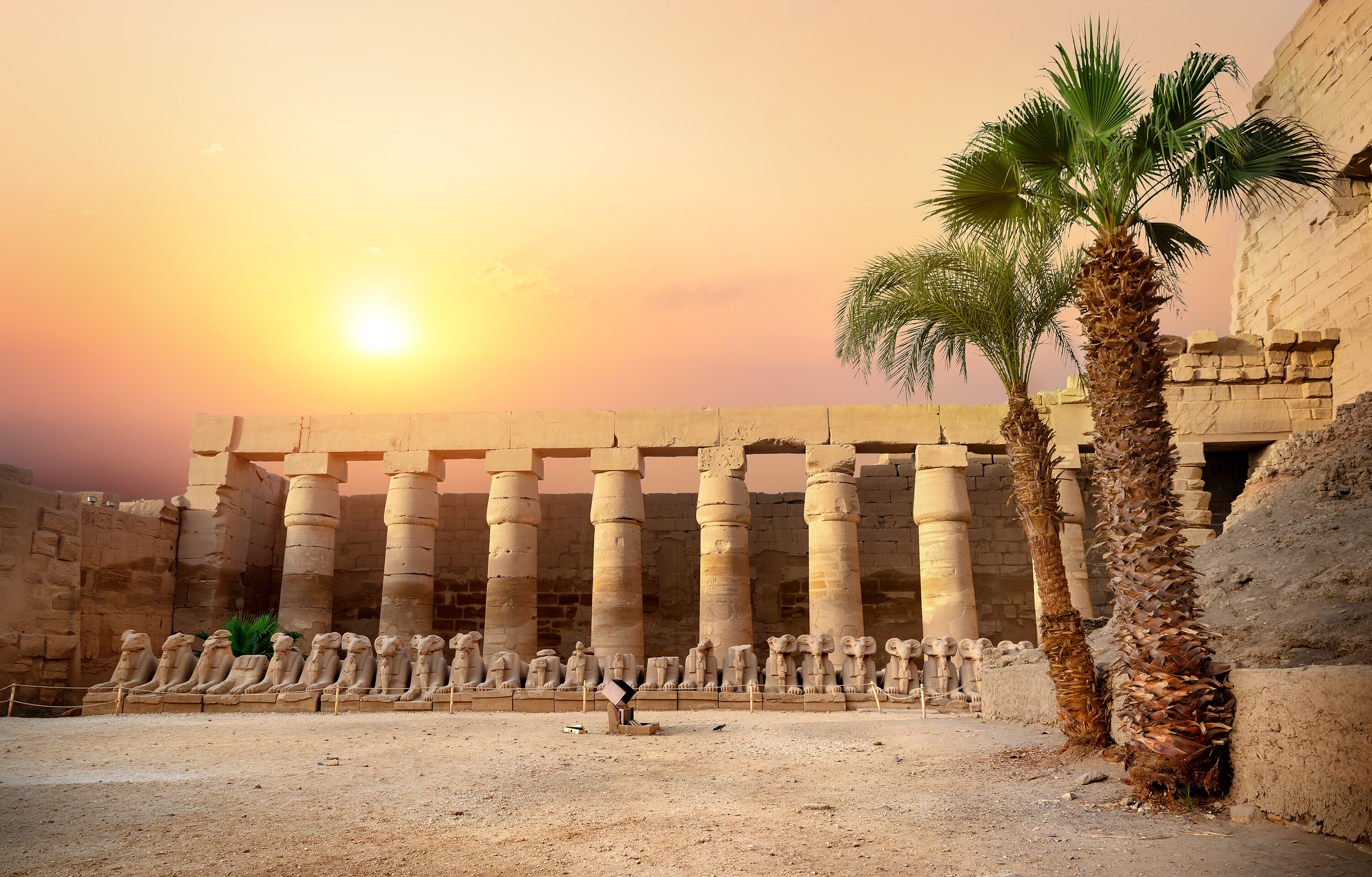
The story survives on the Bentresh Stela, a large inscribed stone monument discovered near the Temple of Khonsu at Karnak.
The inscription presents itself as though it records events from the reign of Ramesses II. Its language and royal setting deliberately evoke Egypt’s New Kingdom past.
However, scholars generally date the stela to the Late or early Ptolemaic Period, many centuries after Ramesses II died.
The writer selected Ramesses because he represented a remembered age of Egyptian wealth, military strength, monumental building, and international power.
Placing Khonsu’s miracle within his reign made the god’s victory appear part of Egypt’s glorious imperial past.
History and Legend
Several elements of the story resemble real events.
Ramesses II conducted campaigns in western Asia, made peace with the Hittites, and married a Hittite princess. Egyptian rulers also exchanged gifts, physicians, scholars, and diplomatic messages with foreign courts.
However, the people in the story do not correspond neatly to documented historical figures.
The foreign queen called Neferure should not simply be identified with Maathorneferure, the historical Hittite wife of Ramesses II. Bakhtan cannot be confidently placed on a modern map, and there is no contemporary evidence that a divine statue was sent abroad to heal a possessed princess.
The tale combines authentic features of international diplomacy with religious storytelling.
Its purpose was not merely to preserve history. It was intended to demonstrate the healing power of Khonsu and the superiority of Egypt’s gods.
The Power of Divine Images
The tale also reveals how ancient Egyptians understood temple statues.
A cult statue was not worshipped because people believed the material object itself had manufactured the universe. Instead, ceremonies allowed the god to inhabit the image and act through it.
By sending Khonsu’s statue to Bakhtan, Ramesses was sending the god’s living presence.
The statue could receive offerings, respond through oracles, defeat hostile spirits, and communicate through dreams.
This explains why the prince’s decision to retain the statue was so serious. He was not keeping a souvenir. He was attempting to hold a god within a foreign land.
Healing in Ancient Egypt
The story does not sharply separate medicine, religion, and magic.
Djehutyemheb first examines Bentresh as a learned specialist. When he determines that her condition has a supernatural cause, religious intervention becomes necessary.
For ancient Egyptians, an illness could have physical, magical, or divine origins. Treatment might therefore combine remedies, recitations, amulets, rituals, prayers, and appeals to a god.
The arrival of Khonsu does not suggest that Egyptian learning was worthless. Instead, the scribe’s wisdom allows him to recognize the limits of human treatment and identify the kind of help Bentresh requires.
Why the Story Matters
The Princess of Bakhtan is more than a tale about possession and miraculous healing.
It explores several powerful ideas:
- The ability of Egyptian gods to act beyond Egypt’s borders
- The prestige of Egyptian religious and medical knowledge
- The relationship between royal authority and divine power
- The sacred nature of temple statues
- The danger of attempting to control a god
- The restoration of order after illness and disruption
The story also presents Ramesses II as an ideal king. He listens to foreign appeals, consults learned advisers, honors the gods, and uses Egypt’s divine power to save a member of his extended family.
Khonsu, meanwhile, appears as both merciful and commanding. He heals the princess without destroying the spirit, accepts the requested offerings, and eventually returns to his rightful home.
Legacy of the Princess of Bakhtan
The Bentresh Stela preserves one of the clearest surviving Egyptian stories about divine healing beyond the borders of Egypt.
Although it was composed long after the age it describes, the tale shows how later Egyptians remembered the reign of Ramesses II and understood the power of Khonsu.
The historical Ramesses had expanded temples, fought foreign wars, negotiated with rival kings, and married into an international royal family. The legendary Ramesses could do even more: he could send an Egyptian god across the known world to confront a demon and restore a dying princess.
Through the power of Khonsu, Bentresh awakened, Bakhtan was saved, and Egypt’s divine authority reached far beyond the Nile.