The Eye of the Sun
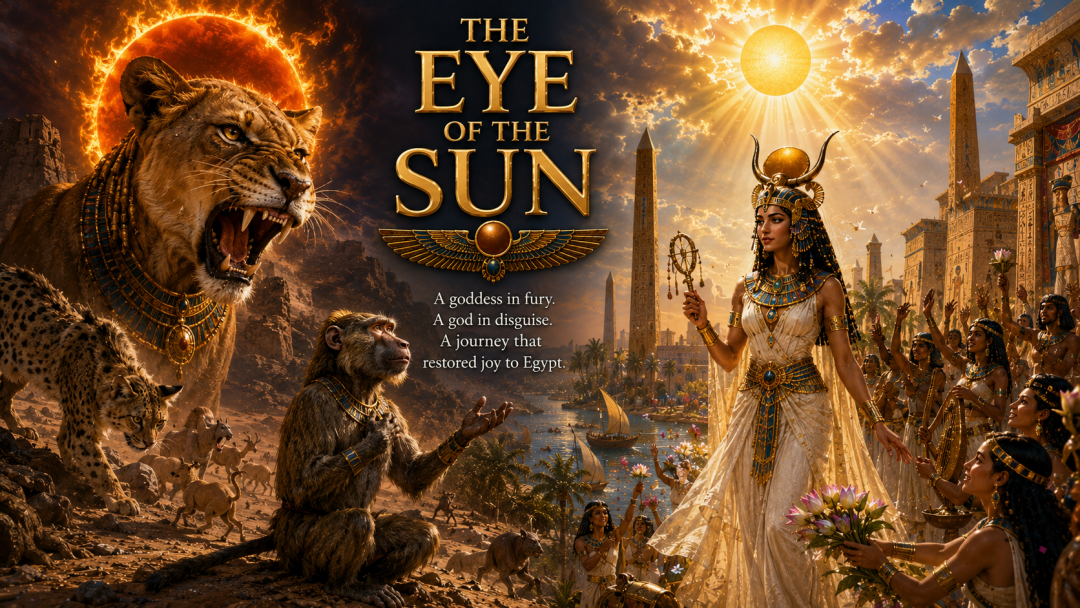
Hathor, the daughter of Ra, possessed many forms. She could appear as a cow, a cat, or one of the Seven Hathors who visited newborn children to foretell their destinies. In human form, Hathor was the most gracious and joyful of goddesses. Yet when she became the Eye of the Sun, she could also be fierce and merciless.
She protected the gods from their enemies, but when her anger was aroused, even the gods feared her.
Temple inscriptions and a story written in Egyptian as late as the second century AD tell of a grim time when Hathor abandoned Egypt and chose to dwell far to the south in Nubia.
Hathor Leaves Egypt
The Eye of the Sun had grown jealous of the other gods and goddesses created by Ra. She quarreled bitterly with her father and fled southward into the deserts of distant Nubia.
There the angry goddess cast aside her beautiful human form and became a savage wildcat or a raging lioness. She survived by hunting and slaughtered every creature unfortunate enough to approach her.
Without Hathor, Egypt became a joyless land.
Love and laughter withered. Music fell silent. Dancing ceased, and life seemed to lose its sweetness. Ra hid his face in sorrow, and gloom spread across the earth.
None of the gods could console him for the loss of his beloved daughter. Worse still, without the power of the Eye of the Sun, Ra had lost his greatest protector. Darkness tightened its coils around light, and Chaos threatened to overwhelm Order.
“Who will bring Hathor back to me?” Ra asked.
The gods remained silent.
The Eye of the Sun possessed the power of life and death over every living being. In her fury, none dared approach her.
At last Ra summoned Thoth, wisest of the gods.
“Go south into Nubia,” he commanded. “Find my daughter and persuade her to return to Egypt.”
Thoth obeyed, though his heart was heavy. He knew that if Hathor recognized him, she might kill him before he had the chance to speak.
Therefore, Thoth transformed himself into a humble baboon.
In this disguise, he crept across the Nubian desert, following the bloody trail left by the goddess.
Thoth Finds the Goddess
At last he found Hathor in the shape of a wildcat, sitting upon a rock and licking her tawny fur.
Thoth crawled toward her, bowing until his forehead touched the ground.
“Hail, Daughter of the Sun,” he said humbly.
Hathor arched her back and spat. When she saw that the intruder appeared to be no more than a baboon, however, she did not attack immediately.
“Gracious goddess,” Thoth stammered, “may a humble ape dare to speak?”
“Speak, and then die,” growled Hathor as she unsheathed her claws.
The baboon trembled and kissed the earth.
“O Powerful One, if you decide to kill me, I cannot prevent it. But before you strike, remember the story of the mother vulture and the mother wildcat.”
“What story?” Hathor demanded.
“Listen, my lady, and I shall tell you.”
Hathor sat down and resumed washing her fur. She appeared to ignore him, but Thoth knew that if he attempted to escape, her claws would tear him apart within moments.
So he began his tale.
The Vulture and the Wildcat
There was once a mother vulture who built her nest in the crown of a palm tree. She sat upon her eggs until four healthy chicks hatched.
As soon as they emerged, the chicks cried for food. Yet the vulture was afraid to leave them because a wildcat lived upon a nearby hillside.
The wildcat had recently given birth to four kittens and was equally afraid to leave them, for she feared the vulture might carry them away.
Before long, both the chicks and kittens were wailing with hunger.
The two mothers met and agreed to a truce. Before Ra, they swore a solemn oath that neither would harm the children of the other.
The vulture could now search for carrion without fear, while the wildcat was free to hunt.
For several weeks, the agreement held.
The young vultures grew strong and began exercising their wings. The kittens played happily across the hillside.
One morning, while the mother vulture circled far above the desert, the boldest chick flew from the nest. His wings were still weak, and after only a short flight he landed among the kittens.
Seeing their food, he snatched away a piece.
The wildcat struck him with lightning speed and wounded him badly.
“Find your own food,” she growled.
The young vulture tried to flap his wings but could no longer fly.
“I shall never return to my nest,” he gasped. “But you have broken your oath, and Ra will avenge me.”
When the mother vulture returned, she found one chick missing. Looking down, she saw his body upon the hillside.
“So the wildcat has broken her oath,” she thought. “I shall have my revenge.”
The next time the wildcat went hunting, the vulture swooped upon the kittens. She killed all four and carried them to her nest to feed her remaining chicks.
When the wildcat returned, her kittens were gone.
She searched the hillside in desperation but found only a few bloodstained tufts of fur.
Realizing what had happened, she raised her face to the heavens.
“O Ra, who judges between the righteous and the wicked, hear me! The vulture has broken her sacred oath and murdered my children. Punish the oath-breaker!”
Ra heard her prayer.
He was angered that an oath sworn in his name had been broken. Because the vulture had taken vengeance into her own hands and killed every kitten, Ra sent a divine messenger to arrange her punishment.
The following day, the mother vulture flew across the desert in search of food. She saw a hunter roasting meat over a campfire.
Swooping down, she seized the meat and carried it triumphantly back to her nest.
She dropped it among her hungry chicks, unaware that glowing embers still clung to its underside.
The sparks touched the dry twigs of the nest. Flames erupted. The three chicks burned while their mother circled helplessly overhead. The wildcat ran to the foot of the blazing palm.
“By Ra,” she called, “you killed my kittens. Now your chicks are dead, and I am avenged!”
“So, my lady,” Thoth concluded, “both mothers broke their oaths, and both were punished. Ra sees and hears everything. No crime escapes his judgment.
“Praise Ra, who gives life to all things and whose shining face brings joy to the earth. The Nile rises for him, and the north and south winds blow at his command. He rules the heights of heaven and the depths of the ocean.
“Praise the Sun God, and praise Hathor, his mighty daughter.”
Hathor sat silently, thinking about the story and remembering her father’s justice and power.
Thoth saw his opportunity and crept closer.
The Divine Herbs
“My lady, I have brought divine food from the palace of the Sun God. These herbs give health and joy to all who taste them.”
He held out a fragrant bundle.
Tempted by their sweetness, Hathor nibbled the leaves.
As she swallowed the divine herbs, her fury began to fade. Her anger melted away, and she listened quietly while Thoth continued.
“These herbs were grown in Egypt, the land that rose from the waters of Nun. It is the country shaped by the Creator for gods and humans, the home of Ra, your beloved father, and Shu, your dear brother.
“Is there any living creature that does not long for the land of its birth? Even stones and plants cling to their native soil. Animals remain near the burrows where they were born.
“As for mankind, Fate shows greatest kindness to those permitted to live, die, and be buried in the land of their birth. What greater happiness can there be? How can anyone truly live in peace upon foreign soil?”
While raging through the Nubian wilderness, Hathor had forgotten Egypt, her family, and the temples where she had once been worshipped.
Thoth’s words restored those memories.
She thought of her father, her brother, and the songs once offered in her honor. Suddenly she was overcome with longing, and her tears fell like a cloudburst.
Thoth allowed her to weep for a time.
Then he spoke gently.
“My lady, you grieve for your home, but think of the tears Egypt has shed for you.
“Without you, the temples are empty and silent. There is no music, dancing, laughter, or celebration. Both young and old despair.
“But come home with me, and the harps, tambourines, lutes, and cymbals will sound again. Egypt will dance. The Two Lands will rejoice as never before.
“Come with me, and I will tell you another story as we travel north. Once a hawk, a vulture, and a cuckoo met together…”
Thoth bounded forward, confident that Hathor would follow.
But suddenly the goddess understood his purpose.
All along, the baboon had been trying to lure her back to Egypt.
She was furious that he had made her weep.
With a terrible roar, Hathor transformed herself into an enormous lioness. Her pelt was red as blood and seemed to crackle like living flame. Her face shone brighter than the sun’s disc.
Her fiery gaze terrified Thoth.
He leaped like a grasshopper, trembled like a frog, and saluted her as though she were the sun itself.
“O Powerful One, have mercy! I beg you in the name of Ra to spare me. Before you strike, listen to the story of the two vultures.”
Hathor’s curiosity cooled her anger.
She returned to the shape of a wildcat.
“Tell it quickly,” she ordered.
The Two Vultures
Two vultures once lived among the desert hills.
One day the first boasted, “My eyes are sharper than yours. No creature possesses sight as keen as mine.”
“What is so remarkable about your sight?” asked the second.
“By day or night, I can see to the ends of the earth. I can watch everything that happens in the sky, upon the land, and beneath the sea.”
The second vulture nodded.
“Your eyes may be sharper than mine, but my ears are far keener. I hear every sound in the heavens, upon the earth, and across the sea. I can even hear Ra when he declares the fate of every creature.”
For many days they argued over which gift was greater.
One morning, as they sat upon a dead tree’s branch, the second vulture began laughing.
“What amuses you?” demanded the first.
“I am laughing because a distant bird has told me how quickly the hunter may become the hunted.
“He watched a lizard swallowed by a snake. Moments later, a falcon seized the snake, but the weight dragged them both into the sea.
“Your sight is supposedly so powerful. Tell me what has happened to them.”
The first vulture raised his head and stared toward the distant coast.
“The falcon has been swallowed by a fish, with the snake still trapped in its claws. Now a larger fish has swallowed the first.”
He paused.
“The larger fish has swum too close to shore. A lion has scooped it from the shallows and is devouring it.”
Suddenly the vulture ruffled his feathers.
“A griffin has descended and carried away the lion!”
“Can that truly be so?” asked the second.
“Fly with me to the griffin’s nest, and you may see for yourself.”
The vultures flew across the desert hills until they neared the creature’s lair.
“Look,” whispered the first. “Its head resembles a falcon, but its eyes are like those of a man. It has the body of a lion, ears like the fins of a fish, and a serpent’s tail.”
The birds watched the griffin tear the last of the lion’s flesh from its bones before fleeing to a safer place.
“Everything we have witnessed reveals the power of Ra,” said the first vulture. “Even the death of a fly is seen by the Sun God. Those who kill shall themselves be killed, and violence is repaid with violence.
“Yet nothing has punished the griffin, though it devoured the lion.”
“That must be because the griffin is a messenger of Ra,” replied the second. “The Sun God has granted it authority over life and death. Nothing is stronger than the griffin except the justice of Ra.”
“So, my lady,” Thoth concluded, “your father repays good with good and evil with evil. He has filled you with his strength, for you are the Eye of the Sun and his divine avenger.”
Hathor’s heart beat with fierce pride.
She remembered the power she possessed as the daughter of Ra.
“Stop trembling,” she said. “I will not kill you. Your words have bewitched me, but I know you intend no harm. You have driven away my grief and anger.”
“My lady,” Thoth ventured, “follow me back to Egypt. The journey across these hills will take only a few days.”
“Then let us leave at once,” Hathor growled. “And no more useless chatter.”
The baboon began walking northward with the wildcat only a few paces behind him.
Thoth was still afraid that Hathor might change her mind, so he began another tale.
The Two Jackals
Two jackals lived together in the desert and were devoted friends. They hunted side by side, shared their food and water, and rested beneath the same patch of shade.
One day, while they lay beneath a desert tree, they saw an angry lion bounding toward them.
The jackals remained perfectly still.
The lion stopped before them, puzzled.
“Are your limbs stiff with age?” he roared. “Did you not see me coming? Why did you not run?”
“Lord Lion,” answered the jackals, “we saw you approaching in your fury. We chose not to run because you would have caught us anyway. Why exhaust ourselves before being eaten?”
The lion was amused by their calm and truthful answer, so he allowed them to live.
“I too have told you nothing but the truth,” said Thoth. “Now that you have spared my life, we can travel together, and I will protect you.”
“You will protect me?” Hathor scoffed. “The Eye of the Sun needs no protection from a baboon.”
“The strong may sometimes be saved by the weak,” replied Thoth. “Remember the tale of the lion and the mouse.”
“What tale is that?”
As they continued toward Egypt, Thoth began again.
The Lion and the Mouse
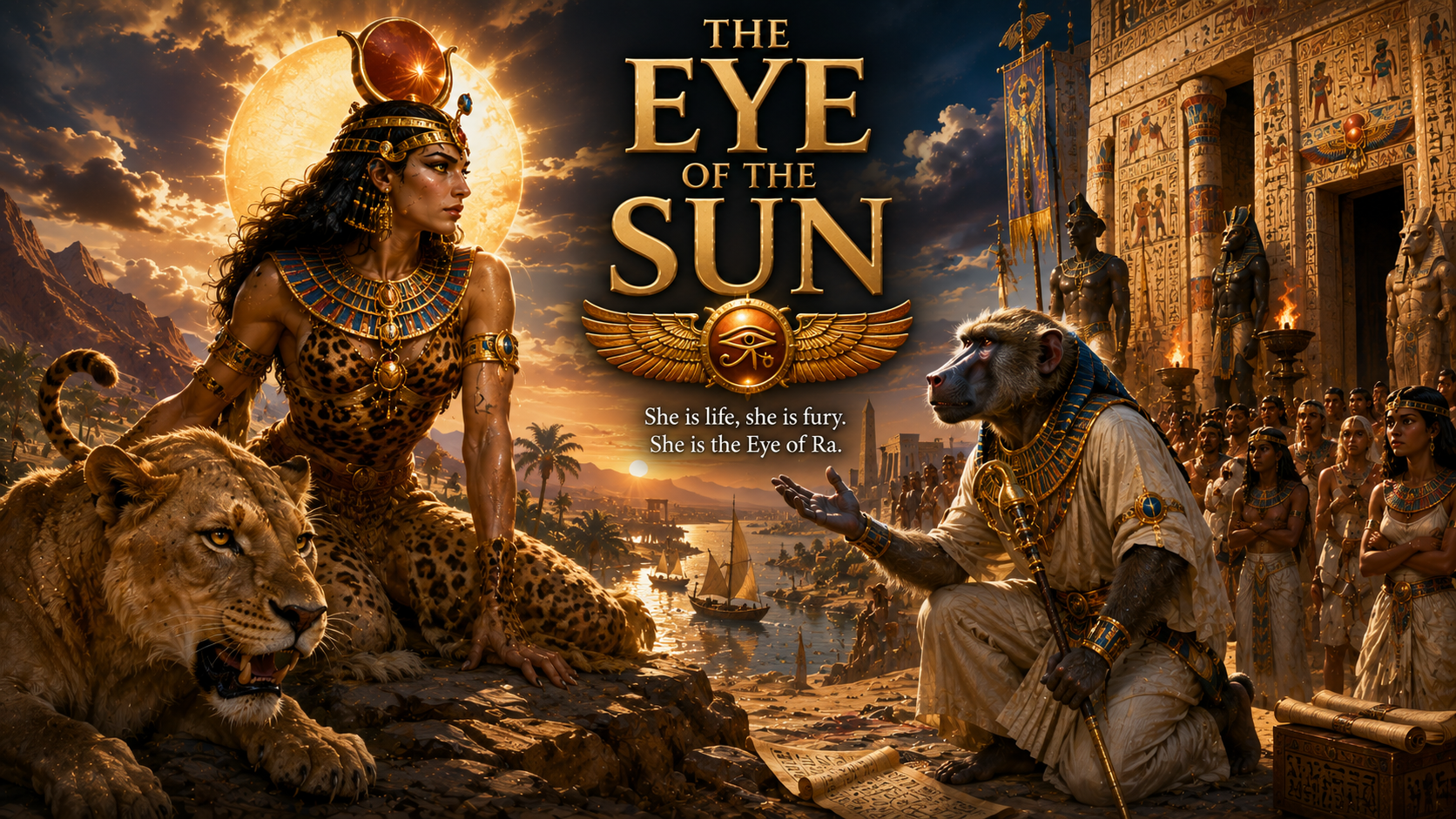
Once there lived a lion among the desert hills. He was so powerful and fierce that every animal feared him.
One day he discovered a panther lying wounded upon the ground. Much of its fur had been torn away, and blood flowed from deep cuts across its body.
The lion was astonished, for he believed no creature but himself could overcome a panther.
“Who did this to you?” he demanded.
“It was Man,” sighed the panther. “No creature is more cunning than Man. May you never fall into his hands.”
The lion had never heard of such a creature. Furious that anyone should inflict suffering for amusement, he set out to find Man.
Before long, he encountered a mule and a horse yoked together. Iron bits tore at their mouths.
“Who did this to you?” asked the lion.
“Man, our master,” answered the horse.
“Is Man stronger than both of you?”
“Lord Lion,” said the mule, “none is more cunning than Man. May you never fall into his hands.”
The lion continued. Soon he met an ox and a cow bound together. Their horns had been cut away, and metal rings pierced their noses.
They too blamed Man. The lion grew even angrier. Farther on, he met a huge bear whose claws and teeth were missing.
“Who did this?” the lion asked. “Surely Man cannot be stronger than you.”
“He is more cunning,” groaned the bear. “I once captured Man and made him my servant.
“He told me, ‘Master, your claws are so long that they make it difficult to gather food, and your teeth are too large to eat comfortably. Allow me to trim them, and you will eat twice as much.’
“I believed him. He pulled out my claws and filed down my teeth. Then he threw sand into my eyes and escaped.”
The lion roared in fury and continued his search. Soon he discovered another lion with one paw trapped inside a split palm trunk.
“What happened to you?” he asked.
“Man did this,” growled the captive lion. “Never trust him.
“He promised to make an amulet that would grant me immortality. He cut a slit into this tree and wedged it open. Then he told me to place my paw inside.
“When I obeyed, he removed the wedge. The tree closed around my paw. Then he threw sand into my eyes and ran away laughing.
“Now I shall remain here until I starve.”
The first lion roared a challenge to the sky.
“Man! I will hunt you and make you suffer for every creature you have harmed.”
As he bounded onward, he saw a tiny mouse in his path. The lion lifted a paw to crush it.
“O Lord Lion, spare me!” squeaked the mouse. “I would hardly make a mouthful. Give me life, and perhaps one day I will repay the gift.”
The lion laughed.
“How could a tiny mouse ever help the strongest beast alive? No one has the power to harm me.”
“The weak may sometimes help the strong,” insisted the mouse.
The lion found the idea amusing. Since the mouse was too small to eat, he allowed it to escape.
Meanwhile, Man had heard the lion roar and had prepared a trap.
He dug a deep pit, stretched a strong net of leather thongs across it, and covered everything with grass.
That evening, the lion fell into the pit and became tangled in the net.
For hours he struggled, but every movement tightened the cords.
By midnight he lay exhausted, waiting for dawn and the return of Man.
Then a tiny voice sounded beside his ear.
“Lord Lion, do you remember me? I am the mouse whose life you spared. Now I have come to save you. What is more beautiful than a good deed repaid?”
The mouse began gnawing through the leather cords. He worked for hours. Just before dawn, the final thong broke.
The lion sprang free, and with the mouse clinging to his mane, he leaped from the pit and fled back to the desert hills.
Fate had taught him that every power eventually meets its master, and even the weak may rescue the strong.
Hathor understood the lesson and regarded Thoth with new respect.
The Return to Egypt
Though she continued following the baboon, Hathor appeared in no hurry to reach Egypt.
At the edge of the desert, she lingered beneath date palms, sycamore figs, and carob trees, praising their fruit.
Thoth climbed the branches, hoping to glimpse Egypt in the distance.
He tasted the fruit and agreed that it was good, but reminded Hathor that the trees of Egypt bore even sweeter produce.
Together they continued north.
When they crossed the border, the people of Egypt flocked to welcome the returning goddess.
At Elkab, she appeared as a vulture. In another town, she became a gazelle. Near Thebes, she once again took the form of a wildcat.
Before entering the city, Hathor lay down to rest. She soon fell asleep, while Thoth remained awake to guard her. The enemies of Ra were enraged that the Eye of the Sun had returned.
Under cover of darkness, a serpent of Chaos crept toward the sleeping goddess, hoping to poison her and deprive Ra of his protector.
The vigilant Thoth saw the serpent preparing to strike. He awakened Hathor. The wildcat leaped upon the serpent and broke its back.
Grateful for the warning, Hathor remembered the mouse who had saved the lion. The following morning, Thoth and Hathor entered Thebes. The entire city erupted with joy.
A magnificent festival was held in the temple of Mut. For seven days, the people ate, drank, played music, danced, and laughed.
Hathor was so delighted that she abandoned the form of the wildcat and became a beautiful and gentle woman once more.
Then she allowed Thoth to guide her farther north. At last they reached the holy city of Heliopolis.
Ra and his daughter embraced, and the whole land seemed to leap with happiness.
Another feast was held in the House of the Sycamore at Memphis, where all the gods and goddesses celebrated Hathor’s return.
There Thoth finally resumed his divine form.
Only then did Hathor recognize the humble baboon as the wise god who had crossed the desert to bring her home.
Thoth sat beside her at the feast, and Ra praised his wisdom, patience, and cunning.
Through stories rather than force, Thoth had calmed the terrible Eye of the Sun and restored joy, music, love, and divine order to Egypt.