What Did the Ancient Egyptians Trade? Goods, Partners and Routes
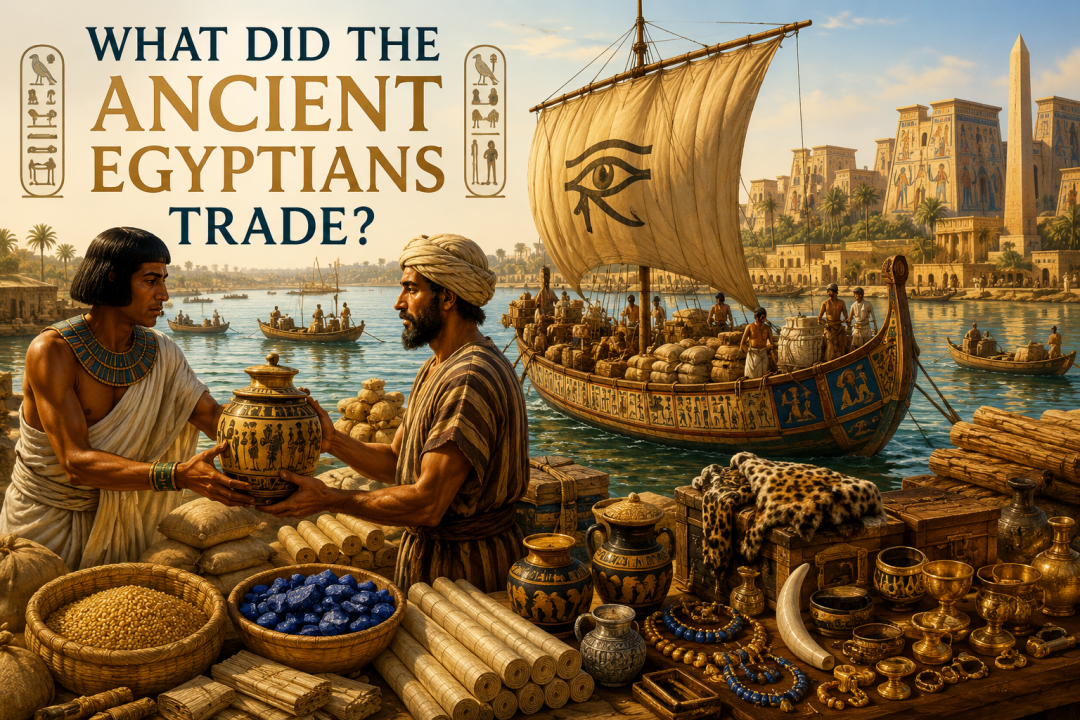
The ancient Egyptians traded grain, gold, linen, papyrus, glass, pottery, wine, oil, jewelry, and other manufactured goods. In return, Egypt imported materials that were scarce or unavailable along the Nile, including cedarwood, silver, copper, tin, incense, ivory, ebony, animal skins, precious stones, and exotic animals.
Egypt’s location connected northeastern Africa with the Mediterranean, the Levant, Nubia, and the Red Sea. The Nile also provided a natural transportation route through the country, allowing merchants, officials, and royal expeditions to move enormous quantities of goods. Trade helped Egypt acquire the timber, metals, luxury materials, and ceremonial products needed to build temples, furnish palaces, equip armies, and honor the gods.
What Goods Did Ancient Egypt Export?
Ancient Egypt’s most important exports came from its fertile agricultural land, skilled workshops, mineral resources, and access to Nubian gold.
Egyptian exports included:
- Grain
- Gold
- Linen
- Papyrus
- Wine
- Beer
- Oils
- Pottery
- Glass and faience objects
- Jewelry
- Amulets
- Stone vessels
- Furniture
- Manufactured luxury goods
The Nile Valley produced large harvests of emmer wheat and barley. These crops fed Egypt’s population, supported the state, and could be traded abroad when surpluses were available.
Egypt also produced linen from flax. Fine Egyptian linen was used for clothing, temple rituals, household textiles, and mummy wrappings.
Papyrus was another distinctively Egyptian product. The plant grew abundantly in marshy areas, especially in the Nile Delta. Its stalks could be used to make writing material, baskets, sandals, mats, rope, and small boats.
During the Ptolemaic and Roman periods, Egyptian grain became increasingly important throughout the Mediterranean. Egypt was later regarded as one of Rome’s major sources of grain, although calling pharaonic Egypt the “breadbasket of Rome” would be anachronistic because Roman control did not begin until 30 BCE.
What Goods Did Ancient Egypt Import?
Although Egypt possessed rich agricultural land and valuable minerals, it lacked several resources that its rulers and craftspeople needed.
Ancient Egyptian imports included:
- Cedarwood and other high-quality timber
- Silver
- Copper
- Tin
- Iron
- Lapis lazuli
- Turquoise and other stones
- Incense and aromatic resins
- Myrrh
- Frankincense
- Ebony
- Ivory
- Animal skins
- Olive oil
- Wine
- Horses
- Cattle
- Monkeys and baboons
- Exotic plants and animals
These goods did not all come from the same place or arrive during every period of Egyptian history. Trading relationships changed as kingdoms rose and fell, routes became safer or more dangerous, and Egyptian power expanded or contracted.
Why Did Egypt Import Wood?
High-quality timber was one of Egypt’s most important imports.
The Nile Valley had palm trees, acacia, sycamore fig, and tamarisk, but these trees did not always provide the long, straight beams required for large ships, temple doors, roofs, columns, and elaborate furniture.
Egypt therefore imported cedar and other timber from the eastern Mediterranean, particularly the region around Byblos in present-day Lebanon.
Cedarwood was prized because it was strong, fragrant, resistant to decay, and available in lengths that Egyptian trees rarely provided. It could be used for ships, coffins, doors, furniture, and monumental construction.
Egypt’s relationship with Byblos became so important that objects bearing Egyptian names and artistic influences have been discovered there. Byblos served as a major point of contact between Egypt and the Levant for thousands of years.
Where Did Ancient Egyptian Gold Come From?
Egypt obtained gold from mines in its Eastern Desert and from territories to the south, especially Nubia.
Gold was used to make jewelry, funerary masks, statues, temple decorations, ceremonial objects, and diplomatic gifts. It was closely associated with the gods, whose flesh was sometimes described as being made of gold.
Egyptian rulers controlled or attempted to control Nubian mining regions and the routes through which gold traveled north. During periods of Egyptian expansion, forts and administrative centers helped protect traffic along the Nile and supervise the movement of people and resources.
Egypt exported gold and used it in international diplomacy. Foreign rulers sometimes requested gold from the pharaoh, particularly during the prosperous New Kingdom.
Gold was not the only reason Egypt valued Nubia, however. Trade from farther south could also bring ivory, ebony, incense, animal skins, cattle, ostrich feathers, and exotic animals into Egypt.
Where Did Lapis Lazuli Come From?
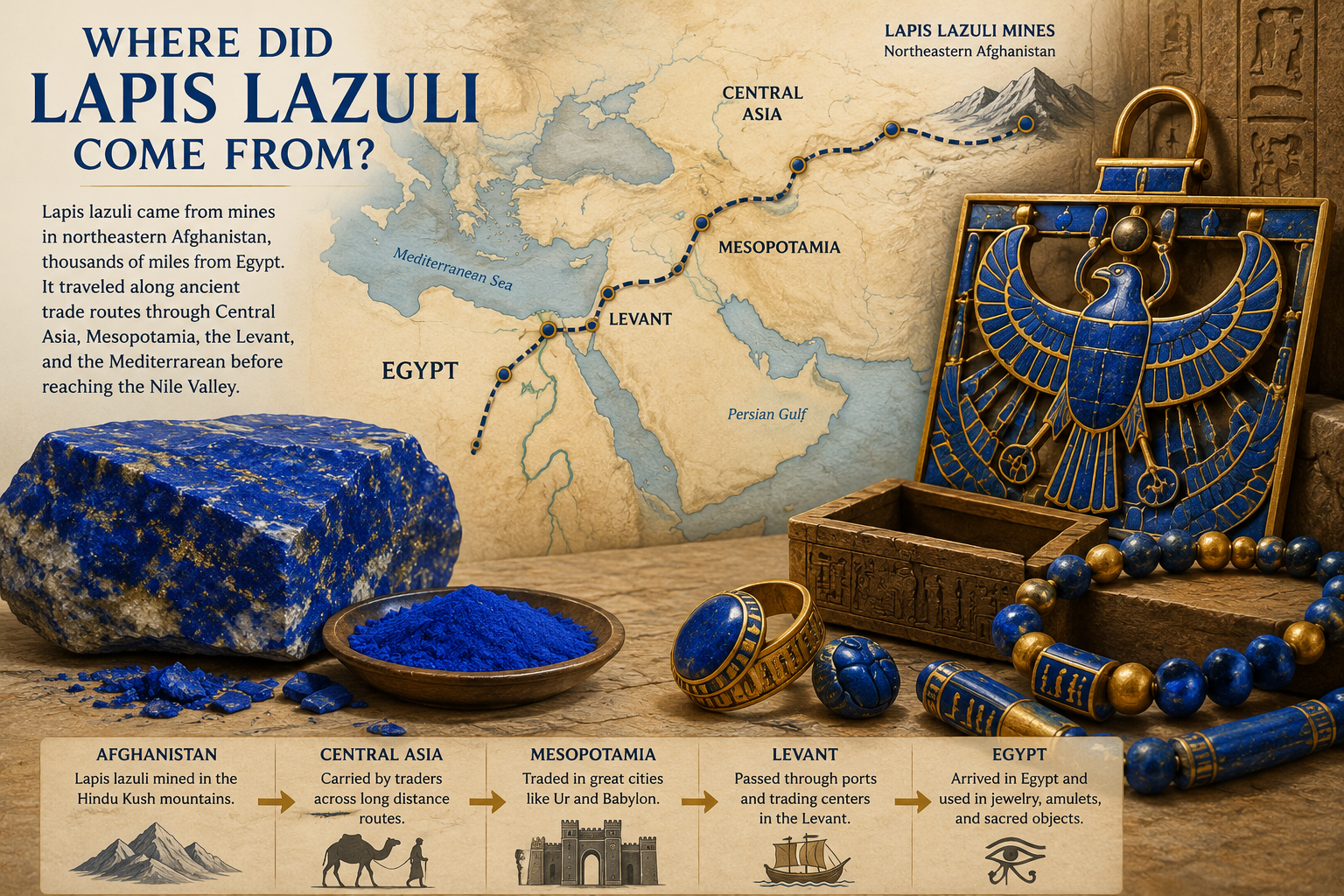
Lapis lazuli was among the most prized stones used in ancient Egyptian jewelry and religious objects.
The deep-blue stone did not occur naturally in Egypt. Its most important ancient source was in what is now northeastern Afghanistan.
Lapis lazuli probably reached Egypt through a long chain of traders rather than through direct Egyptian expeditions to Afghanistan. It passed through regions of Central Asia, Mesopotamia, Syria, and the Levant before reaching the Nile Valley.
Lapis objects have been found in Egypt since the Predynastic Period, demonstrating that long-distance exchange networks existed before Egypt became a unified kingdom.
The stone was used for beads, amulets, inlays, jewelry, scarabs, and ceremonial objects. Its intense blue color was associated with the sky, the heavens, and divine power.
What Did Egypt Trade With Punt?
Punt supplied Egypt with incense, myrrh, ebony, ivory, gold, animal skins, exotic animals, and other luxury products.
The Egyptians called Punt a distant and prosperous land, sometimes describing it as the “God’s Land.” Its exact boundaries remain uncertain, but scholars generally place it somewhere around the southern Red Sea, most likely encompassing parts of modern Eritrea, eastern Sudan, Djibouti, northern Somalia, or neighboring areas.
Punt was not discovered during the reign of Hatshepsut. Egyptian contact with Punt predated her becoming pharaoh.
Records from the Old Kingdom refer to expeditions connected with Punt. Hatshepsut’s famous expedition, conducted during the 18th Dynasty, is simply the best-preserved and most vividly illustrated example.
Reliefs at Hatshepsut’s mortuary temple at Deir el-Bahri show Egyptian ships reaching Punt and returning with:
- Myrrh resin
- Living myrrh trees
- Ebony
- Ivory
- Gold
- Animal skins
- Baboons and other animals
The inclusion of living myrrh trees suggests that Hatshepsut hoped to cultivate this valuable ritual plant in Egypt.
Incense and myrrh were especially important because they were burned in temples and used in perfumes, medicines, purification ceremonies, and funerary rituals.
Who Were Ancient Egypt’s Major Trading Partners?
Ancient Egypt traded with communities throughout northeastern Africa, the Mediterranean, and western Asia.
Its most important trading regions included:
- Nubia
- Punt
- The Levant
- Byblos
- Canaan
- Syria
- Cyprus
- Libya
- The Aegean world
- Mesopotamia
- Anatolia
- Kush
- Phoenician cities
- Greece and Rome in later periods
The importance of each region changed over Egypt’s long history.
Nubia and Kush
Nubia lay immediately south of Egypt and was one of Egypt’s oldest and most important trading partners.
Egypt received gold, ivory, ebony, incense, animal skins, cattle, ostrich feathers, and products carried from farther south through Nubian networks.
Relations between Egypt and Nubia were complicated. At different times, they included peaceful trade, diplomacy, migration, military campaigns, occupation, and political rivalry.
Egyptian rulers built forts in Nubia to control routes and protect their southern frontier. However, Nubian societies were not merely passive suppliers. They possessed powerful kingdoms, controlled valuable trade networks, and at times ruled Egypt itself.
The Levant and Canaan
The Levant included the eastern Mediterranean coast and inland areas corresponding broadly to parts of modern Lebanon, Israel, the Palestinian territories, Jordan, and Syria.
Egypt obtained cedarwood, wine, olive oil, resins, metals, pottery, and luxury goods from the region.
Archaeological evidence demonstrates contact between Egypt and southern Canaan before the First Dynasty. Egyptian pottery, imported vessels, seals, and other objects reveal extensive interaction during the Predynastic and Early Dynastic periods. The Metropolitan Museum notes evidence for substantial imports from Canaan as well as exchange with Nubian communities before and during Egypt’s formation as a state.
Egyptian authority in the Levant varied considerably. During parts of the New Kingdom, Egypt exercised political and military power over many Canaanite cities. At other times, trade depended more heavily on independent rulers, merchants, and diplomatic relationships.
Byblos and Lebanon
Byblos was one of Egypt’s most enduring trading partners.
Its position on the Mediterranean coast made it an important center for the export of cedarwood and other forest products. Egyptian kings maintained contact with Byblos from an early period, although the nature of the relationship changed over time.
Timber could be shipped south along the Mediterranean coast and then transported into Egypt through Delta ports.
Egyptian objects discovered at Byblos and Levantine goods found in Egypt demonstrate that the relationship involved more than a simple exchange of cedar for grain. Religious ideas, artistic styles, technologies, and diplomatic customs also traveled between the two regions.
Libya
Egypt traded and interacted with communities living west of the Nile Valley.
Products associated with Libya and the western deserts included livestock, animal skins, oils, and other regional materials.
As with Nubia and the Levant, Egypt’s relationship with Libyan groups was not always peaceful. Egyptian records describe both trade and warfare, although royal inscriptions often presented foreign peoples through political propaganda and should not always be read as neutral historical accounts.
Cyprus
Cyprus was an important source of copper during the Bronze Age.
Copper was essential for tools, weapons, vessels, mirrors, statues, and other manufactured objects. When mixed with tin, it produced bronze, which was harder and more useful for many purposes.
Cyprus also supplied pottery, timber, and other goods. Egyptian objects found on Cyprus and Cypriot pottery discovered in Egypt demonstrate sustained contact during the second millennium BCE.
The Aegean World
Egypt traded with the civilizations of the Aegean, including Minoan Crete and later Mycenaean Greece.
Aegean pottery, oils, wine, metals, and luxury objects reached Egypt. Egyptian products and artistic influences also traveled into the Aegean.
New Kingdom tomb paintings sometimes show foreign delegations carrying metal vessels, pottery, textiles, and other goods. These scenes may represent trade, tribute, diplomatic gifts, or a combination of all three.
Mesopotamia
Egypt and Mesopotamia were connected through long-distance exchange networks, although the two civilizations did not share a border.
Materials, artistic ideas, technologies, and prestige goods moved between them through intermediaries in Syria and the Levant.
Some Mesopotamian influence can be seen in late Predynastic Egyptian art, but scholars debate whether this resulted from direct contact, traveling craftspeople, elite imitation, or indirect exchange.
It is therefore too strong to say that Egypt simply established a normal bilateral trade agreement with “Mesopotamia” at the beginning of the First Dynasty. Mesopotamia contained numerous independent cities, kingdoms, and cultures rather than a single unified nation.
Anatolia
Anatolia, corresponding largely to modern Turkey, was an important source or transit region for metals.
Copper, silver, and eventually iron could travel from Anatolia and surrounding regions through Syrian and Levantine trade networks.
During the New Kingdom, Egypt maintained diplomatic relations with major powers such as the Hittite Empire. Royal correspondence and gift exchanges reveal a world in which rulers traded luxury goods while also negotiating marriages, military alliances, and political status.
Did Ancient Egyptians Trade With Greece?
Yes, although trade with the Greek world became particularly visible during the Late and Ptolemaic periods.
Greeks had interacted with Egypt before then through Aegean and Mediterranean networks. By the seventh and sixth centuries BCE, Greek merchants and settlers were operating in Egypt in greater numbers.
Naukratis, located in the western Nile Delta, became a prominent center of Greek trade. Greek pottery, wine, olive oil, silver, and manufactured goods entered Egypt, while grain, papyrus, linen, and Egyptian products moved outward.
After Alexander the Great conquered Egypt in 332 BCE, trade with the Greek-speaking Mediterranean expanded dramatically. Alexandria became one of the ancient world’s largest commercial ports.
How Did Ancient Egyptians Transport Trade Goods?
The Nile was Egypt’s most important transportation route.
Boats could carry grain, stone, timber, livestock, pottery, and people between cities far more efficiently than overland transport.
The river’s current flowed north toward the Mediterranean, while prevailing winds often blew from the north. This meant boats could travel north with the current and sail south using the wind.
Egyptian trade routes included:
- The Nile
- Mediterranean shipping lanes
- Red Sea routes
- Desert caravan roads
- Routes across Sinai
- Roads connecting the Nile Valley with Red Sea ports
- Southern routes through Nubia and beyond
Donkeys carried goods across deserts before camels became widely used in Egypt much later. Pack animals transported water, food, metals, stones, incense, and other materials between the Nile and remote mines, quarries, ports, and oases.
Royal expeditions could involve hundreds or even thousands of workers, soldiers, sailors, scribes, guides, and laborers.
Did Ancient Egypt Have Merchants?
Ancient Egypt had traders, merchants, market sellers, transport workers, and officials involved in the exchange and distribution of goods.
However, much large-scale international exchange was organized or controlled by the palace, temples, and government institutions. Royal expeditions traveled to mines, quarries, ports, and foreign lands to obtain resources for the state.
Temples also controlled estates, workshops, herds, ships, and agricultural land. They received goods through taxation, offerings, rents, and trade.
Private exchange also occurred. Recent scholarship emphasizes that Egyptian trade was not limited to spectacular royal expeditions or luxury goods. Ordinary commodities such as grain, fish, textiles, pottery, and household products also moved through local and international networks.
Did Ancient Egyptians Use Money?
For most of pharaonic history, Egyptians did not rely on coined money in the modern sense.
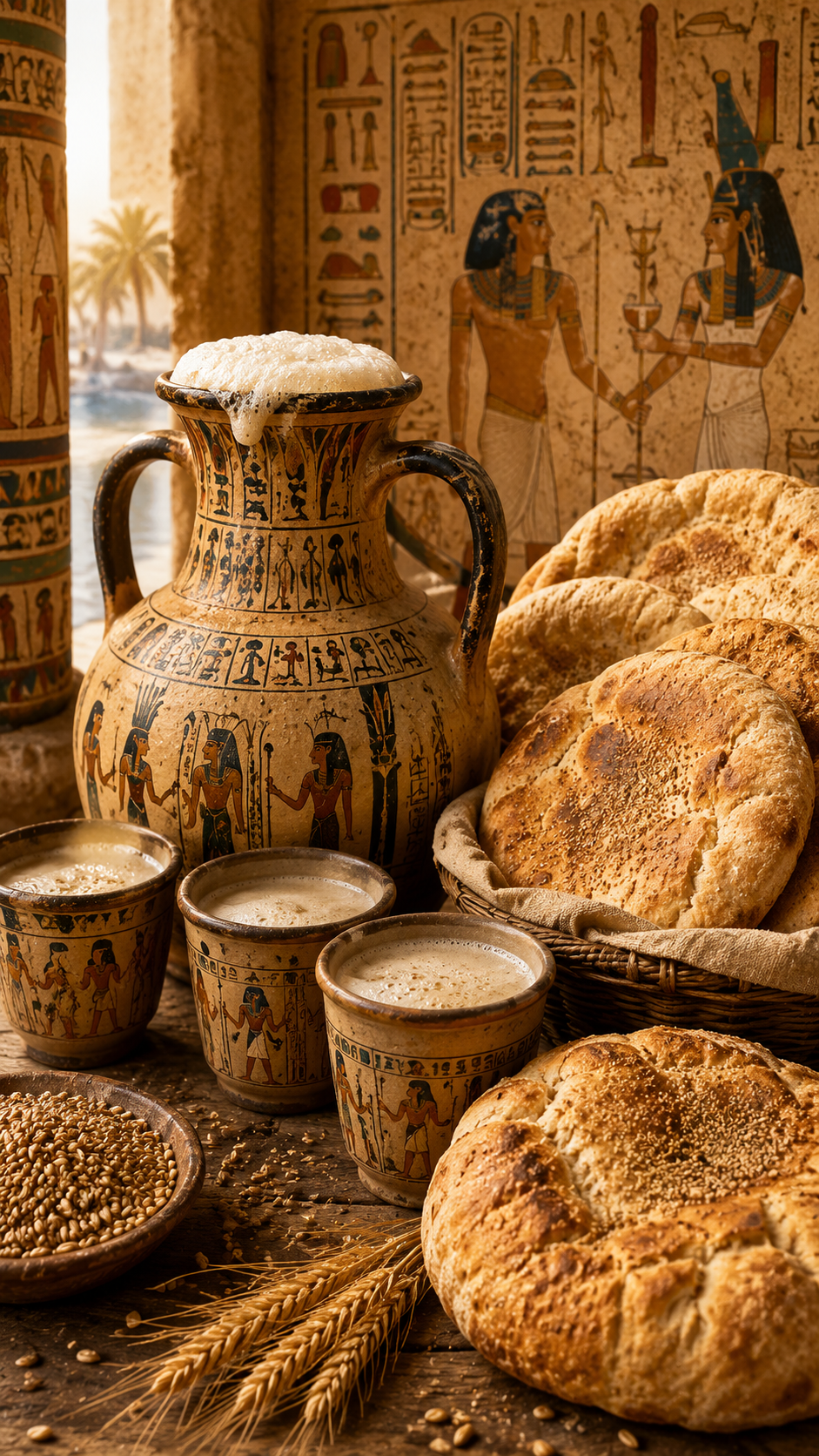
Workers could be paid in grain, bread, beer, oil, cloth, or other goods. Markets operated through barter, negotiated exchange, and systems of accounting.
However, describing the system as simple barter can be misleading. Egyptians used standard units to calculate value even when no physical money changed hands.
The most important of these units was the deben.
What Was a Deben?
The deben was a unit of weight used to express the value of goods.
During much of the New Kingdom, one deben was approximately 91 grams, although its precise weight and the material used as the standard varied by period. Objects could be valued in deben of copper, silver, or gold.
A papyrus, animal, tool, piece of furniture, or quantity of food might be assigned a value in copper deben. The buyer did not necessarily hand over a deben-shaped piece of copper. Instead, several goods equal to that value could be exchanged.
For example, an item worth one deben of copper might be purchased with a combination of grain, cloth, oil, or smaller metal objects whose total assessed value equaled one deben.
The deben was divided into smaller units, including the kite, generally one-tenth of a deben.
Archaeological weights connected with the Egyptian deben system commonly fall around 90 to 95 grams, although other weight standards also circulated, especially in international trading centers.
When Did Egyptians Begin Using Coins?
Coins appeared in Egypt gradually rather than suddenly, beginning with the Persian conquest of 525 BCE.
Foreign coins entered Egypt through Greek merchants, soldiers, and Mediterranean trade before coins became central to the Egyptian economy. Some were treated primarily as weighed pieces of metal rather than accepted according to their stamped face value.
The Persian administration introduced and circulated imperial coinage, while Greek coins were used at commercial centers such as Naukratis.
Coin use expanded considerably after Alexander the Great’s conquest in 332 BCE and under the Ptolemaic dynasty. The Ptolemies established a highly controlled monetary system and issued their own gold, silver, and bronze coins.
Traditional payments in grain and goods nevertheless continued alongside coinage.
Was Trade the Same as Tribute?
Not always.
Foreign goods could reach Egypt through several different processes:
- Commercial trade
- Diplomatic gifts
- Taxes
- Tribute
- Royal expeditions
- Military conquest
- Payments from subject territories
- Exchange between temples or rulers
Egyptian art often depicts foreign delegations presenting goods to the pharaoh. Older interpretations frequently described all these scenes as tribute.
In reality, some may represent diplomatic gift exchange, ceremonial presentations, taxes imposed on controlled territories, or carefully arranged displays of international relations.
The distinction matters because Egyptian royal art was designed to glorify the king. It often portrayed foreign rulers and peoples as subordinate even when the political relationship was more balanced.
How Important Was Trade to Ancient Egypt?
Trade was essential to Egyptian civilization. Without imported timber, Egypt would have struggled to build large seagoing ships and monumental wooden doors. Without copper and tin, craftspeople could not have produced bronze tools and weapons. Without incense and myrrh, temples would have lacked materials central to daily rituals.
Trade also influenced:
- Art
- Religion
- Clothing
- Food
- Technology
- Shipbuilding
- Warfare
- Diplomacy
- Language
- Royal power
Foreign pottery, weapons, musical instruments, plants, animals, clothing styles, and artistic motifs entered Egypt through trade and contact.
Egyptian products and ideas likewise spread outward. Trade was therefore not only an exchange of objects. It was also an exchange of knowledge, technologies, customs, and beliefs.
Frequently Asked Questions
What was ancient Egypt’s most important export?
Grain, linen, papyrus, gold, and manufactured luxury goods were among Egypt’s most important exports. Their importance varied by historical period and trading destination.
What was ancient Egypt’s most important import?
Timber was one of Egypt’s most strategically important imports because the Nile Valley lacked large supplies of high-quality wood. Metals, incense, silver, ivory, and precious stones were also highly valued.
What did ancient Egypt trade with Nubia?
Egypt obtained gold, ivory, ebony, incense, animal skins, cattle, feathers, and exotic goods through Nubian trade networks.
What did Egypt trade with Byblos?
Egypt imported cedarwood and other timber from Byblos. In return, Egypt could export grain, linen, papyrus, gold, and manufactured goods.
What did ancient Egypt trade with Punt?
Punt supplied myrrh, incense, ebony, ivory, gold, animal skins, exotic animals, and living myrrh trees.
Did ancient Egyptians trade slaves?
Enslaved people, war captives, servants, and dependent laborers were transferred between societies in the ancient world. However, the forms of servitude practiced in Egypt changed over time and did not always correspond precisely to later systems of chattel slavery.
Did ancient Egyptians use barter?
Yes, goods were frequently exchanged without coins. However, the Egyptians also calculated prices through standardized units such as the deben, making their economy more sophisticated than a simple direct barter system.
Did ancient Egyptians use coins?
Coins became increasingly common during the Late Period and especially after Alexander the Great’s conquest. Before then, most transactions relied on goods, metal by weight, and accounting units.
How far did Egyptian trade reach?
Egyptian trade networks extended south into Nubia and northeastern Africa, east toward Punt and the Red Sea, north across the Mediterranean, and northeast through the Levant into wider networks connecting Anatolia, Mesopotamia, and Central Asia.
What did the ancient Egyptians trade?
Egypt exported grain, linen, papyrus, gold, wine, pottery, jewelry, and manufactured goods. It imported cedarwood, copper, tin, silver, incense, ivory, ebony, precious stones, animal skins, and exotic plants and animals.
Its major trading partners included Nubia, Punt, Byblos, Canaan, Syria, Cyprus, Libya, the Aegean world, and, in later periods, Greece and Rome.
Trade allowed Egypt to obtain materials that could not be produced in the Nile Valley. It supported temples, palaces, armies, craftspeople, and international diplomacy.
Although Egypt is often imagined as an isolated civilization surrounded by deserts, it was deeply connected to the ancient world. Its boats sailed the Nile, Mediterranean, and Red Sea, while caravans crossed deserts carrying resources, luxury goods, and ideas between Africa and western Asia.
