There were once two loving brothers named Anpu and Bata. Anpu was the elder. He was married and owned a prosperous farm. Bata lived with his brother and his wife, working tirelessly and cheerfully for them. He plowed and harvested the fields, milked the cattle, gathered firewood, and completed countless other tasks each day.
No one could match him for strength, diligence, or kindness. He was also gifted with a remarkable understanding of animals and could even understand their speech.
Each morning, when Bata led the cattle out to pasture, they would tell him where the richest grass could be found, and he faithfully guided them there. The cattle grew sleek and healthy, and Anpu prospered because of his brother’s hard work.
One day Anpu said, “Tomorrow we shall yoke the oxen and begin plowing. Bring enough seed to sow the fields.”
Bata gladly agreed.
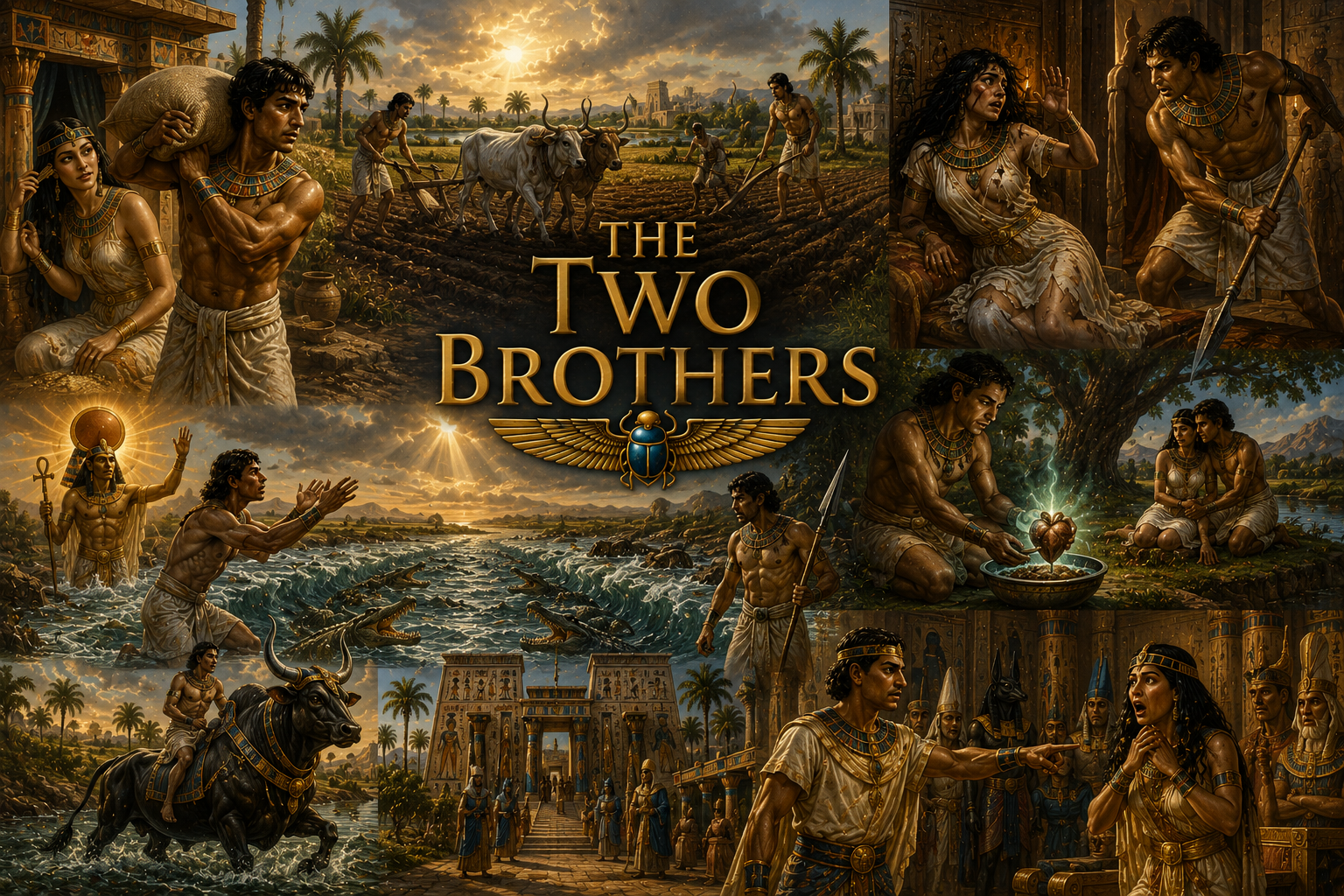
For several days the brothers plowed the land and sowed barley and wheat. At last they reached the final field, only to discover that they had run out of seed.
“Go back to the house,” said Anpu. “Ask my wife for more.”
Bata hurried home and found Anpu’s wife sitting outside in the sunshine, braiding her freshly washed hair.
“Please fetch me some seed,” he said. “Anpu is waiting, and I must return quickly.”
Without looking up, she replied, “The storeroom is open. Fetch it yourself. Can’t you see I’m busy?”
Bata entered the storeroom, filled a large container with enough grain to finish sowing the fields, and emerged carrying the heavy load across his shoulders. Despite its weight, he stood perfectly upright and walked with ease.
Watching him through the curtain of her hair, Anpu’s wife murmured,
“How much are you carrying?”
“The weight of three sacks of wheat and two of barley.”
She stared at him with admiration.
“How strong you are. Strong… and handsome.”
She rose to her feet and gently touched his arm.
“Come inside with me for a little while. Anpu will never know.”
Bata immediately dropped the grain and stepped backward.
“What are you saying? Would I betray the brother who raised me? He has been like a father to me, and you should be like a mother. I will tell no one what you have said, but never speak to me like this again.”
Picking up his burden, Bata returned to the fields.
Anpu’s wife burned with humiliation and anger. Fearing that Bata might reveal what had happened, she tore her own clothes, rubbed grease over her skin to resemble bruises, and lay upon her bed pretending to be badly beaten.
When the day’s work was finished, Bata drove the cattle home while Anpu returned ahead of him.
Immediately he sensed that something was wrong. The fire had not been lit. No meal had been prepared. His wife did not greet him.
Instead he found her lying on the bed, weeping. Her clothing was torn, and she appeared covered with bruises.
“What has happened?” Anpu demanded.
“When your brother came for the seed,” she sobbed, “he saw me braiding my hair. He tried to force himself upon me, but I resisted him. I reminded him that you were like a father to him and that he should treat me as his mother. He became enraged, beat me cruelly, and threatened to kill me if I told you.”
She buried her face in her hands.
“Husband, kill him, or I shall never know another moment’s peace.”
Blinded by anger, Anpu believed every word. He sharpened his spear and hid behind the door of the cattle byre, waiting to kill his brother.
At sunset, Bata returned with the cattle. As the leading cow approached the doorway, she quietly warned him.
“Your brother hides behind the door with a spear. He means to kill you. Run while you still can.”
Bata could scarcely believe it.
He gently patted the cow and sent her into the byre. Then another cow whispered the very same warning.
Bata bent down and saw Anpu’s feet beneath the doorway. Without another thought, he turned and fled. Anpu rushed after him, spear in hand.
Though Bata ran swiftly, his brother slowly gained upon him.
Exhausted and gasping for breath, Bata cried out, “O Ra, righteous judge of the innocent and the guilty, save me!”
Ra heard his prayer.
Instantly, a mighty river appeared between the brothers, deep, wide, and filled with hungry crocodiles.
Anpu could not cross. In frustration, he struck his own hand. Standing safely upon the opposite bank, Bata called across the water.
“Brother, why did you try to kill me without even listening to my side of the story?”
“Do you deny trying to seduce my wife?” Anpu shouted.
“By Ra, I deny it!” Bata cried. “You have been deceived. It was your wife who tried to seduce me, and I refused her.”
To prove his innocence, Bata took a sharp reed knife and mutilated himself.
When Anpu saw his brother’s blood pouring onto the ground, he knew at once that Bata had spoken the truth.
His anger turned to horror and grief. Unable to cross the river, he could only weep.
“We must part,” Bata said weakly.
“I shall go to the Valley of the Cedar and begin a new life. I will hide my heart within the blossom of the great cedar tree. If that tree is ever cut down, I shall die.
“If, one day, a jug of beer suddenly begins to ferment in your hand, you will know that disaster has struck me. Come then to the Valley of the Cedar. Search for my heart, even if it takes you seven years. Place it in a bowl of cool water, and though I appear dead, I shall live again.”
Anpu swore to do exactly as his brother asked.
He returned home, killed his treacherous wife with the spear he had prepared for Bata, and threw her body to the dogs.
Many days later Bata reached the Valley of the Cedar, deep among the desert hills beside the sea.
There his wounds healed. He built himself a beautiful house beneath the mighty cedar and concealed his heart high among its blossoms.
Only one thing was missing. He was alone.
One day the Ennead passed through the valley and discovered Bata’s lonely home.
The gods pitied him. Ra commanded Khnum to fashion a wife for Bata upon his potter’s wheel.
When the gods breathed life into her, she became the most beautiful woman ever created. Yet even the Ennead could not give her a faithful heart.
When the Seven Hathors came to declare her destiny, they spoke together: “She shall die by the knife.”
Nevertheless, the gods gave her to Bata.
“Your brother has avenged you,” said Ra. “Now take this woman as your companion.”
Bata loved her deeply from the moment he saw her. Before leaving each day to hunt, he warned her,
“Remain inside the house. Even the sea itself may desire your beauty, and I would be powerless to save you.”
She promised to obey. Before long, however, she grew restless. One day, while Bata was hunting, she wandered outside. The sea caught sight of her beauty and surged toward her.
Terrified, she fled. The sea called to the cedar tree for help. As she ran beneath its branches, one caught a single lock of her hair.
She escaped, but the lock remained tangled in the tree. The sea tore it free and carried it north to Egypt.
The fragrant lock drifted ashore where Pharaoh’s washermen cleaned the royal linen.
Soon every garment washed in the river carried the sweet perfume of the mysterious hair.
Pharaoh noticed it immediately.
His wisest advisers declared, “Surely this hair belongs to a daughter of Ra.”
Determined to find its owner, Pharaoh sent envoys throughout the lands. Only one expedition reached the Valley of the Cedar.
Bata slew every messenger except one, who escaped and told Pharaoh where the woman lived.
This time Pharaoh sent an army. Among them traveled an old woman chosen for her cunning tongue.
She reached Bata’s house while he was away hunting. With flattering words and promises of jewels, riches, and the throne of Egypt, she persuaded Bata’s wife to leave with them.
Greedy for luxury and weary of her lonely life, she willingly became Pharaoh’s queen.
When Bata returned, he found only an empty house. Knowing he had been betrayed, he cut down the great cedar tree.
As it crashed to the ground, his hidden heart fell from its branches. Immediately, Bata collapsed and died.
Far away, Anpu was drinking beer when suddenly it began to ferment in his hands.
He remembered his brother’s warning. Without delay he journeyed to the Valley of the Cedar.
For seven long years he searched. At last he found Bata’s heart.
He placed it into a bowl of cool water. Slowly the heart began to beat once more.
Bata opened his eyes and returned to life. Using his magic, Bata transformed himself into a magnificent bull.
Anpu rode upon his back into Egypt. Pharaoh admired the extraordinary animal and welcomed it into the royal stables.
But Bata’s faithless wife recognized him. Fearing discovery, she persuaded Pharaoh to slaughter the bull.
When its blood fell upon the ground, two magnificent persea trees sprang up beside the palace gate.
Again the queen recognized Bata. She persuaded Pharaoh to cut down the trees.
As one tree fell, a splinter flew into her mouth. Soon afterward she discovered she was with child.
In time she gave birth to a son. That child was Bata himself, reborn.
As he grew older, he became Crown Prince. When Pharaoh died, Bata ascended the throne of Egypt.
Before the royal court, he revealed the queen’s treachery. She was condemned to death for her betrayal.
Bata ruled Egypt wisely for thirty years, and when at last his reign ended, his faithful brother Anpu succeeded him upon the throne.