Book of the Dead Spell 4: Translation, Meaning, and the Road Above the Earth
The ancient Egyptian Book of the Dead was a collection of funerary spells created to help the deceased awaken, travel through the afterlife, overcome supernatural dangers, and attain renewed life among the gods.
Book of the Dead Spell 4 is one of the shortest spells in the collection. It contains only two main statements, yet those lines introduce several important ideas: movement after death, access to the domain of Osiris, travel across a divine waterway, and the resolution of conflict between opposing gods.
The traditional title is commonly translated in one of two ways:
A spell for traveling on the road above the earth
or:
A spell for passing along the upper road of Rosetau
Despite its brevity, Spell 4 addresses one of the deceased person’s greatest concerns. Death must not leave the individual trapped inside the tomb. The deceased needs a road, a means of travel, and permission to enter the lands ruled by Osiris.
What Is Book of the Dead Spell 4?
Spell 4 is a short funerary formula granting the deceased the ability to travel along a supernatural road and receive a place in the territory of Osiris.
Peter Le Page Renouf and Édouard Naville titled it:
Another Chapter, for travelling on the road which is above the earth.
Their published text reads:
“It is I who travel on the Stream which divideth the divine Pair. I am come, let there be given to me the lands of Osiris.”
The editors noted that Spell 4 had not been found in any of the papyri they considered representative of the Book of the Dead’s best-preserved early period. Their translation was therefore based on later or less securely dated textual evidence.
This limited survival makes Spell 4 more difficult to interpret than longer spells preserved in numerous manuscripts.
English Translation of Book of the Dead Spell 4
The following reader-friendly translation is based on the version published by Renouf and Naville:
Spell 4: Traveling on the Road Above the Earth
I am the one who travels upon the stream
that separates the Divine Pair.I have arrived.
Let the lands of Osiris be given to me.
The historical translation reads:
“It is I who travel on the Stream which divideth the divine Pair, I am come, let there be given to me the lands of Osiris.”
This is the complete text given for Spell 4 in the Renouf and Naville edition.
Because the spell is so short, much of its meaning depends on how we understand three expressions:
- The road above the earth
- The stream separating the Divine Pair
- The lands of Osiris
What Does Book of the Dead Spell 4 Mean?
In simple terms, Spell 4 allows the deceased to travel successfully through the afterlife and claim a place within the realm of Osiris.
The speaker declares that they are already moving along the correct supernatural route. They have crossed or entered a divine waterway, reached their destination, and now request possession of the lands belonging to Osiris.
The spell can be understood as a declaration of arrival:
I know the road. I have completed the journey. I have reached the realm of Osiris. Give me my rightful place there.
This is important because the ancient Egyptian afterlife was not imagined as a single location automatically reached at death.
The deceased had to move through gates, waterways, caverns, roads, fields, halls, and guarded regions. Correct knowledge and magical authority made that movement possible.
What Is the “Road Above the Earth”?
The title describes the deceased traveling on a road “above the earth.”
This may refer to a celestial route rather than an ordinary road traveled by the living. It could evoke the course followed by the sun, the pathways of the gods, or a supernatural road extending through the sky and the realm of the dead.
The phrase also establishes a contrast between the deceased’s buried body and the person’s mobile spiritual form.
The body remained beneath the ground, but the deceased did not wish to remain confined there. Through the spell, the transformed person could rise, travel, and enter regions beyond the tomb.
The road above the earth therefore represents freedom from burial’s physical restrictions.
Spell 4 continues the theme established by the preceding spells:
- Spell 1 concerns the day of burial and admission to the House of Osiris.
- Spell 2 allows the deceased to go forth by day and live after death.
- Spell 3 connects renewed life with the daily rebirth of Ra.
- Spell 4 gives the deceased a road on which to travel.
The early spells collectively transform death from permanent confinement into a new form of active existence.
Is Spell 4 About the Upper Road of Rosetau?
Modern summaries often title Spell 4:
A spell for passing along the upper road of Rosetau
The older Renouf and Naville translation does not include the name Rosetau in either the title or the surviving body of the spell. It instead refers more generally to “the road which is above the earth.”
This difference may reflect variation among manuscripts or differences in how scholars interpret the Egyptian title.
Rosetau, also written Rosetjau, Rostau, or Ro-Setau, was associated with the necropolis and the secret routes of the afterlife. The name could refer specifically to the Memphite burial region near Giza and Saqqara, but it was later extended to supernatural regions connected with Osiris and the Duat.
In funerary literature, Rosetau could represent a mysterious landscape containing roads, gates, caverns, divine guardians, and the resting place of Osiris.
When Spell 4 is described as a spell for traveling on the upper road of Rosetau, its purpose remains essentially the same: it gives the deceased safe access to a sacred route leading toward Osiris.
What Was Rosetau?
Rosetau was both a geographical and mythological place.
Its earliest associations were connected with the Memphite necropolis, including the burial grounds near Giza and Saqqara. Over time, the name developed a broader religious meaning and became connected with the hidden realm of Osiris.
Rosetau was not simply another name for the entire Egyptian underworld. It was a particularly secretive and dangerous region within the geography of death.
It could be imagined as a place of:
- Hidden roads
- Sealed entrances
- Caverns
- Desert pathways
- Divine gates
- Guardians
- The tomb or resting place of Osiris
- Routes connecting the earthly necropolis with the divine realm
Other Book of the Dead spells ask for roads through Rosetau to be opened. This suggests that entry was not automatic. The deceased needed divine recognition and knowledge of the proper path.
Spell 4 grants movement along one of those routes.
What Is the Stream in Spell 4?
The deceased says:
“I travel on the Stream.”
Renouf and Naville explained that the Egyptian term literally carried the sense of weeping or a flood of tears. From that imagery, it could refer to an overflow, inundation, stream, or canal.
They also connected it with names and personifications of the Nile in both the earthly and heavenly worlds.
The stream in Spell 4 may therefore be more than a physical river.
It could represent:
- A celestial form of the Nile
- A waterway through the afterlife
- The dividing boundary between opposing gods
- A route traveled by divine boats
- The regenerative waters associated with resurrection
Water had a deeply creative meaning in ancient Egyptian religion. The ordered world emerged from the primeval waters, and the annual Nile inundation renewed agricultural life.
Traveling on a divine stream could therefore symbolize both transportation and regeneration.
The deceased does not merely cross from one place to another. The journey takes place within a sacred landscape where water carries the power of creation and renewal.
Why Is the Stream Connected With Tears?
The term translated as “stream” could also convey the idea of weeping or a flood of tears.
Tears had several possible religious associations in ancient Egypt.
They could represent mourning for Osiris, whose death was lamented by Isis and Nephthys. They could also become a creative substance. In Egyptian mythology, tears shed by a god could give rise to living beings or contribute to the waters sustaining the world.
The relationship between tears and inundation also reflects a natural comparison.
A flood of tears flows from the eyes just as the Nile’s inundation spreads across the land. Both involve water leaving its boundaries and covering what lies before it.
The exact symbolic meaning intended in Spell 4 cannot be established with certainty, but the wordplay may connect mourning, divine water, and renewed life.
Who Are the “Divine Pair”?
Spell 4 describes the stream as dividing:
The Divine Pair
The surviving text does not identify the two gods by name.
Renouf and Naville suggested several possible interpretations. They observed that Egyptian religious texts often arranged gods into contrasting or complementary pairs.
Their principal examples included:
- Horus and Set
- Ra and Thoth
- Paired goddesses associated with opposing sides or directions
They especially noted that Thoth acts as mediator between Horus and Set, figures associated with opposing forces such as order and conflict or light and darkness. They also mentioned texts in which Ra and Thoth, representing the sun and moon, travel across the sky as a divine pair.
Because the spell does not name the pair, no single identification should be treated as certain.
Could the Divine Pair Be Horus and Set?
Horus and Set are the most likely candidates considered by many readers.
Their conflict was one of ancient Egypt’s most important mythological narratives.
Set killed or opposed Osiris, while Horus fought to avenge his father and inherit the kingship. Their dispute was eventually judged before the gods, with Thoth frequently acting as scribe, mediator, or arbitrator.
Horus and Set could represent opposing but interconnected powers:
- Order and disorder
- Kingship and rebellion
- Fertile land and desert
- Upper and Lower Egypt
- Stability and violence
- Legitimate succession and disruption
A stream dividing them could mark the boundary between opposing divine forces.
If this is the intended pair, the deceased’s declaration becomes especially powerful. The speaker can travel through the region separating Horus and Set without becoming trapped in their conflict.
The deceased has entered a balanced and controlled divine order.
Could the Divine Pair Be Ra and Thoth?
Renouf and Naville also considered Ra and Thoth because both could be associated with celestial light.
Ra represented the sun, while Thoth had strong lunar associations. Together, they could represent two forms of light governing different parts of the celestial cycle.
A heavenly stream dividing or connecting them might symbolize the route across the sky.
This interpretation fits the title’s reference to a road above the earth.
If the deceased travels between solar and lunar powers, the journey could encompass both day and night. The person would then possess access to the complete cycle of time rather than being limited to one realm.
The spell itself does not provide enough information to choose conclusively between these interpretations.
Why Does the Deceased Say, “I Am the One Who Travels”?
The spell begins with a confident declaration:
I am the one who travels.
The deceased does not ask to become a traveler. The speaker states that the journey is already taking place.
This style appears throughout Egyptian funerary literature. A desired outcome is often presented as an accomplished fact.
Instead of saying:
May I travel safely.
The deceased declares:
I travel.
The magical force of the statement transforms hope into reality.
The deceased is no longer a motionless corpse. The person has become an active traveler capable of crossing divine boundaries.
“I Have Arrived”
The second declaration is equally direct:
I have arrived.
This short statement marks the completion of the dangerous journey.
The deceased has not become lost, imprisoned, or turned back. The correct road has led to the intended destination.
Arrival was not guaranteed in Egyptian funerary thought. Numerous spells protect against obstacles that could prevent the deceased from reaching the divine realm.
These dangers included:
- Closed gates
- Hostile guardians
- Snakes and crocodiles
- Executioners
- Divine tribunals
- Loss of memory
- Loss of movement
- Being turned back
- Being trapped in darkness
- Dying a second death
By declaring “I have arrived,” Spell 4 denies the power of these obstacles.
What Are the “Lands of Osiris”?
The deceased concludes:
Let the lands of Osiris be given to me.
Osiris was the ruler of the dead and the divine model of resurrection. He had been killed, mourned, restored, and vindicated against his enemies.
The “lands of Osiris” may refer broadly to the territories under his authority in the afterlife.
These could include:
- The domain of the blessed dead
- Sacred fields where the deceased received food
- The Field of Reeds
- The Field of Offerings
- The House of Osiris
- The necropolis
- Divine estates assigned to the justified dead
Receiving land meant more than acquiring property.
In ancient Egypt, land provided food, identity, status, permanence, and participation in the ordered community. An afterlife estate could offer the deceased a secure place where they could live, cultivate crops, receive offerings, and remain among the followers of Osiris.
The request therefore means:
Grant me a permanent and legitimate place in the afterlife.
Why Was Osiris Important to Spell 4?
Osiris represented the possibility of life after death. According to Egyptian mythology, Osiris was murdered, and his body was attacked or dismembered. Through the actions of Isis, Nephthys, Anubis, Horus, and other gods, he was restored and became ruler of the realm of the dead.
Every deceased person hoped to share in this pattern. The individual could be identified with Osiris in funerary texts, receive the title “Osiris” before their name, and seek the same vindication and renewed existence.
When Spell 4 asks for the lands of Osiris, the deceased is asking to enter the community created through Osiris’s triumph over death. The lands are both a destination and a reward.
Was Spell 4 a Map of the Afterlife?
Spell 4 does not provide a detailed map, but it belongs to a larger tradition that treated the afterlife as a landscape that could be navigated. Egyptian funerary literature contains:
- Roads
- Waterways
- Islands
- Fields
- Caverns
- Mounds
- Gates
- Halls
- Lakes
- Rivers
- Divine estates
The deceased needed to know where to go, whom to address, and which words would open each route. Spell 4 is almost like a magical travel authorization. It identifies the route, declares the journey successful, and claims the destination.
How Does Spell 4 Relate to the Book of Two Ways?
The Book of Two Ways was an earlier funerary composition found primarily on Middle Kingdom coffins. It presented two routes through the afterlife, often depicted as land and water paths separated by barriers and dangerous regions.
Book of the Dead Spell 4 is not simply an excerpt from the Book of Two Ways, and the uploaded sources do not establish a direct textual descent between them.
However, both reflect a shared concern with navigating the afterlife. Their common themes include:
- Multiple supernatural routes
- Roads and waterways
- Dangerous boundaries
- Secret regions
- Access to Osiris
- The importance of knowing the correct path
Spell 4 preserves this broader Egyptian understanding of death as a journey requiring knowledge and divine permission.
Is Book of the Dead Spell 4 the Same as Coffin Text Spell 4?
No. The numbering used for the Book of the Dead and the numbering used for the Coffin Texts belong to separate modern systems.
Book of the Dead Spell 4 is the short composition about traveling on a supernatural stream and receiving the lands of Osiris.
Coffin Text Spell 4 is a different composition. The uploaded doctoral study describes Coffin Text Spell 4 as an eighteen-phrase text preserved in multiple regional witnesses and concerned with the deceased receiving the benefits of justification.
The shared number does not indicate that the two texts are identical or directly related.
This distinction is important when searching for translations online. A result labeled simply “Egyptian Spell 4” may refer to either collection.
How Old Is Book of the Dead Spell 4?
The Renouf and Naville edition states that Spell 4 had not been found in the papyri they considered to come from the “best period.”
That comment reflects the evidence available to scholars in the late nineteenth and early twentieth centuries. It does not establish a precise date of composition.
The spell’s surviving transmission appears limited, and the uploaded source does not provide enough evidence to determine when the text was first created.
It is safest to say that Spell 4 is preserved as part of the Book of the Dead tradition, but its precise origin and early manuscript history remain uncertain.
Did Spell 4 Have a Vignette?
The Renouf and Naville index lists no standard vignette for Spell 4. It groups Spells 2 through 14 among chapters without accompanying illustrations in the manuscripts used for the edition.
That does not mean no manuscript ever placed an image near the spell. Book of the Dead papyri varied significantly, and scribes could arrange texts and images in different ways.
However, there is no widely recognized standard Spell 4 vignette comparable to:
- The funeral procession of Spell 1
- The sunrise image associated with Spell 16
- The heart-weighing scene of Spell 125
- The Field of Reeds illustration of Spell 110
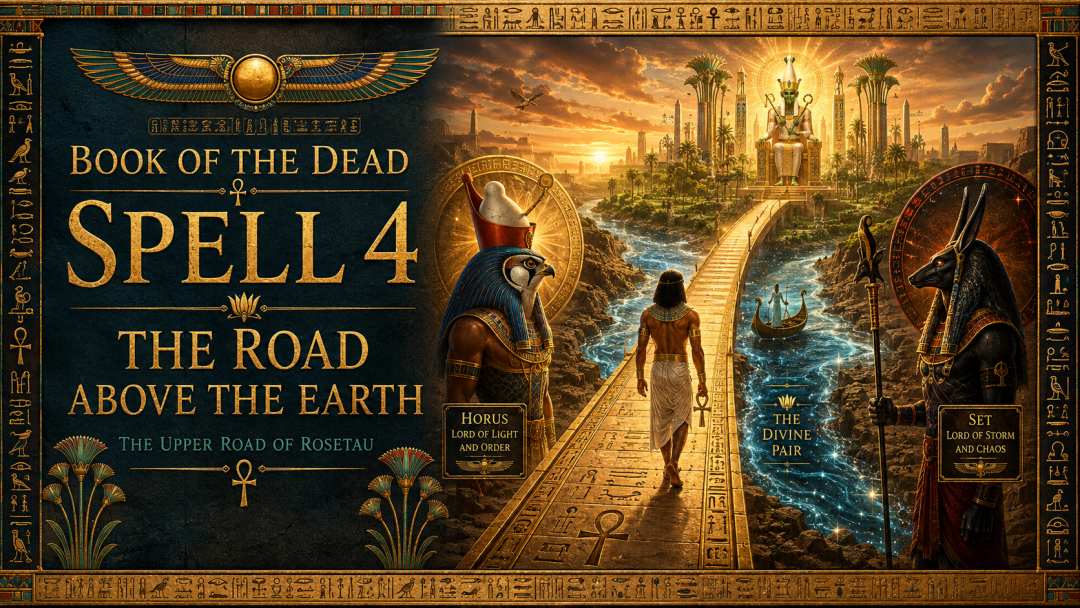
A modern illustration of Spell 4 would therefore be an artistic interpretation rather than a reproduction of a standard ancient vignette.
An appropriate reconstruction might show the deceased traveling by boat along a celestial Nile, with Horus and Set positioned on opposite banks and the realm of Osiris visible ahead.
The Meaning of Spell 4 in Simple Terms
Book of the Dead Spell 4 gives the deceased the power to travel along a sacred route and reach the domain of Osiris.
The person crosses a divine stream associated with celestial water, separation, and possibly the opposing gods Horus and Set. The deceased then announces that the journey is complete and requests a permanent place in the lands ruled by Osiris.
The meaning can be summarized as:
I know the divine road. I can cross the boundary between opposing powers. I have reached Osiris, and I claim my place among the blessed dead.
Although the spell contains only a few lines, it expresses a central hope of ancient Egyptian funerary religion.
The tomb is not the final destination. It is the starting point of a journey.
Frequently Asked Questions About Book of the Dead Spell 4
What is the purpose of Book of the Dead Spell 4?
Spell 4 allows the deceased to travel along a supernatural road or stream, arrive safely in the realm of Osiris, and receive a place within his lands.
What is the title of Spell 4?
Renouf and Naville called it Another Chapter, for Traveling on the Road Which Is Above the Earth. Modern lists often call it a spell for passing along the upper road of Rosetau.
What is the complete translation of Spell 4?
A modernized rendering is: I am the one who travels upon the stream that separates the Divine Pair. I have arrived. Let the lands of Osiris be given to me.
Who are the Divine Pair?
The text does not identify them. Possibilities discussed by Renouf and Naville include Horus and Set or Ra and Thoth. No interpretation is certain.
What is Rosetau?
Rosetau was associated with the Memphite necropolis and later with secret roads and regions of the afterlife connected with Osiris.
What are the lands of Osiris?
They are the territories ruled by Osiris in the afterlife. Receiving them meant gaining an accepted, secure, and nourished existence among the blessed dead.
Why does the spell mention a stream?
The stream may represent a heavenly Nile, an afterlife canal, a boundary between opposing gods, or a regenerative divine waterway.
Is the stream made from tears?
The Egyptian term could carry meanings connected with weeping, overflow, inundation, or a stream. The text may contain deliberate associations between tears and sacred water, but its exact symbolism remains uncertain.
Was Spell 4 accompanied by an illustration?
No standard vignette is listed in the Renouf and Naville edition.
Is Spell 4 well preserved?
No. Renouf and Naville stated that it had not been found in the papyri they considered representative of the best-preserved early period. Its limited textual evidence makes interpretation difficult.
Book of the Dead Spell 4 is one of the collection’s shortest texts, but it carries the deceased across an immense symbolic distance. The speaker travels along a divine stream, passes between opposing powers, reaches the realm of Osiris, and asks to receive land there.
Every statement is confident. The deceased does not remain buried, lost, or powerless. The road exists. The stream can be traveled. The destination has been reached. The lands of renewed life are ready to be claimed. Spell 4 turns the afterlife into a journey that can be completed through sacred knowledge and effective words.