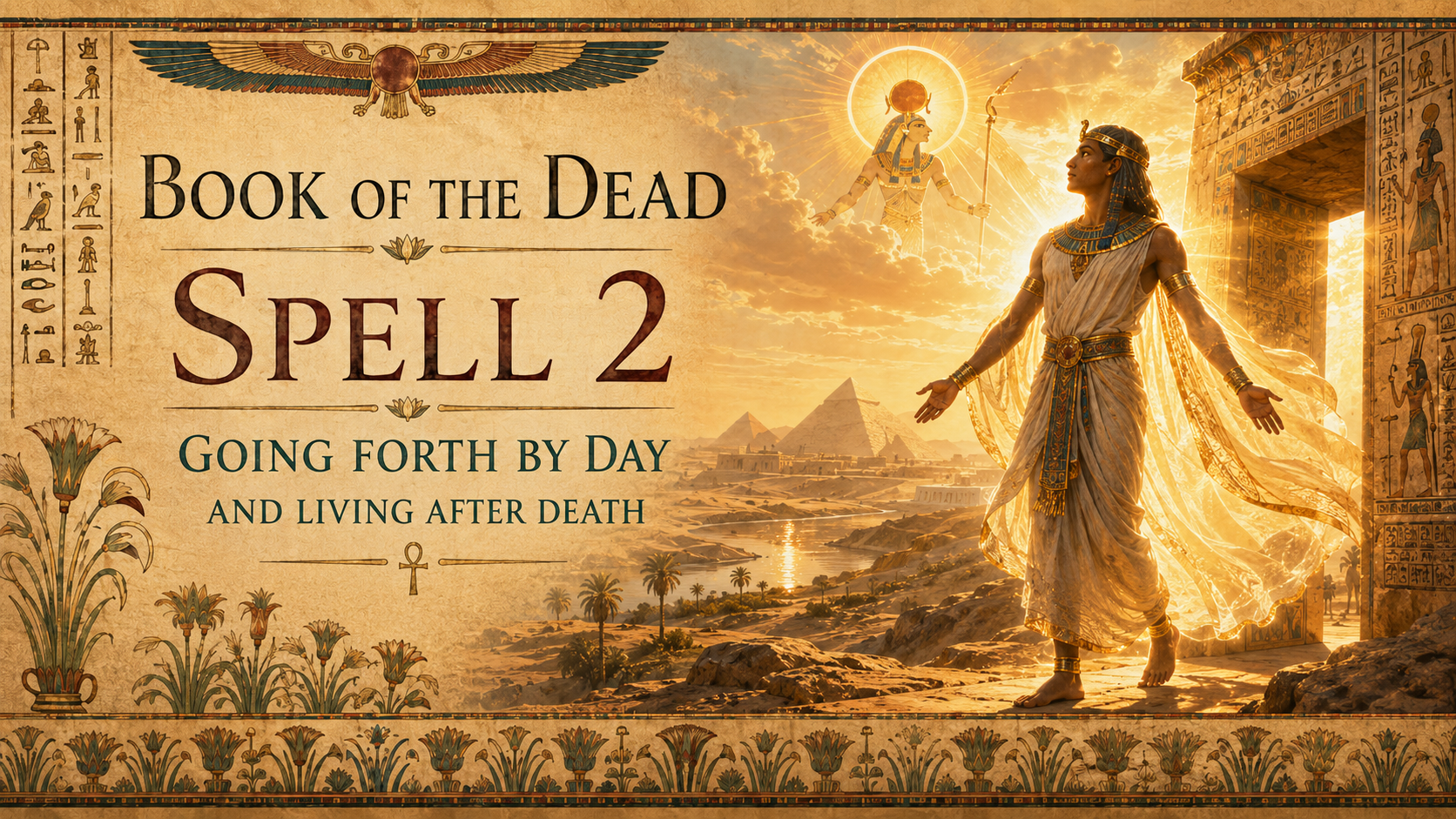
The ancient Egyptian Book of the Dead contains dozens of spells intended to help the deceased overcome the dangers of death and enter a renewed existence in the afterlife.
Book of the Dead Spell 2 is one of the collection’s shortest compositions, but its message is central to ancient Egyptian funerary belief. The spell asks that the deceased be allowed to leave the realm of the dead, join the radiant company of the sun god, and return to the world of the living.
Its traditional title is commonly translated as: A spell for going forth by day and living after death.
Spell 2 expresses a powerful hope: death should not imprison a person inside the tomb. The deceased wanted to awaken, move freely, enter the light, and continue participating in life.
What Is Book of the Dead Spell 2?
Spell 2 is a short funerary formula intended to grant the deceased the power to go forth by day and live after death.
The modern name Book of the Dead was created by Egyptologists. The ancient Egyptians commonly referred to these compositions as spells or chapters of prt m hrw, usually translated as Going Forth by Day or Coming Forth by Day.
Rather than forming a single book with a fixed narrative, the Book of the Dead was a collection of approximately 175 known compositions. Individual papyri could contain different selections of spells, arranged in varying orders.
Spell 2 belongs to a group of early chapters concerned with movement, emergence, and renewed life. Its goal was not merely to preserve the deceased inside the tomb. It gave the person permission to leave the darkness of death and enter the living world once more.
The Title of Spell 2
The title is translated in the Renouf and Naville edition as: Chapter for Coming Forth by Day and Living after Death.
The same edition places Spell 2 immediately after the burial spell known as Spell 1. Unlike Spell 1, Spell 2 was not normally accompanied by a vignette in the manuscripts used for that publication.
The title summarizes the entire purpose of the spell. It promises two related abilities:
- The deceased can come forth into the light of day.
- The deceased can continue living after physical death.
These ideas are closely connected. In ancient Egyptian thought, true survival required more than the preservation of the body. The deceased also needed consciousness, movement, nourishment, recognition, and access to the divine world.
English Translation of Book of the Dead Spell 2
The following translation is adapted into modern English from the version published by Peter Le Page Renouf and Édouard Naville in 1904. The letter N represents the name of the deceased, which would be inserted into the manuscript.
Spell 2: A Spell for Going Forth by Day and Living After Death
O Sole One, who shines from the moon,
let me go forth among your shining company.Let me come out freely,
and let me be revealed as one of the glorified spirits.When the Duat is opened for the gods,
let [Name] go forth
to do what he desires upon the earth
among the living.
The historical translation reads:
“Oh thou Only One, who shinest from the Moon, let me come forth amid that train of thine, at large, and let me be revealed as one of those in glory.
And when the Tuat is opened to the gods, let N come forth to do his pleasure upon earth amid the Living.”
Renouf and Naville describe the “Only One” as an epithet of the sun god. They interpret the divine “train” as the heavenly company surrounding him and explain “at large” as being free and outside the enclosure of the tomb.
What Does Spell 2 Mean?
Spell 2 asks for freedom from the restrictions of death. The deceased does not want to remain sealed inside a coffin or confined within the tomb. Instead, the speaker asks to join the gods, emerge into the daylight, become a glorified spirit, and move among the living.
Every line contributes to this promise of renewed existence.
“O Sole One, Who Shines From the Moon”
The spell begins by addressing a deity called the Sole One or Only One. Renouf and Naville identify this as one of the many titles of the sun god. The wording appears unusual because the deity is described as shining from the moon. This may reflect the close relationship between solar and lunar cycles in Egyptian religious thought.
Both the sun and the moon disappear and return. Each therefore provided a visible model of renewal.
The sun set in the west, traveled through the hidden realm of night, and rose again in the east. The moon similarly disappeared, changed form, and renewed itself.
By addressing a god who shines again after darkness, the deceased aligns personal resurrection with the repeating cycles of the sky. The message is that disappearance does not have to mean destruction. Just as celestial light returns, the dead person can return to life.
“Let Me Go Forth Among Your Shining Company”
The deceased asks to join the god’s divine company. The older translation calls this company a “train,” meaning a group of attendants or followers. Renouf and Naville interpret it as the heavenly host, the divine beings who accompany the god.
This request has both a protective and a social meaning. The deceased did not want to travel through the afterlife alone. Joining the gods placed the person within an established divine community. It provided status, protection, recognition, and a legitimate place in the ordered universe.
To be included among the god’s followers meant that the deceased was no longer merely a dead human being. The person had become one of the blessed and effective spirits.
“Let Me Come Out Freely”
One of the most important words in the spell refers to coming forth freely, openly, or “at large.”
Renouf explains the expression as being:
“forth, out of doors, at large”
He contrasts this freedom with enclosure inside the tomb.
This distinction reveals an important aspect of ancient Egyptian funerary religion. The tomb protected the body, but it could also be imagined as a place of confinement.
The deceased needed magical permission to cross the tomb’s boundaries.
Spell 2 therefore functions almost like a declaration of release. It transforms the tomb from a permanent prison into a protected dwelling that the deceased can enter and leave.
The person may rest within the burial chamber but is not trapped there.
“Let Me Be Revealed as One of the Glorified Spirits”
The deceased asks to be revealed as one of those “in glory.”
This refers to the state of becoming an akh, commonly translated as an effective spirit, transfigured spirit, or glorified being.
The akh was not simply a ghost. It was a successfully transformed form of the deceased, capable of existing among the gods and exercising power in the afterlife.
The idea of being “revealed” is also significant.
Death had hidden the person from the visible world. Through the spell, the deceased asks to become visible again in a new and powerful spiritual form.
The body might remain in the tomb, but the transformed spirit could emerge, shine, travel, and act.
“When the Duat Is Opened to the Gods”
The spell next refers to the opening of the Duat, also written as Tuat in older translations.
The Duat was the hidden realm through which the sun god traveled during the night. It was also a domain inhabited by gods, spirits, guardians, and the dead.
The Duat was not identical to the modern concept of hell. It contained dangerous regions, but it was also a place of regeneration.
During the sun god’s nightly journey, his power was renewed before his rebirth at dawn. The deceased hoped to participate in this same cycle.
When the Duat opened for the gods, the deceased asked to pass through its entrance as a recognized member of their company.
The line implies that access to the divine realm was controlled. A person could not simply enter or leave without the proper knowledge, status, and magical authority.
Spell 2 supplies that authority.
“Let [Name] Go Forth”
Ancient Egyptian funerary spells were personalized.
The name of the deceased would be inserted into the text where modern translations place N, [Name], or a similar placeholder.
Naming the deceased was not merely a scribal convenience. A person’s name was considered an essential part of identity. Preserving and speaking the name helped preserve the person.
By naming the deceased directly, the spell ensured that its benefits applied to a specific individual.
The command is therefore personal:
Let this person go forth.
The deceased is not asking for a vague promise of immortality. The spell demands that a named individual receive the freedom to leave the realm of death.
“To Do What He Desires Upon Earth”
The final section gives the deceased permission to act according to personal desire. This does not necessarily mean that the dead returned permanently in a physical body. It expresses freedom of movement and activity.
The deceased wished to continue doing many of the things associated with life:
- Traveling outside the tomb
- Visiting familiar places
- Receiving offerings
- Seeing relatives
- Joining religious festivals
- Enjoying sunlight
- Moving through the world without obstruction
- Returning safely to the tomb
The phrase also emphasizes independence. The deceased does not want to become a powerless captive who can move only when commanded.
Spell 2 grants agency. The person can go where desired and participate in continued existence.
“Among the Living”
The final words are among the most striking in the spell. The deceased asks to go forth upon the earth: Among the living.
This places the afterlife in direct relationship with the world the person had known before death.
Ancient Egyptian religion did not always imagine the dead as permanently separated from the living. Tombs, offerings, festivals, names, images, and family rituals maintained relationships between the two worlds.
The deceased could receive food from the living, hear prayers, revisit the earthly realm, and remain involved in family affairs. Spell 2 reflects this continuing connection. The dead person is transformed, but not erased. Death changes the person’s form without completely ending participation in life.
What Does “Going Forth by Day” Mean?
“Going forth by day” is one of the central ideas in the Book of the Dead.
At its simplest, it means emerging from the tomb into daylight. Its larger religious meaning includes spiritual freedom, resurrection, and the ability to move between different realms.
Going forth by day could allow the deceased to:
- Leave the darkness of the tomb
- Join the sun god
- Travel through the sky
- Enter and leave the Duat
- Visit the world of the living
- Receive offerings
- Participate in festivals
- Return to the tomb safely
- Assume different spiritual forms
The phrase should not be understood as a one-time escape.
Like the sun god, the deceased could participate in a repeating cycle of departure and return. The person might rest in the tomb, travel through the divine realm, emerge with the sunrise, and return again.
The desired afterlife was therefore active rather than motionless.
Why Was Daylight So Important?
Daylight represented life, visibility, warmth, and the renewed power of the sun.
Night and death were closely associated because both involved darkness, stillness, and disappearance. Yet night was not permanent. Each sunrise proved that darkness could be overcome.
The daily journey of Ra supplied a model for resurrection.
Ra entered the western horizon at sunset, traveled through the Duat, and reappeared in the east at dawn. The deceased hoped to follow the same pattern.
Spell 2 connects the dead person with this celestial cycle. The speaker asks to join the god’s company and emerge when the hidden realm is opened.
The sunrise becomes evidence that renewed life is possible.
How Is Spell 2 Different From Spell 1?
Spell 1 and Spell 2 both concern the deceased’s successful transition into the afterlife, but they approach that transition differently.
Spell 1 is closely associated with the day of burial. It contains declarations linking the deceased with Osiris, Horus, Thoth, sacred festivals, priests, and the funeral procession.
Spell 2 is much shorter. It concentrates on the result of the transformation:
- The tomb no longer confines the deceased.
- The Duat opens.
- The deceased joins the divine company.
- The person emerges into daylight.
- Life continues after death.
Spell 1 establishes the deceased’s ritual identity and admission to the realm of Osiris. Spell 2 grants the freedom to come out again.
Is Spell 2 the Same in Every Manuscript?
No. There was no single copy of the Book of the Dead used by every Egyptian. Individual manuscripts could contain different spell selections, variations in wording, alternate spell orders, omissions, additions, and scribal mistakes.
Renouf and Naville noted that Spell 2 appeared in only two of the older manuscripts collated by Édouard Naville, identified as Ae and Pf. They also stated that it was included in the Papyrus of Ani.
This limited attestation suggests that Spell 2 was not included as consistently as some of the Book of the Dead’s better-known chapters.
Its brevity may also explain why it is often overlooked. It does not contain the elaborate mythology of Spell 17, the judgment scene of Spell 125, or the famous heart-scarab formula of Spell 30B. Nevertheless, it expresses one of the collection’s most fundamental goals.
Did Spell 2 Have an Illustration?
The Renouf and Naville index lists no vignette for Spell 2 in the manuscripts used for their edition. This differs from Spell 1, which was often accompanied by an elaborate funeral procession.
The lack of a standard illustration does not reduce Spell 2’s importance. Many Book of the Dead spells depended primarily on the power of written or spoken words. The spell itself creates the desired transformation by addressing the god, naming the deceased, and declaring the person’s right to emerge.
Was Spell 2 Recited Aloud?
The surviving title does not contain a detailed ritual instruction explaining exactly when or by whom the spell should be recited.
Book of the Dead compositions were written as speech placed in the mouth of the deceased. The collection is not a conventional priestly ritual manual. Renouf and Naville observed that its prayers and hymns generally present the deceased as the speaker in the other world.
The text could therefore function on several levels:
- It may have been recited during funerary rites.
- It could have been spoken symbolically by the deceased.
- Its written presence on the papyrus could ensure its continuing magical effectiveness.
- A priest or relative may have voiced its words on the deceased’s behalf.
The surviving evidence supports its funerary and magical role, but it does not establish one universal performance method.
Spell 2 and the Ancient Egyptian Idea of the Afterlife
Spell 2 challenges the popular image of an Egyptian mummy lying motionless in a sealed tomb for eternity.
Ancient Egyptians preserved the body because it remained important to identity. However, successful existence after death also depended on the continued activity of the person’s spiritual components.
The deceased wanted to:
- Awaken
- Breathe
- Speak
- Remember
- Eat and drink
- Recognize others
- Travel
- Join the gods
- Return to the earth
- Avoid being imprisoned or destroyed
Spell 2 concentrates several of these hopes into a few lines.
It asks for movement, divine companionship, spiritual transformation, personal freedom, and contact with the living world.
The Meaning of Spell 2 in Simple Terms
Book of the Dead Spell 2 asks the sun god to release the deceased from the darkness and confinement of death. The deceased wishes to join the god’s shining followers, become a glorified spirit, pass through the opened Duat, and return freely to the earthly world.
Its message can be summarized as: I am not trapped in death. The way is open. I can enter the light, move freely, and continue living.
Although the spell is brief, it captures the central promise of the Book of the Dead. Death was not supposed to leave the individual silent and helpless. With the correct words and divine protection, the deceased could go forth by day and live again.
Frequently Asked Questions About Book of the Dead Spell 2
What is the purpose of Spell 2?
Spell 2 allows the deceased to emerge from the tomb, join the divine company, become a glorified spirit, and travel upon the earth among the living.
What is the title of Spell 2?
Its title is commonly translated as A Spell for Going Forth by Day and Living After Death.
Who is the “Sole One” in Spell 2?
Renouf and Naville identify the Sole One as an epithet of the sun god. The deceased asks to join the god’s radiant company.
What is the Duat?
The Duat was the hidden realm of the gods and the dead. The sun god traveled through it during the night before being reborn at dawn.
What does “at large” mean in older translations?
It means freely, openly, or outside the enclosure of the tomb. The deceased asks not to remain confined.
What is a glorified spirit?
A glorified or effective spirit, often called an akh, was a successfully transformed form of the deceased capable of living and acting in the divine world.
Could the deceased really return to earth?
The spell expresses spiritual movement rather than an ordinary physical return. The deceased could emerge from the tomb, receive offerings, visit the living world, and participate in life as a transformed spirit.
Was Spell 2 included in the Papyrus of Ani?
Renouf and Naville state that Spell 2 occurs in the Papyrus of Ani, as well as in two of the older manuscripts collated by Naville.
Did Spell 2 have a vignette?
No standard vignette is listed for Spell 2 in the Renouf and Naville edition.
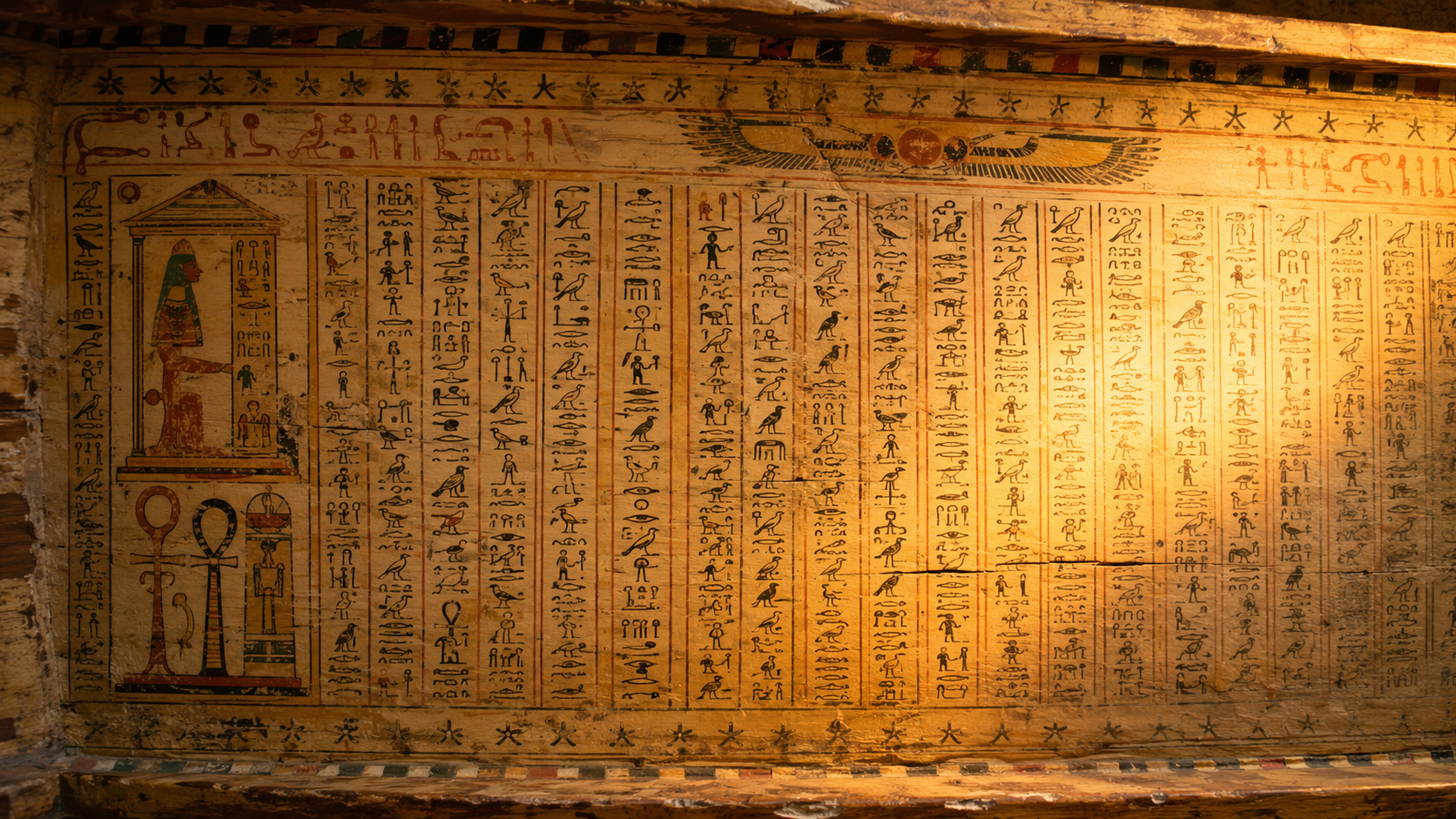
Book of the Dead Spell 2 is one of the shortest spells in the ancient Egyptian funerary collection, yet it expresses one of its most important ideas. The deceased is not asking merely to remain preserved. The speaker wants to emerge, shine, move, choose, and continue participating in life.
The god’s company provides belonging. The opening of the Duat provides a path. Transformation into a glorified spirit provides power. Going forth upon the earth provides freedom. Spell 2 turns the tomb from a final destination into a doorway. The deceased may have entered the darkness of death, but like the sun, they hoped to rise again.