The ancient Egyptian Book of the Dead was a collection of funerary spells intended to help the deceased survive death, pass through the dangers of the afterlife, and attain eternal life among the gods.
Despite its modern name, the Book of the Dead was not a single book written by one author. It was a growing collection of prayers, hymns, declarations, ritual instructions, magical formulas, and illustrated scenes. Ancient Egyptians called it prt m hrw, a title commonly translated as Going Forth by Day or Coming Forth by Day.
Modern scholars have identified approximately 190 numbered Book of the Dead spells, although no surviving papyrus contains all of them. Individual manuscripts were personalized, and their owners selected the spells considered most useful for their journey through the afterlife. The wording, order, illustrations, and selection could vary considerably from one manuscript to another.
This archive explores the spells individually, providing an English translation, historical context, explanation of the gods and places mentioned, and a clear discussion of what each spell meant to an ancient Egyptian reader.
What Were the Book of the Dead Spells?
The spells of the Book of the Dead were designed to solve the many problems a person might encounter after death.
The deceased needed to awaken, breathe, speak, remember their name, retain possession of their heart, receive food and water, avoid dangerous creatures, pass guarded gates, travel through the Duat, join the solar boat of Ra, face divine judgment, and enter the presence of Osiris.
Some spells protected the physical body. Others transformed the deceased into a powerful spirit known as an akh. Some supplied knowledge of secret names, while others allowed the deceased to assume the forms of gods, birds, snakes, crocodiles, or sacred plants.
The spells could be written on papyrus, coffins, tomb walls, burial shrouds, amulets, funerary figurines, and other objects placed with the dead.
The 1904 translation by Peter Le Page Renouf and Édouard Naville describes the collection as a group of independent compositions rather than a continuous book. Families could choose which spells to include, and the standardized numbering still used today was based largely on the order of a long papyrus in Turin.
How Many Spells Are in the Book of the Dead?
Modern lists generally contain 190 numbered spells, including alternate versions such as Spell 1B, 29A, 29B, 30B, 63A, 63B, 81A, 81B, 136A, 136B, 153A, and 153B.
And I’m going to do my best to provide you with a dedicated page for each and every spell that I can. As I complete each new page, translating each spell, you’ll find them listed here on this page.
But you should know, the number 190 can be misleading.
The ancient Egyptians did not create a single official edition containing all 190 spells. Some compositions appeared only rarely. Others were repeated under different numbers, existed in multiple versions, or consisted primarily of an illustration rather than a written text.
Spell 16, for example, is generally represented by a large sunrise vignette rather than a conventional recitation. Spell 150 is also a visual composition, presenting the mounds of the underworld in pictorial form.
List of Book of the Dead Spells by Subject
The numbered spells do not form a continuous story, but they can be arranged into broad thematic groups.
Spells 1–20: Burial, Resurrection, and Going Forth
The opening spells concern the funeral, the beginning of the deceased’s new existence, and the power to emerge from the tomb.
Important spells in this section include:
- Spell 1: A recitation for the day of burial
- Spell 1B: Entering the Netherworld on the day of interment
- Spell 2: Going forth by day and living after death
- Spell 3: Another spell for renewed life
- Spell 4: Traveling on the upper road of Rosetau
- Spell 5: Avoiding compulsory labor in the afterlife
- Spell 6: Causing a shabti to perform work
- Spells 7–14: Protection, movement, and overcoming enemies
- Spell 15: Hymns to the sun god
- Spell 16: A sunrise vignette symbolizing Ra’s rebirth
- Spell 17: Knowledge of creation, Atum, and religious mysteries
- Spells 18–20: Vindication before the divine tribunals
Spell 17 is one of the longest and most complex compositions in the collection. It contains ancient religious explanations, alternative readings, and glosses clarifying obscure mythological references.
Spells 21–30: Preserving Identity and the Parts of the Person
These spells restore or protect the essential elements of the deceased.
They include formulas for:
- Opening the mouth
- Restoring speech
- Recovering magical power
- Remembering the deceased’s name
- Returning the heart
- Preventing the heart from being stolen
- Preventing the heart from testifying against its owner
Spell 30B, often written on a heart scarab, asks the heart not to oppose its owner during the Weighing of the Heart.
The ancient Egyptians believed that identity involved several interconnected elements, including the body, name, heart, ka, ba, shadow, and transformed akh. Eternal survival depended on preserving or reuniting these parts.
Spells 31–53: Protection From Dangerous Creatures and Other Perils
The afterlife contained snakes, crocodiles, insects, executioners, hostile gods, traps, and supernatural beings.
These spells protected the deceased from:
- Crocodiles
- Venomous snakes
- Dangerous insects
- Decapitation
- Slaughter
- Putrefaction
- Destruction
- Losing a place in the afterlife
- Being forced to eat excrement or drink urine
- Dying a second death
Spell 42 identifies every part of the deceased’s body with a god. By declaring that the hair, face, eyes, ears, limbs, and organs belonged to divine beings, the spell made the body sacred and difficult to harm.
Spells 54–63: Breathing, Water, and Nourishment
Physical death deprived the body of breath and the ability to drink. These spells restored those essential powers.
They granted the deceased:
- Air to breathe
- Control over water
- Access to fresh water
- Protection from fire
- Protection from boiling or scalding
- Continued possession of the soul
Spell 59 addresses a sacred sycamore tree associated with the sky goddess Nut and asks it to provide life-giving air.
These spells demonstrate that eternal life was imagined as a complete existence. The deceased did not merely continue as an abstract spirit. They wanted to breathe, drink, eat, move, speak, and experience pleasure.
Spells 64–89: Going Forth by Day and Transformation
This large group returns to the central goal expressed by the ancient title of the collection: going forth by day.
The spells allowed the deceased to:
- Leave the tomb
- Open the burial chamber
- Defeat enemies
- Receive power over the body
- Travel to Heliopolis
- Take any desired form
- Reunite the ba with the body
Spells 76 through 88 are commonly called transformation spells.
They allowed the deceased to become:
- A golden falcon
- A divine falcon
- A member of the divine tribunal
- A light-giving god
- A lotus
- Ptah
- The Bennu bird
- A heron
- A living ba
- A swallow
- A snake
- A crocodile
These transformations gave the deceased different abilities and allowed movement between the tomb, the earthly world, and the realm of the gods.
Spell 89 reunites the ba, usually represented as a human-headed bird, with the mummy. Its vignette often shows the ba hovering over the body.
Spells 90–123: Traveling Through the Afterlife
These spells concern movement through the Duat and access to sacred places.
They include formulas for:
- Freeing the soul from restraint
- Opening the tomb
- Restoring the use of the legs
- Obtaining writing equipment
- Joining Thoth
- Using ferries and divine boats
- Entering the solar barque
- Sitting among the gods
- Receiving offerings
- Knowing the spirits of eastern and western regions
- Reaching Rosetau
- Entering divine mansions
Spell 110 contains the famous representation of the Field of Reeds, an idealized afterlife where the deceased could farm, eat, drink, and enjoy an existence resembling life in Egypt. It was commonly accompanied by an elaborate vignette.
Spells 124–126: Judgment Before Osiris
This group concerns the deceased’s examination before the gods.
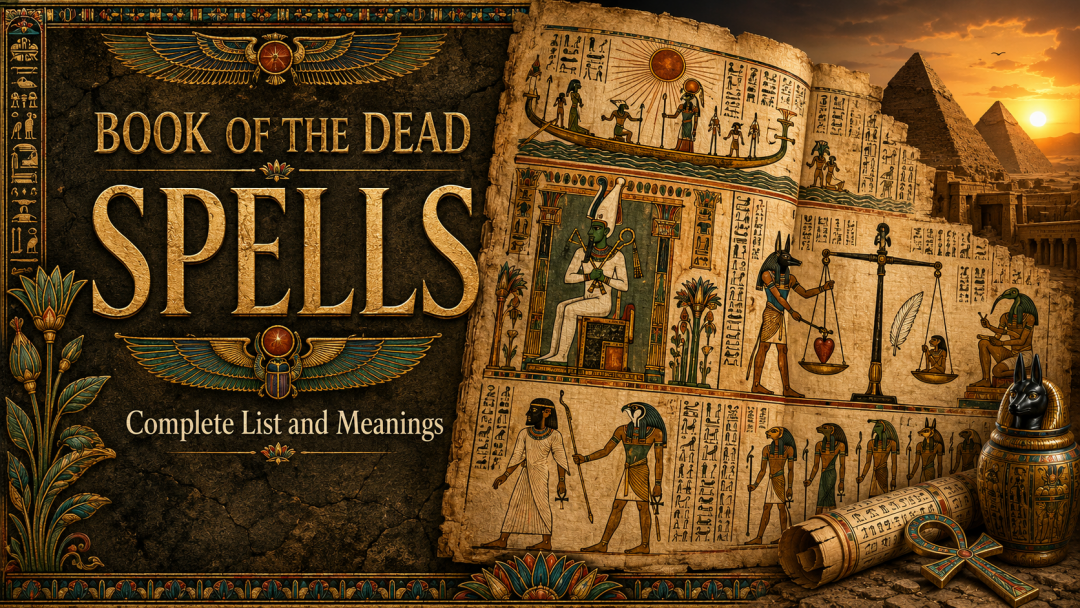
Spell 125 is the best-known composition in the Book of the Dead. It describes the deceased entering the Hall of Two Truths, addressing 42 divine judges, and declaring innocence through statements commonly known as the Negative Confession.
The deceased’s heart is weighed against the feather of Ma’at, representing truth, justice, order, and moral balance.
If the heart balanced with the feather, the deceased was declared justified and admitted into the afterlife. If it failed, the heart could be consumed by Ammit, the terrifying Devourer.
Spell 126 concerns a fiery lake guarded by four baboons. The fire destroyed the wicked but provided nourishment to the blessed dead.
Spells 127–143: The Duat and the Solar Boat of Ra
These spells help the deceased navigate caverns, worship Osiris, and travel aboard the solar barque.
They include formulas for:
- Passing supernatural guardians
- Worshipping Osiris
- Joining Ra
- Becoming an effective spirit
- Seeing one’s earthly home
- Defeating the enemies of Ra
- Traveling with the sun god
- Entering Abydos
- Lighting lamps for the deceased
The solar journey offered one of ancient Egypt’s most powerful models of resurrection.
Ra disappeared in the west each evening, traveled through the hidden world during the night, and returned in the east at dawn. By joining Ra’s boat, the deceased participated in this daily cycle of death and rebirth.
Spells 144–150: Gates, Guardians, Caverns, and Mounds
The deceased could encounter guarded gates and dangerous regions while crossing the underworld.
Success depended on knowing:
- The name of each gate
- The name of its guardian
- The name of its doorkeeper
- The correct words of greeting
- The divine beings associated with each region
Spell 144 describes seven guarded gates. Spell 146 describes 21 portals belonging to the House of Osiris. Spell 149 lists 14 mounds through which the deceased must pass. Spell 150 presents a pictorial summary of these mysterious places.
Knowing a being’s secret name gave the deceased power to address it correctly and prove that they possessed the religious knowledge required to continue.
Spells 151–190: Protection, Amulets, and the Preservation of the Body
The final group contains protective texts, amulet spells, hymns, and several compositions added during later periods.
These spells include:
- Spell 151: Protecting the burial chamber and body
- Spell 152: Building a mansion on earth
- Spells 153A–B: Escaping from the net of the afterlife
- Spell 154: Preventing the corpse from decaying
- Spell 155: The djed-pillar amulet
- Spell 156: The knot of Isis amulet
- Spells 157–158: Golden vulture and falcon collars
- Spells 159–160: Papyrus-column amulets
- Spell 161: Opening the sky to release the four winds
- Spell 162: Creating a protective flame beneath the head
- Spells 163–167: Preserving the body, head, and sacred eye
- Spells 169–170: Raising and arranging the funerary bier
- Spell 171: Clothing the deceased in a pure garment
- Spells 174–178: Restoring the spirit, soul, body, eyes, ears, and head
- Spell 179: Leaving yesterday and entering today
- Spells 180–186: Worshipping Ra, Osiris, and Hathor
- Spells 187–190: Joining the gods and overcoming final dangers
Spell 151 is especially elaborate. It combines protective images and texts around the deceased, including guardians associated with the four sides of the burial chamber. Some of its formulas were also written on magical bricks placed in niches in tomb walls.
Were All Book of the Dead Spells Used Together?
No surviving manuscript contains every spell.
A Book of the Dead papyrus was usually prepared for a particular person. Wealth, available space, local tradition, personal preference, and the practices of the workshop could all affect which spells appeared.
A shorter papyrus might contain only a limited selection. A wealthy owner could commission a long, beautifully illustrated manuscript with numerous spells and elaborate vignettes.
The arrangement also changed over time. Earlier New Kingdom papyri often varied greatly in their sequence. Later manuscripts became more standardized, although variations continued. The Renouf and Naville edition explains that the compositions remained largely independent and that accepting one spell did not require the inclusion of the next.
Explore Every Book of the Dead Spell
This archive is being expanded into a complete guide to the ancient Egyptian Book of the Dead.
Each article examines one spell and includes:
- A readable English translation
- The spell’s traditional title
- Its purpose in the afterlife
- An explanation of difficult lines
- The gods and sacred places named in the text
- Connections with the Pyramid Texts and Coffin Texts
- Variations found in surviving manuscripts
- The meaning of any accompanying vignette
- A plain-English summary of the spell
Begin exploring the series:
Book of the Dead Spell 1
For the Day of Burial
Spell 1 accompanied the funeral and helped the deceased enter the House of Osiris, receive food and drink, move freely, and become vindicated among the gods.
Book of the Dead Spell 2
Going Forth by Day and Living After Death
Spell 2 asks that the tomb and Duat be opened so the deceased can emerge into daylight, join the glorified spirits, and move upon the earth among the living.
Book of the Dead Spell 3
Another Spell Like It
Spell 3 connects the resurrection of the deceased with the daily rebirth of Ra and declares that the dead person can be born again from yesterday.
More translations and explanations will be added as this series continues.
What Was the Overall Purpose of the Book of the Dead?
The spells addressed many different dangers, but together they served one central purpose:
They helped the deceased regain life, identity, freedom, and a place within the divine order.
The ideal afterlife was not silent or motionless.
The deceased wanted to speak, remember, breathe, travel, receive offerings, transform into different forms, visit the living, join Ra in the sky, enter the Field of Reeds, and stand vindicated before Osiris.
The Book of the Dead provided the knowledge and sacred words needed to make that renewed existence possible.