Book of the Dead Spell 3: Translation, Meaning, and Rebirth With Ra
The ancient Egyptian Book of the Dead was a collection of funerary compositions designed to help the deceased survive death, enter the divine world, and continue living as a transformed spirit.
Book of the Dead Spell 3 is a brief spell concerning resurrection and renewed life. It addresses the creator and sun god Atum, calls upon the crew of Ra’s solar boat, and compares the rebirth of the deceased with the daily renewal of the sun.
Although the text is short, its message is powerful. The deceased declares that just as Ra is born anew each day, they too will rise from the past and rejoice in life among the gods.
What Is Book of the Dead Spell 3?
Spell 3 is traditionally titled: Another spell like it.
The phrase refers back to Spell 2, whose purpose was to enable the deceased to go forth by day and live after death.
Spell 3 develops that same promise through solar imagery. Rather than simply asking to leave the tomb, the deceased is connected with Ra’s daily rebirth.
The surviving spell includes several important ideas:
- Atum appears in radiant divine form.
- The deceased belongs among those who obey the god.
- The crew of Ra is asked to grant life after death.
- Ra’s rebirth provides the model for the deceased’s resurrection.
- The deceased identifies with Thoth.
- Life after death is presented as a repeated renewal, not a motionless existence.
The Renouf and Naville edition states that the only ancient copy known to its editors was preserved in the Papyrus of Amen-neb and that even this version was incomplete. That means every translation of Spell 3 must be approached with caution.
The Title of Spell 3
The older English title reads:
Another Chapter Like It
In this context, “like it” means that Spell 3 has a purpose similar to Spell 2. Spell 2 asks that the deceased be allowed to go forth into daylight, join the glorified spirits, and live among the living. Spell 3 reinforces that goal by linking the deceased with the sun god’s cycle of death and rebirth.
A more descriptive modern title could be: A spell for living after death through the daily rebirth of Ra.
That is not the original title, but it accurately summarizes the spell’s central theme.
English Translation of Book of the Dead Spell 3
The following reader-friendly translation is based on the version published by Peter Le Page Renouf and Édouard Naville in 1904. The letter N represents the name of the deceased, which would have been inserted into the manuscript.
Spell 3: Another Spell for Living After Death
O Atum, who comes forth from Ur-henhenu,
who shines brilliantly as the Lion-Faced One,
and who sends your words to those who stand before you:Behold, the faithful [Name] has come
from among those who obey your commands.O sailors of Ra at the evening of the day,
let [Name] live after death,
just as Ra lives every day.The helmsman says:
As Ra is born from Yesterday,
so [Name] is also born from Yesterday.Just as every god rejoices in life,
so shall [Name] rejoice
as they rejoice in life.I am Thoth
as he comes forth from the House of the Prince
in Heliopolis.
This version preserves the ideas and structure of the historical translation while using more natural modern English.
Historical Translation of Spell 3
Renouf and Naville translated the spell as follows:
“Oh Tmu, who proceedest from Ur-henhenu, who art resplendent as the Lion-faced, and who strewest thy words to those who are before thee;
Here cometh the faithful N, from the band of those who do the bidding of thy words.
O ye seamen of Ra at the gloaming of the day, let N live after death, like Ra daily.
Here the helmsman: As Ra is born from Yesterday, so he too is born from Yesterday, and as every god exulteth in life, so shall N exult even as they exult in life.
I am Thoth as he goeth forth from the House of the Prince in Heliopolis.”
The older translation uses Tmu for the god more commonly called Atum today. It also uses poetic expressions such as “the gloaming of the day,” meaning evening or twilight.
What Does Book of the Dead Spell 3 Mean?
Spell 3 uses the daily journey of the sun to explain how the deceased can live again.
Each evening, the sun appeared to die as it disappeared beneath the western horizon. During the night, Ra traveled through the hidden realm. At dawn, he emerged renewed in the east.
For ancient Egyptians, this was more than an astronomical event. It was visible proof that death could be followed by regeneration.
Spell 3 places the deceased inside that same cycle.
The person does not merely watch Ra’s renewal. The deceased declares:
As Ra is born from Yesterday, so I am born from Yesterday.
The past contains death, but it also becomes the source from which new life emerges.
Who Is Atum in Spell 3?
The spell opens by addressing Atum, written as Tmu in the older translation.
Atum was an ancient Egyptian creator god strongly associated with Heliopolis. He represented the complete or self-created deity who existed before the ordered world emerged.
Atum could also be associated with the setting sun.
Ra was often connected with the sun in its visible power, while Atum represented the sun as it descended toward the western horizon. The combined form Ra-Atum expressed different stages of the same solar cycle.
Addressing Atum at the beginning of Spell 3 is therefore appropriate. The spell concerns the moment when daylight ends but life is not destroyed. The sun enters darkness only to be born again. The deceased hopes to do the same.
What Does “Ur-henhenu” Mean?
Renouf and Naville translated the opening as:
“O Tmu, who proceedest from Ur-henhenu”
Their notes describe Ur-henhenu as a personification connected with the Nile. They also record a later variant meaning approximately “the great goddess in the water.”
The precise interpretation is difficult because the surviving text is incomplete and the place or divine name is obscure.
However, the water imagery fits a larger pattern in Egyptian creation theology.
Ancient Egyptian traditions often described the ordered world as emerging from primeval waters. A solar or creator god proceeding from water could therefore symbolize creation, birth, and the appearance of life from an undifferentiated state.
In Spell 3, the image may reinforce the idea that the deceased can emerge into renewed existence just as creation once emerged from the waters.
Why Is Atum Called the Lion-Faced One?
Spell 3 describes Atum as radiant or resplendent in a lion-faced form.
Renouf and Naville noted that later versions appear to refer to two lions, possibly Shu and Tefnut, while the older text refers to a single lion-faced god. They also observed that both ideas appear together in the Pyramid Texts.
The lion was associated with strength, divine protection, royal power, and the horizon.
A particularly important Egyptian symbol showed two lions positioned back-to-back. One faced the past while the other faced the future. Together, they could represent the eastern and western horizons, yesterday and tomorrow, or the complete solar cycle.
This symbolism is especially relevant to Spell 3 because the text later declares that Ra and the deceased are born from “Yesterday.”
The lion imagery may therefore represent more than physical power. It can also suggest mastery over time and the passage from one day into the next.
“Who Sends Your Words to Those Before You”
The spell praises Atum as a god whose words go out to those standing before him.
In ancient Egyptian religion, divine speech had creative and authoritative power.
A god’s word was not merely information. It could establish order, command divine beings, determine events, and bring conditions into existence.
The deceased then presents themselves as one of those who obey the divine words:
The faithful [Name] has come from among those who obey your commands.
This establishes the deceased as a legitimate member of the god’s community.
The person is not arriving as an enemy, intruder, or rebel. The deceased belongs among those who recognize and carry out divine order.
What Does “The Faithful One” Mean?
The historical translation calls the deceased “the faithful N.”
This description indicates loyalty, trustworthiness, and obedience to the god’s commands.
Admission to the afterlife was not presented only as a matter of possessing magical formulas. The deceased also needed to appear as someone aligned with divine order.
By introducing themselves as faithful, the speaker claims:
- I belong here.
- I have obeyed the divine command.
- I am not an enemy of the gods.
- I am qualified to join the divine company.
- The promise of resurrection applies to me.
The statement functions almost like a spiritual credential.
Who Are the Sailors of Ra?
The deceased next addresses the sailors or seamen of Ra:
O sailors of Ra at the evening of the day, let [Name] live after death, just as Ra lives every day.
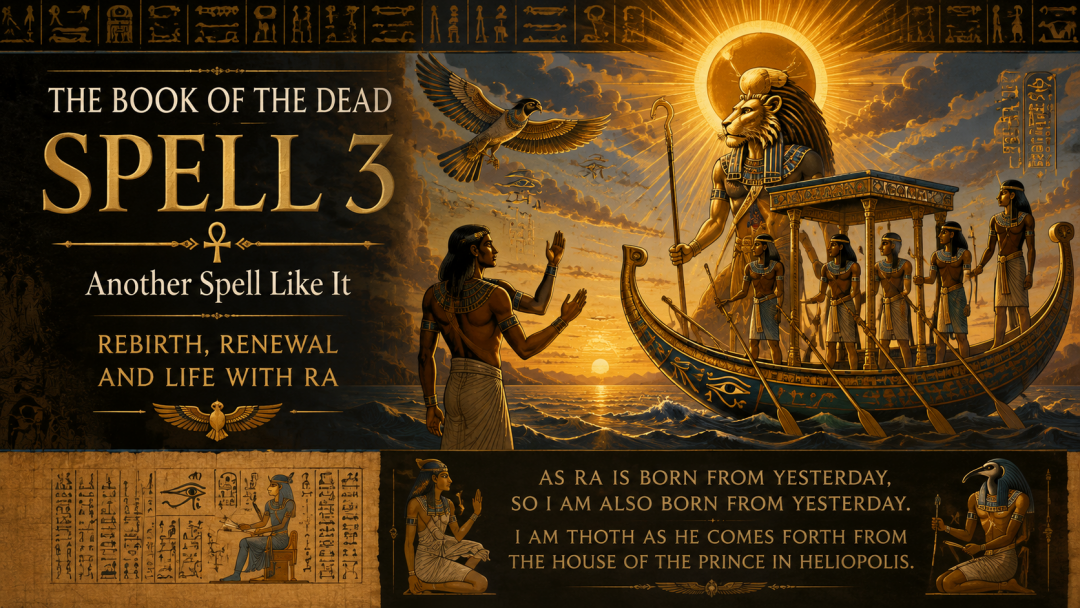
Ra was believed to travel through the sky in a solar boat. During the day, the vessel carried him across the visible heavens. At night, another phase of the voyage took him through the hidden world.
The solar boat was accompanied by gods and divine attendants who helped protect Ra and maintain his journey.
The crew could include:
- A helmsman or navigator
- Divine sailors
- Protective deities
- Gods who fought the serpent Apophis
- Beings who opened gates and pathways
- Attendants who assisted Ra’s nightly renewal
By calling upon the sailors, the deceased asks those responsible for Ra’s successful voyage to provide the same assistance to a human soul.
They know the route through darkness. They know how the sun survives the night. They are therefore ideal guides for someone who has entered death.
Why Does the Spell Take Place at Evening?
The sailors are addressed at “the gloaming of the day,” an older expression for twilight.
Evening was the critical moment when the sun approached the western horizon and entered the realm associated with death.
This moment carried an obvious danger. The visible sun disappeared, and darkness covered the world.
Yet the disappearance was temporary.
Every sunrise demonstrated that the sun had survived its hidden journey. Evening was therefore both an ending and the beginning of renewal.
Spell 3 places the deceased at this threshold.
The person has died, just as the sun appears to die at sunset. The spell asks that the deceased be carried safely through the darkness so that life may begin again.
“Let [Name] Live After Death, Like Ra Daily”
This line expresses the spell’s central purpose:
Let [Name] live after death, like Ra daily.
The comparison with Ra is important because the sun’s renewal was not a single event.
Ra was reborn every day.
The deceased therefore wanted more than one moment of resurrection. The goal was continuing, repeated, and dependable renewal.
Each solar cycle could renew the person again.
This created a vision of immortality based not on remaining unchanged forever, but on endlessly overcoming death.
The afterlife was dynamic. The deceased entered darkness, was restored, emerged into light, and repeated the cycle.
What Does “Born From Yesterday” Mean?
The helmsman announces:
As Ra is born from Yesterday, so [Name] is also born from Yesterday.
This is the most mysterious and important line in Spell 3.
“Yesterday” represents what has already passed. For the deceased, it includes mortal life, burial, and death itself.
Yet the spell does not treat yesterday as something completely lost. Yesterday becomes the source from which today is born.
Ra’s dawn follows his disappearance the previous evening. In the same way, the deceased’s new existence follows physical death.
The line can be understood as saying:
Just as today’s sun emerges from the previous day, my renewed life emerges from the life and death that came before it.
The person is not created as an entirely different being. The transformed spirit retains continuity with the individual who lived on earth.
Death divides the two conditions, but it does not erase identity.
Why Does the Helmsman Speak?
The surviving translation introduces one section with:
Here the helmsman.
This may indicate that the following words are spoken by the divine pilot or navigator of the solar boat.
The helmsman’s role was essential. He guided the vessel and kept it on the correct course.
In a funerary context, this figure represents safe passage.
The deceased has entered an unfamiliar and potentially dangerous realm. By having the helmsman declare the person’s rebirth, the text gives the statement authority from someone who understands the divine route.
The navigator does more than promise transportation. He confirms that the deceased participates in the same process that renews Ra.
“As Every God Rejoices in Life”
The spell continues:
Just as every god rejoices in life, so shall [Name] rejoice as they rejoice in life.
This moves the deceased beyond mere survival.
The goal is not simply to avoid destruction. The person wishes to experience life as the gods experience it.
The deceased asks for:
- Conscious existence
- Joy
- Participation in the divine community
- Freedom of movement
- Renewal
- Recognition among the gods
- The ability to act as a glorified spirit
Life in the afterworld was meant to be active and desirable.
The line also grants the deceased equality of experience. If the gods rejoice in life, the transformed person should be allowed to rejoice with them.
Why Does the Deceased Say, “I Am Thoth”?
The spell ends with the declaration:
I am Thoth as he comes forth from the House of the Prince in Heliopolis.
Statements beginning with “I am” occur throughout the Book of the Dead. They allow the deceased to assume the identity, authority, or powers of a god.
This did not necessarily mean that the deceased claimed to replace Thoth permanently.
Instead, the identification gave the speaker access to the qualities Thoth represented:
- Sacred knowledge
- Effective speech
- Writing
- Divine judgment
- Accurate calculation
- The regulation of time
- Mediation between opposing forces
- The restoration of order
Thoth was particularly important in funerary literature because knowledge and correct speech allowed the deceased to overcome obstacles.
By declaring “I am Thoth,” the deceased becomes someone who knows the correct words, understands divine order, and possesses the authority to emerge successfully.
What Is the House of the Prince?
The spell states that Thoth comes forth from the House of the Prince in Heliopolis.
Renouf’s commentary on Spell 1 identifies the House of the Prince as the name of a major sanctuary at Heliopolis.
Heliopolis was one of ancient Egypt’s most important religious centers and was closely associated with solar creation traditions.
The reference therefore brings several ideas together:
- Atum as creator
- Ra as the daily sun
- Thoth as divine speaker and mediator
- Heliopolis as a center of solar theology
- The deceased as a participant in creation and renewal
The deceased’s emergence mirrors a divine coming forth from a sacred center.
How Does Spell 3 Relate to Spell 2?
Spell 2 and Spell 3 share the same general goal, but they emphasize different parts of the process.
Spell 2
Spell 2 asks the deceased to be allowed to:
- Join the sun god’s company
- Emerge freely from confinement
- Become one of the glorified spirits
- Leave the Duat
- Move upon the earth among the living
Spell 3
Spell 3 explains renewed life through:
- Atum and solar creation
- The sailors of Ra
- The evening journey of the sun
- Birth from Yesterday
- Rejoicing in life with the gods
- Identification with Thoth
Spell 2 focuses on freedom to emerge. Spell 3 focuses on the divine process that makes renewed life possible.
Together, they express the hope that the deceased can leave the tomb because they have entered the same cycle of regeneration as the sun.
How Does Spell 3 Relate to the Coffin Texts?
Book of the Dead Spell 3 belongs to a much older tradition of Egyptian funerary literature.
Before Book of the Dead spells were commonly written on papyrus, funerary compositions appeared on the interior surfaces of Middle Kingdom coffins. These are now known collectively as the Coffin Texts.
The numbering systems must not be confused.
Book of the Dead Spell 3 and Coffin Text Spell 3 are not automatically the same composition simply because they share a modern number. The numbers were assigned by modern editors to separate collections.
However, the ideas expressed in Book of the Dead Spell 3 have deep roots in earlier funerary traditions:
- Solar resurrection
- Going forth from death
- Joining the gods
- Divine identification
- Traveling in sacred boats
- Renewed life
- The power of ritual speech
The Book of the Dead did not appear suddenly as an entirely new religious work. It inherited, adapted, and reorganized older Egyptian traditions.
Is Spell 3 Complete?
No complete and uniform version of Spell 3 is currently represented by the historical translation used here.
Renouf and Naville stated:
“The only ancient copy of this chapter is in the papyrus of Amen-neb, and here it is imperfect.”
They also compared parts of the spell with later texts and much older Pyramid Text passages, particularly in their discussion of the lion-faced deity.
This creates several limitations:
- Some original wording may be missing.
- Certain divine names remain uncertain.
- Later manuscripts may preserve altered versions.
- Modern translations may differ.
- Some symbolic references cannot be explained with certainty.
A responsible interpretation should therefore distinguish between what the text clearly says and what scholars infer from related traditions.
Did Spell 3 Have a Vignette?
The Renouf and Naville index does not list a standard vignette for Spell 3.
This is not unusual. Many Book of the Dead spells were transmitted primarily through their written words rather than through a fixed accompanying illustration.
Spell 3’s imagery is verbal:
- A radiant creator god
- Lion symbolism
- The solar boat
- Sailors at twilight
- A helmsman
- Ra’s rebirth
- Thoth emerging at Heliopolis
These elements could inspire a modern educational illustration, but such an image should be labeled as an artistic reconstruction rather than an original vignette from Spell 3.
The Religious Meaning of Spell 3
Spell 3 presents death as part of a cycle rather than a permanent ending.
The sun disappears every evening, yet it is not destroyed. It enters a hidden state and returns.
The deceased hopes for the same pattern:
- Mortal life ends.
- The person enters the hidden realm.
- Divine guides provide safe passage.
- The deceased is renewed with Ra.
- The transformed spirit emerges again.
- The person rejoices in life among the gods.
The spell’s optimism does not come from denying death. It comes from treating death as a stage within a larger process of transformation.
The Meaning of Spell 3 in Simple Terms
Book of the Dead Spell 3 asks that the deceased be renewed just as the sun is renewed every morning.
Atum stands at the boundary between daylight and darkness. The sailors of Ra know how to cross the hidden realm. The helmsman confirms that the deceased can be born again from yesterday. Thoth provides knowledge and authoritative speech.
The spell’s message can be summarized as:
The sun survived yesterday and was born again. I will also emerge from death, live with the gods, and rejoice in renewed life.
Spell 3 is therefore not only about leaving the tomb.
It is about becoming part of the divine rhythm of the universe.
Frequently Asked Questions About Book of the Dead Spell 3
What is Book of the Dead Spell 3?
Spell 3 is a short funerary composition that asks for the deceased to live after death through the same daily process of renewal experienced by Ra.
What is the title of Spell 3?
Its traditional title is Another Chapter Like It, referring to the similar purpose of Spell 2.
Who is Tmu?
Tmu is an older English spelling of Atum, the creator god of Heliopolis and a deity associated with the setting sun.
Who are the sailors of Ra?
They are the divine crew of the solar boat who assist Ra during his daily and nightly journey.
What does “born from Yesterday” mean?
It means that renewed life emerges from what has already passed. Just as today’s sunrise follows yesterday’s sunset, the deceased’s transformed existence follows physical death.
Why is the deceased compared with Ra?
Ra disappeared into the west each evening and returned at dawn. His daily rebirth provided a divine model for resurrection.
Why does the deceased identify with Thoth?
Identification with Thoth gives the deceased access to sacred knowledge, effective speech, divine judgment, and the power to maintain order.
Was Spell 3 found in the Papyrus of Ani?
The Renouf and Naville commentary identifies the Papyrus of Amen-neb as the only ancient copy available to its editors, and it states that this copy was incomplete. It does not identify the Papyrus of Ani as a witness for Spell 3.
Was there a standard illustration for Spell 3?
No standard vignette is listed in the Renouf and Naville edition.
Is Book of the Dead Spell 3 the same as Coffin Text Spell 3?
No. The Book of the Dead and Coffin Texts use separate numbering systems created by modern scholars. Spells with the same number are not necessarily the same composition.
Book of the Dead Spell 3 is brief, but it contains one of the clearest expressions of solar resurrection in Egyptian funerary literature.
The deceased approaches Atum, calls upon the sailors of Ra, and receives confirmation from the divine helmsman. Just as Ra is born from yesterday, the deceased will also be born from the past.
The final identification with Thoth gives the speaker knowledge, authority, and the power of sacred words.
Spell 3 transforms sunset into a promise.
The descent into darkness is real, but it is temporary. Beyond it lies rebirth, divine companionship, and joy in life.