Book of the Dead Spell 1: Translation, Meaning, and the Day of Burial
The ancient Egyptian Book of the Dead was not a single book with a fixed beginning, middle, and end. It was a collection of funerary spells chosen to help a deceased person survive death, enter the afterlife, and continue living as a transformed spirit.
Book of the Dead Spell 1 was closely associated with the funeral itself. Its title identifies it as a recitation for the day of burial, and surviving copies often place it beneath a detailed illustration of the funeral procession.
The spell allows the deceased to participate in the resurrection of Osiris, identify with powerful gods such as Horus and Thoth, enter the House of Osiris, receive food and drink, and travel freely without being rejected or turned back.
In simple terms, Spell 1 begins the deceased person’s transition from someone who has died into someone who can live, speak, move, and exercise power in the afterlife.
What Is Book of the Dead Spell 1?
Spell 1 is commonly described as a spell for going forth by day or a recitation for the day of burial.
Its longer title can be translated approximately as:
The beginning of the spells of going forth by day, of the words that bring about resurrection and transfiguration, and of entering and leaving the West. To be spoken on the day of burial.
The “West” refers to the realm of the dead. Because the sun set in the west, ancient Egyptians associated the western horizon with death, burial, and the entrance to the afterlife.
Spell 1 regularly appeared near the beginning of New Kingdom and later copies of the Book of the Dead. It was not always literally the first spell, however. In the Papyrus of Nu, dating to approximately 1400 BCE, it appears after Spells 17 and 18. Much of its composition has an earlier predecessor in Coffin Text Spell 314.
This is important because the numbered Coffin Text Spell 1 is a different composition. Book of the Dead Spell 1 should not be confused with the spell numbered 1 in modern editions of the Coffin Texts.
What Was the Purpose of Spell 1?
Spell 1 had several connected purposes.
It associated the deceased with the gods who defended and restored Osiris. It presented the deceased as someone who had participated in sacred festivals and rituals. It asked the blessed dead to welcome the deceased into the House of Osiris. Finally, it declared that no wrongdoing had been found and that the deceased should be permitted to enter and leave freely.
The spell was therefore more than a prayer for protection. It was a declaration of identity, ritual knowledge, innocence, and belonging.
Recent scholarship describes the text as a self-presentation spoken by the deceased in a mythological identity. The speaker does not remain an ordinary human being. The deceased becomes a participant in the divine events that restored Osiris and established order after his death.
A Translation of Book of the Dead Spell 1
The following is a reader-friendly English rendering based primarily on the version preserved in the Papyrus of Hunefer, as translated by Peter Le Page Renouf and Édouard Naville. It has been modernized and compared with the version from the Papyrus of Nu published by UCL Digital Egypt.
Different manuscripts contain variations in wording, divine names, place-names, and individual passages. The deceased person’s name would replace the word [Name].
The Title of the Spell
The beginning of the spells of going forth by day, of the words that bring about resurrection and transfiguration, and of entering and leaving the West.
To be spoken on the day of the burial of [Name], the justified, who enters after coming forth.
The Deceased Speaks
O Bull of the West, Thoth, king of eternity, is here.
I am the great god beside the sacred bark. I have fought for you.
I am one of the gods of the divine council who cause Osiris to be vindicated against his enemies on the day when judgment is pronounced. I belong to your company, Osiris.
I am one of the children of Nut who strike down the enemies of Osiris and restrain those who rebel against him. I belong to your company, Osiris.
I have fought for you, and I have caused your name to prevail.
I am Thoth, who vindicates Osiris against his enemies on the day of judgment in the Great House of the Prince at Heliopolis.
I am the one of Djedu who is in Djedu.
I am with the mourners who lament Osiris and who cause Osiris to triumph over his enemies.
Ra commanded Thoth to vindicate Osiris against his enemies, and Thoth has fulfilled the command.
I am with Horus on the day when the dismembered god is wrapped, when the caverns are opened, when the weary-hearted god is refreshed, and when the entrance to the secret places of Rosetau is closed.
I am with Horus as the avenger of the left arm of Osiris that is in Khem.
I enter and I emerge from the Lake of Flame on the day when the rebels are destroyed in Khem.
I am with Horus on the day when the festivals of Osiris are celebrated and offerings are presented to Ra during the festivals at Heliopolis.
I am the pure priest in Djedu, raising the one who is upon the mound.
I am the servant of the god at Abydos on the day when the earth is raised.
I am the one who sees the secret things in Rosetau.
I am the one who recites the festival book of the Soul who is Lord of Djedet.
I am the sem-priest performing his sacred duties.
I am the Chief Director of Craftsmen on the day when the Henu-bark of Sokar is placed upon its sledge.
I am the one who takes up the hoe on the day when the earth is broken at Heracleopolis.
The Appeal to the Blessed Dead
O you who bring the effective spirits into the House of Osiris, bring the soul of [Name] with you into the House of Osiris.
Let him hear as you hear.
Let him see as you see.
Let him stand as you stand.
Let him sit as you sit.
O you who give bread and beer to the effective spirits in the House of Osiris, give bread and beer at the appointed times to the soul of [Name], who is with you.
O you who open the ways and clear the roads for the effective spirits in the House of Osiris, open the ways and clear the roads for the soul of [Name], who is with you.
Let him enter boldly and emerge in peace from the House of Osiris.
Let him not be obstructed.
Let him not be driven back.
Let him enter praised and emerge beloved, justified and triumphant.
Let his commands be carried out in the House of Osiris.
I have come here, and no fault has been found in me.
The scales have been cleared of my case.
This rendering follows the surviving structure of Spell 1 while making its repeated declarations easier for a modern reader to understand.
What Does Spell 1 Mean?
At first glance, Spell 1 can appear to be a confusing list of gods, ceremonies, festivals, and sacred places. Its meaning becomes clearer when the spell is divided into several major ideas.
The Deceased Becomes Part of the Story of Osiris
Osiris was murdered, dismembered, mourned, restored, and declared victorious over his enemies. His resurrection became the central model for the deceased person’s own survival after death.
In Spell 1, the deceased does not merely ask Osiris for assistance. The speaker claims to have fought beside the gods who defended him:
I have fought for you.
By joining the divine struggle, the deceased becomes part of the events that led to the restoration of Osiris. The implication is clear: because Osiris overcame death, the deceased can overcome it as well.
The identification with Osiris was not a claim that the person had literally been Osiris during life. It was a ritual transformation. In death, the deceased entered the same sacred pattern of death, restoration, vindication, and renewed existence.
The Deceased Takes on the Roles of Horus and Thoth
Horus was the son and avenger of Osiris. He defended his father, fought against his enemies, and helped establish Osiris as ruler of the dead.
Thoth was the divine scribe, master of sacred speech, and an important figure in divine judgment. He represented the power of correct words, knowledge, and authoritative declarations.
Spell 1 identifies the deceased with both gods. As Horus, the speaker fights for Osiris. As Thoth, the speaker causes Osiris to be vindicated.
This identification gives the deceased two forms of power:
- The active power of Horus to defeat opposition
- The verbal and judicial power of Thoth to establish truth
The deceased therefore enters the afterlife not as a helpless victim but as someone protected by divine authority.
The Priesthood Passages Give the Deceased Ritual Authority
The middle portion of the spell contains a series of statements such as:
I am the pure priest.
I am the sem-priest.
I am the Chief Director of Craftsmen.
These statements should not necessarily be read as a list of jobs the deceased held while alive. They place the speaker into the roles of priests who performed ceremonies associated with Osiris, Sokar, Ptah, and the burial ritual.
The deceased claims knowledge of the correct ceremonies and the authority to participate in them. By naming sacred festivals and priestly offices, the speaker demonstrates familiarity with the ritual world of the gods.
Spell 1 treats sacred knowledge as a form of power. The person who knows the ceremonies, names, places, and divine events cannot easily be excluded from the afterlife.
Entering the House of Osiris Restores the Person
The final section asks the effective spirits to bring the deceased into the House of Osiris.
The deceased asks to:
- Hear as they hear
- See as they see
- Stand as they stand
- Sit as they sit
- Receive bread and beer
- Enter and leave without obstruction
These requests reflect the fear that death could rob a person of movement, awareness, nourishment, and social identity.
The spell reverses that loss. The deceased will not remain silent, blind, motionless, hungry, or isolated. The person will be restored as an active being who can interact with gods and other blessed spirits.
Bread and beer were especially important because they represented continued nourishment. Food offerings placed in the tomb or presented through funerary rituals could sustain the deceased through their spiritual essence.
The Roads of the Afterlife Must Be Opened
Movement is one of the most important themes in the Book of the Dead.
The deceased repeatedly asks for doors, gates, roads, and paths to be opened. Being trapped, blocked, or turned back was a form of spiritual danger.
Spell 1 asks the blessed dead to clear the roads so the deceased may:
Enter boldly and emerge in peace.
This is one of the central meanings of “going forth by day.” The deceased wished to possess freedom of movement rather than remain permanently confined inside the tomb.
The person could enter the divine realm, leave it, revisit the world of the living, receive offerings, and participate in the daily renewal associated with the rising sun.
The Final Lines Declare the Deceased Vindicated
Spell 1 ends by declaring that no fault has been found in the speaker and that the scales are free of the case.
This anticipates the judgment imagery found elsewhere in the Book of the Dead, especially the famous Weighing of the Heart in Spell 125.
The deceased is not asking to avoid judgment entirely. Instead, the speaker claims to have successfully passed the examination and to possess the status needed to enter the House of Osiris.
Words translated as justified, vindicated, true of voice, or triumphant come from the Egyptian expression maa-kheru. The term indicated that a person’s claim had been confirmed as true and that opposition had been defeated.
Why Is Spell 1 Connected to a Funeral Procession?
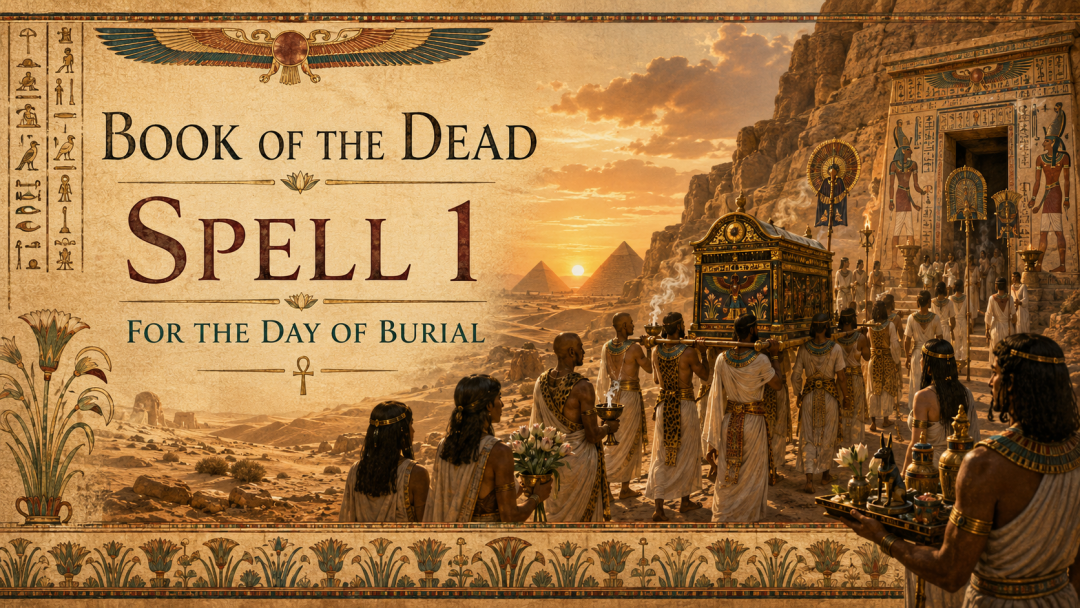
From the Ramesside Period onward, Spell 1 was frequently placed beneath a large vignette showing the funeral procession and rites performed at the tomb. The illustration could include mourners, priests, offering bearers, cattle, funerary equipment, and the coffin being transported toward the burial place.
The Papyrus of Ani contains one of the best-known examples. Its vignette shows Ani’s funeral procession approaching the tomb. The coffin is carried on a large boat-shaped bier, linking the deceased’s journey with the sacred boats used by the gods and with the solar god’s voyage across the sky. At the tomb, the mummy would be placed upright while priests performed the final rites and grieving women made their farewells.
The plates in the Renouf and Naville edition you uploaded show several versions of this imagery. Oxen pull the shrine-like bier, mourners accompany the procession, offerings are carried forward, and the mummy is shown upright near the tomb while priests perform ceremonies.
The image and the spell describe two sides of the same transition.
The vignette shows what is happening to the body in the visible world. The text describes what is happening to the deceased’s spiritual identity in the invisible world.
Why Is It Called a Spell for “Going Forth by Day”?
The modern title Book of the Dead was created by Egyptologists. Ancient Egyptian manuscripts commonly used the expression prt m hrw, conventionally translated as Going Forth by Day or Coming Forth by Day.
The phrase refers to the deceased’s ability to emerge from the darkness of death and participate in renewed life.
“Going forth” could include:
- Leaving the tomb
- Entering the realm of Osiris
- Joining the solar god’s cycle
- Visiting the world of the living
- Receiving offerings
- Assuming different spiritual forms
- Traveling freely through the afterlife
The goal was not simply to escape the underworld. The deceased needed the power to enter and leave different realms at will.
That freedom appears clearly in Spell 1 when the speaker asks to enter boldly, emerge peacefully, and never be blocked or turned back.
Important Places Mentioned in Spell 1
Several sacred locations appear in the spell because they were connected with Osiris, his body, his festivals, or his resurrection.
Djedu
Djedu, known to the Greeks as Busiris, was an important cult center of Osiris in the Nile Delta. Its name was associated with the djed pillar, a symbol of stability and the restored backbone of Osiris.
Abydos
Abydos was one of the most important centers of Osiris worship. Egyptians believed it was closely connected with the burial of Osiris, and many people wished to participate symbolically in the festivals held there.
Heliopolis
Heliopolis was the great center of solar theology. Its appearance in Spell 1 connects the resurrection of Osiris with Ra, Thoth, divine judgment, and the daily rebirth of the sun.
Rosetau
Rosetau was associated with the necropolis and the hidden passages of the realm of the dead. It could refer to the Memphite burial region and, more broadly, to the mysterious domain through which the deceased traveled.
Heracleopolis
Heracleopolis appears in connection with the ritual breaking or hoeing of the earth. Such agricultural imagery symbolized regeneration, just as seeds placed beneath the soil could rise again as living plants.
What Is Spell 1B?
Some lists place a separate composition immediately after Spell 1 and call it Spell 1B.
Spell 1B is another recitation associated with the day of burial. Its title concerns introducing the deceased into the Duat or Netherworld on the day of interment.
It is not simply a longer version of Spell 1. It is a separate and much more poorly preserved composition.
Renouf and Naville noted that Spell 1B survived in very few copies and that the known versions differed substantially. The surviving text includes protection against dangerous creatures in Rosetau and declarations identifying the deceased with Horus and Ra.
For your series, Spell 1B would work best as its own article rather than as part of the main Spell 1 post.
Frequently Asked Questions About Book of the Dead Spell 1
What was the purpose of Spell 1?
Spell 1 helped the deceased complete the transition from burial to afterlife. It associated the deceased with Osiris, Horus, and Thoth; opened the roads of the afterlife; restored the person’s senses and movement; secured food and drink; and declared the deceased justified.
Was Spell 1 read during the funeral?
Its title states that it was to be spoken on the day of burial. The exact use may have varied between periods and manuscripts, but its close association with funeral procession scenes strongly connects it with the burial ceremonies.
Who is speaking in Spell 1?
The deceased is the speaker. During the spell, however, the deceased assumes the identities and roles of gods and priests, especially Horus and Thoth.
Why does the deceased say, “I am Thoth”?
The declaration gives the deceased access to Thoth’s authority as divine scribe, master of sacred knowledge, and defender of truth. Through Thoth, the deceased can claim vindication and overcome hostile accusations.
What does the House of Osiris represent?
It represents the divine community and realm ruled by Osiris. Admission meant that the deceased had been accepted among the blessed dead and could receive nourishment, protection, and renewed life.
Is Spell 1 the first surviving Egyptian funerary spell?
No. Egyptian funerary literature existed long before the Book of the Dead. Much of Spell 1 has an earlier parallel in Coffin Text Spell 314, while other Book of the Dead compositions developed from the Pyramid Texts and Coffin Texts.
The Meaning of Spell 1 in Simple Terms
Book of the Dead Spell 1 transforms the funeral from an ending into a beginning.
The body is carried to the tomb, but the deceased declares that they can still hear, see, stand, travel, receive food, speak with authority, and join the gods.
The deceased becomes a companion of Osiris, an avenger like Horus, and a speaker of truth like Thoth. Roads are opened, enemies are defeated, nourishment is provided, and judgment ends in vindication.
Spell 1 therefore introduces one of the most important promises of the Book of the Dead:
Death does not have to mean silence, helplessness, or confinement. Through ritual knowledge and divine identification, the deceased can go forth once again.