The Opet Festival: Ancient Egypt’s Greatest Religious Celebration
The Opet Festival was one of the most important and spectacular religious festivals in ancient Egypt. Held annually in Thebes, modern-day Luxor, this grand celebration honored the gods, renewed the pharaoh’s power, and strengthened the sacred bond between Egypt’s ruler and the divine.
For the ancient Egyptians, the Opet Festival was far more than a public holiday. It was a powerful religious event believed to renew kingship, restore divine energy, and help maintain Ma’at, the cosmic order that kept the world in balance.
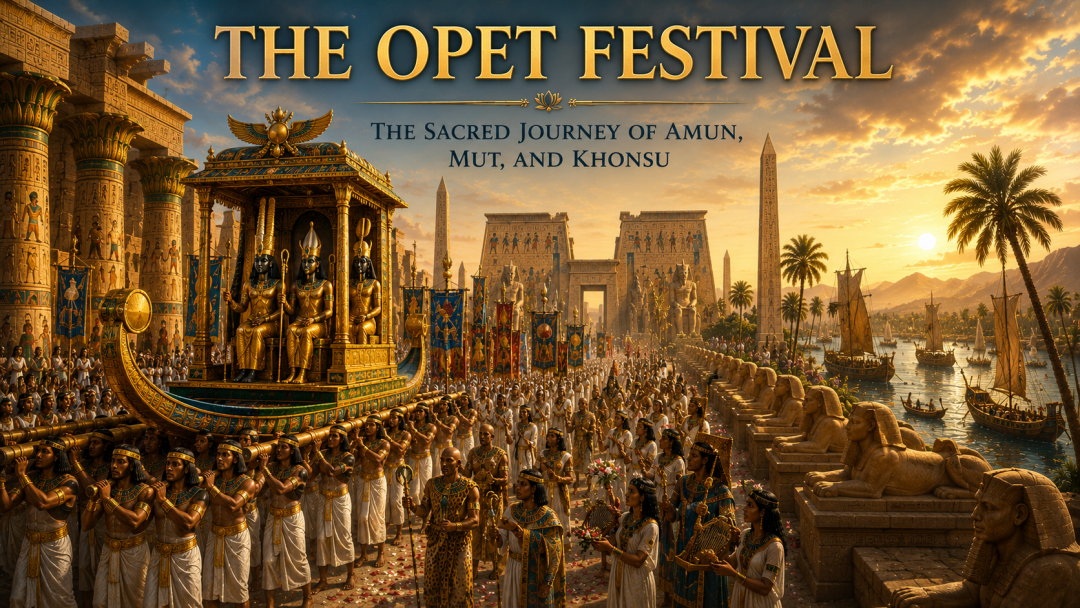
The festival centered on the Theban Triad: Amun, Mut, and Khonsu. During the celebration, the sacred statues of these gods were taken from their shrines at Karnak Temple and carried in a magnificent procession to Luxor Temple. There, rituals were performed inside the temple, away from public view.
Over time, the Opet Festival became one of the greatest celebrations in Egypt. It remained an important religious event for more than 1,500 years and played a central role in the religious life of Thebes.
The Opet Festival was celebrated annually in the second month of Akhet (the season of the Nile’s flooding), which corresponds to roughly late August to early September in our modern calendar.
The timing was deeply tied to the agricultural and spiritual cycles of ancient Egypt. The festival traditionally began around the 15th to 19th day of the second month of Akhet.
Origins of the Opet Festival
The exact origins of the Opet Festival are uncertain, but many scholars believe that it may have begun during the Middle Kingdom, around 2055 to 1650 BCE.
The earliest clearly preserved evidence of the festival comes from the reign of Queen Hatshepsut, who ruled during the Eighteenth Dynasty from around 1479 to 1458 BCE. Scenes of the festival were carved on her Red Chapel at Karnak, where Amun’s sacred barque was kept during important religious ceremonies.
The festival grew in importance during the New Kingdom, especially under powerful rulers such as Amenhotep III and Ramesses II. These pharaohs expanded the temples of Thebes and emphasized the connection between the king and the god Amun.
By the time of Ramesses III, the festival had become a major state celebration lasting several weeks. In later periods, it could last as long as twenty-seven days.
What Does “Opet” Mean?
The name Opet comes from the ancient Egyptian word Ipet, which is often translated as “sanctuary” or “harem.” The name is closely connected to Luxor Temple, which was known in ancient Egyptian as Ipet Resyt, meaning “The Southern Sanctuary.”
This name is important because Luxor Temple was the destination of the Opet procession. It was not simply another temple. It was a sacred place where the pharaoh’s divine authority was renewed through rituals linked to Amun and kingship.
The Theban Triad: Amun, Mut, and Khonsu
At the heart of the Opet Festival was the Theban Triad.
Amun was the chief god of Thebes and one of the most powerful deities in ancient Egypt. During the New Kingdom, he became closely associated with kingship and royal power.
Mut was Amun’s divine consort. Her name means “mother,” and she was often connected with queenship, protection, and divine motherhood.
Khonsu was their son, a moon god associated with time, healing, and protection.
Together, Amun, Mut, and Khonsu formed the sacred family of Thebes. During the Opet Festival, their divine statues left Karnak Temple and traveled together to Luxor Temple, allowing the people of Thebes to witness the gods outside their hidden sanctuaries.
The Procession of the Gods
The most famous part of the Opet Festival was the grand procession between Karnak Temple and Luxor Temple.
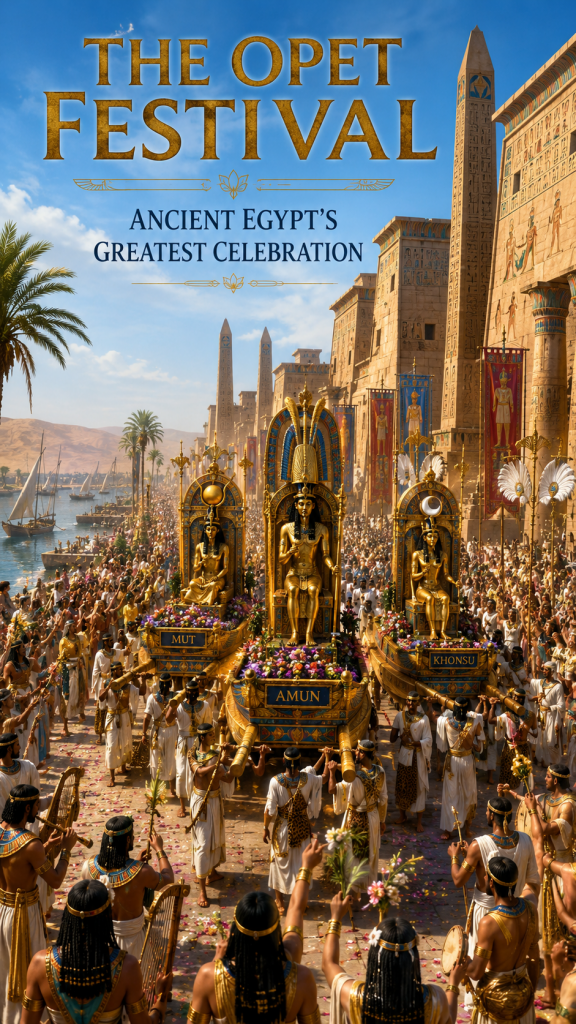
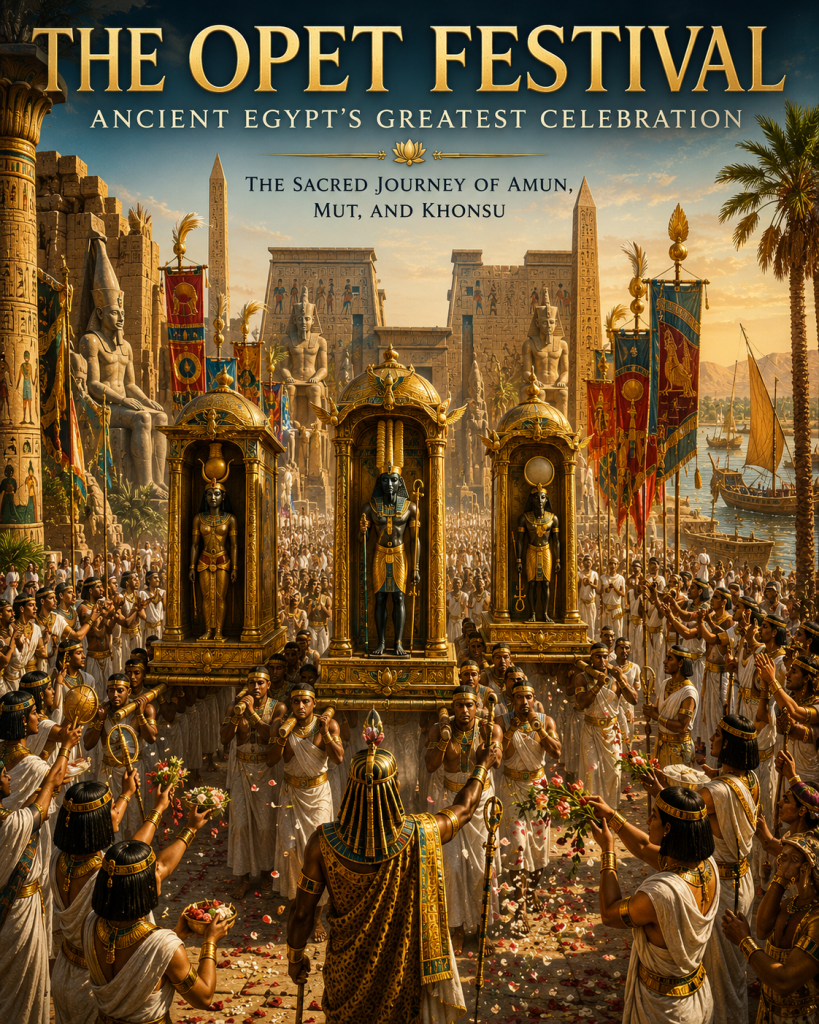
At the beginning of the celebration, priests entered the sanctuaries of Karnak and brought out the sacred statues of Amun, Mut, and Khonsu. These statues were not viewed as simple images. To the Egyptians, they were living vessels through which the gods could be present on earth.
The statues were placed inside richly decorated portable shrines mounted on sacred barques. These ceremonial boats could be carried on priests’ shoulders or placed on larger vessels for travel along the Nile.
In some periods, the procession moved by land along the ceremonial road between Karnak and Luxor. At other times, the divine barques traveled by river.
The procession must have been a breathtaking sight. Priests carried the sacred shrines, musicians played, singers performed, dancers celebrated, and crowds gathered along the route. For ordinary Egyptians, this was one of the rare moments when they could come close to the gods and receive their blessings.
The Avenue of Sphinxes
One of the most impressive features of the Opet Festival was the processional route between the Karnak and Luxor Temples.
Today, this route is known as the Avenue of Sphinxes. It stretched for nearly three kilometers, or about 1.7 miles, and was lined with hundreds of sphinx statues.
These sphinxes created a sacred pathway for the gods as they traveled between the two temples. The road helped transform the journey into a formal religious procession, turning the city itself into part of the temple landscape.
Modern restoration work has uncovered much of this ancient route, allowing visitors to imagine the path once taken by priests, pharaohs, musicians, and sacred barques during the Opet Festival.
The Role of the Pharaoh
The Opet Festival was deeply connected to kingship.
Ancient Egyptians believed that the pharaoh ruled because he had been chosen by the gods. However, this divine authority needed to be renewed. The Opet Festival provided a sacred setting for that renewal.
During the festival, the king participated in rituals inside Luxor Temple that reaffirmed his relationship with Amun. These ceremonies likely emphasized the pharaoh as the living son of Amun and the rightful ruler of Egypt.
Many scholars believe that the rituals symbolically reenacted the king’s divine birth. This helped renew the pharaoh’s ka, or spiritual life force, and strengthened his ability to rule.
By renewing the king’s power, the festival also renewed Egypt’s strength. A powerful pharaoh meant a stable kingdom, fertile land, and continued protection from the gods.
Rituals Hidden from Public View
Although the procession was visible to the public, the most important rituals of the Opet Festival took place inside Luxor Temple.
Once the sacred statues arrived, they were taken into the temple’s inner chambers. These areas were highly restricted. Only the king and selected priests were permitted to enter.
Inside the temple, offerings, prayers, and sacred rites were performed before the gods. The exact details of these rituals are not fully known, but they appear to have focused on the renewal of divine power and royal authority.
The ceremonies likely included the renewal of kingship, the rejuvenation of Amun, the reaffirmation of Ma’at, and prayers for Egypt’s prosperity.
To the ancient Egyptians, these hidden rituals were essential. They maintained the relationship between the gods, the pharaoh, and the land of Egypt.
A Festival for the People
Although the Opet Festival had deep religious and political meaning, it was also a major public celebration.
The streets of Thebes filled with music, dancing, singing, feasting, offerings, and crowds of worshippers. Ordinary Egyptians may not have been allowed inside the most sacred parts of the temple, but they could still take part in the public celebration.
Food and drink were distributed during major festivals, allowing the people to join in the joy of the occasion. The festival gave them a rare chance to see the sacred images of the gods as they traveled outside their temple sanctuaries.
For many Egyptians, the Opet Festival would have been one of the most exciting events of the year. It combined devotion, celebration, royal ceremony, and public spectacle on a massive scale.
Evidence from Ancient Monuments
Archaeologists and historians know about the Opet Festival from temple reliefs, inscriptions, and monuments.
Important evidence survives at several major sites, including Karnak Temple, Luxor Temple, Hatshepsut’s Red Chapel, and the Temple of Ramesses III at Medinet Habu.
These scenes show priests carrying sacred barques, musicians performing, dancers celebrating, and pharaohs taking part in religious rituals.
Together, these images provide valuable insight into how the festival was performed and how important it was to ancient Egyptian religious life.
How Long Did the Opet Festival Last?
The length of the Opet Festival changed over time.
During the reign of Thutmose III, it appears to have lasted around eleven days. By the time of Ramesses III, it had grown to twenty-four days. Later, it could last as long as twenty-seven days.
This expansion shows how important the festival became, especially during the New Kingdom and later periods. What may have begun as a shorter religious procession developed into one of Egypt’s greatest annual celebrations.
The Legacy of the Opet Festival
The Opet Festival remained one of ancient Egypt’s most important religious events for centuries.
It brought together the gods, the king, the priests, and the people of Thebes in a celebration of divine power and royal renewal. It also showed how closely religion and politics were connected in ancient Egypt.
For the ancient Egyptians, the festival helped preserve Ma’at, renew the pharaoh’s strength, and ensure the continued prosperity of the land.
Today, the temples of Karnak and Luxor still stand as reminders of this magnificent celebration. The Avenue of Sphinxes, the temple reliefs, and the sacred spaces of Thebes continue to preserve the memory of a festival that once filled the city with music, ritual, and devotion.
The Opet Festival was not just a celebration. It was a sacred renewal of Egypt itself.
