Book of the Dead Spell 5: Translation, Meaning, and Freedom From Work in the Afterlife
The ancient Egyptian Book of the Dead was a collection of funerary spells intended to help the deceased awaken, move freely, overcome supernatural dangers, and attain an enduring existence among the gods.
Book of the Dead Spell 5 addresses a surprisingly practical concern:
Would the deceased be forced to work in the afterlife?
Its traditional title is commonly translated as:
A spell for preventing a person from having to do work in the underworld.
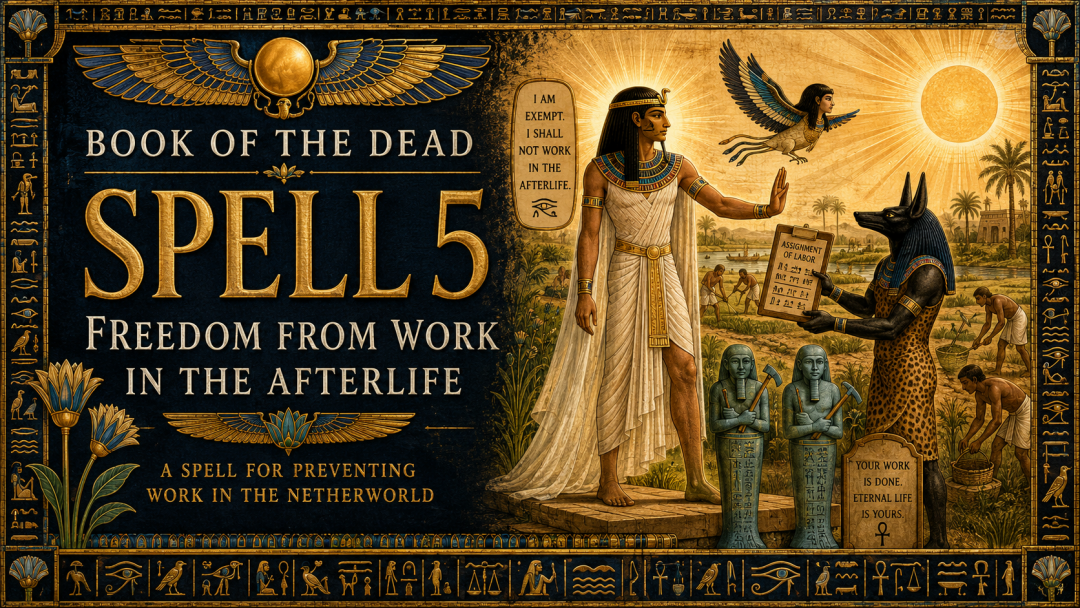
Spell 5 was meant to protect the deceased from compulsory labor. It presents the speaker as a living and active soul who belongs among divine beings rather than among laborers who could be ordered to perform agricultural or construction work.
Although the composition is short, its surviving text is difficult. Ancient copies differ, portions appear corrupt, and even Egyptian scribes may no longer have fully understood some of its wording. For that reason, Spell 5 must be explained carefully rather than treated as a perfectly preserved statement about avoiding work.
What Is Book of the Dead Spell 5?
Book of the Dead Spell 5 is a funerary formula intended to prevent work from being imposed upon the deceased in the realm of the dead.
The version published by Peter Le Page Renouf and Édouard Naville bears the title:
Chapter whereby work may not be imposed upon a person in the Netherworld.
UCL Digital Egypt gives a similar modern title:
Formula for preventing a man from having to do work in the underworld.
The spell belongs to an older funerary tradition. UCL identifies an earlier version among the Coffin Texts, where it is numbered Coffin Text Spell 431. A damaged version also survives on a later papyrus in the collection of the Hannover Kestner Museum. (ucl.ac.uk)
This earlier history is important. Spell 5 was not invented when the Book of the Dead began appearing on papyrus. It developed from ideas already found in the funerary texts written inside Middle Kingdom coffins.
The Title of Book of the Dead Spell 5
The spell’s title clearly states its desired result:
For not doing work in the necropolis
or, in another translation:
A spell by which work may not be imposed upon a person in the Netherworld
The “necropolis” and “Netherworld” translations refer to the realm occupied by the deceased. The Egyptian title does not mean that the person hoped to avoid every possible activity. Rather, it protects against being assigned labor by another authority.
This distinction matters.
Ancient Egyptian visions of the afterlife included farming, harvesting, irrigation, and other activities resembling life along the Nile. The deceased might willingly cultivate personal fields or enjoy the abundance produced there. Spell 5 addresses the fear of being compelled to work as a servant or laborer.
English Translation of Book of the Dead Spell 5
Spell 5 survives in different and sometimes damaged forms. Two translations are especially useful because they show how uncertain the text is.
A Short Translation From an Earlier Version
UCL Digital Egypt provides the following translation from a damaged version related to Coffin Text Spell 431:
For not doing work in the necropolis.
I am the searcher for the weary one, emerging from Wenu,
who lives on the entrails of the baboons.
The transliteration supplied by UCL is:
tm irt kAt m Xrt-nTr
ink aaf wrd pr m wnw
anx m bskw ianw
This version is very brief and preserves imagery that remains difficult to interpret with certainty.
The Renouf and Naville Translation
Renouf and Naville translated a version based mainly on the Papyrus of Nebseni:
Here is [Name]. He says:
I am he who raises the hand that is motionless,
and I come forth at the appointed hour.I am the living Soul,
and before me go the desires
of those who bring salutation.
A smoother modern rendering would be:
The deceased speaks:
I am the one who raises the motionless hand.
I emerge at the proper time.I am the living ba.
The wishes of those who greet the rising sun
go before me.
The word [Name] replaces the name of the deceased, which would have been inserted into the manuscript.
Renouf and Naville cautioned that the spell’s text was “extremely corrupt.” They based their translation principally on an older copy in the Papyrus of Nebseni because later versions differed considerably and contained apparent word transpositions.
Why Are There Different Translations of Spell 5?
The two translations look so different that they may initially appear to be unrelated.
One version speaks of:
- Searching for a weary being
- Emerging from Wenu
- Living on the entrails of baboons
The other speaks of:
- Raising a motionless hand
- Emerging at the proper hour
- Becoming a living soul
- Being preceded by those who salute the sun
These differences reflect the poor condition and complicated transmission of the composition.
Renouf and Naville reported that Spell 5 appeared in several important manuscripts, but that its wording had become so corrupt that portions were probably unintelligible even to later Egyptian copyists. The Turin version differed substantially from earlier copies, and words were apparently moved into new positions by scribes who no longer understood the passage.
For this reason, there is no single English version that can be presented as a completely certain translation of every line. The title and overall function are much clearer than the surviving body of the spell.
What Does Book of the Dead Spell 5 Mean?
At its most basic level, Spell 5 declares that the deceased is a living, divinely empowered being who cannot be reduced to the status of a laborer. The speaker is no longer a helpless corpse. The deceased can:
- Raise what had become motionless
- Emerge at the correct moment
- Live as a transformed soul
- Join beings associated with the rising sun
- Resist the imposition of unwanted work
The spell does not explain who might order the deceased to work or how such assignments would be issued. Its title supplies the context: the declarations within the text magically establish a status that exempts the speaker from compulsory service.
Its meaning can be summarized as:
I am alive, mobile, and joined with divine powers. I am not subject to forced labor in the realm of the dead.
Why Did Ancient Egyptians Fear Working in the Afterlife?
Agricultural labor was essential to ancient Egyptian life. The annual cycle of farming required people to:
- Plow and plant fields
- Maintain irrigation channels
- Move earth and sand
- Water crops
- Harvest grain
- Carry produce
- Repair embankments
State authorities could also require people to provide labor for royal, temple, agricultural, and construction projects.
It is therefore understandable that compulsory work might appear among the concerns carried into the afterlife. Eternal life would not be ideal if the deceased could be summoned endlessly to perform exhausting labor for someone else.
Spell 5 attempts to prevent that possibility.
It does not reject agriculture itself. Other funerary texts describe the deceased possessing fields, harvesting grain, and enjoying abundance. The objection is to work being imposed rather than freely chosen or performed for personal benefit.
Spell 5 and Spell 6
Book of the Dead Spells 5 and 6 are closely related, but they solve the problem of afterlife labor in different ways.
Spell 5 Prevents the Assignment
Spell 5 protects the deceased from having labor imposed upon them.
Its solution is direct:
The deceased must not be assigned the work.
Spell 6 Provides a Substitute Worker
Spell 6 addresses a funerary statuette called a shabti or ushabti. If the deceased is summoned to cultivate fields, irrigate land, or move sand, the figure is instructed to answer in the owner’s place.
The shabti declares:
Here I am.
Spell 6 therefore assumes that a summons to work might still occur. Instead of refusing the assignment, the deceased sends a magical substitute.
Renouf and Naville’s arrangement places Spell 5 immediately before the shabti formula of Spell 6. Their index gives Spell 5 as the chapter preventing work and Spell 6 as the chapter enabling funerary statuettes to work for the deceased.
Together, the two spells offered layered protection:
- Do not assign the deceased any labor.
- Should labor nevertheless be assigned, let the shabti perform it.
What Was a Shabti?
A shabti was a small funerary figure placed in a tomb.
Many shabtis were shaped like mummified people holding agricultural tools. Some carried baskets or were accompanied by overseer figures. Their purpose was to act as substitute workers for the deceased.
Spell 6 could be written directly on the figure. When the deceased was called to work, the shabti was magically expected to respond and perform the task.
Spell 5 does not mention shabtis in its surviving text, but its position beside Spell 6 connects it with the same concern about labor obligations.
A person who possessed both spells was protected through refusal and substitution.
“I Raise the Hand That Is Motionless”
The Renouf translation begins:
I am he who raises the hand which is motionless.
Physical death caused the body to become still. A motionless hand represented the deceased’s inability to act.
Raising the hand reverses that condition.
The line may symbolize:
- Awakening from death
- Recovering movement
- Exercising personal power
- Making a gesture of authority
- Emerging from the body’s stillness
The deceased is not presenting themselves as someone available for labor. Instead, the speaker demonstrates mastery over the condition of death.
The hand moves because the person has regained life and agency.
“I Come Forth at the Hour”
The speaker next says:
I come forth at the hour.
The “hour” may refer to the correct or divinely appointed time for emergence.
Egyptian funerary religion frequently connected resurrection with celestial cycles. The sun disappeared in the west, traveled through the hidden realm, and reappeared at dawn. The deceased hoped to emerge according to this same ordered rhythm.
Renouf and Naville noted uncertainty in the surviving reading of this phrase, so a detailed interpretation cannot be considered definitive.
The general image, however, is clear. The deceased possesses the ability to emerge at the proper moment rather than remain trapped, delayed, or controlled by another being.
“I Am the Living Soul”
The most important declaration in the Renouf version may be:
I am the living Soul.
The word translated as “Soul” refers to the Egyptian ba.
The ba was one component of a person’s identity. It was often represented as a bird with a human head and could travel between the tomb, the world of the living, and the divine realm.
A living ba was:
- Conscious
- Mobile
- Capable of action
- Able to leave and return
- Connected with the preserved body
- Able to join divine beings
Renouf and Naville interpreted the “living Soul” in this passage as the soul of the sun, whether understood as Ra or Osiris. The deceased therefore appears to identify with a divine source of continuing life.
This identification raises the speaker above ordinary labor obligations.
The deceased is not merely a dead human who can be commanded by an underworld official. The speaker has become a living divine ba participating in cosmic renewal.
What Does It Mean to Identify With the Sun?
Throughout the Book of the Dead, the deceased assumes the identities or powers of gods.
These declarations do not necessarily mean the person believed they had permanently replaced a deity. Rather, identification allowed the deceased to claim divine qualities.
By becoming associated with the living soul of the sun, the deceased gains:
- Daily renewal
- Freedom of movement
- Light
- Divine recognition
- Protection from stillness
- Authority to emerge from darkness
The sun god crossed the heavens freely and could not be assigned ordinary human labor.
Spell 5 appears to use this elevated solar status to protect the deceased from compulsory work.
Who Are “Those Who Bring Salutation”?
The final part of the Renouf translation refers to beings who bring salutation.
Renouf and Naville connected them with baboon-shaped beings shown greeting or praising the rising sun. The baboons appearing in funerary and solar imagery were not meant as ordinary animals. They could represent the Spirits of the East, divine beings who helped open the eastern horizon and welcomed Ra at sunrise.
Baboons were associated with sunrise partly because their loud morning calls resembled ritual cries of praise.
In Egyptian art, baboons may appear:
- Raising their hands
- Facing the sun
- Greeting Ra
- Assisting the dawn
- Praising the solar disk
By being preceded by those who salute the sun, the deceased joins a divine sunrise procession.
This is very different from appearing as a laborer summoned for fieldwork. The speaker belongs to the celestial company that welcomes the renewal of creation.
Why Does Another Version Mention Baboons?
The UCL translation ends with the difficult line:
who lives on the entrails of the baboons
The meaning is obscure.
Because the surviving version is damaged, the imagery cannot be explained confidently. It may preserve a mythological expression that was altered or misunderstood during transmission.
It is tempting to connect these baboons with the solar beings described in Renouf and Naville’s commentary, but the surviving sources do not establish that connection with certainty.
A careful article should therefore avoid claiming that the deceased literally ate sacrificed baboons or that the line describes an established funerary ritual.
What can safely be said is:
- Baboons had solar and ritual associations.
- They could be depicted greeting the rising sun.
- The exact meaning of the “entrails” passage remains uncertain.
- The damaged state of the text limits interpretation.
Who Is the “Weary One”?
The shorter UCL translation includes:
I am the searcher for the weary one.
Egyptian funerary texts sometimes call Osiris the Weary-Hearted One or describe him as motionless after his death.
The phrase may therefore refer to Osiris, but the UCL page does not explicitly identify the weary being. The surviving fragment alone is not enough to establish the interpretation securely.
Should the weary one be Osiris, the deceased would be taking part in the search, protection, or restoration of the murdered god. That would fit the wider logic of Egyptian funerary religion. A person who assisted Osiris could share in his resurrection and claim a place within his divine community.
This remains a plausible interpretation rather than a certain translation.
What Is Wenu?
The damaged version states that the speaker emerges from Wenu. This name is often associated with the ancient Egyptian city better known in Greek as Hermopolis, an important center of the god Thoth.
However, the brief UCL presentation does not explain whether Wenu here should be understood as the earthly city, its divine counterpart, or another mythological locality.
Egyptian funerary texts frequently placed earthly sacred cities within a parallel landscape of the afterlife. A reference to Wenu might therefore carry both geographical and celestial meanings.
Because Spell 5 is damaged, it is safest to leave the location partially unexplained rather than build a detailed interpretation unsupported by the surviving text.
Was Spell 5 About Avoiding All Work Forever?
Probably not. Ancient Egyptians did not necessarily imagine the ideal afterlife as endless inactivity. The Field of Reeds was often portrayed as a fertile and abundant version of Egypt. The deceased might:
- Cultivate personal land
- Harvest enormous grain
- Receive offerings
- Sail through waterways
- Visit sacred places
- Participate in festivals
- Join the gods
- Enjoy food, drink, and family life
Some of this existence involved agricultural imagery. Spell 5 is specifically concerned with work being imposed. It protects the deceased from compulsory service and preserves personal freedom.
The distinction is similar to the difference between tending one’s own prosperous estate and being drafted to labor on another person’s project.
Did Ancient Egyptians Believe Everyone Would Work in the Afterlife?
The surviving funerary literature does not provide one universal description applying equally to every Egyptian.
The Book of the Dead itself was not a single standardized work. Individual manuscripts contained different selections, versions, and arrangements of spells.
The presence of Spells 5 and 6 indicates that at least some Egyptians feared being summoned for labor after death. The solution might be magical exemption, the employment of shabtis, or both.
That does not prove that every Egyptian expected to receive the same assignment or understood the afterlife in exactly the same way.
Funerary beliefs changed across regions, periods, social classes, and textual traditions.
Spell 5 and the Coffin Texts
UCL identifies the predecessor of Book of the Dead Spell 5 as Coffin Text Spell 431.
The Coffin Texts were collections of funerary compositions written mainly on Middle Kingdom coffins. They developed from earlier royal traditions represented by the Pyramid Texts and contributed material later incorporated into the Book of the Dead.
The relationship illustrates the long development of Egyptian funerary literature:
- Pyramid Texts: Written primarily in royal pyramids during the Old Kingdom
- Coffin Texts: Written on coffins and other burial objects during the Middle Kingdom
- Book of the Dead: Written especially on papyri from the New Kingdom onward
These were not three completely separate religions. They were overlapping stages in an evolving funerary tradition.
Is Book of the Dead Spell 5 the Same as Coffin Text Spell 5?
No. This is an easy source of confusion. Book of the Dead Spell 5 developed from Coffin Text Spell 431, according to UCL Digital Egypt. Coffin Text Spell 5 is a different composition with its own modern number.
The Book of the Dead and Coffin Texts were numbered independently by modern editors. Matching numbers do not automatically indicate matching spells.
For accurate research, always specify the collection:
- Book of the Dead Spell 5
- Coffin Text Spell 431
Did Spell 5 Have a Vignette?
The Renouf and Naville index does not list a standard vignette for Spell 5. It places the spell among the early chapters that lacked a regular accompanying illustration in the manuscripts used for that edition.
A modern illustration could still represent the spell’s ideas, but it should be identified as an artistic reconstruction.
An appropriate image might show:
- The deceased refusing an assignment from an underworld official
- A living ba rising from the tomb
- Solar baboons greeting the sunrise
- Agricultural workers in the distant Field of Reeds
- A shabti standing ready as a substitute
- The deceased raising a hand in a gesture of life and authority
Because Spell 5 has no recognized standard vignette, such imagery would be interpretive rather than copied from an ancient Book of the Dead manuscript.
How Reliable Is the Translation of Spell 5?
Spell 5 is among the compositions that require particular caution.
Renouf and Naville explicitly stated that:
- The spell survives in several important manuscripts.
- The text is extremely corrupt.
- The Turin version differs greatly from earlier copies.
- Words were apparently transposed.
- Later scribes may not have understood the passage.
- Their translation relies mainly on the Papyrus of Nebseni.
The UCL version is also described as broken. Therefore, the title and broad purpose are more secure than the interpretation of every individual phrase.
A responsible translation should clearly separate:
- What the title confidently tells us
- What surviving words appear to say
- What editors reconstructed
- What modern readers infer from related Egyptian beliefs
The Meaning of Spell 5 in Simple Terms
Book of the Dead Spell 5 protects the deceased from being forced to labor in the afterlife.
Its surviving versions present the deceased as someone who can rise from stillness, emerge at the proper time, live as a powerful ba, and join divine beings associated with the sun.
The spell’s core message can be summarized as:
I am not a helpless corpse or a servant who can be ordered to work. I am a living and transformed spirit with the power to move freely among the gods.
Spell 5 promises exemption.
Spell 6 adds insurance by providing a shabti to answer should a summons come anyway.
Together, the two spells reveal that ancient Egyptians hoped eternal life would bring freedom, status, and abundance rather than endless compulsory labor.
Frequently Asked Questions About Book of the Dead Spell 5
What is Book of the Dead Spell 5?
Spell 5 is a funerary formula intended to prevent the deceased from being compelled to work in the underworld.
What is the title of Spell 5?
Its title is commonly translated as A Spell for Preventing a Person From Having to Do Work in the Underworld.
What is the full translation of Spell 5?
The text varies by manuscript. Renouf and Naville translated one version: I am he who raises the hand which is motionless, and I come forth at the hour. I am the living Soul, and there go before me the longings of those who bring salutation.
A shorter, damaged version published by UCL reads: I am the searcher for the weary one, emerging from Wenu, who lives on the entrails of the baboons.
Both versions must be treated cautiously because the composition is corrupt and incompletely preserved.
What kind of work did the deceased fear?
The spell’s title does not list particular duties. Spell 6, however, names tasks such as cultivating fields, watering soil, and transporting sand, showing the kind of agricultural labor that could be imagined in the underworld.
How is Spell 5 different from Spell 6?
Spell 5 prevents work from being assigned. Spell 6 commands a shabti figure to perform the work on the deceased’s behalf.
What is a living soul in Spell 5?
The “living Soul” refers to the ba, a mobile aspect of the individual capable of leaving the tomb and participating in divine life. Renouf associated the phrase in this spell with the living soul of the sun.
Why are baboons mentioned?
Baboons could be associated with beings who greeted and praised the rising sun. However, the exact meaning of the baboon passage in the damaged version remains uncertain.
Is the translation certain?
No. Renouf and Naville described the text as extremely corrupt, while UCL’s version is broken. The spell’s purpose is clearer than the meaning of every surviving line.
Did Spell 5 have an illustration?
No standard vignette is listed in the Renouf and Naville edition.
Is Spell 5 based on a Coffin Text?
Yes. UCL identifies its earlier counterpart as Coffin Text Spell 431.
Book of the Dead Spell 5 addresses a fear that remains remarkably understandable thousands of years later: the possibility that work and obligation might continue even after death.
The deceased responds by claiming a higher identity.
The motionless hand rises. The transformed soul lives. The proper moment of emergence arrives. Divine beings move before the speaker as the sun returns to the horizon.
The deceased is no longer available to be commanded as an ordinary laborer.
Spell 5 therefore transforms freedom from work into a statement about spiritual status. The person escapes compulsory service because death has not made them powerless. It has made them a living and effective spirit.