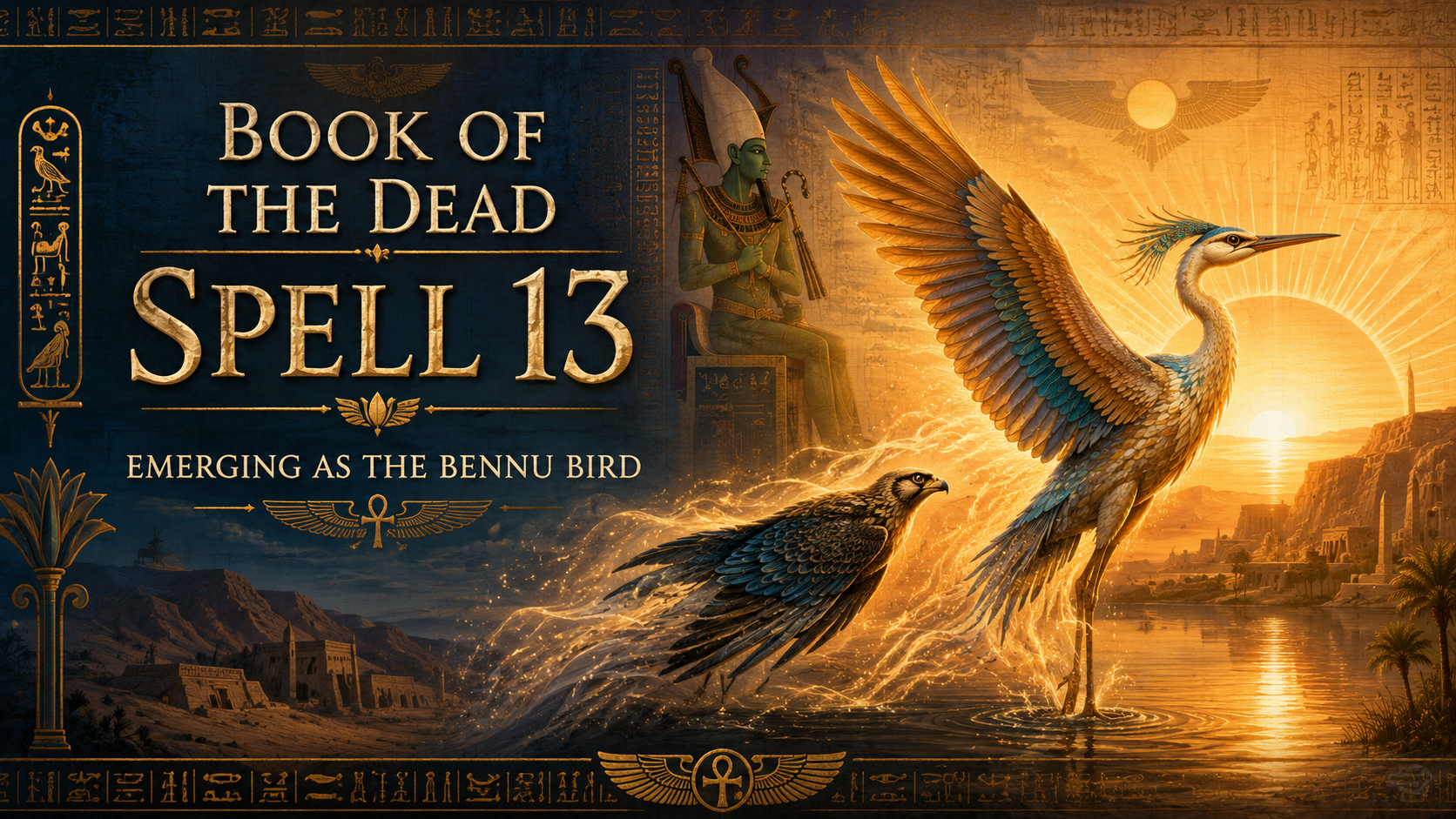
The ancient Egyptian Book of the Dead was a collection of funerary spells created to help the deceased awaken, travel through the afterlife, overcome supernatural obstacles, and continue living as a transformed spirit. Book of the Dead Spell 13 gives the deceased the power to enter the divine realm in the form of a falcon and emerge at dawn as the Bennu bird, one of ancient Egypt’s most important symbols of renewal.
Its traditional title is commonly translated as:
A spell for entering after coming forth from Amenta
The spell asks that a road be prepared so the deceased can worship both Ra and Osiris. It also refers to the mysterious “locks of Osiris” and the hounds of Horus. Although the text is extremely short, it brings together several major ideas in Egyptian funerary religion:
- The western realm of the dead
- Transformation into sacred birds
- Solar rebirth at dawn
- Freedom of movement
- Worship of Ra and Osiris
- Admission to the divine world
- Renewed life after death
Spell 13 therefore concerns much more than entering a location. It transforms the deceased into a divine traveler who can pass through death and emerge with the morning sun.
What Is Book of the Dead Spell 13?
Book of the Dead Spell 13 is a short funerary formula for entering after emerging from Amenta, the western realm associated with death and burial.
Peter Le Page Renouf and Édouard Naville titled it:
Chapter for entering after coming out from Amenta
Their translation presents the deceased entering as a hawk or falcon and coming forth as a Bennu bird at dawn. The speaker then asks for a road to be prepared so they may worship Ra in Amenta and Osiris, the Lord of Life. The spell also contains two difficult expressions involving the “locks of Osiris” and the “hounds of Horus.”
Spell 13 follows Spell 12, which allowed the deceased to enter and leave the Netherworld. The two compositions form a natural pair:
- Spell 12 grants freedom to enter and emerge.
- Spell 13 describes the sacred forms and divine destinations involved in that movement.
The Title of Spell 13
The historical title reads:
Chapter for entering after coming out from Amenta
A smoother modern version would be:
A spell for entering the divine realm after emerging from the West
The title may initially sound contradictory. If the deceased has already come out of Amenta, what are they entering? The spell appears to describe movement between different regions or states rather than one simple trip from one location to another.
The deceased emerges from the western realm and then enters another sacred domain, perhaps the solar world, the presence of the gods, or a renewed state of divine existence. The title reinforces one of the Book of the Dead’s central ideas: eternal life required the ability to move freely in more than one direction.
English Translation of Book of the Dead Spell 13
Spell 13: Entering After Coming Forth From Amenta
I enter as a falcon
and come forth as the Bennu bird at dawn.Let a road be prepared for me
so that I may worship Ra
in beautiful Amenta
and approach the locks of Osiris.I urge forward the hounds of Horus.
Let a road be prepared for me
so that I may worship Osiris,
the Lord of Life.
The precise meaning of the “locks of Osiris” and the action involving the hounds remains uncertain. The translation should therefore be read as a close modernization of the historical text rather than a final interpretation of every phrase.
Historical Translation of Spell 13
Renouf and Naville translated the chapter as follows:
“I enter as a Hawk and come forth as a Bennu at Dawn.
Let the way be made for me that I may adore Ra at the fair Amenta, and the locks of Osiris. I urge on the hounds of Horus.
Let the way be made for me that I may adore Osiris, the Lord of Life.”
The same edition states that Spell 13, like Spell 12, occurs in only one of the older manuscripts available to the editors. It is later repeated as Spell 121 in the standardized sequence.
What Does Book of the Dead Spell 13 Mean?
Spell 13 presents the deceased as a being capable of transformation, movement, and rebirth. The speaker enters as a falcon and emerges at dawn as the Bennu bird. Both birds carried powerful divine associations.
The falcon was connected with Horus, kingship, the sky, and solar power. The Bennu bird was associated with creation, renewal, and the rising sun.
The deceased therefore moves through two complementary identities:
- The falcon provides divine authority and freedom of movement.
- The Bennu bird represents emergence, renewal, and rebirth at dawn.
The speaker then asks for an open road to worship Ra and Osiris, uniting the solar and Osirian models of eternal life.
In simple terms, Spell 13 declares: I can cross the realm of death in divine form. Like the falcon, I possess the power of the sky. Like the Bennu bird, I rise renewed at dawn. The road to Ra and Osiris is open before me.
What Was Amenta?
Amenta, also written Amenti, was the western realm associated with death and the afterlife. The word is related to the Egyptian concept of the West. Ancient Egyptians connected the west with death for several reasons:
- The sun disappeared in the west each evening.
- Many cemeteries were located on the western desert edge.
- Osiris was called Lord of the West.
- The western horizon was imagined as an entrance into the hidden realm.
Amenta could therefore refer to:
- The western necropolis
- The realm of the dead
- A region ruled by Osiris
- The entrance to the Duat
- The sacred landscape beyond the sunset
Spell 13 describes Amenta as “fair” or beautiful. This indicates that the western realm was not imagined only as a place of fear. For the successful deceased, it could become a sacred and desirable domain where gods were encountered and renewed life became possible.
Was Amenta the Same as the Duat?
Amenta and the Duat overlap, but they are not always identical terms. The Duat was the hidden realm through which Ra traveled during the night. It contained gates, caverns, gods, spirits, enemies, and places of regeneration. Amenta emphasized the West, the region of sunset and burial.
Depending on the period and text, Amenta could function as:
- An entrance to the Duat
- The realm of Osiris
- The western part of the afterlife
- A broader name for the land of the dead
Spell 13 does not provide a geographical map. Its concern is the deceased’s ability to emerge from the West and continue into divine life.
“I Enter as a Falcon”
The spell begins: I enter as a falcon. The falcon was one of the most important sacred birds in ancient Egypt.
It was especially associated with:
- Horus
- The sky
- Kingship
- Divine vision
- Solar power
- Speed
- Freedom of movement
A falcon could rise high above the earth, cross great distances, and see what lay below. These qualities made it an ideal form for a deceased person navigating the afterlife. By entering as a falcon, the deceased claims the ability to:
- Travel freely
- Rise above obstacles
- Enter the sky
- Approach the gods
- See hidden roads
- Share in the authority of Horus
The statement also places the deceased in an active rather than passive role. The speaker is no longer confined to the wrapped body. The transformed spirit possesses wings, vision, and divine mobility.
Falcon or Hawk?
Older translations often use the word hawk, while modern writing commonly prefers falcon. The distinction does not substantially change the symbolic meaning of the spell. Egyptian divine bird imagery often represents a falcon associated with Horus or solar deities.
The Falcon and Horus
Horus was frequently represented as a falcon or as a man with a falcon’s head.
He was associated with:
- The sky
- The living king
- The son of Osiris
- Royal succession
- Protection
- Victory over enemies
- The restored divine order
When the deceased enters as a falcon, the speaker may be drawing upon Horus’s ability to move between heaven, earth, and the realm of Osiris. Horus could approach his father, defend him, perform funerary duties, and restore what had been damaged. The falcon form therefore provides both movement and a legitimate relationship with Osiris.
“I Come Forth as the Bennu Bird”
The deceased next declares: I come forth as the Bennu bird. The Bennu was a sacred bird connected with solar creation and renewal. It was often associated with the city of Heliopolis and with the gods Ra and Atum.
The Bennu could symbolize:
- Creation
- Self-generation
- Sunrise
- Renewal
- The return of life
- The appearance of light
- Cyclical rebirth
By emerging as the Bennu bird, the deceased becomes part of the same creative power that renewed the world. The speaker does not merely survive the journey through death. The deceased emerges in a form associated with the beginning of creation itself.
What Did the Bennu Bird Look Like?
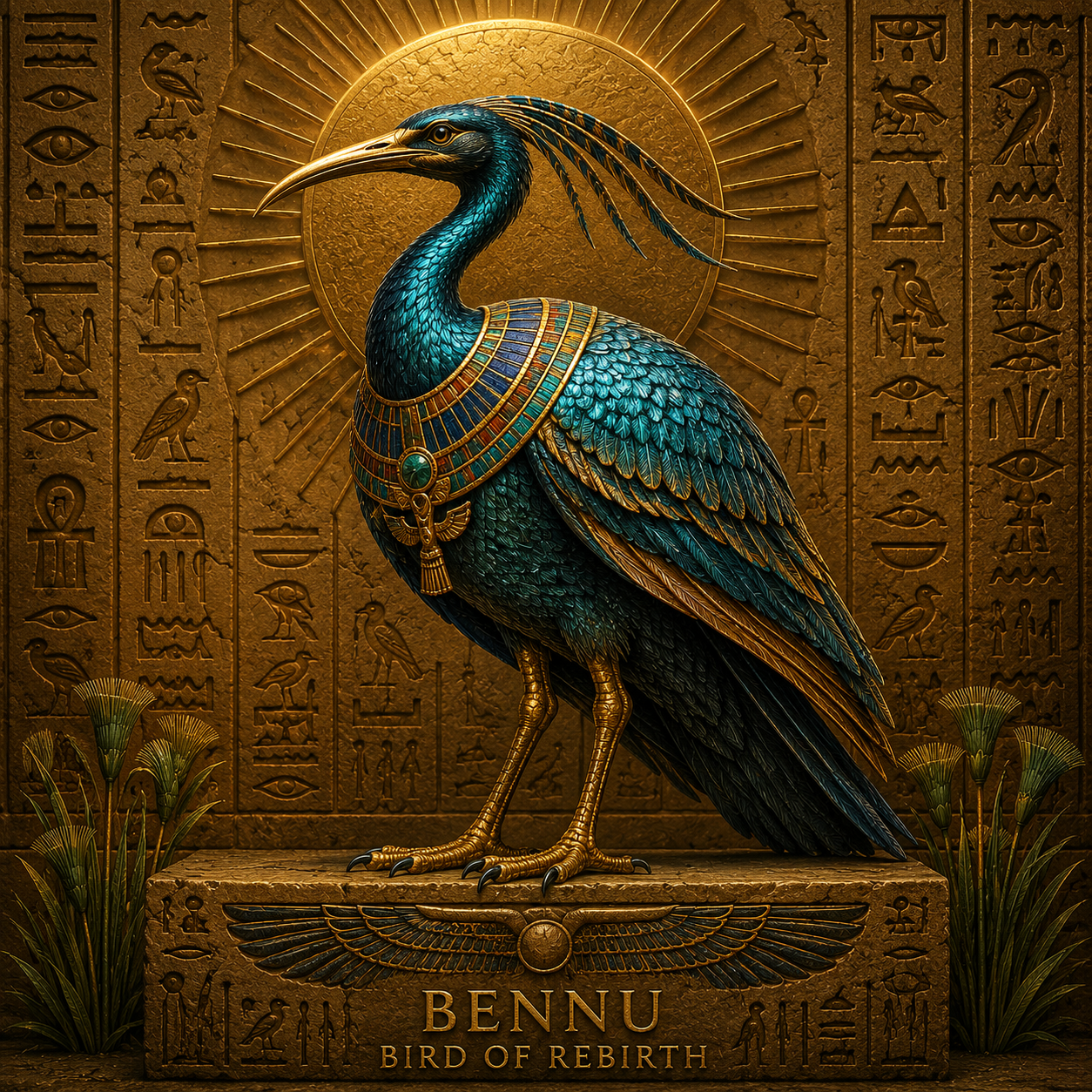
Ancient Egyptian images commonly show the Bennu as a long-legged bird, often resembling a heron. It could be depicted with:
- A long beak
- Long legs
- A slender body
- A two-feathered crest
- A solar disk in some representations
The exact real bird behind the symbol remains debated, but the Bennu’s mythological role is more important than its zoological identification. It was the bird of renewal and divine emergence.
Was the Bennu the Egyptian Phoenix?
The Bennu is frequently described as the Egyptian predecessor of the Greek phoenix. There are genuine similarities:
- Both are sacred birds.
- Both are associated with the sun.
- Both carry ideas of renewal and cyclical life.
- Later Greek traditions connected the phoenix with Egypt.
However, the Bennu and the classical phoenix were not identical in every detail. The familiar story of a phoenix burning and rising from its ashes does not appear in Spell 13. For accuracy, it is better to describe the Bennu as an Egyptian bird of creation and renewal that later influenced or became associated with phoenix traditions.
Why Does the Bennu Appear at Dawn?
Spell 13 says the deceased comes forth as the Bennu: At dawn. Dawn was the moment when the sun reappeared after traveling through the hidden world.
It represented:
- Rebirth
- Restoration of light
- Victory over darkness
- The continuation of time
- Renewal of creation
- The return of life
The timing is essential. The deceased does not emerge randomly. The person comes forth at the same moment when Ra rises, and the ordered world is renewed. The dawn transforms the deceased’s emergence into a solar resurrection.
Entering as a Falcon and Emerging as the Bennu
The two bird forms create a movement from power to rebirth. The falcon suggests:
- Flight
- Divine kingship
- Horus
- Entry into sacred space
- Control over the sky
The Bennu suggests:
- Solar renewal
- Creation
- Dawn
- Emergence
- New life
The deceased enters with the authority of Horus and comes forth with the regenerative power of the Bennu. The transformation shows that the afterlife journey changes the person. The one who enters death is not destroyed. The person emerges in a renewed divine form.
Why Did the Deceased Need Different Forms?
Many Book of the Dead spells allowed the deceased to assume different forms. Later transformation spells include becoming:
- A falcon
- A Bennu bird
- A lotus
- A swallow
- A crocodile
- A snake
- A divine soul
- A god associated with light
Each form supplied different powers. Transformation did not necessarily mean permanently abandoning human identity. The deceased could assume a useful form for a particular journey or purpose. Spell 13 uses bird forms because birds could move between earth and sky in ways humans could not. The deceased needed that freedom to cross divine boundaries.
“Let the Road Be Prepared for Me”
The spell repeats the request: Let the road be prepared for me. Roads and paths were central to Egyptian funerary literature.
The deceased might need to cross:
- Desert roads
- Celestial paths
- Waterways
- Tomb passages
- Gates
- Caverns
- The western horizon
- Roads leading to Osiris or Ra
A blocked road could prevent resurrection.
The request ensures that:
- No guardian refuses passage.
- No gate remains closed.
- No enemy blocks the route.
- The correct destination can be reached.
- The deceased does not become lost.
The phrase appears twice, emphasizing that the speaker needs access to both Ra and Osiris.
The Importance of an Open Road
An open road represented freedom, recognition, and divine permission. The deceased did not want to wander without direction or be confined to one region. An open road allowed the transformed person to:
- Approach the gods
- Return to daylight
- Travel through Amenta
- Join the solar cycle
- Reach Osiris
- Receive divine acceptance
- Continue moving eternally
Spell 13 is therefore partly a travel authorization. The divine world must recognize the deceased’s right to pass.
“That I May Worship Ra”
The first road is prepared so the deceased may worship Ra. Ra represented the sun and the daily renewal of creation. To worship Ra meant aligning the deceased with:
- Light
- Order
- Rebirth
- Divine kingship
- The solar journey
- Victory over darkness
The deceased emerges as the Bennu at dawn, making the worship of Ra especially appropriate. The bird’s renewal and the sun’s renewal become the same event.
Why Is Ra Worshipped in Amenta?
The spell refers to worshipping Ra at or within beautiful Amenta. Ra entered the West every evening. He was therefore present within the realm of death during his nightly journey.
The West did not belong exclusively to Osiris. Ra passed through it, brought light into darkness, and united with regenerative powers before dawn. Worshipping Ra in Amenta acknowledges his hidden nocturnal form. The deceased encounters the sun god not only in the visible sky but also within the world of death.
Ra and Osiris in the Afterlife
Spell 13 invokes both Ra and Osiris. This reflects the blending of solar and Osirian beliefs in Egyptian funerary religion.
Ra represented:
- Daily rebirth
- Light
- The sky
- The solar boat
- Renewal at dawn
Osiris represented:
- Resurrection
- The preserved dead
- The western realm
- Divine judgment
- Eternal life within the Netherworld
The deceased wanted access to both divine models. Through Ra, the person could rise with the sun. Through Osiris, the person could survive death and live among the blessed dead. Spell 13 places the deceased within both cycles.
What Are the “Locks of Osiris”?
The spell contains the difficult phrase: The locks of Osiris. This may refer to hair, braided locks, sacred emblems, or a divine object associated with Osiris. The Renouf and Naville source marks the phrase with a note, indicating that it presented a textual or interpretive difficulty. The accessible portion of the source does not provide enough detail to establish one certain meaning.
A responsible interpretation should therefore avoid claiming that the phrase definitely refers to one specific object. Possible symbolic associations include:
- The physical body of Osiris
- A sacred relic
- Signs of divine renewal
- A feature of an Osirian cult image
- Vegetation or fertility imagery
The passage clearly places the deceased near something sacred and closely connected with Osiris, but its precise meaning remains uncertain.
Hair and Regeneration in Egyptian Symbolism
Hair could carry associations with:
- Youth
- Mourning
- Divine identity
- Renewal
- Sacred appearance
Osiris was a god of restored life and vegetation, so the reference to his locks may have carried regenerative symbolism. However, Spell 13 itself does not explain the phrase. It should be presented as a difficult and possibly corrupt expression rather than as a fully understood theological statement.
“I Urge On the Hounds of Horus”
The spell also says: I urge on the hounds of Horus. The identity of these hounds is not explained in the surviving translation. They may represent divine or supernatural hunting animals associated with Horus.
Possible functions could include:
- Driving enemies away
- Clearing the road
- Pursuing hostile beings
- Guarding the deceased
- Assisting Horus
- Guiding movement through the sacred realm
The verb suggests that the deceased sends or encourages the hounds forward. This places the speaker in a position of command. The transformed deceased does not merely follow divine animals. The person can direct them.
Were the Hounds of Horus Jackals?
The word “hounds” may cause readers to imagine dogs or jackals, but the surviving source does not provide enough information to identify the animals more precisely. Jackal-shaped gods such as Anubis and Wepwawet were closely connected with cemeteries, roads, and the opening of ways.
However, Spell 13 specifically calls these animals the hounds of Horus. It is possible that they function as divine hunting or protective animals, but any stronger identification would require evidence beyond this short text.
Hounds as Road Clearers
The hounds appear between two requests that the road be prepared. This placement suggests that they may help clear or secure the path.
They could symbolically:
- Chase away enemies
- Find a hidden route
- Protect the traveler
- Lead the procession
- Remove dangerous beings
This interpretation fits the spell’s overall concern with safe movement, but it should be presented as a reasonable reading rather than a certain translation.
“That I May Worship Osiris”
The second request for an open road leads to Osiris. The deceased wishes to worship Osiris, the Lord of Life. This title may seem surprising because Osiris ruled the dead. However, Osiris was not simply a god of death. He represented life restored after death.
His mythology centered on:
- Murder
- Bodily destruction
- Mourning
- Reassembly
- Vindication
- Renewed existence
- Kingship in the afterlife
Calling Osiris the Lord of Life emphasizes the outcome of his resurrection rather than the fact of his death.
Why Was Osiris Called Lord of Life?
Osiris represented the possibility that death could be overcome.
He was connected with:
- The renewal of vegetation
- The fertility of the Nile Valley
- The survival of the deceased
- The kingdom of the blessed dead
- Eternal nourishment
- The restoration of the body
- Continuing life beyond burial
His realm was populated by those who had successfully passed through death. The deceased therefore approaches Osiris not to remain dead, but to receive life in a transformed condition.
Worship as Proof of Admission
The ability to worship a god in the divine realm implied access and acceptance. A rejected spirit could not necessarily approach Osiris or Ra freely. By asking for the road to be prepared, the deceased seeks recognition as someone permitted to stand before the gods.
Worship confirms that the speaker belongs within divine order. The deceased is not an intruder in Amenta. The person has become an accepted worshipper of Ra and Osiris.
How Does Spell 13 Relate to Spell 12?
Spell 12 and Spell 13 are closely connected.
Book of the Dead Spell 12
Spell 12 allows the deceased to:
- Enter the Netherworld
- Come forth again
- Approach Ra
- Pass the secret gates
- Split open the earth
- Continue through the solar life cycle
Book of the Dead Spell 13
Spell 13 allows the deceased to:
- Enter as a falcon
- Emerge as the Bennu at dawn
- Travel upon a prepared road
- Worship Ra
- Approach Osiris
- Command the hounds of Horus
Spell 12 establishes the right to move. Spell 13 gives that movement divine form and direction.
How Does Spell 13 Relate to Later Transformation Spells?
Spell 13 anticipates the transformation spells found later in the Book of the Dead.
These include:
- Spell 77, becoming a golden falcon
- Spell 78, becoming a sacred falcon
- Spell 83, becoming the Bennu bird
- Spell 85, becoming a living soul
- Spell 86, becoming a swallow
Spell 13 is unusual because it includes two forms within one short composition. The deceased enters as one sacred bird and emerges as another. This highlights transformation as a process rather than a fixed identity.
Is Spell 121 the Same as Spell 13?
Yes. The Renouf and Naville index identifies Spell 121 as the same composition as Spell 13. This is similar to other duplicated spells in the Book of the Dead:
- Spell 48 repeats Spell 10.
- Spell 49 repeats Spell 11.
- Spell 120 repeats Spell 12.
- Spell 121 repeats Spell 13.
The duplication reflects the way the Book of the Dead developed from independent compositions copied in varying orders. Readers searching for Book of the Dead Spell 121 may therefore find the same text as Spell 13.
Was Spell 13 Common?
Renouf and Naville state that Spell 13, like Spell 12, occurs in only one of the older manuscripts available to them, identified as Pa. This suggests that it was not one of the most consistently included early spells in their manuscript sample. However, its repetition as Spell 121 shows that the composition continued to circulate in later arrangements.
The surviving evidence should not be used to claim that the spell was completely unknown or unimportant. It simply appears less widely attested than some other Book of the Dead chapters.
Did Spell 13 Have a Standard Vignette?
The Renouf and Naville index does not list a standard vignette for Spell 13. It groups Spells 12 through 14 among texts without regular accompanying illustrations in the manuscripts used for their edition. A modern educational illustration could show:
- The deceased entering a western gateway as a falcon
- The Bennu bird emerging into the sunrise
- Ra appearing above the eastern horizon
- Osiris enthroned within Amenta
- A sacred road connecting the two gods
- Divine hounds clearing the path
Such an image would be an artistic interpretation rather than a reproduction of a standard ancient Spell 13 vignette.
Is Book of the Dead Spell 13 the Same as Coffin Text Spell 13?
No. The Book of the Dead and the Coffin Texts use different numbering systems created by modern scholars. Book of the Dead Spell 13 concerns entering as a falcon and emerging as the Bennu bird. Coffin Text Spell 13 is a separate Middle Kingdom composition. The matching numbers do not mean the spells are the same. When researching the text, it is important to specify Book of the Dead Spell 13.
How Reliable Is the Translation?
Spell 13 is short, but several expressions remain difficult.
The main ideas are reasonably clear:
- Entry as a falcon
- Emergence as a Bennu bird
- Dawn
- An open road
- Worship of Ra
- Worship of Osiris
The more uncertain phrases are:
- The locks of Osiris
- The hounds of Horus
- The exact destination implied by “entering”
- The precise relationship between Amenta and the road
A responsible explanation should separate the spell’s clear themes from speculative interpretation.
The Meaning of Spell 13 in Simple Terms
Book of the Dead Spell 13 transforms the deceased into two sacred birds. The speaker enters as a falcon, gaining the mobility, authority, and divine vision associated with Horus. At dawn, the deceased emerges as the Bennu bird, symbolizing creation, solar renewal, and life returning after darkness.
The speaker asks for an open road to worship Ra and Osiris, joining the two great models of Egyptian resurrection. The spell’s meaning can be summarized as:
I can pass through the western realm in divine form. I enter with the power of Horus and emerge renewed with the rising sun. The road to Ra and Osiris is open, and death cannot prevent my return to life.
Spell 13 transforms the journey through Amenta into a flight toward dawn.
Frequently Asked Questions About Book of the Dead Spell 13
What is Book of the Dead Spell 13?
Spell 13 is a short funerary formula that allows the deceased to enter as a falcon, emerge as the Bennu bird at dawn, and travel upon an open road to worship Ra and Osiris.
What is the title of Spell 13?
Renouf and Naville title it: Chapter for Entering After Coming Out From Amenta.
What is the full translation of Spell 13?
A reader-friendly rendering is:
I enter as a falcon and come forth as the Bennu bird at dawn. Let a road be prepared for me so that I may worship Ra in beautiful Amenta and approach the locks of Osiris. I urge forward the hounds of Horus. Let a road be prepared for me so that I may worship Osiris, the Lord of Life.
What is Amenta?
Amenta is the western realm associated with sunset, burial, Osiris, and the land of the dead.
Why does the deceased become a falcon?
The falcon provides the sky power, mobility, vision, kingship, and divine authority associated with Horus.
What is the Bennu bird?
The Bennu was a sacred bird associated with creation, Ra, Atum, dawn, and cyclical renewal.
Was the Bennu the same as the phoenix?
The Bennu influenced or became associated with later phoenix traditions, but the two were not identical in every detail. Spell 13 does not describe the bird rising from ashes.
Why does the Bennu emerge at dawn?
Dawn marked Ra’s return from the hidden realm and symbolized rebirth, renewed light, and the restoration of cosmic order.
What are the locks of Osiris?
The phrase is uncertain. It may refer to hair, a sacred relic, a divine image, or another Osirian symbol. The surviving source does not support one definitive interpretation.
Who are the hounds of Horus?
The text does not explain them. They may be protective, hunting, or path-clearing divine animals associated with Horus.
Why are both Ra and Osiris worshipped?
Ra represents daily solar rebirth, while Osiris represents resurrection and continuing life in the realm of the dead. The deceased seeks both forms of renewal.
Is Spell 121 the same as Spell 13?
Yes. The Renouf and Naville index identifies Spell 121 as a repetition of Spell 13.
Did Spell 13 have a standard illustration?
No standard vignette is listed in the Renouf and Naville edition.
Book of the Dead Spell 13 is one of the collection’s shortest transformation spells, yet it contains an entire journey through death and rebirth. The deceased enters as a falcon, carrying the authority and freedom of Horus.
At dawn, the speaker emerges as the Bennu bird, joining the renewal of Ra and the return of light. A road is prepared through Amenta. The deceased approaches both Ra and Osiris, uniting solar rebirth with resurrection in the western realm.
The spell’s message is clear even where some of its expressions remain mysterious. The deceased is not trapped beneath the earth or lost in darkness. The person can take wing, cross the hidden realm, and emerge renewed with the dawn.