The ancient Egyptian Book of the Dead was a collection of funerary spells intended to help the deceased awaken, travel through the afterlife, overcome supernatural dangers, and continue living as a transformed spirit.
Book of the Dead Spell 12 gave the deceased the power to enter the Netherworld and come out again.
Its traditional title is commonly translated as:
A spell for entering and coming forth from the Netherworld
The spell is extremely brief, but it addresses one of the most important goals of ancient Egyptian funerary religion. The deceased did not want to become permanently trapped inside the tomb or confined to the realm of the dead.
Instead, the transformed person hoped to move freely between different regions of existence, including the Duat, the earth, the sky, and the divine realm. Spell 12 asks Ra to guard the hidden gates, invokes the balance through which Ma’at is raised each day, and presents the deceased as someone capable of splitting open the earth and gaining renewed life.
What Is Book of the Dead Spell 12?
Book of the Dead Spell 12 is a short funerary formula that allows the deceased to enter the Netherworld and emerge from it. Peter Le Page Renouf and Édouard Naville titled it:
Chapter for entering and for coming forth out of the Netherworld
The text addresses Ra as the guardian of secret gates. It then refers to the balance by which Ra raises Ma’at every day.
Finally, the deceased declares the power to break open the earth and asks to come forth and advance in age.
Renouf and Naville noted that Spell 12 was rare among the older manuscripts available to them. They found it in only one of the early papyri they used, identified as manuscript Pa. They also observed that the spell appears twice in the Turin Book of the Dead, where it is repeated as Spell 120.
The Title of Spell 12
The historical title reads:
Chapter for entering and for coming forth out of the Netherworld
A smoother modern version would be:
A spell for entering and leaving the realm of the dead
The wording expresses two equally important powers:
- The deceased can enter the Netherworld.
- The deceased can leave it again.
Entering was necessary because the realm contained Osiris, divine mysteries, regenerative powers, and the route traveled by Ra during the night.
Leaving was equally important because eternal life required freedom rather than confinement.
Spell 12 therefore grants movement in both directions.
English Translation of Book of the Dead Spell 12
Spell 12: Entering and Coming Forth From the Netherworld
Hail to you, Ra,
guardian of the secrets of the gates
above this domain of Geb,and guardian of the balance
by which Ra raises Ma’at every day.Here I am.
I am the one who splits open the earth.
Grant that I may come forth
and advance in age.
This is the complete short spell preserved in the Renouf and Naville edition.
Historical Translation of Spell 12
Renouf and Naville translated the spell as follows:
“Salutation to thee, O Ra, who guardest the secrets of the gates over this domain of Seb, and this Balance with which Ra raiseth up Maat daily:
Here am I, who cleave open the earth, grant that I may come and acquire advance in age.”
In this older translation:
- Seb is an older form of the name Geb.
- Maat is now commonly written Ma’at.
- “Cleave open the earth” means to split or break it open.
- “Acquire advance in age” refers to continuing life or participating in a complete life cycle.
What Does Book of the Dead Spell 12 Mean?
Spell 12 gives the deceased authority to cross the boundary between burial and renewed life. The body has been placed beneath the earth, but the deceased declares: I split open the earth.
The speaker is not trapped inside the burial chamber. The person can rise, emerge, and continue through the divine cycle.
The spell links this emergence with three major powers:
- Ra, who travels through darkness and returns each morning
- Ma’at, who represents truth, balance, justice, and cosmic order
- Geb, who represents the earth through which the deceased must pass
Its central meaning can be summarized as:
The gates of the hidden world are known to me. The earth cannot imprison me. Through Ra and Ma’at, I can enter death, come forth again, and continue living.
Why Was Entering the Netherworld Important?
The Netherworld was not simply a place of punishment or permanent darkness.
It was also a realm of:
- Osiris
- The blessed dead
- Regeneration
- Divine judgment
- Sacred gates
- Hidden knowledge
- Solar renewal
- Powerful gods and spirits
Ra entered the hidden realm each evening when the sun set. During the night, he traveled through its regions, defeated hostile forces, united with regenerative powers, and emerged at dawn. The deceased hoped to participate in this same journey. Entering the Netherworld therefore allowed the person to join the divine process through which death became renewed life.
Why Did the Deceased Need to Come Out Again?
Entering the realm of the dead was only part of a successful afterlife. Permanent confinement would have prevented the deceased from:
- Going forth by day
- Joining Ra in the sky
- Visiting the world of the living
- Receiving offerings
- Traveling through divine regions
- Participating in festivals
- Returning to the tomb
- Assuming different spiritual forms
The ideal deceased possessed freedom of movement. The tomb remained an important dwelling place, and the preserved body remained essential, but the transformed spirit could leave and return. Spell 12 helps prevent the tomb and Netherworld from becoming prisons.
What Is the Netherworld in Spell 12?
Renouf and Naville use the English term Netherworld. Other translations may use:
- Duat
- Underworld
- Realm of the dead
- Hidden world
- Western realm
These terms overlap but are not always exact equivalents. The Duat was the hidden realm traveled by Ra during the night. It included gods, spirits, gates, waterways, caverns, dangerous beings, and places of regeneration.
The broader term Netherworld can include this divine landscape as well as the realm associated with burial and Osiris. In Spell 12, the emphasis is not on describing the geography in detail. The spell concerns gaining the right to enter and leave it.
“Hail to You, Ra”
The spell begins by addressing Ra directly: Hail to you, Ra. Ra was the sun god and one of the most powerful deities in Egyptian religion. His daily cycle provided a visible model for survival after death:
- The sun appeared to descend into the west.
- Ra entered the hidden realm.
- He traveled through darkness.
- He overcame enemies and obstacles.
- He emerged again in the east.
- Creation was renewed.
The deceased wished to imitate this cycle. By greeting Ra, the speaker approaches the god who already knows how to enter the Netherworld and return safely.
Ra as Guardian of the Gates
Spell 12 describes Ra as one who guards: The secrets of the gates. The Netherworld contained numerous gates, doors, portals, and guarded passages. Access depended on knowledge and divine permission.
The deceased might need to know:
- The name of a gate
- The identity of its guardian
- The correct words of greeting
- The divine myth associated with the location
- The proper moment to enter
- The spell required to pass
Calling Ra the guardian of these secrets acknowledges that the solar god controls knowledge of the route. Ra does not simply travel through the gates. He understands their mysteries. By addressing him, the deceased seeks access to the same knowledge.
Why Were Gates So Important?
Gates represented boundaries between different states and regions.
They could separate:
- Life and death
- Darkness and daylight
- The tomb and the open world
- One hour of the night from another
- The deceased from Osiris
- The mortal world from the divine realm
A closed gate meant exclusion, delay, or imprisonment. An open gate meant recognition and freedom. Spell 12 does not list individual guardians because its purpose is broader. It appeals to Ra as the keeper of the entire hidden system.
What Is the Domain of Geb?
The historical translation refers to: This domain of Seb.
Seb is the older English form of Geb, the ancient Egyptian god of the earth. Geb represented the ground beneath the sky and was often depicted lying beneath the arched body of the sky goddess Nut.
The dead were buried within the earth, placing them within Geb’s domain. The phrase may therefore refer to:
- The earth itself
- The burial ground
- The realm beneath the surface
- The territory through which the deceased must emerge
- The earthly section of the cosmic order
The deceased is buried in Geb, but Spell 12 grants the power to pass through his domain.
Who Was Geb?
Geb was the god of the earth and a member of the Heliopolitan Ennead. He was associated with:
- The physical ground
- Fertility
- Vegetation
- Earthquakes
- Kingship
- Burial
- The bodies of the dead
Because the deceased was placed beneath the soil, Geb could act as both protector and enclosure. The earth preserved the burial, but it also had to open so the transformed deceased could emerge. Spell 12 presents the earth as something that can be split open rather than an eternal barrier.
The Gates Above the Domain of Geb
The phrase “gates over this domain of Geb” may suggest entrances positioned between the earthly world and the hidden realm.
These gates could mark the boundary between:
- The surface and the tomb
- Earth and sky
- Earth and Duat
- The visible world and divine space
The text does not provide a map or explain their precise location. Its central claim is that Ra knows and guards their secrets. The deceased therefore appeals to the correct divine authority before attempting to emerge.
What Is the Balance in Spell 12?
The spell refers to: The balance by which Ra raises Ma’at every day.
A balance or set of scales is most famously associated with the Weighing of the Heart, where the deceased’s heart was compared with the feather of Ma’at.
Spell 12 does not explicitly describe that judgment scene. Instead, the balance appears to be part of the daily restoration of cosmic order. Ra raises Ma’at as the sun rises and the ordered world is renewed.
The image may connect:
- Solar rebirth
- Justice
- Cosmic equilibrium
- Divine judgment
- The restoration of order after night
The deceased can come forth because emergence occurs within Ma’at rather than outside the divine order.
Who Was Ma’at?
Ma’at was both a goddess and a fundamental Egyptian concept.
She represented:
- Truth
- Justice
- Balance
- Order
- Proper conduct
- Cosmic stability
- Rightful relationships between gods, rulers, and people
Renouf and Naville specifically caution that Ma’at should often be treated as a proper name rather than translated merely as an abstract idea. In Spell 12, Ra raises Ma’at daily. This suggests that order must be actively renewed.
Each sunrise confirms that darkness, chaos, and obstruction have not permanently defeated creation. The deceased seeks to rise within that same renewal.
Ra Raising Ma’at Every Day
The phrase connects the deceased’s resurrection with the daily maintenance of the universe.
When Ra rises:
- Darkness retreats.
- The sun returns.
- Time continues.
- Life resumes.
- Ma’at is restored.
- Chaos is held back.
The deceased’s coming forth is therefore not an isolated personal event.
It becomes part of the cosmic process that preserves existence.
The person rises because the universe itself is renewed.
Does the Balance Refer to Judgment?
The balance may evoke judgment, but the text does not explicitly say that the deceased’s heart is being weighed. A cautious interpretation is that the image combines judgment and cosmic balance without presenting the full tribunal later associated with Spell 125.
The deceased must belong to Ma’at to travel successfully. A hostile, condemned, or disordered spirit might be denied passage.
By invoking the balance through which Ma’at is raised, Spell 12 places the speaker on the side of truth and divine order.
“Here I Am”
The deceased announces: Here I am. This short declaration establishes presence and identity. The speaker has arrived before Ra and the guarded gates.
The phrase may function as:
- An announcement of readiness
- A declaration that the deceased has survived
- A demand to be recognized
- Proof that the person is present and active
- A magical assertion of existence
Death has not erased the speaker. The deceased can still present themselves before a god and claim passage.
“I Split Open the Earth”
The most powerful declaration in Spell 12 is: I am the one who splits open the earth. The deceased does not wait passively for the grave to release them.
The speaker possesses the power to break through the boundary personally.
The image can represent:
- Rising from the tomb
- Escaping burial
- Breaking through the earth at dawn
- Emerging like vegetation from soil
- Overcoming physical confinement
- Repeating the sun’s emergence from darkness
The dead body remains buried, but the transformed spirit cannot be held beneath the ground.
Resurrection and Agricultural Imagery
Renouf and Naville note that the Egyptian verb used for splitting or opening was not limited to agriculture, although it could appear in agricultural contexts.
The connection is still meaningful. Egyptian resurrection imagery frequently compared renewed life with:
- Seeds growing beneath the soil
- Grain sprouting after burial
- Vegetation returning after dormancy
- The Nile renewing the land
- Osiris as a god of fertility and regeneration
Something placed beneath the earth could appear dead and still, yet later emerge alive. The deceased hoped for a comparable transformation.
The Earth as Barrier and Source of Life
The earth had two roles in funerary thought. It could be a barrier because the body was sealed beneath it. It could also be a source of regeneration because plants, crops, and new life emerged from the soil.
Spell 12 transforms the burial ground from a place of confinement into a place of birth. The deceased does not merely escape the earth. The person emerges from it renewed.
“Grant That I May Come”
The speaker asks: Grant that I may come. The destination is not stated explicitly in the surviving English translation.
The request may refer to coming:
- Forth from the tomb
- Into the presence of Ra
- Through the gates
- Into daylight
- Among the gods
- Back to the earth
- Into a renewed spiritual existence
The broad wording allows all these ideas to remain connected. The deceased asks for recognition and access rather than one narrowly defined journey.
“And Advance in Age”
The final request is: That I may acquire advance in age. This phrase might initially sound strange for someone who has already died. Renouf and Naville explain it through the solar cycle. The sun could be represented as:
- A child at dawn
- A mature adult during the day
- An aged man at sunset
The sun therefore passed through an entire life cycle each day. The deceased may be asking to participate in that complete cycle rather than remain frozen at the moment of death.
What Does Advancing in Age Mean After Death?
Advancing in age may symbolize:
- Continued existence
- Completion of the solar cycle
- Growth in divine status
- Movement through time
- Escape from the timeless stillness of death
- Participation in repeated renewal
The deceased does not wish to remain permanently motionless or unchanged. True eternal life involved continuing through ordered cycles. The person could be renewed as a child at dawn, move through maturity, reach old age at sunset, and be reborn again.
Eternal Life as Repeated Renewal
Modern readers often imagine immortality as remaining in one unchanging state forever. Ancient Egyptian solar imagery offered a different model. Eternal life could mean endless renewal:
- Birth
- Growth
- Maturity
- Aging
- Descent into darkness
- Regeneration
- Rebirth
Spell 12’s request to advance in age fits this dynamic vision. The deceased seeks not permanent stillness but continuing participation in time.
How Does Spell 12 Relate to Spell 9?
Spell 9 and Spell 12 both concern entering the hidden realm, but they have different emphases.
Spell 9
Spell 9 opens the Duat so the deceased can:
- See Osiris
- Drive away darkness
- Defeat Set
- Perform duties as the loving son
- Open paths in heaven and earth
Spell 12
Spell 12 focuses on:
- Entering and leaving the Netherworld
- Ra as guardian of hidden gates
- The daily raising of Ma’at
- Splitting open the earth
- Continuing through the solar life cycle
Spell 9 presents the deceased primarily in the role of Horus seeking Osiris. Spell 12 places the deceased within the ordered solar cycle governed by Ra and Ma’at.
How Does Spell 12 Relate to Spell 13?
Spell 13 immediately follows Spell 12 and is titled:
A spell for entering after coming forth from Amenta
Its text describes the deceased entering as a falcon and coming forth as a Bennu bird at dawn. It also asks for a road to be prepared so the speaker can worship Ra and Osiris.
The two spells form a natural pair:
- Spell 12 grants entry into and emergence from the Netherworld.
- Spell 13 describes divine bird forms used during that movement.
Spell 12 establishes freedom of passage. Spell 13 develops the form and destination of the journey.
What Is Amenta?
Amenta, Amenti, or the West refers to the western realm associated with the dead. The sun disappeared in the west each evening, and many Egyptian burial grounds lay on the western desert margin.
The West therefore became associated with:
- Sunset
- Burial
- Osiris
- Entry into the Duat
- The community of the dead
Spell 12 uses the broader term Netherworld, while Spell 13 specifically refers to emerging from Amenta.
Both concern passage through the western realm and return into renewed life.
Is Spell 120 the Same as Spell 12?
Yes. Renouf and Naville state that Spell 12 appears twice in the Turin Book of the Dead and is repeated as Spell 120. Their later index also lists:
CXX, same as XII
This duplication reflects the independent history of Book of the Dead compositions. The spells were not originally written as a single consecutively numbered book. Modern scholars assigned numbers based largely on particular manuscript arrangements.
As a result, the same composition can appear under more than one number. Readers searching for Book of the Dead Spell 120 may therefore encounter the same text as Spell 12.
Why Was Spell 12 Repeated?
The exact reason for its repetition in the Turin manuscript is not explained in the source.
Possible reasons include:
- The spell circulated in more than one group.
- A scribe copied it twice from different sources.
- Its protective value made repetition desirable.
- Separate manuscript traditions placed it in different locations.
- Later editors treated repeated material as a separate chapter.
These possibilities are reasonable, but the Renouf and Naville source does not identify one definite explanation.
What is certain is that the spell appears as both Chapter 12 and Chapter 120 in the standardized list.
How Well Is Spell 12 Preserved?
Renouf and Naville state that the chapter appears in only one of the older manuscripts available to them, identified as Pa. The Turin copy contains another version and repeats it as Spell 120.
Their notes mention at least one textual difference:
- The older manuscript reads “gates over this domain of Geb.”
- The Turin copy instead refers to “the Duat.”
This variation affects how the location is understood but not the spell’s general purpose.
Both versions concern access to the hidden realm.
Did Spell 12 Have a Standard Vignette?
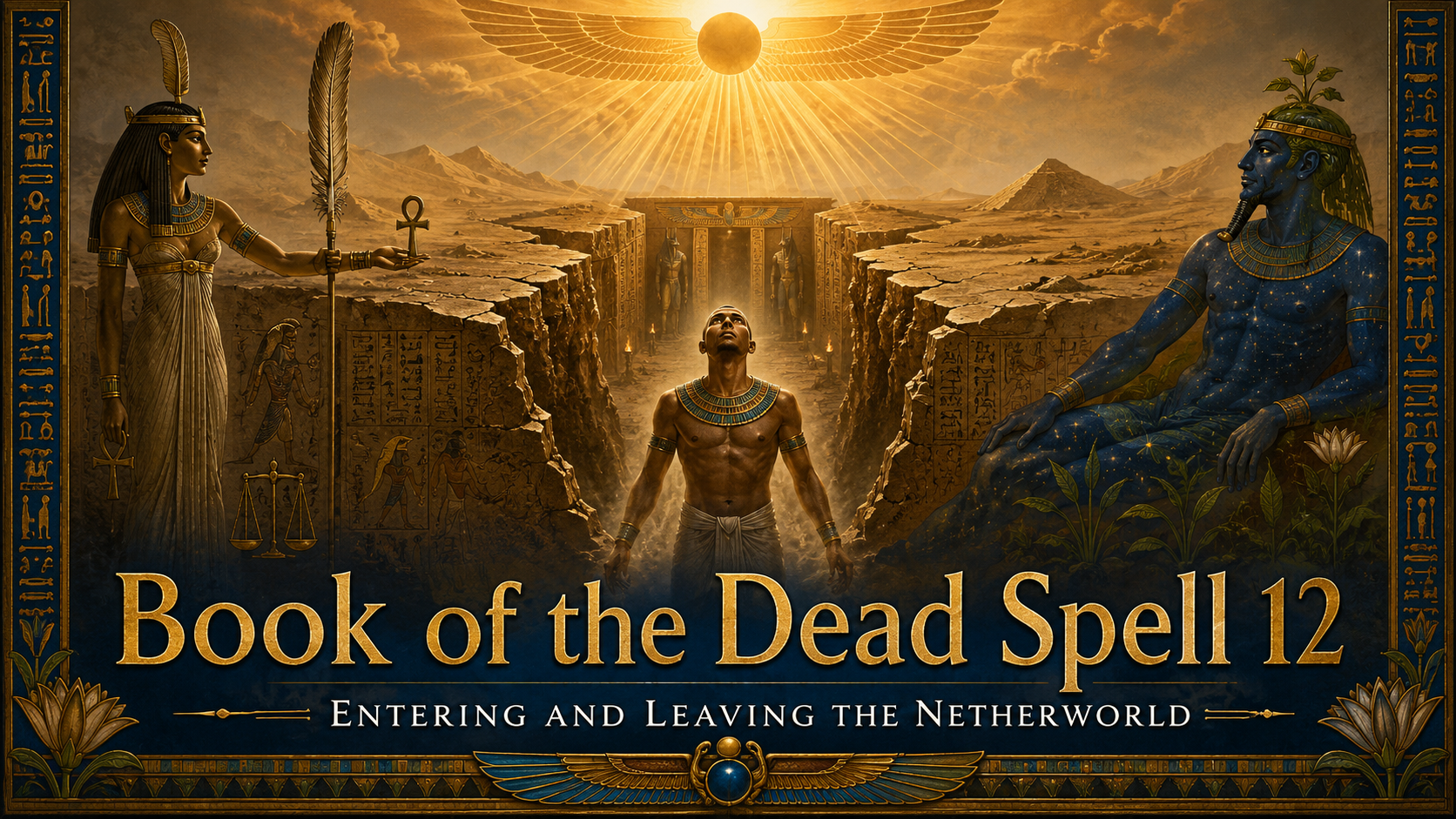
The Renouf and Naville index lists no standard vignette for Spell 12. It groups Spells 12 through 14 among chapters without regular accompanying illustrations in the manuscripts used for the edition.
A modern educational illustration could show:
- Ra standing before guarded gates
- The scales of Ma’at rising with the sun
- The deceased emerging through a split in the earth
- Geb beneath the scene
- The Duat opening behind the western horizon
- A sequence showing the sun as child, adult, and old man
Such an image would be an artistic interpretation rather than a reproduction of a standard ancient Spell 12 vignette.
Is Book of the Dead Spell 12 the Same as Coffin Text Spell 12?
No. The Book of the Dead and the Coffin Texts use independent numbering systems assigned by modern scholars. Book of the Dead Spell 12 concerns entering and leaving the Netherworld. Coffin Text Spell 12 is a separate composition. A shared number does not mean the texts are identical or directly related. When researching online, it is important to specify the collection clearly.
Was Spell 12 Meant to Be Spoken?
The surviving text is written as a direct address and first-person declaration. The deceased speaks to Ra and announces: Here I am. Book of the Dead compositions were generally placed in the mouth of the deceased, even when priests or relatives may have recited them during funerary ceremonies. The written spell could continue speaking magically on the deceased’s behalf after the burial. Its effectiveness therefore did not necessarily depend on a living person reciting it forever. The papyrus preserved the words as an enduring declaration.
Why Is Spell 12 So Short?
Many Book of the Dead spells are much longer, but brevity does not indicate unimportance. Spell 12 compresses several major ideas into only a few statements:
- Ra guards the gates.
- The gates possess secret knowledge.
- Ma’at is renewed daily.
- The deceased is present and recognized.
- The earth can be opened.
- Emergence is permitted.
- Life continues through time.
Its title and divine references provide much of the context. Ancient readers who knew the mythology did not require every connection to be explained within the spell itself.
The Meaning of Spell 12 in Simple Terms
Book of the Dead Spell 12 gives the deceased freedom to enter the Netherworld and leave it again. Ra guards the hidden gates and renews Ma’at every day. The deceased approaches within that divine order, splits open the earth, and asks to come forth and continue through the stages of life.
The spell’s meaning can be summarized as:
The gates of the hidden realm cannot remain closed to me. The earth cannot imprison me. I enter death as Ra enters the night, and I emerge again to continue living within the order of Ma’at.
Spell 12 turns burial into a passage rather than a permanent destination.
Frequently Asked Questions About Book of the Dead Spell 12
What is Book of the Dead Spell 12?
Spell 12 is a short funerary formula that allows the deceased to enter the Netherworld and come forth from it again.
What is the title of Spell 12?
Renouf and Naville title it: Chapter for Entering and for Coming Forth Out of the Netherworld.
What is the complete translation of Spell 12?
A reader-friendly rendering is: Hail to you, Ra, guardian of the secrets of the gates above the domain of Geb and guardian of the balance by which Ra raises Ma’at every day. Here I am. I split open the earth. Grant that I may come forth and advance in age.
Who guards the gates?
The spell identifies Ra as the guardian of the secrets of the gates.
What is the domain of Geb?
It is the earth, burial ground, or earthly realm through which the deceased must pass.
Why is Ma’at mentioned?
Ma’at represents truth, justice, balance, and cosmic order. Ra renews Ma’at daily as he restores the ordered world with the rising sun.
What does it mean to split open the earth?
It means breaking free from burial, emerging from the tomb, and overcoming the physical and supernatural confinement of death.
Why does the deceased ask to advance in age?
The request may connect the deceased with the sun’s daily life cycle, from infancy at dawn to old age at sunset. It represents continuing life and movement through time.
Is Spell 120 the same as Spell 12?
Yes. Renouf and Naville state that Spell 12 is repeated as Spell 120 in the Turin Book of the Dead.
Was Spell 12 common?
It appears to have been relatively rare among the older manuscripts used by Renouf and Naville. They found it in only one early witness, identified as Pa.
Did Spell 12 have a standard illustration?
No standard vignette is listed in the Renouf and Naville edition.
Is Book of the Dead Spell 12 the same as Coffin Text Spell 12?
No. They belong to separately numbered funerary collections and are different texts.
Book of the Dead Spell 12 grants the deceased one of the most important powers required for eternal life: the freedom to cross the boundary of death in both directions. Ra guards the hidden gates, but the deceased approaches with the knowledge and authority needed to pass. Ma’at rises each day, confirming that order has survived the darkness. The earth opens. The deceased emerges. Life continues through the same cycle that carries the sun from dawn to sunset and back into rebirth. Spell 12 promises that the tomb is not a prison and the Netherworld is not a final destination. Both are stages within a journey that the transformed deceased can enter, leave, and repeat.