The ancient Egyptian Book of the Dead was a collection of funerary spells created to help the deceased awaken, travel freely, overcome supernatural dangers, and attain a renewed existence among the gods.
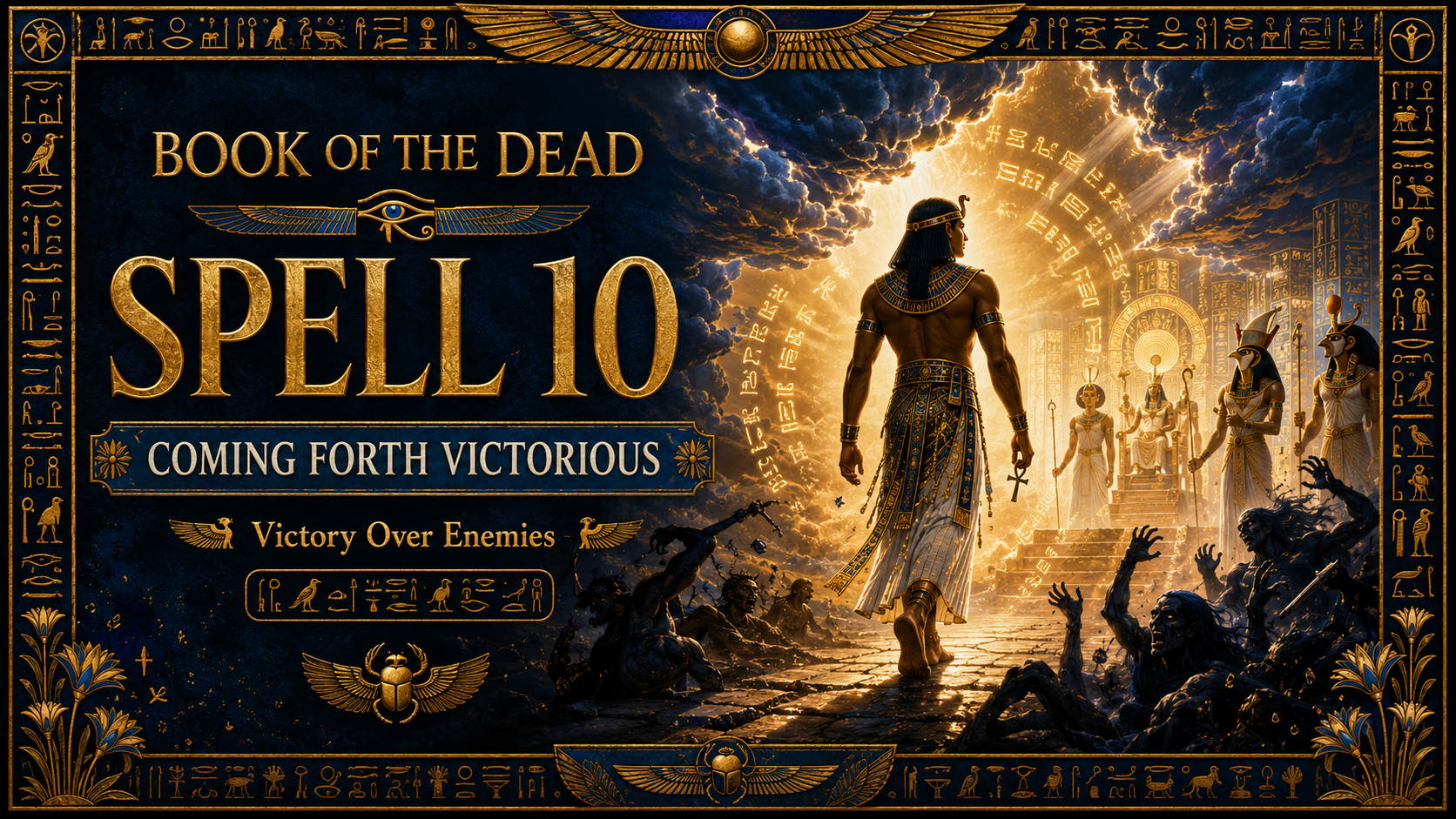
Book of the Dead Spell 10 gave the deceased the power to emerge triumphantly despite the enemies and obstacles encountered after death.
Its traditional title is commonly translated as:
A spell for coming forth victoriously
The spell is extremely short, but its claims are expansive. The deceased defeats adversaries, breaks through heaven, opens the horizon, walks across the earth, receives recognition from glorified spirits, commands countless words of magical power, eats normally, and worships the ruler of the Duat.
Spell 10 is therefore not simply a battle spell. It restores the deceased as a complete, powerful, mobile, and socially accepted being.
What Is Book of the Dead Spell 10?
Book of the Dead Spell 10 is a funerary formula for emerging victoriously against adversaries.
Peter Le Page Renouf and Édouard Naville titled it:
Chapter for coming forth victoriously
The opening line states its purpose immediately:
I come forth victoriously against the adversaries.
The spell then describes the deceased opening the sky and horizon, traveling upon the earth, receiving recognition from powerful spirits, and possessing countless “Words of Might.”
Finally, the deceased confirms the ability to eat, chew, worship the ruler of the Duat, and receive something enduring even amid destruction or upheaval.
In the Renouf and Naville index, Spell 10 is listed without a standard vignette. The same index also identifies Spell 48 as a repetition of Spell 10, showing that the composition could appear under more than one number in the later standardized sequence.
English Translation of Book of the Dead Spell 10
The following reader-friendly version is based on the 1904 translation by Renouf and Naville.
Spell 10: Coming Forth Victoriously
I come forth in victory
against my adversaries.I split open the sky.
I open the horizon.
I travel across the earth on foot.The glorified and mighty ones
come forward to meet me,
for I am equipped
with countless words of power.I eat with my mouth,
and I chew with my jaw.Behold, I worship the god
who is Lord of the Duat.That which endures
amid destruction
is given to me.
The translation is short because Spell 10 itself is a brief composition. Unlike several other Book of the Dead spells, the Renouf and Naville edition does not supply a separate commentary explaining each phrase.
Historical Translation of Spell 10
Renouf and Naville translated the complete chapter as follows:
“I come forth victoriously against the adversaries.
I cleave the heaven, I open the horizon and I travel over the earth on foot. There come forward to me the Glorious and the Great ones, for I am furnished with numberless Words of Might.
I eat with my mouth, and I chew with my jaw; for, lo, I worship the god who is Lord of the Tuat, and that is given to me which endureth amid overthrow.”
In this older translation:
- Tuat is an older spelling of Duat.
- Glorious ones refers to glorified or effective spirits.
- Words of Might means magically effective or authoritative utterances.
- Overthrow can suggest destruction, disorder, reversal, or the defeat of hostile forces.
What Does Book of the Dead Spell 10 Mean?
Spell 10 declares that the deceased has defeated everything capable of preventing renewed life.
The adversaries are overcome. The sky is opened. The horizon no longer blocks passage. The deceased walks freely, receives recognition from the blessed dead, commands magical speech, eats normally, and enters the divine realm.
Its meaning can be summarized as:
No enemy can prevent me from emerging. Heaven, the horizon, and the earth are open to me. I possess the sacred words, physical powers, and divine recognition needed to live again.
The spell transforms the deceased from a potentially helpless corpse into a triumphant traveler.
What Does “Coming Forth Victoriously” Mean?
The ancient Egyptian Book of the Dead was connected with the expression prt m hrw, conventionally translated as Going Forth by Day or Coming Forth by Day.
This referred to much more than leaving a tomb physically. It described the deceased’s ability to emerge from death into an active spiritual existence.
Coming forth could involve:
- Leaving the tomb
- Entering daylight
- Passing through the Duat
- Traveling through the sky
- Walking upon the earth
- Visiting the living
- Receiving offerings
- Joining Ra and Osiris
- Assuming different forms
- Returning safely to the body
Spell 10 adds the idea of victory. The deceased does not merely emerge. The person comes forth after overcoming opposition.
The British Museum describes the Book of the Dead as a practical collection of spells intended to help a person negotiate the next world rather than as a fixed book of doctrine. Spell 10 is a clear example of that practical purpose.
Who Are the Adversaries in Spell 10?
The spell does not identify its adversaries by name.
Throughout Egyptian funerary literature, however, the deceased could encounter many forms of opposition:
- Enemies from mortal life
- Hostile spirits
- Demons and guardians
- Serpents and other dangerous creatures
- Accusers before divine tribunals
- Servants of Set
- Forces connected with Apep
- Beings who blocked gates or roads
- Powers of darkness, decay, and spiritual destruction
The broad wording allows Spell 10 to apply to any enemy that might prevent the deceased from going forth.
The adversaries may therefore be both personal and cosmic. They include not only individual enemies but everything opposed to resurrection, movement, divine order, and continued existence.
Was Victory Physical or Legal?
Ancient Egyptian ideas of victory could include both combat and vindication.
A person could become maa-kheru, commonly translated as:
- True of voice
- Justified
- Vindicated
- Triumphant
The expression indicated that the person’s words or claims had been confirmed and that opposition had been defeated. Spell 10 does not describe a divine trial in detail, but its language of triumph can carry a judicial as well as military meaning.
The deceased may be victorious because:
- Enemies have been defeated.
- Accusations have failed.
- The gods have accepted the speaker.
- The deceased has been declared justified.
- No hostile being can legally or magically restrain the person.
Victory in the afterlife meant possessing an uncontested right to continue existing.
“I Split Open the Sky”
The deceased declares: I split open the sky. This is not the speech of an ordinary human traveler. The speaker assumes a divine or cosmic level of power. Heaven itself cannot remain sealed.
The image may express:
- Opening access to the divine realm
- Breaking through celestial barriers
- Joining the gods in the sky
- Reaching the solar road
- Escaping enclosure
- Exercising creator-like power
Death had placed the person inside a tomb, coffin, and wrapped body. The statement reverses every form of enclosure. Even the sky can be opened by the triumphant deceased.
“I Open the Horizon”
The horizon was a place of transition. The sun appeared on the eastern horizon each morning and disappeared through the western horizon each evening. These two boundaries linked the visible world with the hidden realm.
Opening the horizon therefore gives the deceased access to the sun god’s cycle.
The speaker can:
- Enter the western realm
- Travel through the night
- Emerge in the east
- Participate in solar rebirth
- Pass between the worlds of gods, dead, and living
In Egyptian art, the horizon was represented by the hieroglyph akhet, showing the sun rising or setting between two mountains. By opening the horizon, the deceased removes the boundary between darkness and renewed light.
The Horizon as a Gateway
The horizon was not simply a distant line where the sky appeared to touch the earth. It was a supernatural gateway.
Ra entered the western horizon at sunset, traveled through the Duat, and emerged from the eastern horizon at dawn. The deceased hoped to follow the same path.
Spell 10 gives the speaker direct authority over this gateway: I open the horizon.
The person is not waiting passively for another being to open it. The deceased possesses the power to do so personally.
“I Travel Over the Earth on Foot”
After opening heaven and the horizon, the deceased says: I travel over the earth on foot.
This line restores ordinary physical movement. The contrast is important. The speaker possesses enough power to split heaven, yet also values the simple ability to walk.
Death threatened the use of the body. The deceased feared being:
- Motionless
- Paralyzed
- Confined
- Turned upside down
- Deprived of the legs
- Prevented from leaving the tomb
Numerous Book of the Dead spells restore specific bodily functions because eternal life required movement.
Walking on earth also allowed the deceased to maintain a relationship with the living world. The transformed spirit could leave the tomb, visit familiar places, and receive offerings.
Why Does the Spell Mention Heaven and Earth?
Spell 10 grants access to both realms. The deceased can open the sky and walk upon the earth. This creates complete cosmic freedom.
Ancient Egyptian funerary traditions did not always place the deceased in one permanent destination. A successful spirit might exist:
- In the tomb
- Among the stars
- Within the Duat
- In the solar boat
- In the realm of Osiris
- In the Field of Reeds
- Upon the earth among the living
These possibilities could overlap. Spell 10 prevents the deceased from being confined to only one region. Heaven and earth both become accessible.
Who Are the “Glorious Ones”?
Renouf’s translation states: There come forward to me the Glorious and the Great ones.
The “Glorious Ones” are likely glorified or transfigured spirits, often connected with the Egyptian concept of the akh. An akh was a deceased person who had been successfully transformed and could function effectively in the divine realm.
The Great Ones may refer more broadly to:
- Powerful gods
- Divine ancestors
- High-ranking spirits
- Members of the celestial community
- Beings with recognized authority
Their approach indicates acceptance.
The deceased does not enter the afterlife unnoticed or rejected. Powerful beings come forward to receive the speaker.
Why Is Recognition Important?
Belonging was essential to a successful afterlife. The deceased did not want to become an isolated ghost wandering outside the divine order. The goal was to join an established community of gods and blessed spirits.
When the glorious and great beings approach, they acknowledge that:
- The deceased belongs among them.
- The person has achieved transformation.
- The victory is recognized.
- The speaker possesses legitimate status.
- No enemy has successfully excluded the deceased.
The passage is therefore both social and magical. The deceased has not only survived. The person has been welcomed.
“I Am Equipped With Countless Words of Power”
The reason the powerful spirits approach is that the deceased possesses:
Numberless Words of Might.
These words are not ordinary conversation. They are sacred and magically effective utterances. Ancient Egyptian religion attributed creative and authoritative power to correctly spoken words.
A word of power could:
- Open a gate
- Repel a serpent
- Name a guardian
- Defeat an enemy
- Restore a body part
- Transform the speaker
- Command a divine servant
- Establish the truth of a claim
- Cause a desired condition to exist
The Book of the Dead itself supplied such words. By possessing countless magical utterances, the deceased is prepared for any challenge that may arise.
What Were “Words of Power”?
The older English phrase “Words of Might” is often used to translate concepts related to magical or authoritative speech. Egyptian magic did not depend only on mysterious sounds. Effectiveness came from several connected elements:
- Knowing the correct name
- Speaking with divine authority
- Identifying with a god
- Repeating mythological events
- Declaring the desired result as fact
- Using a properly written spell
- Performing the correct ritual action
Spell 10 presents the deceased as fully supplied with this verbal power.
The person can overcome adversaries because no hostile being possesses superior knowledge or speech.
Knowledge as Protection
Many threats in the Book of the Dead could be overcome through knowledge.
The deceased might need to know:
- The name of a gate
- The name of its guardian
- The parts of a divine boat
- The names of supernatural regions
- The identities of dangerous creatures
- The correct divine myth
- The formula required to answer a challenge
Knowledge gave the deceased control over an otherwise unfamiliar realm.
Spell 10’s “numberless Words of Might” represent an inexhaustible supply of that protective knowledge.
“I Eat With My Mouth”
The deceased next declares: I eat with my mouth.
This may seem ordinary compared with splitting heaven, but eating was a fundamental concern in Egyptian funerary religion.
Death threatened the person’s ability to receive nourishment. Without magical and ritual protection, the deceased might suffer hunger, thirst, or even be forced to consume impure substances.
Funerary texts therefore restore:
- The mouth
- The jaw
- The throat
- The stomach
- Access to bread and beer
- The ability to receive offerings
Eating confirms that the deceased is truly alive.
The person is not merely conscious. The transformed being possesses functioning bodily powers.
“I Chew With My Jaw”
The next phrase reinforces the restoration: I chew with my jaw.
The mouth and jaw had become still in death. Through mummification and funerary ritual, they needed to be symbolically reactivated.
This concern is developed more fully in later chapters dealing with:
- Giving the mouth back to the deceased
- Opening the mouth
- Restoring speech
- Providing words of power
Spell 10 anticipates those themes by declaring that the mouth already functions. The deceased can eat, chew, and therefore receive the nourishment necessary for eternal life.
Food as Evidence of Victory
Eating also confirms that the adversaries have failed. A defeated or imprisoned spirit might be denied offerings. A victorious deceased person can eat normally and participate in the divine community.
The sequence of the spell is significant:
- Enemies are defeated.
- Heaven and the horizon open.
- The deceased travels freely.
- Powerful spirits offer recognition.
- Magical speech is available.
- The body receives food.
- The speaker worships the ruler of the Duat.
Victory results in a complete and sustainable existence.
Who Is the Lord of the Duat?
Spell 10 refers to: The god who is Lord of the Duat.
The text does not name him in the surviving translation.
The title most naturally suggests Osiris, who ruled the realm of the dead. However, Ra also traveled through the Duat and exercised authority within its nightly cycle.
It is safest not to identify the unnamed god with absolute certainty unless a particular Egyptian manuscript supplies the name. The essential point is that the deceased recognizes and worships the legitimate divine ruler of the hidden realm. This worship demonstrates that the speaker is aligned with divine order rather than with the adversaries.
Why Does Worship Matter?
Spell 10 does not present victory as rebellion against all authority. The deceased overcomes hostile beings but willingly honors the rightful god of the Duat.
This distinction establishes the speaker as a legitimate member of the divine order. The deceased is:
- An enemy of chaos
- A victor over adversaries
- A worshipper of the gods
- A follower of the ruler of the dead
- A recognized participant in the afterlife
Power and devotion work together. The speaker succeeds because the victory supports, rather than threatens, the cosmic order.
“That Which Endures Amid Overthrow”
The final line is the most difficult to interpret: That is given to me which endureth amid overthrow. The text does not clearly identify what is given.
It may refer to:
- Enduring life
- A permanent spiritual status
- An imperishable divine quality
- Sustenance that survives destruction
- A secure place in the Duat
- Something preserved despite the fall of enemies
The phrase “amid overthrow” suggests a contrast between what is destroyed and what remains. The adversaries fall, but the deceased endures.
A cautious modern paraphrase would be: I receive the enduring life or power that remains even when hostile forces are overthrown.
The line should not be made more specific than the source permits.
Endurance as the Result of Victory
The Book of the Dead repeatedly protects the deceased from:
- Decay
- Annihilation
- A second death
- Loss of the body
- Loss of the name
- Loss of the heart
- Spiritual imprisonment
- Destruction by hostile gods
Spell 10’s final promise fits this broader concern. Victory is not temporary. The deceased receives something lasting.
The adversaries may be overthrown, cosmic battles may recur, and hostile forces may threaten the divine realm, but the speaker’s transformed existence endures.
Is Spell 10 a Combat Spell?
Spell 10 concerns victory over enemies, but it does not describe a physical battle. There are no weapons, wounds, or named monsters in the surviving text.
The deceased wins through:
- Divine authority
- Freedom of movement
- Magical knowledge
- Recognition by powerful spirits
- Restored bodily functions
- Worship of the rightful god
- Endurance beyond destruction
The spell is therefore better understood as a triumph and liberation formula rather than a simple combat incantation.
Its victory is spiritual, cosmic, social, and possibly judicial.
How Is Spell 10 Different From Spell 11?
Spells 10 and 11 both concern enemies, but they are not identical.
Spell 10
Spell 10 is titled:
A spell for coming forth victoriously
It emphasizes:
- General victory over adversaries
- Opening heaven and the horizon
- Traveling on earth
- Possessing words of power
- Eating and chewing
- Worshipping the Lord of the Duat
- Receiving enduring power
Spell 11
Spell 11 is titled: A spell for coming forth against an adversary in the Netherworld.
It focuses on a more direct confrontation with a specific enemy. The deceased identifies with Ra, Horus, Ptah, Thoth, and Atum while declaring that the adversary will fall and cannot escape. Renouf and Naville caution that Spell 11 survives in a corrupt form and lacks a secure early text.
Spell 10 establishes the condition of general triumph. Spell 11 describes the pursuit and defeat of a particular adversary.
Is Spell 48 the Same as Spell 10?
Yes, in the numbering used by Renouf and Naville, Spell 48 is identified as the same composition as Spell 10. Their chapter index explicitly lists: XLVIII, same as X. The same index also identifies Spell 49 as a repetition of Spell 11.
This duplication reflects the complicated history of the Book of the Dead.
The collection was not created as one fixed, consecutively numbered book. Individual spells circulated independently, appeared in different orders, and could be repeated. The numbering system was imposed by modern scholars from particular manuscript arrangements.
Why Are Book of the Dead Spells Repeated?
The Book of the Dead was assembled from independent compositions rather than written as one continuous work.
A manuscript owner or workshop could:
- Select particular spells
- Omit others
- Change the order
- Combine texts
- Repeat useful formulas
- Use alternative versions
- Add or remove illustrations
When later scholars created standardized numbering systems, duplicated or closely related compositions sometimes received separate numbers. Spell 10 and Spell 48 are an example of this process.
Is Spell 10 Connected to the Coffin Texts?
The uploaded Coffin Text study does not establish a direct relationship between Book of the Dead Spell 10 and the independently numbered Coffin Text Spell 10.
The two collections use different numbering systems, so matching numbers do not indicate that the compositions are the same.
Book of the Dead Spell 10 should therefore not be described as Coffin Text Spell 10 without additional textual evidence.
The broader themes of defeating enemies, possessing magical speech, traveling through divine regions, and achieving vindication do have earlier roots in Egyptian funerary literature. However, that general continuity is not the same as proving direct descent from a particular numbered Coffin Text.
The Meaning of Spell 10 in Simple Terms
Book of the Dead Spell 10 gives the deceased complete victory over anything that might prevent renewed life. The speaker defeats adversaries, breaks open the sky, opens the horizon, walks across the earth, receives recognition from glorified beings, and commands countless sacred words.
The deceased can eat and chew, demonstrating that the body’s powers have been restored. The speaker worships the ruler of the Duat and receives an enduring condition that survives the destruction of enemies.
The spell’s message can be summarized as:
I have defeated every power that opposed me. No boundary in heaven, on the horizon, or upon earth can contain me. I possess the words, the body, and the divine recognition required to live forever.
Spell 10 is therefore a declaration of total liberation. The deceased does not merely survive death. The person emerges from it triumphantly.
Frequently Asked Questions About Book of the Dead Spell 10
What is Book of the Dead Spell 10?
Spell 10 is a short funerary formula that allows the deceased to come forth victoriously against adversaries and travel freely through heaven, the horizon, and the earth.
What is the title of Spell 10?
Renouf and Naville title it: Chapter for Coming Forth Victoriously.
What is the complete translation of Spell 10?
A reader-friendly translation is: I come forth in victory against my adversaries. I split open the sky, open the horizon, and travel across the earth on foot. The glorified and mighty ones come to meet me because I possess countless words of power. I eat with my mouth and chew with my jaw. I worship the Lord of the Duat, and that which endures amid destruction is given to me.
Who are the adversaries?
The spell does not name them. They may represent personal enemies, hostile spirits, supernatural guardians, accusers, or broader powers of darkness and destruction.
What does it mean to open the horizon?
It means gaining access to the gateway through which the sun entered and emerged from the hidden realm. The deceased can participate in the solar cycle of death and rebirth.
What are Words of Might?
They are magically effective or divinely authoritative utterances capable of opening roads, repelling enemies, commanding beings, and establishing the deceased’s rights.
Why does the deceased mention eating?
Eating proves that the person’s physical and spiritual functions have been restored. It also guarantees access to funerary offerings and continued nourishment.
Who is the Lord of the Duat?
The spell does not name the god in the surviving translation. The title may refer to Osiris, although Ra also exercised authority during his nightly journey through the Duat.
What does “endures amid overthrow” mean?
The phrase is uncertain. It likely refers to enduring life, status, or divine power that remains after hostile forces have been overthrown.
Is Spell 48 the same as Spell 10?
Yes. The Renouf and Naville index identifies Spell 48 as the same composition as Spell 10.
How is Spell 10 different from Spell 11?
Spell 10 declares general victory and freedom. Spell 11 focuses more directly on confronting and defeating a particular adversary in the Netherworld.
Did Spell 10 have a standard vignette?
No standard vignette is listed for Spell 10 in the Renouf and Naville edition.
Book of the Dead Spell 10 is brief, confident, and complete. The deceased emerges in victory. Enemies have failed. Heaven is split open, the horizon is unlocked, and the earth can be crossed freely.
Glorified beings recognize the speaker. Sacred words provide unlimited magical power. The mouth and jaw function again, allowing the deceased to eat and receive nourishment. Finally, the speaker honors the ruler of the Duat and receives what endures after hostile forces have fallen.
Spell 10 transforms death into triumph. The deceased is not trapped, silenced, starved, or defeated. Every boundary has opened, and every necessary power has been restored.