The ancient Egyptian Book of the Dead was a collection of funerary spells intended to help the deceased survive the journey through death, overcome supernatural obstacles, and attain a renewed existence among the gods.
Book of the Dead Spell 11 confronts one of those obstacles directly: an adversary who threatens the deceased in the Netherworld.
Its traditional title is:
A spell for coming forth against an adversary in the Netherworld
The deceased does not hide from the enemy or merely ask the gods for protection. Instead, the speaker assumes the identities and powers of Ra, Horus, Ptah, Thoth, and Atum. With the combined authority of these gods, the deceased pursues the enemy and declares that escape is impossible.
Spell 11 is therefore a formula of confrontation, divine transformation, and total victory over opposition.
What Is Book of the Dead Spell 11?
Book of the Dead Spell 11 is a short protective spell that allows the deceased to confront and defeat an adversary in the realm of the dead.
Peter Le Page Renouf and Édouard Naville titled it:
Chapter for coming out against the adversary in the Netherworld
The spell begins by commanding a mysterious being called the Eater of His Arm to move out of the way. The deceased then identifies with Ra emerging from the horizon and declares that the adversary has been surrendered into the speaker’s power.
The deceased rises like Horus, sits like Ptah, triumphs like Thoth, and becomes powerful like Atum. The enemy is pursued and repeatedly denied any possibility of escape.
Renouf and Naville cautioned that the surviving text is highly corrupt and that no reliable early version was available to them. Their restoration was therefore partly conjectural. They interpreted the “Eater of His Arm” as a personification of darkness destroyed by the rising sun.
The Title of Spell 11
The title appears in the Renouf and Naville edition as:
Chapter for coming out against the adversary in the Netherworld
A slightly smoother modern version would be:
A spell for going forth against an enemy in the realm of the dead
The title distinguishes Spell 11 from the preceding composition. Spell 10 grants general victory over adversaries and opens heaven, the horizon, and the earth.
Spell 11 focuses on pursuing and defeating one particular adversary. The enemy is not merely repelled. The deceased goes out to confront that enemy directly.
English Translation of Book of the Dead Spell 11
The following reader-friendly translation is based on the text published by Renouf and Naville. Because the original survives in a corrupt form, this should be treated as a modernized rendering of their reconstruction rather than a definitive translation of every Egyptian word.
Spell 11: Going Forth Against an Adversary
Here is the Osiris [Name].
O Eater of His Arm,
get out of his path.I am Ra,
coming forth from the horizon
against his adversary.He shall not escape from me.
I have stretched out my hand
as the Lord of the Crown,
and I have raised my feet.I shall not be surrendered.
My adversary shall fall before me.
He has been given into my power,
and he shall not escape from me.I rise like Horus.
I sit like Ptah.
I triumph like Thoth.
I am powerful like Atum.
I walk upon my feet.
I speak with my mouth.
I search for the one
who has been delivered into my power.He shall not escape from me.
The name of the deceased would replace [Name] in an individual manuscript.
Historical Translation of Spell 11
Renouf and Naville translated the spell as follows:
“Here is the Osiris N.
O Eater of his arm: away from his path!
I am Râ coming forth from the horizon against his adversary, who shall not be delivered from me.
I have stretched out my hand, as the Lord of the Crown, and lifted my feet.
I shall not be given up; my adversary shall fall before me; he hath been given up to me and shall not be delivered from me.
I rise up like Horus, I sit down as Ptah, I am victorious as Thoth, and powerful as Tmu: I walk upon my feet, I speak with my mouth, searching for him who hath been given up to me; he shall not be delivered from me.”
Their edition notes that Spell 11 survives without a dependable early text and in a form too corrupt to restore with complete confidence. The same historical translation is preserved in the Project Gutenberg edition.
What Does Book of the Dead Spell 11 Mean?
Spell 11 gives the deceased complete control over a hostile being.
The enemy has already been defeated in principle. The adversary has been “given up” or delivered into the deceased’s power. The repeated claim that the enemy cannot escape turns the desired victory into an established fact.
The spell’s central message can be summarized as:
I possess the powers of the gods. My body can move, my voice can command, and no enemy can escape my authority.
The deceased is not portrayed as a frightened soul seeking shelter. The speaker becomes the pursuer rather than the pursued.
Who Is the Adversary?
The spell does not identify the adversary by name. This may have been intentional. Leaving the enemy unnamed allowed the formula to apply to many possible threats, including:
- A personal enemy from life
- A hostile spirit
- A supernatural guardian
- An accuser in the divine court
- A servant of chaos
- A being that blocked the deceased’s path
- A force connected with darkness or death
- An enemy of Ra or Osiris
The adversary could therefore represent any power attempting to prevent the deceased from moving, speaking, rising, or reaching the gods.
Because the text is damaged and lacks a secure early version, it is impossible to identify the adversary more precisely from Spell 11 alone.
What Is the “Eater of His Arm”?
The spell begins with the unusual command: O Eater of His Arm, get out of his path. Renouf and Naville interpreted the Eater of His Arm as darkness, which is destroyed when the sun rises.
The name may describe a being that consumes its own limb, hides its arm, or becomes inactive through self-destruction. The exact Egyptian expression remains uncertain because of the corrupt state of the text.
The symbolic interpretation offered by Renouf fits the next line: I am Ra coming forth from the horizon.
When Ra emerges at dawn, darkness retreats. The command for the Eater of His Arm to leave the path may therefore clear the way for the deceased’s solar emergence.
The hostile being represents what cannot remain when divine light appears.
Darkness as an Enemy
Darkness was not always evil in Egyptian religion. The hidden world was also a place of regeneration, and the sun god passed through darkness every night. However, permanent darkness represented a serious danger.
It could mean:
- Confinement within the tomb
- Loss of sight
- Separation from Ra
- Inability to find the correct road
- Spiritual inactivity
- Failure to emerge into daylight
- Continued existence outside divine order
Spell 11 does not necessarily destroy every form of night. It removes the darkness that obstructs the deceased’s progress. Just as dawn forces darkness from the horizon, the transformed deceased forces the adversary from the path.
“Here Is the Osiris [Name]”
The spell introduces the deceased as:
The Osiris [Name]
This was a common funerary designation.
Placing “Osiris” before the person’s name identified the deceased with the god who had died, been restored, and become ruler of the dead.
The formula did not necessarily erase the person’s individual identity. Instead, it connected the deceased’s fate with the successful resurrection of Osiris.
The title declares:
- The person has undergone death like Osiris.
- The person can be restored like Osiris.
- The deceased belongs within the realm ruled by Osiris.
- Enemies can be defeated as the enemies of Osiris were defeated.
Before the confrontation even begins, the deceased is introduced as someone participating in divine resurrection.
“I Am Ra Coming Forth From the Horizon”
The deceased then assumes another divine identity: I am Ra coming forth from the horizon.
Ra’s daily emergence provided one of the strongest Egyptian images of renewed life. Each night, the sun disappeared into the western horizon and traveled through the Duat. Each morning, it returned in the east.
By declaring “I am Ra,” the deceased claims:
- The power to rise again
- Victory over darkness
- Access to the solar road
- Freedom from permanent death
- Divine light
- Authority over enemies of the sun
The speaker is not simply protected by Ra. The deceased acts in Ra’s identity. The adversary therefore faces the full force of the rising sun.
The Horizon as a Place of Rebirth
The horizon was not merely the visible line where the sky met the earth. It was a supernatural gateway between the visible and hidden worlds. The western horizon received the sun at sunset. The eastern horizon released it at dawn.
Ra’s emergence from the horizon represented:
- Rebirth
- Restoration of light
- The defeat of night
- Renewal of cosmic order
- The continuation of time
Spell 11 places the deceased at this moment of maximum transformation.
The person has passed through death and now comes forth with enough power to defeat anything blocking the new day.
“He Shall Not Escape From Me”
The spell repeatedly states that the enemy will not be released or delivered from the deceased. This repetition is deliberate. Ancient Egyptian magical speech often declared the desired result several times. Repetition reinforced the condition and denied every alternative outcome.
The adversary cannot:
- Run away
- Be rescued
- Escape judgment
- Return later
- Continue blocking the road
- Regain power over the deceased
The formula creates total control. The enemy is not merely pushed aside temporarily. The adversary has been handed over to the deceased and remains within the speaker’s authority.
“I Have Stretched Out My Hand”
The deceased states:
I have stretched out my hand.
Death caused the body to become motionless. Stretching out the hand demonstrates that the deceased has recovered physical and spiritual agency.
The gesture may express:
- Reaching toward the enemy
- Seizing control
- Exercising royal authority
- Performing a magical command
- Reawakening after death
- Taking possession of what has been delivered
The line is followed by the title Lord of the Crown, strengthening the association with kingship and authority. The deceased stretches out the hand not as a helpless supplicant, but as a crowned ruler taking possession of an enemy.
Who Is the Lord of the Crown?
The text does not clearly identify the god or divine form called the Lord of the Crown. The title may evoke royal power generally rather than refer to one specific deity. Crowns in ancient Egypt represented more than ceremonial clothing. They expressed:
- Legitimate kingship
- Divine authority
- Rule over territory
- Protection by the gods
- Victory over enemies
- Union of different regions
By acting as the Lord of the Crown, the deceased assumes the authority of a divine king. The enemy is not facing an ordinary dead person. The adversary is facing someone empowered to rule, judge, and command.
“I Have Raised My Feet”
The deceased also says: I have raised my feet. This may sound simple, but movement was one of the greatest concerns of Egyptian funerary literature.
Death made the body still. The deceased therefore required spells to restore:
- The legs
- The feet
- The mouth
- The heart
- The breath
- The senses
- The ability to leave the tomb
Raising the feet proves that the deceased can stand and walk. It also signals readiness for pursuit. The enemy cannot escape because the speaker has regained the ability to follow.
“I Shall Not Be Surrendered”
The deceased declares:
I shall not be surrendered.
This creates a direct contrast with the enemy.
The adversary has been surrendered into the deceased’s hands, but the deceased cannot be handed over to hostile powers.
The distinction establishes control over fate:
- The enemy is vulnerable.
- The deceased is protected.
- The enemy can be seized.
- The deceased cannot be seized.
- The enemy is judged.
- The deceased possesses divine authority.
The spell reverses any danger that the deceased might be captured, imprisoned, or delivered to supernatural executioners.
“My Adversary Shall Fall Before Me”
The enemy’s defeat is stated as certain:
My adversary shall fall before me.
Falling before another being could represent:
- Physical defeat
- Submission
- Judicial condemnation
- Loss of supernatural power
- Recognition of the victor’s authority
- Prostration before a god or ruler
The adversary falls because the deceased has assumed divine identities that cannot be successfully opposed.
This victory may be both martial and legal. The enemy is defeated in power and stripped of any valid claim against the deceased.
“I Rise Like Horus”
The first divine comparison in the final section is:
I rise like Horus.
Horus was associated with kingship, the sky, divine succession, and the restoration of order after the death of Osiris.
He rose to defend his father, defeat hostile forces, and claim the throne.
By rising like Horus, the deceased gains:
- The power of a dutiful son
- Legitimate royal authority
- Victory over the enemies of Osiris
- The ability to stand after death
- Restoration to an active divine state
The line may also recall Horus’s emergence as the rightful ruler following conflict with Set.
The deceased rises because the forces opposing divine order have failed.
“I Sit Like Ptah”
The next declaration is:
I sit like Ptah.
Ptah was the great creator god of Memphis and a patron of craftsmen.
In Memphite theology, creation could occur through divine thought and speech. Ptah conceived the world in his heart and brought it into existence through his tongue.
Sitting like Ptah may suggest:
- Stability
- Authority
- Enthronement
- Creative power
- Control through speech
- A secure place among the gods
Standing and rising demonstrate movement, but sitting demonstrates possession of a stable seat.
The deceased is not a restless or homeless spirit. Like Ptah, the person possesses an established divine position.
“I Am Victorious Like Thoth”
The deceased then declares:
I am victorious like Thoth.
Thoth was associated with writing, sacred knowledge, divine judgment, measurement, and effective speech.
He also played an important role in the conflict between Horus and Set, often acting as mediator, healer, scribe, or judge.
Thoth’s victory may therefore be intellectual and judicial rather than simply physical.
By triumphing like Thoth, the deceased possesses:
- Correct knowledge
- Authoritative words
- Skill in divine judgment
- The ability to establish truth
- Control over magical language
- Vindication against accusations
The enemy cannot escape because the divine record and judgment support the deceased.
“I Am Powerful Like Atum”
The older translation uses Tmu, an earlier spelling of Atum. The deceased says: I am powerful like Atum.
Atum was the creator god of Heliopolis. He was believed to have emerged from the primeval waters and brought the ordered world into existence.
Atum represented:
- Self-creation
- Completion
- Primordial authority
- The totality of divine power
- The setting sun
- The transition into and out of the hidden realm
By becoming powerful like Atum, the deceased claims authority rooted in the beginning of creation itself.
The adversary is not merely facing a human soul. The enemy confronts the power that established order out of chaos.
Why Does the Spell Invoke So Many Gods?
Spell 11 combines the powers of several gods:
- Ra provides solar emergence and victory over darkness.
- Horus provides rising power, kingship, and triumph over enemies.
- Ptah provides stability and creative authority.
- Thoth provides knowledge, judgment, and effective speech.
- Atum provides primordial and imperishable power.
- Osiris provides resurrection and status in the realm of the dead.
These identifications create a complete divine personality. The deceased can:
- Rise
- Sit securely
- Walk
- Speak
- Judge
- Pursue
- Rule
- Create
- Defeat opposition
No single vulnerability remains for the enemy to exploit.
“I Walk Upon My Feet”
The spell returns from divine identities to a practical declaration: I walk upon my feet. The deceased’s bodily powers have been restored.
Walking confirms that the person can:
- Leave the coffin
- Exit the tomb
- Cross the Duat
- Follow the enemy
- Approach the gods
- Travel between heaven and earth
The afterlife was imagined as a journey, and a person deprived of movement could not complete it.
Spell 11 makes the deceased both divine and physically functional.
“I Speak With My Mouth”
The speaker also declares: I speak with my mouth. Speech was essential to magical power. The deceased needed the mouth to:
- Recite spells
- Name guardians
- Answer divine questions
- Defend against accusations
- Command enemies
- Request food and drink
- Praise the gods
- Establish identity
The mouth had become still in death, so restoring speech was a major funerary concern. Spell 11 confirms that the speaker can pronounce the words that keep the adversary under control.
Why Speech Was a Weapon
The deceased does not carry a clearly described weapon in Spell 11. The primary weapons are identity and speech. By saying “I am Ra,” the speaker becomes solar power. By saying the enemy cannot escape, the spell creates that condition. By naming divine comparisons, the deceased acquires their qualities.
In Egyptian magical thought, correctly spoken words could make a desired reality present. The confrontation is therefore fought through:
- Divine names
- Authoritative declarations
- Repetition
- Mythological identification
- Restoration of the mouth
- Control over the enemy’s fate
The adversary is defeated because the deceased possesses speech that carries divine force.
Searching for the Enemy
The deceased says: I search for the one who has been delivered into my power. This reverses the normal fear of the afterlife. Instead of worrying that an enemy may find and attack the deceased, the deceased actively hunts the enemy.
The pursuit demonstrates that:
- The speaker knows the enemy can be found.
- The deceased can move freely.
- The enemy has nowhere safe to hide.
- Divine judgment has already decided the outcome.
- The deceased controls the confrontation.
The enemy’s inability to escape is repeated at the end, closing the spell with certainty.
How Is Spell 11 Different From Spell 10?
Spells 10 and 11 both concern enemies, but they emphasize different outcomes.
Book of the Dead Spell 10
Spell 10 grants broad victory over adversaries.
The deceased:
- Comes forth triumphantly
- Splits open heaven
- Opens the horizon
- Walks across the earth
- Receives recognition from glorified spirits
- Possesses countless words of power
- Eats and receives lasting life
Book of the Dead Spell 11
Spell 11 focuses on a direct pursuit.
The deceased:
- Commands a dark obstacle to leave
- Emerges as Ra
- Seizes control of an adversary
- Refuses to be surrendered
- Causes the enemy to fall
- Assumes the powers of Horus, Ptah, Thoth, and Atum
- Walks and speaks
- Searches for the defeated enemy
Spell 10 establishes general triumph. Spell 11 applies that triumph to one hostile being.
Is Spell 49 the Same as Spell 11?
Yes. The Renouf and Naville index identifies Spell 49 as the same composition as Spell 11. It similarly identifies Spell 48 as a repetition of Spell 10. This duplication reflects the way the Book of the Dead developed.
The collection was not originally composed as one numbered volume. Individual spells circulated in different sequences and combinations. When modern scholars assigned numbers based on particular manuscripts, some repeated compositions received separate numbers.
Readers researching Book of the Dead Spell 49 may therefore encounter the same text as Spell 11.
Is Spell 11 Well Preserved?
No. Renouf and Naville state: “There is unfortunately no early text of this chapter, which we have in a very corrupt form, and can only restore conjecturally.”
This warning is essential. It means:
- Some words may have been copied incorrectly.
- Parts of the original composition may be missing.
- Later scribes may not have fully understood the text.
- Modern translations may disagree.
- The identity of the Eater of His Arm remains uncertain.
- Some divine titles may have been reconstructed imperfectly.
The spell’s broad purpose is clear from its title and repeated declarations. The exact meaning of every phrase is not.
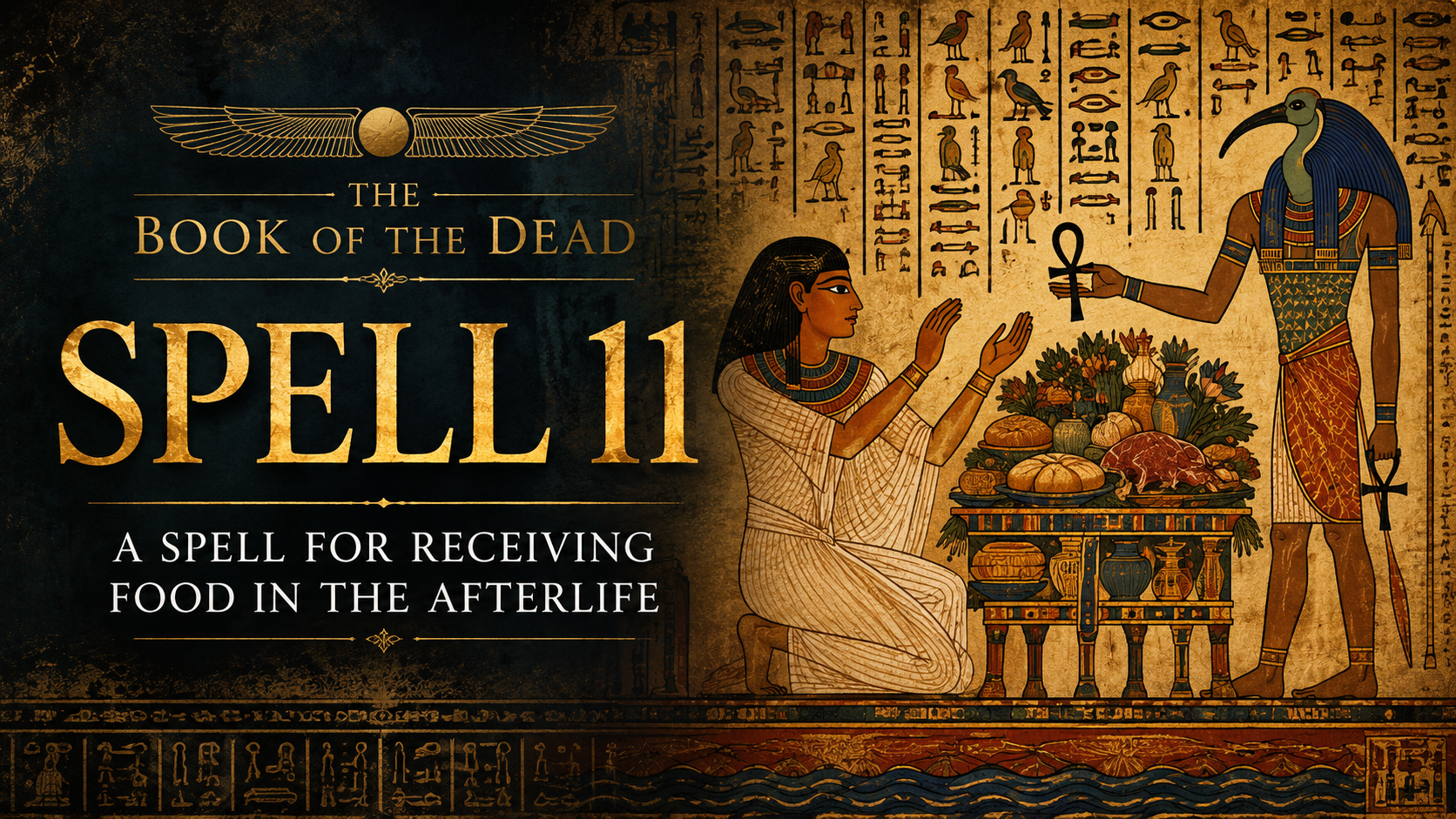
Did Spell 11 Have a Standard Vignette?
The Renouf and Naville index does not list a standard vignette for Spell 11. Spell 11 appears among the early compositions without regular accompanying illustrations in the manuscripts used for that edition.
A modern educational illustration could show:
- The deceased emerging from the horizon as Ra
- A shadowy adversary falling before the speaker
- Horus, Ptah, Thoth, and Atum standing behind the deceased
- The deceased reaching out with one hand
- Darkness retreating from a golden solar path
- Hieroglyphic words of power surrounding the speaker
Such an image would be an artistic interpretation rather than a reconstruction of a standard ancient Spell 11 vignette.
Is Book of the Dead Spell 11 the Same as Coffin Text Spell 11?
No. The Book of the Dead and the Coffin Texts use independent numbering systems created by modern scholars. Book of the Dead Spell 11 concerns confronting an adversary in the Netherworld. Coffin Text Spell 11 is a different Middle Kingdom composition.
The shared number does not indicate that the two spells are identical or directly related. Earlier Egyptian funerary literature certainly contains themes of vindication and defeating enemies, but the available sources used here do not establish that Book of the Dead Spell 11 developed directly from Coffin Text Spell 11.
The Meaning of Spell 11 in Simple Terms
Book of the Dead Spell 11 turns the deceased into a relentless divine opponent of every hostile force.
Darkness is ordered away. The deceased emerges as Ra and takes possession of the enemy. The speaker cannot be surrendered or captured.
The deceased rises like Horus, sits securely like Ptah, triumphs like Thoth, and becomes powerful like Atum. The feet can walk. The mouth can speak. The adversary can be pursued and cannot escape.
The spell’s message can be summarized as:
I am not helpless before my enemy. I possess the light of Ra, the authority of Horus, the stability of Ptah, the victory of Thoth, and the power of Atum. My adversary has been delivered into my hands and cannot escape.
Spell 11 does more than protect the deceased. It ensures that the deceased becomes the victor, judge, and pursuer.
Frequently Asked Questions About Book of the Dead Spell 11
What is Book of the Dead Spell 11?
Spell 11 is a funerary formula for confronting and defeating an adversary in the Netherworld.
What is the title of Spell 11?
Renouf and Naville title it: Chapter for Coming Out Against the Adversary in the Netherworld
What is the complete translation of Spell 11?
A reader-friendly rendering is:
O Eater of His Arm, leave my path. I am Ra emerging from the horizon against my adversary, who cannot escape me. I stretch out my hand and raise my feet. I shall not be surrendered. My enemy shall fall before me. I rise like Horus, sit like Ptah, triumph like Thoth, and become powerful like Atum. I walk, speak, and search for the enemy delivered into my power. He shall not escape.
Who is the Eater of His Arm?
The identity is uncertain. Renouf and Naville interpreted the being as darkness destroyed by the rising sun.
Who is the adversary?
The spell does not name the enemy. The adversary may represent a hostile spirit, accuser, supernatural guardian, personal enemy, or general force opposing resurrection.
Why does the deceased say, “I am Ra”?
Ra emerged from the horizon each morning after passing through the darkness of the Duat. Identifying with Ra gives the deceased the same power of renewal and victory over darkness.
Why are Horus, Ptah, Thoth, and Atum mentioned?
Each deity contributes a different power. Horus provides rising and kingship, Ptah stability and creation, Thoth victory and magical speech, and Atum primordial strength.
What does “I shall not be surrendered” mean?
It means the deceased cannot be handed over to enemies, executioners, hostile judges, or supernatural captors.
Why does the spell emphasize walking and speaking?
Death caused the body to become motionless and silent. Walking and speaking prove that the deceased has regained the abilities necessary to travel and use magical words.
Is Spell 49 the same as Spell 11?
Yes. The Renouf and Naville index identifies Spell 49 as a repetition of Spell 11.
Is the translation certain?
No. The surviving text is corrupt, and Renouf and Naville acknowledged that their restoration was conjectural.
Did Spell 11 have a standard illustration?
No standard vignette is listed in the Renouf and Naville edition.
Book of the Dead Spell 11 presents the deceased as a force no enemy can escape. The speaker emerges from the horizon as Ra, forces darkness from the road, stretches out a commanding hand, and stands beyond capture. The deceased combines the powers of several gods. Horus provides the ability to rise. Ptah provides stability. Thoth provides victory and authoritative speech. Atum provides the strength of the creator. By the end of the spell, the deceased can walk, speak, pursue, and command. The adversary has fallen, and the journey through the afterlife can continue without obstruction.