The ancient Egyptian Book of the Dead was a collection of funerary spells intended to help the deceased awaken, travel through the afterlife, overcome supernatural dangers, and continue living as a transformed spirit.
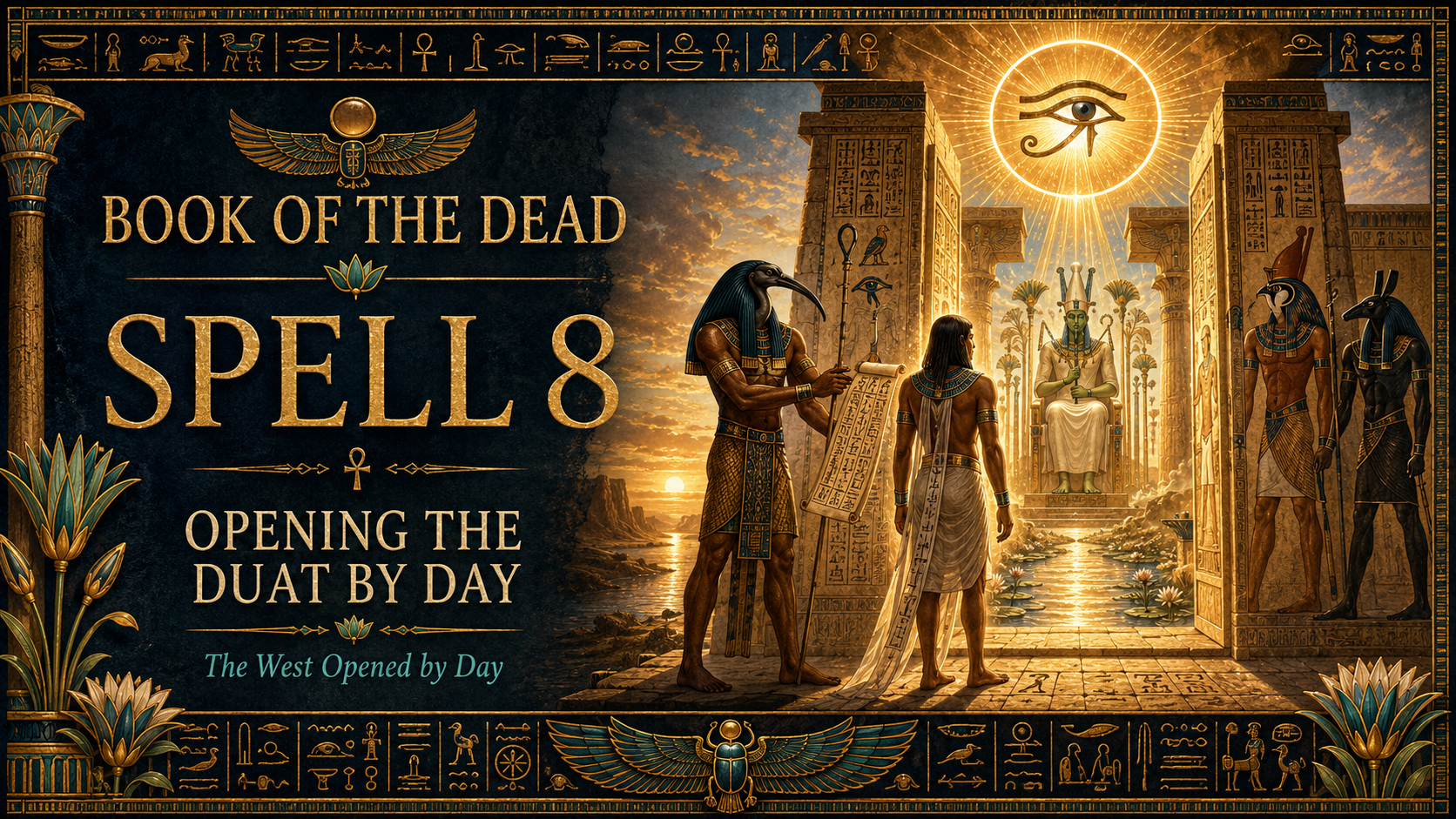
Book of the Dead Spell 8 concerns the opening of the Duat, the hidden realm through which the gods and the deceased traveled. The spell invokes Thoth, the Eye of Horus, Ra, Osiris, Set, and Horus while presenting the deceased as someone who possesses the divine knowledge and authority needed to pass between darkness and daylight.
Its title is commonly translated as: A spell for opening the West by day or A chapter for opening the Duat by day.
The spell is short, but its language is difficult. Even the early Egyptologist Peter Le Page Renouf called one of its passages among the most challenging in the Book of the Dead. For that reason, the purpose of Spell 8 is clearer than the precise meaning of every line.
At its heart, Spell 8 gives the deceased access to the hidden world and the power to emerge from it again.
What Is Book of the Dead Spell 8?
Book of the Dead Spell 8 is a funerary formula for opening the Duat or western realm during the day.
Peter Le Page Renouf and Édouard Naville titled it:
Chapter of Opening the Tuat by Day
The UCL Digital Egypt list gives the title as:
Formula for opening the West by day
Tuat is an older spelling of Duat. The “West” refers to the region associated with sunset, burial, and entrance into the realm of the dead. These titles describe the same general objective: opening the hidden world so the deceased can pass through it rather than remain sealed inside.
Spell 8 belongs to a sequence of early Book of the Dead spells concerned with movement:
- Spell 2 allows the deceased to go forth by day and live after death.
- Spell 3 connects resurrection with the daily rebirth of Ra.
- Spell 4 grants travel along a divine road.
- Spells 5 and Spell 6 protect the deceased from labor.
- Spell 7 allows passage beyond Apep.
- Spell 8 opens the Duat by day.
- Spell 9 opens the Duat, so the deceased may see Osiris.
Together, these spells transform the tomb from a permanent enclosure into a gateway through which the deceased can travel.
English Translation of Book of the Dead Spell 8
The following reader-friendly translation is based on the version published by Renouf and Naville in 1904.
Spell 8: Opening the Duat by Day
The Hour reveals
what the head of Thoth keeps concealed,
he who gives power to the Eye of Horus.I call upon the Eye of Horus,
which shines as an ornament
upon the brow of Ra,
the father of the gods.I am that Osiris,
the Lord of the West.Osiris knows his appointed day,
when it is his destiny
to bring his activity to its completion
and to be no more.I am Set,
the father of the gods,
the imperishable one.Remain, Horus,
for he is counted among the gods.
The unusual language should not be smoothed over too aggressively. Several statements remain uncertain, especially the passage about Osiris reaching the end of his activity and the final command addressed to Horus.
Historical Translation of Spell 8
Renouf and Naville translated the spell as follows:
“The Hour discloseth what the head of Thoth keepeth close, who giveth might to the Eye of Horus.
And I call upon the Eye of Horus which gleams as an ornament upon the brow of Ra, the father of the gods.
I am that Osiris, the Lord of Amenta, and Osiris knoweth his day, that it is in his lot that he should end his being, and be no more.
I am Sutu, the father of the gods, the imperishable one.
Stay, Horus, for he is counted among the gods.”
In this translation:
- Tuat means Duat.
- Amenta means the western realm of the dead.
- Sutu is an older spelling of Set.
- Tmu, when found in related texts, is an older spelling of Atum.
Renouf warned that the passage concerning Osiris is exceptionally difficult and that his translation reflected what he believed the Egyptian grammar required, not a completely certain interpretation.
What Does Book of the Dead Spell 8 Mean?
Spell 8 concerns the opening of what death has closed.
The deceased has entered the West, the region of sunset and burial. To continue existing, the person must gain access to the Duat, understand its hidden processes, and emerge from it as the sun emerges from darkness.
The spell establishes that authority through several divine identifications:
- Thoth reveals hidden knowledge.
- The Eye of Horus supplies restored power.
- Ra provides solar light.
- Osiris represents death and renewed existence.
- Set represents an enduring divine force.
- Horus belongs among the gods and participates in the restoration of order.
The speaker does not merely ask a door to open. The deceased identifies with the divine powers governing time, darkness, death, conflict, restoration, and rebirth.
In simple terms, the spell declares:
The hidden realm is revealed to me. I possess the restored Eye of Horus. I share in the powers of Osiris, Set, and Horus. The way through death and back into daylight is open.
What Was the Duat?
The Duat was the hidden region through which the sun god traveled during the night. It was also a realm occupied by:
- Gods
- The blessed dead
- Hostile beings
- Gatekeepers
- Serpents
- Lakes
- Caverns
- Fields
- Divine tribunals
- Places of regeneration
The Duat was not simply equivalent to the modern idea of hell. It contained dangerous regions, but it was also the place where the sun god was renewed before dawn.
Each evening, Ra entered the western horizon. During the night, he crossed the hidden world, encountered gods and enemies, and emerged again in the east. The deceased hoped to participate in this same pattern.
Opening the Duat therefore meant more than gaining entrance to an underworld. It meant gaining access to the cosmic process through which death became renewed life.
Why Is Spell 8 Also Called “Opening the West by Day”?
Ancient Egyptians associated the west with death because the sun appeared to descend there each evening.
Most cemeteries near major settlements were located on the desert margins, and many important burial grounds lay west of the Nile. The western horizon therefore became both a physical and symbolic entrance into the realm of the dead.
Calling Spell 8 a formula for opening the West by day emphasizes the reversal of ordinary expectations. The West belongs to sunset and darkness. Spell 8 opens it during the day.
That opening allows the deceased to:
- Move between darkness and light
- Leave the tomb
- Enter the divine realm
- Return from the Duat
- Join the solar cycle
- Avoid permanent confinement
The title expresses one of the central promises of the Book of the Dead: the deceased should be able to enter and leave the afterlife freely.
“The Hour Reveals What Thoth Keeps Hidden”
The spell begins: The Hour reveals what the head of Thoth keeps concealed. Renouf’s notes explain the Hour as Time. This suggests that the hidden knowledge becomes available at the correct moment.
Time was not merely an abstract measurement in Egyptian religion. Hours could be personified and treated as active powers, especially in descriptions of the sun god’s journey through the night.
Different hours of the Duat brought different:
- Gates
- Gods
- Transformations
- Dangers
- Ritual events
- Stages of solar renewal
The first line may therefore announce that the proper hour has arrived for a divine secret to be disclosed. The deceased gains access not by forcing the hidden world open at random, but by entering the ordered cycle at the correct moment.
Why Is Thoth Important in Spell 8?
Thoth was the god of:
- Writing
- Sacred speech
- Knowledge
- Calculation
- Time
- The moon
- Divine judgment
- Mediation
Renouf specifically connects Thoth with the moon in his notes to Spell 8. He argues that relationships between solar and lunar phenomena contributed to much Egyptian mythology.
Thoth is well suited to guard hidden knowledge because he understands divine words, time, celestial cycles, and the correct order of rituals.
The spell does not say that Thoth reveals everything immediately. His head keeps something closed until the Hour discloses it. The image suggests controlled access to sacred knowledge. The deceased must possess the right spell and reach the correct moment before the mystery becomes available.
What Does Thoth Keep Hidden?
The spell does not clearly identify the secret kept within or by the head of Thoth.
It may concern:
- The knowledge required to open the Duat
- The correct moment of passage
- The restoration of the Eye of Horus
- The transition between lunar and solar light
- The mystery of death and resurrection
Because the surviving text does not explain the phrase, any precise identification would be speculative. The safest interpretation is that Thoth guards divine knowledge and that Time reveals it when the deceased is prepared to proceed.
“Who Gives Power to the Eye of Horus”
Thoth is described as one who gives strength or power to the Eye of Horus. The Eye of Horus was one of ancient Egypt’s most important symbols of restoration, protection, health, and completeness.
In the mythological conflict between Horus and Set, the Eye of Horus was damaged or removed. Thoth was frequently associated with its healing and restoration.
The repaired Eye came to symbolize something that had been injured but made whole again. That made it especially appropriate for funerary religion.
Death had damaged the person’s unity. The body had become motionless, and the individual’s spiritual components risked separation. Like the Eye, the deceased needed to be restored. When Thoth gives power to the Eye of Horus, the spell invokes the process through which loss is reversed, and wholeness is recovered.
Solar and Lunar Meanings of the Eye
The Eye of Horus could carry several overlapping associations. It was frequently connected with the moon, while the Eye of Ra was strongly solar. Egyptian religious texts did not always maintain rigid divisions between these images.
Spell 8 places the Eye of Horus on the forehead of Ra: It gleams as an ornament upon the brow of Ra.
This unites lunar and solar symbolism. Thoth, associated with the moon and measurement of time, empowers the Eye. The Eye then shines from the solar god’s brow.
The image can be understood as the restoration of light after darkness. The deceased seeks the same transformation:
- Darkness becomes light.
- Injury becomes wholeness.
- Concealment becomes revelation.
- Death becomes renewed life.
Why Is the Eye on the Brow of Ra?
The divine eye shining from Ra’s forehead represents active protective power. The forehead is the place from which the uraeus serpent could appear on divine and royal crowns. The fiery eye of the sun god could protect Ra, destroy enemies, and demonstrate his authority.
In Spell 8, the restored Eye of Horus becomes an ornament of Ra.
This may communicate several ideas:
- Horus and Ra are joined through divine sight.
- The damaged eye has been restored to power.
- Solar light illuminates the hidden world.
- The deceased gains protection against darkness.
- The Duat opens before the divine eye.
The speaker calls upon the Eye because it can see and illuminate what would otherwise remain concealed.
“I Am That Osiris”
The deceased declares: I am that Osiris, the Lord of the West.
This is a familiar strategy in Egyptian funerary literature.
The deceased does not merely ask Osiris for help. The speaker assumes the identity and condition of Osiris.
Osiris had experienced:
- Death
- Bodily destruction
- Mourning
- Restoration
- Vindication
- Renewed existence
- Kingship over the dead
By becoming Osiris, the deceased enters the same pattern. The statement means: What happened successfully to Osiris will happen successfully to me.
The dead person can enter the West because Osiris rules there. The person can survive death because Osiris survived it.
Who Was Osiris, Lord of the West?
Osiris was one of the principal gods of the Egyptian afterlife. He was associated with:
- Resurrection
- Regeneration
- Fertility
- Kingship
- Divine judgment
- The realm of the dead
- The annual renewal of vegetation
The title Lord of Amenta means Lord of the West or Lord of the western realm.
The West was where the sun set and where the deceased entered the afterlife. Osiris ruled this region as a resurrected god.
Identifying with him gave the deceased both admission and status.
The speaker does not enter as an unknown soul. The person enters in the identity of the ruler himself.
“Osiris Knows His Day”
The spell says: Osiris knows his day. This may refer to the appointed day of death, transition, judgment, or transformation.
In Egyptian religion, knowing the correct time was a form of power. The divine cycle operated according to ordered moments:
- Sunset
- Entry into the Duat
- Nightly regeneration
- Dawn
- Reappearance in light
Osiris knows when his transformation must occur. The deceased, identified with Osiris, gains the same knowledge.
The line therefore may indicate that death does not arrive as uncontrolled chaos. It occupies a recognized place within the divine order.
“He Should End His Being and Be No More”
This is the most difficult passage in Spell 8. Renouf translated it as saying that Osiris knows it is his fate: “that he should end his being, and be no more.”
He immediately cautioned that this was among the most difficult passages in the Book of the Dead. He explained that the underlying Egyptian term was closer to motion or activity than the abstract English word “being.” The phrase translated as ending did not necessarily imply simple annihilation but completion or the bringing of an activity to its appointed end.
A more cautious modern rendering would therefore be: Osiris knows the day when his present activity reaches completion.
This does not mean Egyptian funerary religion taught that Osiris permanently ceased to exist. That would contradict his central role as the resurrected ruler of the dead.
The line probably concerns a transition from one state to another:
- Activity gives way to stillness.
- Day gives way to night.
- Mortal life reaches completion.
- The god enters the condition from which renewal will emerge.
The end described here is part of a cycle, not necessarily final destruction.
From Light to Darkness and Back Again
Renouf’s commentary connects the difficult passage with movement: From Light to Darkness and the converse. This provides an important clue.
The spell may describe the alternating conditions experienced by the sun god, Osiris, and the deceased:
- Light changes into darkness.
- Activity changes into stillness.
- Life enters death.
- The hidden transformation takes place.
- Darkness returns to light.
- Stillness becomes renewed activity.
Spell 8 opens the Duat “by day” because it gives the deceased power over both directions of the transition.
The person can enter the darkness without being permanently consumed by it.
Why Does the Deceased Say, “I Am Set”?
The next declaration is unexpected: I am Set, the father of the gods, the imperishable one.
Set is often remembered as the enemy of Osiris and the rival of Horus. Yet Egyptian religion was not static, and Set’s role was more complex than that of a purely evil being.
Set could represent:
- Disorder
- Violence
- The desert
- Storms
- Foreign lands
- Strength
- Royal power
- Protection of Ra against Apep
In some traditions, Set stood in Ra’s solar boat and used his strength to repel the serpent Apep. By identifying with Set, the deceased may claim his fierce and indestructible power.
The statement is especially striking because the speaker has just said: I am Osiris. The deceased therefore contains both sides of a divine conflict.
Why Identify With Both Osiris and Set?
At first, identifying with Osiris and Set appears contradictory. Osiris was the murdered god, while Set was his attacker. Yet funerary spells frequently combine divine identities that would seem incompatible in a simple narrative.
The purpose is not to tell the myth from beginning to end. It is to gather every divine power needed by the deceased.
From Osiris, the speaker receives:
- Resurrection
- Rule over the West
- Vindication
- Eternal existence among the dead
From Set, the speaker receives:
- Strength
- Resistance
- Imperishability
- Power against hostile forces
The deceased becomes both the god who survives death and the force too powerful to be destroyed. Spell 8 may also reflect a larger concern with reconciling opposing powers so the cosmos can remain balanced.
Is Set Really Called “Father of the Gods”?
Renouf’s translation calls Set: The father of the gods.
The phrase is unusual, and the textual interpretation should be treated cautiously. Set could be given elevated titles in particular religious contexts, especially where his power was valued rather than condemned.
It is also possible that textual variation or translation difficulty affects the passage.
The important point is that Spell 8 presents Set positively as imperishable. The deceased assumes that endurance.
“Remain, Horus”
The final line reads: Stay, Horus, for he is counted among the gods.
This passage is also difficult. The command translated as “stay” could imply remaining, standing firm, or waiting. The pronoun in the second clause is not entirely clear in English.
Possible interpretations include:
- Horus is commanded to remain because the deceased has joined the gods.
- The deceased is recognized as a divine being through Horus.
- Horus is asked to stand as witness to the speaker’s transformation.
- The line confirms Horus’s place among the divine company.
The surviving text does not provide enough context to settle the question confidently. What remains clear is that the spell ends by invoking Horus and divine membership. The deceased has moved from concealed knowledge to recognition among the gods.
Horus and the Restoration of Order
Horus was the son and avenger of Osiris. He fought Set, defended his father, recovered the kingship, and helped establish divine order after the murder of Osiris.
Horus is therefore essential to the themes of Spell 8:
- His Eye is restored.
- His father Osiris rules the West.
- His conflict with Set contributes to cosmic order.
- His status among the gods is affirmed.
The deceased enters this mythological network and gains power from every part of it.
The restored Eye, resurrected father, powerful rival, and divine son all contribute to opening the hidden realm.
Does Spell 8 Describe the Opening of a Physical Door?
Spell 8 does not describe hinges, bolts, gatekeepers, or a visible doorway. “Opening” is broader than opening a physical gate.
It may refer to:
- Revealing hidden knowledge
- Making the Duat accessible
- Illuminating darkness
- Opening a route through the western horizon
- Allowing the deceased to enter and emerge
- Restoring spiritual sight
- Beginning the process of transformation
The first line itself describes disclosure. What Thoth had kept hidden becomes revealed. The opening is therefore intellectual, magical, cosmic, and geographical at the same time.
How Does Spell 8 Differ From Spell 9?
Spell 8 and Spell 9 have very similar titles, but their texts are different.
Spell 8
Spell 8 is titled Opening the Duat by Day.
It invokes:
- Thoth
- The Eye of Horus
- Ra
- Osiris
- Set
- Horus
Its emphasis is on hidden knowledge, divine identities, time, and the transition between light and darkness.
Spell 9
Spell 9 is titled Opening the Duat. In Spell 9, the deceased addresses a mighty soul and declares: I open the Duat that I may see my father Osiris and drive away the darkness.
The speaker takes the role of Horus, the loving son who comes to see and avenge Osiris. The spell asks the gods to prepare a path. Spell 8 establishes the cosmic and divine power needed to open the hidden realm. Spell 9 focuses more directly on entering it to reach Osiris.
Is Spell 8 the Same as Coffin Text Spell 8?
No. The Book of the Dead and the Coffin Texts use independent numbering systems created by modern scholars. Book of the Dead Spell 8 is the formula for opening the Duat or West by day. Coffin Text Spell 8 is a different composition.
A shared number does not establish a relationship between the two texts. This distinction should be included because searches for “Egyptian Spell 8” may return results from either collection.
Why Is Spell 8 Difficult to Translate?
Several features make the spell challenging:
- The composition is extremely short.
- Its statements lack explanatory context.
- Divine identities change rapidly.
- Some Egyptian words express action rather than abstract existence.
- The passage about Osiris reaching an end is grammatically and theologically difficult.
- Pronouns in the final line are unclear.
- Different editions may choose different titles and readings.
Renouf himself acknowledged these problems rather than pretending the meaning was certain.
A responsible interpretation should therefore distinguish between:
- The clear purpose expressed by the title
- The words preserved in the translation
- Renouf’s grammatical explanation
- Broader interpretations drawn from Egyptian mythology
The Meaning of Spell 8 in Simple Terms
Book of the Dead Spell 8 gives the deceased the power to open the hidden realm during the day.
Thoth reveals secret knowledge at the proper hour. The restored Eye of Horus shines from the brow of Ra. The deceased identifies with Osiris, who rules the West and passes through death, and with Set, who possesses fierce and imperishable power. Horus is recognized among the gods.
The meaning can be summarized as:
The mysteries of the hidden world are revealed to me. Divine light opens the darkness. I possess the resurrection of Osiris, the endurance of Set, and the restored power of Horus. The Duat cannot remain closed to me.
Spell 8 is not simply about entering the underworld. It is about controlling the boundary between death and renewed life.
Frequently Asked Questions About Book of the Dead Spell 8
What is Book of the Dead Spell 8?
Spell 8 is a funerary formula that opens the Duat or western realm by day, allowing the deceased to gain access to the hidden world and participate in divine renewal.
What is the title of Spell 8?
Renouf and Naville call it Chapter of Opening the Tuat by Day. UCL lists it as Formula for Opening the West by Day.
Are Tuat and Duat the same place?
Yes. Tuat is an older English spelling of Duat, the hidden realm traveled by the sun god and the deceased.
Why does the spell mention Thoth?
Thoth guards divine knowledge, regulates time, restores the Eye of Horus, and helps reveal the mysteries needed to enter the hidden world.
What is the Eye of Horus?
The Eye of Horus is a symbol of protection, restoration, healing, and wholeness. In Spell 8, Thoth gives it power, and it shines from the brow of Ra.
Why does the deceased say, “I am Osiris”?
Identifying with Osiris allows the deceased to share in his resurrection, vindication, and authority over the western realm.
Does the spell say Osiris ceases to exist?
Renouf’s translation appears to say this, but he explains that the Egyptian wording is closer to the completion of motion or activity than abstract nonexistence. The line likely describes transition rather than permanent annihilation.
Why does the deceased identify with Set?
Set could provide strength, endurance, and the violent power needed to resist hostile forces. In some traditions, he protected Ra from Apep.
How is Spell 8 different from Spell 9?
Spell 8 uses divine identifications and celestial symbolism to open the Duat by day. Spell 9 presents the deceased as Horus entering the Duat to see Osiris and drive away darkness.
Did Spell 8 have a standard illustration?
No standard vignette is listed in the Renouf and Naville edition.
Is Book of the Dead Spell 8 the same as Coffin Text Spell 8?
No. They belong to separately numbered collections and are different compositions.
Book of the Dead Spell 8 opens a realm that death had closed. Time reveals the secret guarded by Thoth. The Eye of Horus shines with renewed power. Osiris provides the pattern of death and resurrection. Set provides imperishable strength. Horus confirms the restoration of divine order.
The language is difficult because the spell compresses several complicated religious ideas into only a few lines. Its central message, however, is clear. The deceased possesses the knowledge and divine identities needed to cross the western horizon, enter the hidden realm, and return from darkness into light. The Duat is no longer a prison. It has become an open path toward renewed life.