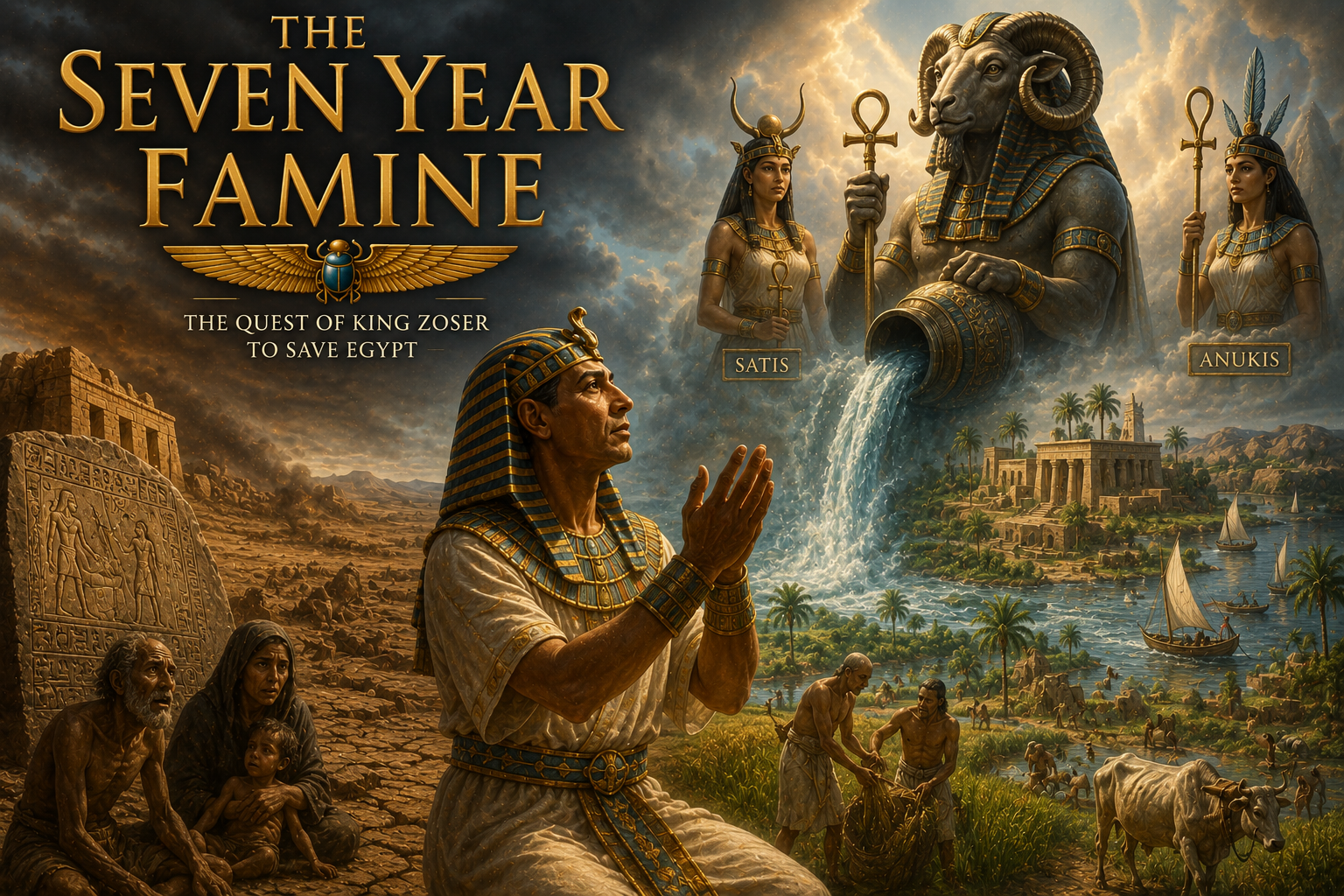
On an island in the Nile, near the ancient city of Elephantine, stands a granite rock carved with both an inscription and a scene depicting a king with three deities: Khnum, Satis, and Anukis. The carving and inscription are about two thousand years old, but the story itself is set during the reign of King Zoser, who ruled Egypt more than four and a half thousand years ago.
The story illustrates just how vital the River Nile was to the people of ancient Egypt. The Blue Nile rises in the mountains of Ethiopia, while the White Nile begins in the lakes and marshes of central Africa. The two rivers join near Khartoum, the capital of Sudan, before flowing north toward Egypt.
Each year, heavy summer rains in Ethiopia and Sudan cause the Nile to swell. Today, the river is controlled by the great Aswan High Dam, but in ancient times the swollen waters overflowed into the valley, leaving behind a layer of rich mud ideal for growing crops. When the waters finally receded, planting could begin.
A particularly powerful flood could sometimes damage settlements built on higher ground, but a weak flood, known as a “low Nile,” was far worse. If the floodwaters failed to spread across enough farmland, Egypt faced starvation.
In the eighteenth year of Zoser’s reign, the Nile failed to rise and flood the land with its life-giving waters. For six years Egypt had suffered from low Nile floods. The floods reached only half the fields, and too little grain was harvested to feed the people. Year after year the Egyptians prayed for a great flood, yet each year the waters grew lower still.
By the seventh year, Zoser was in despair.
Food of every kind had become scarce. Men robbed their own brothers to obtain enough to eat. Children wailed with hunger in their mothers’ arms. Old men crouched in the dust, hugging their knees, and even the nobles had become gaunt and grim. The temples had been closed for lack of offerings, and the shrines of the gods stood deserted.
None of the king’s advisers knew what to do until Zoser turned to his vizier, the wise Imhotep.
“Tell me,” said Zoser, “where is the source of the Nile? What is the city of the Sinuous One, and what god dwells there? If I knew this, I could pray to him to end our seven years of famine.”
Imhotep was famous throughout Egypt for his skill in architecture, medicine, and every other branch of learning, but even he could not answer the king immediately.
“Sovereign, my lord,” said Imhotep, “I shall go to the temple of Thoth and consult the sacred books in the House of Life. If the answers exist, I will find them there.”
For many days Imhotep studied the sacred writings, texts so ancient and mysterious that only he possessed the wisdom to understand them. At last he discovered everything the king wished to know and hurried back to court.
“Sovereign, my lord,” said Imhotep, “far to the south, on an island in the Nile, lies the city of Elephantine. It stands upon the first mound of land that rose from the dark waters of Nun at the beginning of creation. The hills surrounding the city are rich in red and black granite, as well as copper, silver, gold, turquoise, carnelian, emerald, and jasper.
“In the heart of the city stands a temple called Joy of Life. Beneath this temple lie two caverns from which the Nile emerges. From these hidden chambers the river rises and rushes toward Egypt in a mighty flood.
“Khnum is the god who opens the floodgates. He sits enthroned at Elephantine, his sandals resting upon the Nile and his crown touching the sky. Khnum is lord of barley and wheat, fruits and flowers, birds and fish, and all living creatures. Each day offerings are presented in his temple to Khnum, to Satis his consort, to Anukis their daughter, and to all the other deities of Elephantine.”
Zoser was delighted to learn of such a wondrous place on the edge of his kingdom. He immediately consulted the secret books to learn the rituals that would please Khnum and the gods of Elephantine.
The king spent the entire day leading processions of priests and presenting offerings.
That night, as Zoser slept, he dreamed that the ram-headed god Khnum stood beside his bed. In his dream, the king leapt up and kissed the ground before the deity.
Khnum spoke kindly to him.
“I am the maker of mankind. My arms surround you to steady and protect you. I have given precious stones to Egypt so that temples may be built and the statues of the gods adorned.
“I am master of the flood. When I open the two caverns, the Nile pours forth to nourish your land and kiss your fields.
“Mourn no longer. Because you have called upon me, I shall end the seven years of famine. I will make the Nile flow abundantly once more, and the great flood shall again shine upon the fertile shores of Egypt.”
Then the glorious god faded from the king’s sight.
When Zoser awoke, he remembered every detail of his dream. Filled with joy and renewed vigor, he knew with certainty that Egypt would be saved.
In gratitude for Khnum’s promise, Zoser decreed that Elephantine should belong to Khnum forever and that one-tenth of all the produce of Upper Egypt should be offered to his temple.
Farmers were to dedicate a portion of every harvest. Hunters, fishermen, and bird trappers were to surrender a portion of each catch. Merchants were to heap the altars of Khnum with ivory, ebony, and all the riches of Africa.
The Temple of Joy of Life was to be maintained in perfect condition, and its shrines filled with statues fashioned from gold, silver, and precious stones.
The king’s decree was carved upon granite so that it would never be forgotten.
Khnum kept his promise.
For the remainder of Zoser’s reign, and for many years afterward, the Nile flooded the land abundantly.
The Egyptians came to regard Zoser’s reign as the beginning of a golden age. The wise Imhotep was eventually worshipped as a god, and Zoser was remembered as the greatest ruler of the Third Dynasty.
The Fourth Dynasty, which followed, marked the height of Egypt’s Old Kingdom, an age during which the civilization reached the pinnacle of its power and splendor.