More than five thousand years ago, Egypt was not yet the united kingdom remembered by history.
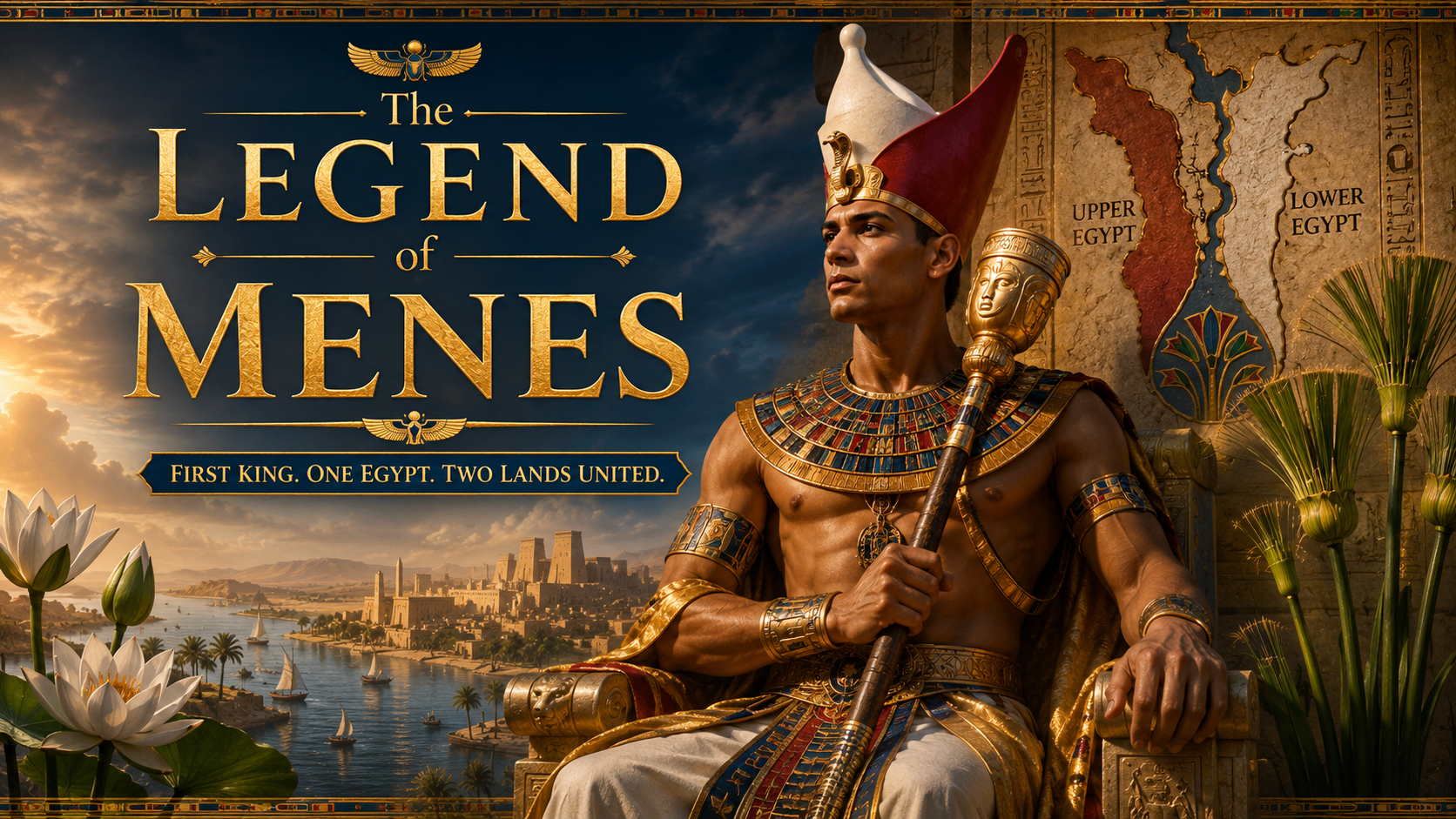
The Nile flowed through two distinct lands. To the south was Upper Egypt, a narrow kingdom stretching along the river valley. To the north was Lower Egypt, where the Nile divided into many branches before reaching the Mediterranean Sea.
Each land had its own rulers, gods, symbols, and crown.
The king of Upper Egypt wore the tall White Crown, known as the Hedjet. The ruler of Lower Egypt wore the Red Crown, called the Deshret. The vulture goddess Nekhbet protected the south, while the cobra goddess Wadjet guarded the north.
According to later Egyptian tradition, one king brought these lands together and became the first ruler of a united Egypt.
His name was Menes. Yet the true identity of Menes remains one of the oldest mysteries in Egyptian history.
The First King of Egypt
Ancient Egyptian king lists placed a ruler named Menes at the beginning of the First Dynasty. Much later, Egyptian priests told Greek and Roman writers that he had been the first human king to rule after the age of the gods.
Before Menes, they said, Egypt had been ruled by divine beings such as Ra, Osiris, Horus, and Seth. Menes marked the beginning of mortal kingship and the long succession of rulers who would govern Egypt for thousands of years.
According to these traditions, Menes came from Upper Egypt, possibly from the ancient city of Thinis near Abydos.
He inherited a southern kingdom that had grown rich and powerful through farming, trade, warfare, and control of the Nile. The rulers of Upper Egypt had gradually extended their influence northward, but Lower Egypt remained a separate land.
Menes dreamed of ruling them both.
Some stories portray the unification as a great military conquest. Others suggest that it happened gradually through alliances, marriages, trade, and the expansion of royal authority.
Whatever the truth, later generations remembered Menes as the king who joined the Two Lands.
The Battle for the Two Lands
According to legend, Menes gathered the warriors of Upper Egypt beneath the White Crown.
They marched northward carrying standards decorated with falcons, jackals, and other sacred animals. Boats filled with soldiers followed the Nile, while archers and spearmen advanced along its banks.
The armies of Lower Egypt met them beneath the Red Crown. A terrible struggle followed.
Menes fought at the head of his forces, wearing the White Crown and carrying a mace. His enemies fell before him, and the rulers of the north were defeated.
When the fighting ended, Menes claimed both kingdoms.
He placed the Red Crown of Lower Egypt together with the White Crown of Upper Egypt. In time, these two crowns became the Pschent, the Double Crown that symbolized dominion over the united country.
The king was no longer merely ruler of the south. He had become King of Upper and Lower Egypt, Lord of the Two Lands.
The union was not simply political. It represented the joining of opposites into a balanced whole: north and south, desert and river, red and white, cobra and vulture.
This balance reflected Ma’at, the divine order that held the world together. By uniting Egypt, Menes had transformed conquest into cosmic harmony.
Was Menes Really Narmer?
Although later traditions celebrate Menes, no contemporary monument has been found that clearly identifies a king by that name. Instead, archaeological evidence points to an early ruler named Narmer.
The famous Narmer Palette shows a king wearing the White Crown of Upper Egypt on one side and the Red Crown of Lower Egypt on the other. He defeats an enemy, inspects the bodies of conquered men, and appears in scenes filled with symbols of royal victory and control.
Because Narmer is associated with both crowns, many historians believe that he was the king who completed or symbolized the unification of Egypt.
For this reason, Menes is often identified with Narmer.
Other scholars have suggested that Menes may have been Hor-Aha, the ruler who followed Narmer. It is also possible that “Menes” was not the personal name of one king but a later title or legendary identity attached to the founder of the First Dynasty.
The Egyptians themselves often remembered the distant past through stories rather than strict historical records. Over thousands of years, the achievements of several kings could have been combined into the life of one heroic founder.
The Menes of legend may therefore preserve a memory of Narmer, Hor-Aha, and the long process that created the Egyptian state.
The Founding of Memphis
After uniting Egypt, Menes needed a capital from which he could govern both lands. According to a story recorded by the Greek historian Herodotus, the king chose a site near the meeting point of Upper and Lower Egypt. The location stood south of the Nile Delta and offered access to both the river valley and the northern marshlands.
There was one problem.
The Nile flowed too close to the place where Menes wished to build.
The king ordered an enormous embankment to be constructed. His workers diverted the river and reclaimed land from the water. On this newly protected ground, Menes founded a city that would later become known as Memphis.
The city occupied a strategically important position near the border between Upper and Lower Egypt. From there, the king could watch over the united country and control the trade routes passing along the Nile.
Menes was also said to have built a temple dedicated to Ptah, the divine craftsman and creator god who became the patron of Memphis.
The city grew into one of the greatest political and religious centers of ancient Egypt. Even when later kings ruled from other capitals, Memphis remained important for thousands of years.
Whether Menes truly founded the city is uncertain. Settlement in the region may have existed before his reign. Nevertheless, the legend made Memphis a symbol of the new kingdom he had created.
Just as Menes had brought two lands together, Memphis stood between them.
Establishing the Egyptian Kingdom
Unifying Egypt required more than winning battles and wearing two crowns. Menes had to transform separate regions into a single kingdom.
The ruler appointed officials to collect taxes, oversee irrigation, settle disputes, and record the land’s wealth. Scribes counted grain, livestock, fields, and workers. Royal messengers carried orders along the Nile, while governors administered distant districts in the king’s name.
The Nile became the great road of the united kingdom.
Boats transported stone, grain, soldiers, officials, livestock, and luxury goods between north and south. The king’s authority traveled with them.
Menes was also remembered as the founder of royal customs that would define Egyptian kingship. The king stood between the human and divine worlds. He maintained Ma’at, honored the gods, protected Egypt from its enemies, and ensured that the Nile and the land remained fertile.
The pharaoh was not merely a political ruler. He was the living Horus.
Later kings would continue to use the symbols associated with the union of the Two Lands. They wore the Double Crown, displayed the cobra and vulture together, and used royal titles proclaiming their authority over both Upper and Lower Egypt.
Every coronation renewed the achievement attributed to Menes.
The Festival of Unification
Later Egyptian kings celebrated a ritual known as the Unification of the Two Lands.
In temple scenes, the gods Horus and Seth were sometimes shown binding together the plants of Upper and Lower Egypt around a central symbol. The lotus represented the south, while the papyrus represented the north.
The image suggested that the two regions had been united under a single ruler.
Although these ceremonies were performed long after the time of Menes, they preserved the idea that Egypt’s unity was sacred and had to be continually renewed.
The king protected that union from rebellion, foreign invasion, and Chaos.
In this sense, Menes never disappeared from Egyptian kingship. Every ruler who wore the Double Crown repeated his legendary act.
Menes and the Crocodile
Another legend connects Menes with a crocodile.
According to one tradition, the king was hunting near a lake when his dogs suddenly turned against him. Trapped and in danger, Menes escaped by climbing onto the back of a crocodile, which carried him safely across the water.
Grateful for his rescue, the king founded a city there and established worship of the crocodile god.
The story is difficult to verify and appears in much later traditions, but it reflects the complicated Egyptian attitude toward crocodiles. These creatures were feared as deadly predators, yet admired for their strength and honored as manifestations of powerful gods such as Sobek.
A crocodile could bring death, but it could also protect a king. Like many Egyptian deities, it embodied both danger and salvation.
The Death of Menes

Ancient accounts disagree about how the first king died. One later tradition claimed that Menes ruled for more than sixty years before being killed by a hippopotamus.
The hippopotamus was one of the most dangerous animals of the Nile. Its enormous body, powerful jaws, and violent temper made it a threat to boats, crops, hunters, and fishermen.
To later storytellers, there may have been a grim lesson in the king’s death.
Menes had defeated armies, united kingdoms, diverted the Nile, and founded a great city. Yet even the most powerful ruler remained mortal and could fall before the wild forces of nature.
The death may also have carried religious symbolism. In later Egyptian mythology, the male hippopotamus was associated with Seth and the forces of disorder. A king killed by such an animal could be remembered as a ruler struck down by the very Chaos he had struggled to control.
No contemporary evidence confirms this story. Like so much else connected with Menes, it belongs to legend rather than proven history.
The Legacy of Menes
Whether Menes was Narmer, Hor-Aha, another king, or a legendary combination of early rulers, the story attached to his name expressed an essential Egyptian belief.
Before him, there had been division. After him, there was one kingdom.
The union of Upper and Lower Egypt created the foundations of one of the longest-lasting civilizations in world history. It allowed rulers to organize labor, collect taxes, build temples, expand trade, and command resources on an enormous scale.
Within a few centuries, Egyptian kings would construct vast stone monuments. Eventually, the pyramids would rise above the desert.
None of this began in a single day, and Egypt was probably not united by a single battle or a single man. The process developed over generations as southern rulers expanded northward and powerful centers competed for control.
Yet civilizations often remember their beginnings through a single heroic figure. For ancient Egypt, that figure was Menes.
He was remembered as the conqueror who wore both crowns, the founder who built Memphis, and the first mortal king to inherit the authority once held by the gods.
The historical man remains hidden behind more than five thousand years of silence. The legend survives.
Whenever a pharaoh wore the Double Crown and called himself Lord of the Two Lands, he became the heir of Menes, the king who was said to have made Egypt one.