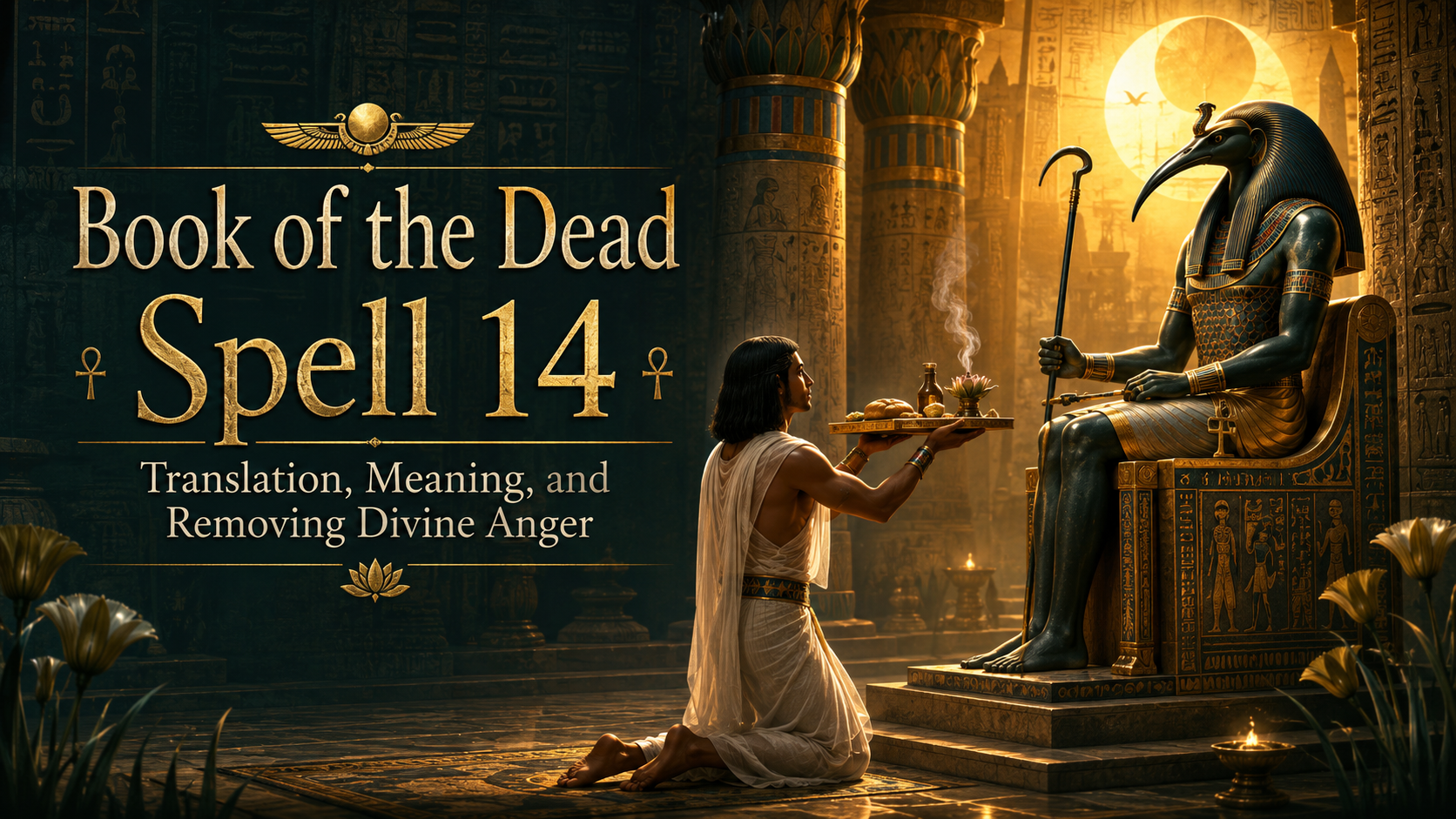
The ancient Egyptian Book of the Dead was a collection of funerary spells intended to help the deceased awaken, travel safely through the afterlife, receive divine protection, and attain renewed life among the gods. Book of the Dead Spell 14 addresses a danger that was less visible than serpents, closed gates, or hostile spirits: the anger of a god.
Its traditional title is commonly translated as:
A spell for removing displeasure from the heart of a god against the deceased
In the spell, the deceased acknowledges that a deity is displeased with them. The speaker appeals to a divine Lord of Law, asks that wrongdoing, darkness, and internal obstacles be removed, and offers a propitiatory gift intended to restore peace.
Spell 14 is therefore a prayer of reconciliation. Its purpose was to remove divine hostility so the deceased would not be delayed, rejected, or prevented from approaching the gods.
What Is Book of the Dead Spell 14?
Book of the Dead Spell 14 is a funerary formula intended to reconcile the deceased with an offended god.
Peter Le Page Renouf and Édouard Naville titled it:
Chapter for removing displeasure from the heart of the god against the deceased person
The spell asks that everything separating the deceased from the divine realm be removed. These obstacles include wrongdoing, evil, darkness, and an unnamed condition that “detains” the speaker from the god. The deceased also promises a propitiatory offering to the Lord of Offerings in Kenu. Through this offering, the speaker hopes to share in divine life and restore harmony.
Renouf and Naville emphasize that the earlier and later versions of Spell 14 differ greatly, making some of its wording and divine references difficult to interpret with certainty.
The Title of Spell 14
The historical title reads:
Chapter for removing displeasure from the heart of the god against the deceased person
A more natural modern version would be:
A spell for removing a god’s anger toward the deceased
The word displeasure should not be reduced to a passing bad mood. Divine displeasure could have serious consequences in the afterlife. An offended god might:
- Refuse to admit the deceased
- Block a road or gateway
- Withhold protection
- Reject an offering
- Allow accusations to stand
- Prevent the deceased from joining the divine community
- Delay transformation into an effective spirit
Spell 14 seeks to repair that damaged relationship before it becomes a permanent obstacle.
English Translation of Book of the Dead Spell 14
Spell 14: Removing Divine Displeasure
Hail to you,
O god who sends forth the appointed moment,who presides over all secret things
and protects the words I speak.A god is displeased with me.
Let wrongdoing be overwhelmed,
and let it fall into the hands
of the Lord of Law.Remove the obstacles within me,
the evil and the darkness,O Lord of Law.
Let that god be reconciled with me.
Remove everything
that keeps me away from you.O Lord of Offerings in Kenu,
let me present to you
the offering of reconciliation
by which you live.Let me live through it
and be reconciled.Let all the displeasure
within your heart against me
be removed.
This modernization keeps the structure of the historical translation while making its purpose clearer to modern readers.
Historical Translation of Spell 14
Renouf and Naville translated the spell as follows:
“Hail to thee, oh god who sendest forth the Moment, who presidest over all the Secret things, and protectest the utterance of my words.
Here is a god displeased against me; let wrong be overwhelmed and let it fall upon the hands of the Lord of Law.
Remove the impediments which are in me and the evil and the darkness, oh Lord of Law, and let that god be reconciled to me, removing that which detaineth me from thee.
Oh, lord of offerings in Kenu, let me offer to thee the propitiary offering by which thou livest, and let me live by it and be reconciled.
Let all the displeasure which is in thy heart against me be removed.”
The editors note that the chapter’s earlier and later textual forms differ substantially. This means that the identities of some divine figures and the exact meaning of several phrases remain uncertain.
What Does Book of the Dead Spell 14 Mean?
Spell 14 asks for the restoration of a damaged relationship between the deceased and a god. The deceased does not deny that divine displeasure exists. Instead, the speaker seeks to neutralize its cause and remove its consequences.
The spell follows a clear sequence:
- The deceased approaches a god connected with hidden knowledge and effective speech.
- The speaker admits that a deity is displeased.
- Wrongdoing is transferred to the authority of the Lord of Law.
- Internal evil, darkness, and obstacles are removed.
- A propitiatory offering is presented.
- The offended god is reconciled with the deceased.
- Divine displeasure disappears from the god’s heart.
The spell’s message can be summarized as:
Whatever has caused divine anger must be removed. Let wrongdoing be judged, let darkness leave me, let my offering restore peace, and let nothing separate me from the gods.
Why Would a God Be Angry With the Deceased?
Spell 14 does not identify the offense or the offended god. The displeasure may have arisen from:
- Wrongdoing committed during life
- Failure to perform a religious duty
- Improper speech
- Ritual impurity
- An accusation made by an enemy
- A neglected offering
- A broken obligation
- A supernatural obstacle rather than a specific moral offense
The lack of detail makes the spell broadly useful. A deceased person did not need to know precisely which god was angry or why. Spell 14 could remove any divine resentment capable of blocking progress through the afterlife.
Is Spell 14 a Confession of Sin?
Spell 14 is not a detailed confession like the declarations found in Spell 125. The deceased does not list specific offenses or ask forgiveness for named actions. Instead, the spell acknowledges a general condition: A god is displeased with me. The speaker then asks that wrong, evil, darkness, and impediments be removed. This makes Spell 14 closer to a prayer of reconciliation and ritual purification than a formal confession. Its focus is not on narrating the offense. Its focus is on restoring access to the divine world.
Divine Anger in Ancient Egyptian Religion
Ancient Egyptian gods were believed to uphold the ordered world, but they could also become angry when that order was violated.
Divine anger might be associated with:
- Disorder
- Falsehood
- Rebellion
- Ritual neglect
- Improper offerings
- Harm against sacred property
- Actions contrary to Ma’at
The consequences could affect both the living and the dead.
For the deceased, divine anger was especially dangerous because successful entry into the afterlife depended on acceptance by gods, judges, guardians, and divine communities.
Spell 14 prevents anger from becoming a permanent spiritual sentence.
“The God Who Sends Forth the Moment”
The spell begins by addressing: The god who sends forth the Moment.
The identity of this god is not given clearly in the surviving translation.
The phrase may refer to a deity who governs:
- Time
- The proper ritual moment
- Judgment
- A divinely appointed event
- The moment of reconciliation
- The transition from one state to another
The capitalization of Moment in the historical edition suggests that Renouf treated it as more than an ordinary instant. It may represent a personified time or the decisive moment when the deceased’s case is heard, and the divine relationship is restored.
Because the early and later versions of the spell differ, identifying the deity with certainty would go beyond what the source supports.
Why Was the Correct Moment Important?
Timing mattered throughout Egyptian religion. Ritual actions had to occur:
- At the proper festival
- At the correct hour
- During the appropriate stage of burial
- At sunrise or sunset
- Before a particular divine encounter
- At the moment when gates or roads became accessible
A reconciliation performed at the proper moment could restore order before the deceased faced further judgment or entered another sacred region.
The god who sends forth the Moment may therefore control the opportunity for forgiveness or renewed access.
“Who Presides Over All Secret Things”
The opening deity also presides over: All the secret things. Secrets were powerful in Egyptian funerary literature.
The deceased needed knowledge of:
- Hidden divine names
- Secret gates
- Sacred places
- Ritual words
- Divine transformations
- The mysteries of Osiris
- The routes followed by Ra
- The correct formulas of protection
A god who controlled such secrets possessed authority over access to the afterlife. By approaching this deity, the deceased appeals to someone capable of uncovering the hidden cause of the problem and removing it.
“Who Protects the Words I Speak”
The god is also asked to protect: The utterance of my words. Speech was essential to the effectiveness of funerary magic.
The deceased needed words to:
- Announce their identity
- Address guardians
- Request admission
- Defeat enemies
- Present offerings
- Defend against accusations
- Invoke divine protection
- Restore broken relationships
If the speaker’s words were rejected, distorted, silenced, or judged false, the spell could fail. The opening appeal therefore asks that the deceased’s speech remain protected and effective.
Why Did Words Need Protection?
The Book of the Dead repeatedly treats speech as a form of power. However, speech could also be challenged.
An enemy might contradict the deceased. A divine tribunal might reject a claim. A guardian might refuse to recognize a name. An offended god might ignore a prayer. Spell 14 asks a divine protector to ensure that the words of reconciliation reach their intended destination and produce the desired result.
The deceased’s speech must remain:
- True
- Effective
- Recognized
- Unobstructed
- Divinely authorized
“A God Is Displeased With Me”
The central problem is stated directly: A god is displeased with me. The speaker does not attempt to hide the conflict. This admission is important because reconciliation begins with recognition that a damaged relationship exists.
The phrase also suggests that divine displeasure could be treated as a condition that ritual language might change. Anger is present, but it is not necessarily permanent.
Why Is the God Not Named?
The god may remain unnamed for several reasons. The text may have been designed to address whichever deity was offended. The original divine name may also have varied between manuscripts or become unclear during transmission.
An unnamed god makes the spell adaptable. The deceased can use it whether the displeasure belongs to:
- Ra
- Osiris
- A local god
- A guardian
- A member of the divine tribunal
- Another deity encountered in the afterlife
The spell’s purpose depends more on restoring harmony than on naming one specific god.
“Let Wrong Be Overwhelmed”
The deceased asks: Let wrong be overwhelmed.
Wrongdoing is treated almost like an enemy that can be subdued, defeated, or drowned beneath a superior power. The speaker does not ask that wrong be ignored.
Instead, it must be overcome by the force of divine law. This distinction is important. The goal is not to escape order but to restore it.
What Is the Lord of Law?
The spell appeals to: The Lord of Law. The historical English word Law likely refers more broadly to divine justice, truth, right order, or Ma’at.
The Lord of Law is the authority capable of:
- Judging wrongdoing
- Restoring balance
- Removing false accusations
- Overcoming evil
- Reuniting the deceased with the gods
- Confirming that the speaker belongs within divine order
The source does not securely identify this figure by name. He may represent a god connected with judgment, Ma’at, or the administration of justice. Any specific identification should therefore be treated cautiously.
Is the Lord of Law Osiris?
Osiris would be a plausible possibility because he ruled the dead and presided over divine judgment. However, the surviving translation does not explicitly name him.
Other gods, especially Thoth, could also be associated with law, truth, and the judgment of disputes. A responsible interpretation should therefore say that the title may evoke Osiris, Thoth, or another judicial deity, but the text used here does not establish one definitive identity.
Law, Justice, and Ma’at
Ancient Egyptian justice was closely connected with Ma’at.
Ma’at represented:
- Truth
- Justice
- Balance
- Proper order
- Correct speech
- Rightful conduct
- Harmony between humans and gods
When wrong falls into the hands of the Lord of Law, disorder is transferred to the authority responsible for restoring Ma’at. The deceased can then be separated from the wrong that caused divine anger.
“Remove the Obstacles Within Me”
The spell asks: Remove the obstacles which are in me.
This is one of its most revealing lines.
The obstacle is not only outside the deceased. Something within the speaker is preventing divine reconciliation.
It may represent:
- Guilt
- Impurity
- Falsehood
- Spiritual darkness
- The lingering effect of wrongdoing
- An accusation attached to the deceased
- An internal condition inherited from death
The spell recognizes that successful transformation requires more than opening external gates. Internal barriers must also be removed.
External and Internal Barriers
Earlier Book of the Dead spells deal with external dangers such as:
- Apep
- Hostile adversaries
- Closed roads
- The gates of the Duat
- The enclosing earth
Spell 14 turns inward. The deceased may have reached the divine realm but still carry something that prevents full acceptance.
The transition is significant:
- Spells 7 through 13 largely concern movement and hostile obstacles.
- Spell 14 concerns reconciliation and purification.
The journey cannot continue successfully unless both kinds of barriers are overcome.
“The Evil and the Darkness”
The deceased asks that the Lord of Law remove:
The evil and the darkness.
These may be separate but related conditions.
Evil could refer to actions, accusations, impurity, or hostile influence.
Darkness could refer to:
- Death
- Ignorance
- Separation from Ra
- Lack of spiritual sight
- Concealed wrongdoing
- Isolation from the gods
- The condition preventing renewed life
Removing darkness restores visibility, knowledge, and connection with divine light.
Darkness as Moral and Funerary Imagery
Darkness in Egyptian funerary religion was not always morally evil. The Duat itself was dark but regenerative. The dangerous form of darkness was the kind that remained permanently or prevented the deceased from reaching light.
In Spell 14, darkness appears beside evil and impediments, suggesting an obstructive condition rather than the ordinary nighttime phase of solar renewal. The speaker asks to be freed from any darkness that keeps them separated from divine presence.
“Let That God Be Reconciled With Me”
The deceased asks directly for reconciliation. This is the spell’s true goal. Removing wrongdoing is not enough if the relationship remains damaged.
The god must:
- Withdraw anger
- Accept the deceased
- Recognize the offering
- Restore communication
- Allow the speaker to approach
- Stop withholding divine favor
The afterlife was imagined as a social and religious community. The deceased needed relationships with the gods, not merely physical survival.
Reconciliation Rather Than Escape
Spell 14 does not seek to overpower the offended god. This differs from spells that threaten enemies, repel serpents, or force gates to open.
The deceased approaches the god through:
- Respectful greeting
- Appeal to justice
- Removal of wrongdoing
- Offering
- Request for reconciliation
The goal is restored harmony, not victory over the deity.
“Remove What Keeps Me From You”
The speaker asks the divine authority to remove:
That which detains me from you.
This phrase suggests that divine displeasure has created distance. The deceased is prevented from approaching the god or entering the god’s presence.
Possible barriers include:
- A legal accusation
- Ritual impurity
- A forgotten obligation
- Divine anger
- A spiritual defect
- The unresolved effects of an offense
The spell removes the cause of separation so the deceased can rejoin the divine community.
What Is a Propitiatory Offering?
The deceased promises:
A propitiatory offering.
A propitiatory offering is a gift intended to calm anger and restore favor. It is not simply food given for nourishment. It has a specific relational purpose.
The offering communicates:
- Respect
- Recognition of divine authority
- A desire for peace
- Restoration of proper exchange
- Renewal of the bond between worshipper and god
Through the offering, the deceased seeks to transform divine anger into acceptance.
Offerings and Reciprocity
Offerings were central to Egyptian religion.
Humans presented food, drink, incense, clothing, and other goods to the gods. In return, the gods maintained life, order, protection, and abundance.
This exchange was not a commercial purchase of divine favor. It was part of the proper circulation of life within Ma’at.
Spell 14 reflects that reciprocity:
- The offering sustains the god.
- The deceased lives through the same offering.
- Shared participation restores harmony.
The offering becomes a bridge between divine and human existence.
“The Offering by Which You Live”
The deceased says that the offering is one:
By which you live.
Egyptian temple theology often described gods as receiving life, strength, and satisfaction through offerings.
The god did not consume the physical food in an ordinary human manner. Its sacred essence could be accepted, after which the material food might support priests and temple personnel.
In funerary belief, offerings similarly transmitted life to the deceased.
Spell 14 unites these ideas. The divine and deceased recipient participate in the life-giving power of the offering.
“Let Me Live Through It”
The speaker continues:
Let me live by it.
The offering restores more than a peaceful relationship. It becomes a source of life.
The deceased wishes to receive:
- Nourishment
- Divine acceptance
- Renewed vitality
- Continuing existence
- Participation in sacred exchange
Reconciliation and survival are inseparable.
The person cannot live successfully in the afterlife while remaining cut off from the gods.
What Is Kenu?
The spell addresses:
The Lord of Offerings in Kenu.
The source used here does not provide enough securely preserved information to identify Kenu with confidence.
It may have been:
- A sacred locality
- A divine domain
- A cult center
- A place associated with offerings
- A location whose name changed or became corrupted between versions
Renouf and Naville’s note numbering shows that the phrase required commentary, but the accessible text does not support one certain modern identification.
It is best to preserve the name Kenu rather than replace it with a speculative location.
Why Is Kenu Important?
Even though its identification is uncertain, Kenu serves an important role in the spell. It is associated with a divine lord who receives offerings and grants life through them. The location represents a place where reconciliation can be ritually completed. The deceased does not offer to an abstract idea. The offering occurs within a sacred geography governed by a divine recipient.
“Let All the Displeasure in Your Heart Be Removed”
The spell ends by returning to the heart of the god. For ancient Egyptians, the heart was associated with:
- Thought
- Intention
- Emotion
- Memory
- Judgment
- Moral awareness
Divine anger existed within the god’s heart, so reconciliation required a change of heart. The final line does not merely ask the god to behave less harshly. It asks that the displeasure itself disappear completely.
The Heart as the Seat of Divine Intention
The god’s heart determines how the deceased will be received.
If anger remains in the heart, hostility can return.
If the anger is removed from its source, reconciliation becomes complete.
The final petition therefore seeks permanent transformation:
- The offense is overcome.
- The obstacle is removed.
- The offering is accepted.
- The divine heart becomes peaceful.
- The deceased can approach without fear.
Does Spell 14 Forgive the Deceased?
The spell clearly seeks reconciliation, but the word forgiveness should be used carefully.
The text does not present a detailed doctrine of forgiveness like those found in some later religious traditions.
Instead, it describes a ritual and judicial restoration:
- Wrong is overwhelmed.
- Evil and darkness are removed.
- The divine relationship is repaired.
- An offering restores peace.
- Anger leaves the god’s heart.
This resembles forgiveness in practical effect, but the Egyptian framework emphasizes purification, Ma’at, offering, and restored access.
Spell 14 and the Weighing of the Heart
Spell 14 does not describe the famous Weighing of the Heart.
That scene is associated especially with Spell 125.
However, Spell 14 shares several related themes:
- Wrongdoing
- Divine displeasure
- Justice
- The heart
- Reconciliation
- Removal of obstacles
- Acceptance by the gods
Spell 14 may prepare the deceased for divine encounters by resolving anger before more formal judgment occurs.
It should not be described as an alternative version of Spell 125, but both participate in the broader concern with moral and divine acceptance.
Spell 14 and Spell 125
The difference can be summarized simply.
Spell 14
Spell 14 seeks to remove the anger of an offended god through:
- Appeal to the Lord of Law
- Removal of evil and darkness
- A propitiatory offering
- Reconciliation
Spell 125
Spell 125 presents the deceased before the divine tribunal and includes:
- The Hall of Two Truths
- The Negative Confession
- Divine judges
- The Weighing of the Heart
- Formal vindication
Spell 14 is personal and relational. Spell 125 is judicial and public.
How Does Spell 14 Relate to Spell 13?
Spell 13 asks for an open road so the deceased can worship Ra and Osiris.
Spell 14 addresses what could happen once the deceased approached the divine world.
A road may be open, but an offended god could still refuse acceptance.
The transition between the spells is meaningful:
- Spell 13: Let the road to the gods be prepared.
- Spell 14: Let the anger of the god be removed.
Movement alone is not enough. The deceased also needs reconciliation.
Were Earlier and Later Versions Different?
Yes. Renouf and Naville explicitly state: “There is a very great difference between the earlier and the later texts of this chapter.” This warning is important because older translations often depended heavily on the later Turin version.
The differences may affect:
- Divine names
- Grammar
- Sequence of phrases
- The interpretation of Kenu
- The identity of the Lord of Law
- The meaning of the opening deity
- The relationship between offering and reconciliation
A responsible article should not treat every English phrase as certain or universal across all manuscripts.
Why Did Book of the Dead Spells Change?
The Book of the Dead was copied over many centuries.
During that time:
- Scribes made errors.
- Older words became obscure.
- Local traditions introduced variations.
- Divine names were substituted.
- Phrases were rearranged.
- Explanatory additions entered the text.
- New manuscript sequences were created.
Spell 14’s substantial variation is therefore part of the larger history of Egyptian funerary literature. There was no single master copy followed perfectly in every period.
Is Book of the Dead Spell 14 the Same as Coffin Text Spell 14?
No. The Book of the Dead and Coffin Texts use independent numbering systems created by modern scholars. Book of the Dead Spell 14 removes divine displeasure against the deceased. Coffin Text Spell 14 is a different Middle Kingdom composition. A matching modern number does not indicate that the texts are identical or directly related.
How Reliable Is the Translation of Spell 14?
The broad purpose is clear from the title and repeated requests:
- A god is displeased.
- Wrong must be overcome.
- Evil and darkness must be removed.
- An offering must restore peace.
- The divine heart must release its anger.
Several details remain uncertain:
- The identity of the opening god
- The meaning of “the Moment”
- The identity of the Lord of Law
- The precise location of Kenu
- The wording of earlier versus later versions
The article should therefore distinguish between the spell’s clear function and uncertain mythological details.
The Meaning of Spell 14 in Simple Terms
Book of the Dead Spell 14 removes the anger of a god toward the deceased. The speaker acknowledges that a divine relationship has been damaged. The deceased asks the Lord of Law to overcome wrongdoing, remove evil and darkness, and eliminate anything preventing access to the gods.
A propitiatory offering is then presented to restore harmony and provide life.
The spell’s meaning can be summarized as:
Whatever has separated me from the gods must be removed. Let wrongdoing be judged, let darkness leave me, let my offering restore peace, and let no anger remain in the divine heart.
Spell 14 ensures that the deceased does not reach the afterlife only to be rejected by an offended god.
Frequently Asked Questions About Book of the Dead Spell 14
What is Book of the Dead Spell 14?
Spell 14 is a funerary formula intended to remove a god’s anger or displeasure toward the deceased and restore divine favor.
What is the title of Spell 14?
Renouf and Naville title it: Chapter for Removing Displeasure From the Heart of the God Against the Deceased Person.
What is the full translation of Spell 14?
A reader-friendly rendering is: Hail to you, god who sends forth the appointed moment, who presides over secret things and protects my words. A god is displeased with me. Let wrongdoing be overwhelmed and placed in the hands of the Lord of Law. Remove the obstacles, evil, and darkness within me. Let the god be reconciled with me. Let me present the offering of reconciliation, live through it, and let all displeasure be removed from your heart.
Why was a god angry with the deceased?
The spell does not say. The cause could have been wrongdoing, ritual impurity, neglected duties, accusations, or another spiritual obstacle.
Who is the Lord of Law?
The text does not securely identify the deity. The title refers to a divine authority associated with truth, judgment, justice, or Ma’at.
Is the Lord of Law Osiris?
Osiris is a possible interpretation because of his role as judge of the dead, but the surviving translation does not name him. Thoth or another judicial deity may also be possible.
What is the propitiatory offering?
It is an offering intended to calm divine anger, restore favor, and renew the proper relationship between the deceased and the god.
What is Kenu?
Kenu is a sacred location mentioned in the spell. Its exact identification is uncertain in the source used here.
What does the darkness represent?
It may represent death, impurity, wrongdoing, spiritual obstruction, ignorance, or separation from divine light.
Is Spell 14 a confession?
Not in the formal sense. It acknowledges divine displeasure but does not list individual offenses. It is primarily a spell of purification and reconciliation.
Does Spell 14 describe forgiveness?
It describes the removal of wrong and divine anger, followed by reconciliation. This resembles forgiveness in effect, although the Egyptian framework emphasizes Ma’at, purification, offerings, and restored harmony.
Did Spell 14 have a standard illustration?
No standard vignette is listed in the Renouf and Naville edition.
Why do translations of Spell 14 differ?
Renouf and Naville state that earlier and later versions differ greatly. Some divine names and phrases were probably changed, rearranged, or misunderstood during transmission.
Book of the Dead Spell 14 addresses a danger that could not be defeated by force alone. The deceased may have passed Apep, defeated adversaries, opened the Duat, and found the roads to Ra and Osiris. Yet none of those victories guaranteed acceptance by a god whose heart remained angry. Spell 14 therefore seeks reconciliation. Wrong is placed under divine judgment. Evil, darkness, and internal barriers are removed. A life-giving offering is presented, and the offended god is asked to release every trace of displeasure. The spell transforms rejection into restored harmony. For the deceased, eternal life required more than movement and magical strength. It also required peace with the gods.