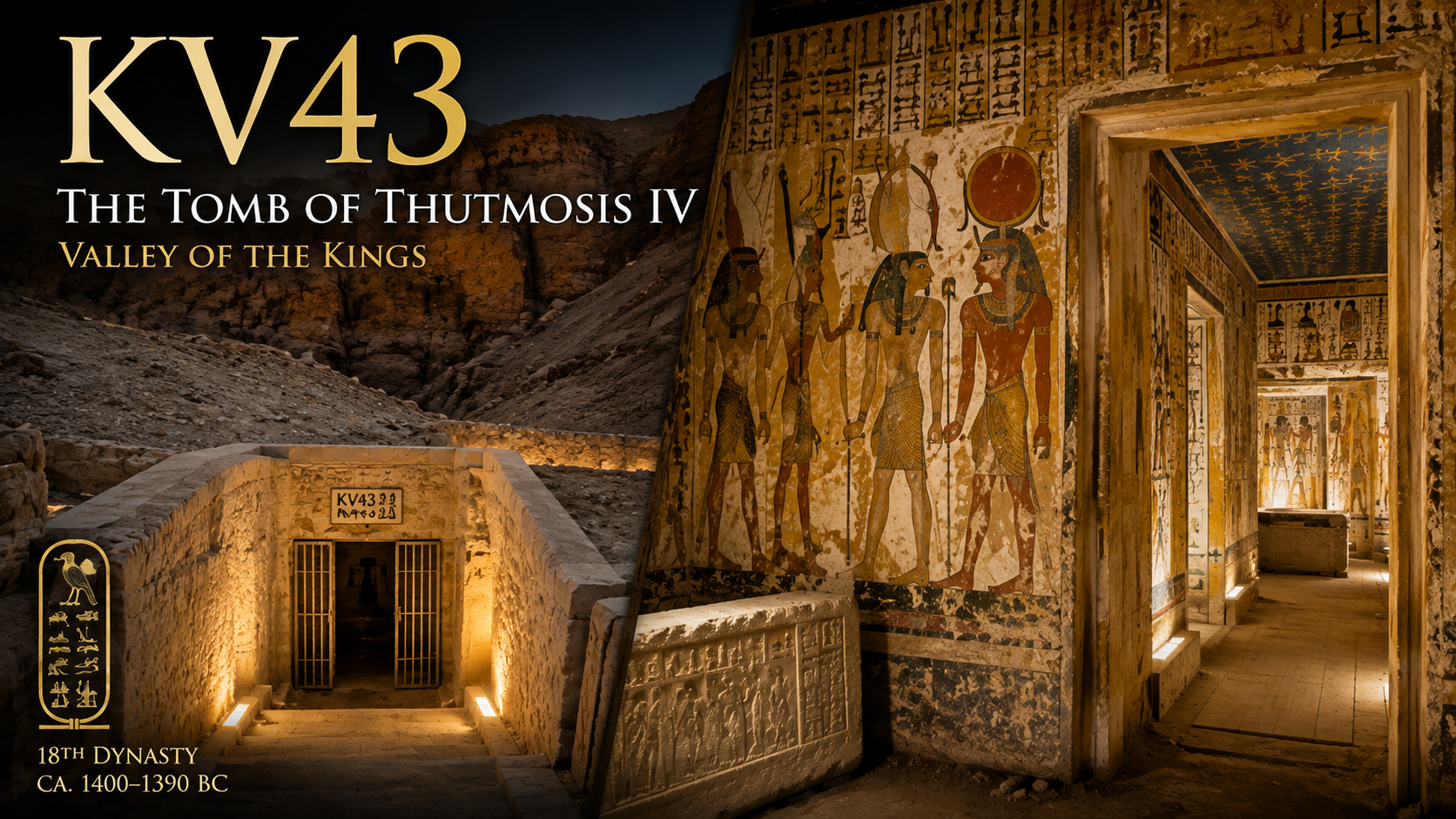
KV43 is the royal tomb of Pharaoh Thutmose IV, one of the rulers of Egypt’s Eighteenth Dynasty and the father of Amenhotep III. Hidden high in a secluded side valley, the monument represents an important stage in the development of New Kingdom royal tomb architecture.
Its plan builds directly upon the tomb of Thutmose IV’s father, Amenhotep II, KV35. A steep descent passes through corridors and stairways to a deep well chamber. From there, the axis turns sharply through a pillared hall before descending toward an antechamber and a large burial chamber with four surrounding storerooms.
KV43 also introduced architectural details that became standard in later royal tombs. Among the most important are small magical niches cut into the walls and a lowered section of the burial chamber designed to form a distinct crypt around the king’s sarcophagus. These features would continue to influence royal burial architecture through the later Eighteenth and early Nineteenth Dynasties.
When Howard Carter entered KV43 in January 1903 while excavating for Theodore M. Davis, the tomb had already been robbed in antiquity. Thutmose IV’s mummy was gone, but his massive stone sarcophagus remained in place. Carter also recovered extraordinary pieces of the king’s original burial equipment, including a ceremonial chariot, furniture, faience vessels, shabtis, weapons and hunting equipment, food offerings, and fragments of royal clothing. The Metropolitan Museum of Art now holds several objects from the discovery.
KV43 preserves another remarkable piece of history. A hieratic inscription records that the tomb had already been violated by the reign of Horemheb. In Horemheb’s eighth regnal year, the official Maya was ordered to restore the burial of Thutmose IV. The inscription provides rare written evidence of royal tomb restoration centuries before the large-scale mummy rescue operations of the Twenty-first Dynasty.
More than a century after Carter’s excavation, KV43 remains the subject of active research. A new project founded in 2022 is reexamining the tomb, its surviving artifacts, traces of ancient workmen, restoration graffiti, and conservation needs.
- Structure: KV43
- Location: Valley of the Kings, East Valley, Thebes West Bank, Luxor
- Owner: Thutmose IV
- Dynasty: Eighteenth Dynasty
- Site Type: Royal tomb
- Decoration: Painted scenes of Thutmose IV before deities
- Interior Layout: Stairways, corridors, well chamber, pillared hall, antechamber, burial chamber, and four storerooms
- Axis Type: Bent
- Public Access: Generally closed or restricted
Who Was Thutmose IV?
Thutmose IV was an Eighteenth Dynasty pharaoh who ruled during the middle of the New Kingdom. He was the son of Amenhotep II and Queen Tiaa. His mother’s tomb, KV32, lies elsewhere in the Valley of the Kings.
Thutmose IV inherited an Egyptian empire his grandfather, Thutmose III, established and Amenhotep II maintained. Although his reign was considerably shorter than those of several members of his family, Egypt remained one of the dominant powers of the ancient Near East. His son Amenhotep III succeeded him, and his reign became famous for its wealth, monumental architecture, diplomacy, and international influence.
The Dream Stela
Thutmose IV is perhaps best known outside the Valley of the Kings for the Dream Stela placed between the paws of the Great Sphinx at Giza. According to the inscription, the young prince fell asleep near the Sphinx while hunting or traveling in the area.
In a dream, the Sphinx, identified with the solar god Horemakhet-Khepri-Ra-Atum, promised Thutmose kingship if he cleared away the sand covering the monument. After becoming pharaoh, Thutmose IV commemorated the event with the stela. The story has sometimes been interpreted as evidence that Thutmose was not originally the expected heir to the throne, although the text itself does not conclusively prove this.
Location of KV43
KV43 lies high in a small side valley branching from the main Valley of the Kings. Its entrance was cut into a natural platform at the base of a sheer cliff. The location resembles the strategy used for several earlier Eighteenth Dynasty royal tombs, where concealment and difficult access were important elements of tomb security.
Rather than placing the entrance directly on the valley floor, the builders selected a secluded position that could be hidden after the funeral. Despite these precautions, ancient thieves eventually discovered the tomb.
Description
KV43 follows the classic bent or dog-leg axis characteristic of early Eighteenth Dynasty royal tombs. The monument consists of:
- Entrance stairway A
- Corridor B
- Stairway C
- Corridor D
- Well Chamber E
- Pillared Chamber F
- Descending Corridor G
- Stairway H
- Antechamber I
- Burial Chamber J
- Four subsidiary chambers, Ja through Jd
The tomb initially descends in a relatively straight line. At the well chamber and pillared hall, however, the path changes direction sharply. The visitor then descends through another corridor and stairway before reaching the antechamber and burial chamber. This changing direction visually and physically separates the burial chamber from the outside world.
The Bent Axis
The bent-axis design was inherited from earlier royal tombs. KV34, the tomb of Thutmose III, uses an even more dramatic series of turns. KV35, belonging to Amenhotep II, established many of the architectural features later refined in KV43.
The repeated turns may have had both practical and symbolic purposes. They allowed ancient engineers to respond to geological conditions inside the mountain, but they also created a progressively hidden journey into the underworld. The king’s body lay far removed from the entrance and could not be seen from any of the upper corridors. Later royal tombs gradually became straighter, particularly during the Ramesside Period.
Architectural Relationship With KV35
KV43 is closely related to KV35, the tomb of Thutmose IV’s father, Amenhotep II.
Both contain:
- Descending entrance passages
- A deep well shaft
- A transverse pillared hall
- A second descending section
- A rectangular burial chamber
- Multiple side chambers
- A two-level burial area
KV43, however, is more carefully aligned and precisely cut. It represents a refinement of the architectural experiments introduced in KV35. The sequence from KV34 to KV35 to KV43 allows archaeologists to trace the gradual development of royal tomb planning through three generations of the Eighteenth Dynasty.
The Well Chamber
Chamber E contains a deep well shaft. The well is one of the most important architectural elements in early Eighteenth Dynasty royal tombs.
It may have served several functions. Practically, the pit could intercept some water and debris entering from the upper corridors. It also created an obstacle for anyone attempting to penetrate the deeper rooms.
Symbolically, the well may have represented the primeval waters, the depths of the underworld, or the burial place of Osiris. The upper walls of the well chamber were decorated, making this room one of only two principal areas of KV43 to receive painted scenes.
Decoration of the Well Chamber
The surviving decoration depicts Thutmose IV standing before several gods associated with death, protection, and rebirth.
These include:
The ceiling is painted blue and covered with yellow stars, representing the night sky. A decorative kheker frieze runs along the upper wall. Parts of the decorative program were never completed. One wall preserves an unfinished representation of Anubis. The incomplete work is important because it allows archaeologists to see different stages of ancient tomb decoration within the same chamber.
Chamber F: The Pillared Hall
Beyond the well chamber, the tomb turns sharply into Chamber F. This large room contains pillars and marks the major change in the tomb’s axis. The chamber served as a transitional space between the upper passages and the deeper royal burial suite. A descent leads from this room toward Corridor G. The position of the descent is comparable to the arrangement developed in KV35.
Magical Niches
One of KV43’s most important architectural innovations is the appearance of small magical niches. These niches were cut into the walls at specific locations in the lower tomb. They probably contained magical bricks or protective objects intended to defend the king against supernatural dangers.
Magical bricks were placed according to funerary ritual at cardinal points surrounding the deceased. KV43 is an important early example of these niches being incorporated directly into the tomb architecture. Similar features became standard in later Eighteenth Dynasty and early Nineteenth Dynasty royal tombs.
Antechamber I
After descending through Corridor G and Stairway H, the route enters Antechamber I. This is the second major decorated room of KV43. Like the well chamber, the antechamber contains images of the king standing before gods. The ceiling again represents the night sky with yellow stars against a deep blue background.
The limited decorative program is typical of royal tombs from this phase of the Eighteenth Dynasty. Unlike the tomb of Thutmose III, KV34, the corridors and burial chamber were not covered with a complete Amduat. Instead, decoration was concentrated in selected transitional rooms.
The Restoration Graffiti
The antechamber preserves one of the most historically valuable inscriptions in the Valley of the Kings. A hieratic graffito written in black ink records an official restoration of Thutmose IV’s burial.
The inscription dates the work to Year 8 of Pharaoh Horemheb.
Horemheb ordered the powerful official Maya to renew the burial of Thutmose IV after the tomb had apparently been violated.
A second, shorter inscription mentions Maya’s subordinate Djehutymose, who may have supervised the work directly. This is extraordinary evidence because it records a royal tomb restoration as an administrative event.
Horemheb’s Restoration
Horemheb ruled at the end of the Eighteenth Dynasty following the turmoil of the Amarna Period.
By his eighth regnal year, KV43 had apparently already been entered.
The disturbance may have occurred during the political instability surrounding the end of Akhenaten’s religious revolution and the reigns that followed.
Horemheb’s government undertook extensive restoration throughout Egypt.
At KV43, the goal was not simply to repair damaged architecture. The royal burial itself had to be restored so that Thutmose IV could continue to exist properly in the afterlife.
The workers repaired doors, replaced seals, reorganized burial equipment, and apparently restored the body or coffin arrangements.
Maya
Maya was one of the most important officials of the late Eighteenth Dynasty. His titles included responsibilities connected with the treasury, royal works, and the royal necropolis. He is also known from activities associated with Tutankhamun.
Horemheb’s inscription in KV43 demonstrates that Maya had authority over the restoration of earlier royal burials. The presence of his name links KV43 directly with the administrative system responsible for maintaining the Valley of the Kings.
Djehutymose
A second graffito identifies Djehutymose, who served under Maya.
The handwriting of the two inscriptions appears similar, leading researchers to suggest that Djehutymose may have written both and personally supervised the restoration.
He has also been connected with restoration activity in Tutankhamun’s tomb.
These inscriptions reveal something rarely visible in royal tombs: the names of the officials responsible for caring for ancient kings generations after their deaths.
The Burial Chamber
Burial Chamber J is the largest and deepest room in KV43. It contains a rectangular upper section with pillars and a lowered area at the far end. This lower section formed a distinct crypt where the king’s sarcophagus was placed.
The separation between the upper and lower floor represents an important development of the two-level burial chamber first introduced in KV35. The room also contains four symmetrical storerooms opening from its sides.
The Lowered Crypt
The lowered portion of the burial chamber is one of KV43’s important architectural innovations. Rather than simply placing the sarcophagus on the general chamber floor, the architects created a separate lower zone specifically for the king’s burial.
This emphasized the sarcophagus as the central sacred object within the chamber. Later Eighteenth Dynasty royal tombs continued to develop increasingly formal divisions between the upper burial hall and the lower crypt.
The Sarcophagus of Thutmose IV
Thutmose IV’s stone sarcophagus remained inside KV43 when Howard Carter entered the tomb.
The box was made from reddish stone and decorated with figures and hieroglyphic inscriptions whose carved details were highlighted in yellow.
Its ends have different symbolic figures.
Nephthys appears at the head end with her arms raised protectively.
Isis appears at the foot.
The long sides depict Thutmose IV with Anubis and protective texts.
The sarcophagus lid had been removed and was found propped nearby.
The king’s mummy was no longer inside.
The Four Storerooms
Four subsidiary rooms open from Burial Chamber J.
They are designated:
- Ja
- Jb
- Jc
- Jd
These storerooms originally contained different categories of funerary equipment.
The arrangement is strikingly orderly and symmetrical.
Rather than piling all supplies together, the ancient burial planners distributed objects among separate chambers.
This offers important evidence about how royal funerary equipment was organized.
Chamber Ja
Chamber Ja contained large quantities of linen and mummy wrappings.
The wrappings may have come from disturbed burial equipment or bodies originally stored within the tomb.
Sockets and surviving wood indicate that the side chambers may once have been closed with wooden doors rather than permanently sealed masonry.
Chamber Jb
Chamber Jb contained food offerings.
Among the finds were mummified portions of meat and birds.
Egyptians placed prepared food within tombs because the deceased required nourishment in the afterlife.
These offerings could be preserved, wrapped, and treated almost like human mummies.
Their survival gives us a direct glimpse into the enormous logistical effort required to provision a royal burial.
Chamber Jc
Chamber Jc contained broken pottery vessels and large quantities of grain.
The grain represented another form of eternal food provision.
Royal tombs could contain enormous amounts of food, drink, oils, perfumes, and other supplies intended to sustain the king indefinitely.
The jars were smashed during ancient robbery, but their remains allowed archaeologists to reconstruct part of the original funerary inventory.
Chamber Jd
Chamber Jd contained particularly important discoveries.
Carter found quantities of broken faience vessels and shabtis.
He also discovered the unwrapped mummy of a young boy leaning against the wall.
The body is usually identified as Prince Amenemhat, a son of Thutmose IV, because canopic equipment bearing that prince’s name was found within the tomb.
KV43 therefore appears to have functioned not only as the king’s tomb but also as a burial place for at least some of his children.
Prince Amenemhat
Prince Amenemhat was a son of Thutmose IV.
He appears to have died before his father.
His burial inside KV43 follows a pattern seen elsewhere in the Eighteenth Dynasty, where royal children could be interred within or near their father’s tomb.
His mummy remained in the tomb after the king’s body had been removed.
This difference may indicate that later priests were primarily concerned with rescuing reigning kings rather than every member of the royal household.
Princess Tentamun
Canopic jars bearing the name of a princess called Tentamun were also recovered from KV43. This indicates that she too was probably buried within her father’s tomb. Her body has not been securely identified. The presence of both Amenemhat and Tentamun demonstrates that KV43 was partly a family burial monument. It also helps explain the need for four large storerooms surrounding the burial chamber.
The Royal Chariot
One of the most spectacular objects recovered from KV43 was a ceremonial chariot.
The chariot body had once been covered partly with silver and decorated with scenes emphasizing royal power.
Such scenes typically showed the king dominating foreign enemies or participating in activities associated with royal strength.
Chariots had military, ceremonial, and hunting functions during the New Kingdom.
Placing one inside the tomb ensured that the king retained royal mobility and authority in the afterlife.
The Ceremonial Throne
Fragments of an extraordinary wooden throne were also discovered.
One surviving arm panel is now in the Metropolitan Museum of Art.
On one side, Thutmose IV appears as a sphinx trampling the enemies of Egypt. On the other, he sits enthroned while the goddess Weret-hekau and the god Thoth grant him divine protection and eternal life. The panel was originally covered with gold foil.
The Metropolitan Museum suggests that the throne may have been created for the king’s coronation or perhaps for a royal jubilee ceremony.
Its survival makes KV43 particularly important for understanding Eighteenth Dynasty royal furniture.
Shabtis
Numerous shabti figures were placed within KV43.
Shabtis were funerary figurines intended to work on behalf of the deceased in the afterlife.
One faience shabti of Thutmose IV recovered during the 1903 excavation is now in the Metropolitan Museum of Art.
The tomb also contained small shabti coffins.
These miniature coffins symbolically protected the figures in much the same way that full-sized coffins protected the king.
Faience Objects
KV43 contained a rich collection of blue and green faience.
Surviving objects include:
- Shabtis
- Amulets
- Ritual vessels
- Hes vases
- Miniature objects
- Ceremonial implements
A faience hes vase from the tomb is now preserved at the Metropolitan Museum of Art.
Faience’s brilliant blue-green color was associated with water, fertility, regeneration, and the brilliance of the divine world.
Its extensive use in funerary equipment made it particularly appropriate for a royal burial focused on eternal rebirth.
The Ankh Ceremonial Object
Among the finds was a large faience ceremonial implement shaped like an ankh.
The ankh hieroglyph represented life.
An enlarged ritual version placed in a royal tomb therefore carried obvious symbolic significance.
The object reinforced the central goal of Egyptian funerary religion: allowing the deceased king to continue living eternally in a transformed divine state.
Weapons and Hunting Equipment
KV43 also contained equipment associated with archery and hunting.
Among the finds was a leather archer’s gauntlet.
Hunting and archery were closely associated with royal strength during the Eighteenth Dynasty.
Kings were frequently portrayed shooting arrows, hunting wild animals, or controlling dangerous forces.
These activities were not merely recreational. They symbolized the pharaoh’s ability to maintain order over chaos.
Clothing
Fragments of elaborate woven clothing survived inside the burial assemblage.
One textile reportedly preserved the name of Amenhotep II, Thutmose IV’s father.
The presence of an inherited or reused garment within the king’s burial demonstrates that royal funerary equipment could include objects possessing dynastic associations and personal histories.
Such items may have carried symbolic or emotional importance beyond their practical value.
Foundation Deposits
Howard Carter discovered intact foundation deposits near the entrance to KV43.
Foundation deposits were ceremonially buried when construction began.
They could contain:
- Model tools
- Miniature vessels
- Pottery
- Food
- Ritual objects
- Inscribed pieces bearing the king’s name
The deposits confirmed that the monument belonged to Thutmose IV.
One vessel reused in the foundation deposit apparently originated from the reign of Hatshepsut, showing that older objects could be incorporated into later royal building rituals.
Discovery in 1903
Howard Carter discovered KV43 in January 1903 while conducting excavations financed by Theodore M. Davis.
Carter had already found an alabaster vessel bearing Thutmose IV’s name in the surrounding valley in 1902.
This clue led him to suspect that the king’s tomb was nearby.
Excavations eventually reached a natural platform at the base of a cliff where foundation deposits revealed the entrance area.
On January 18, 1903, the entrance had been cleared sufficiently for Carter to enter.
The tomb proved to be one of the major discoveries of his career before Tutankhamun.
Carter Entered Without Davis
The story of the first modern entry into KV43 has an amusing detail.
Theodore Davis was away in Aswan when Carter reached the point where the tomb could be entered.
Unable to contact his sponsor, Carter decided not to wait.
He invited American amateur Egyptologist Robb de Peyster Tytus to accompany him and entered the tomb.
The decision reflects both Carter’s confidence and the very different archaeological working conditions of the early twentieth century.
Theodore M. Davis
Theodore M. Davis was a wealthy American lawyer and businessman who financed extensive excavation in the Valley of the Kings.
His sponsorship contributed to the discovery or excavation of several important tombs.
Objects from Davis-funded excavations were distributed according to the archaeological practices of the period, which is why some KV43 finds eventually entered collections such as the Metropolitan Museum of Art.
The Met specifically records objects from KV43 as originating from the Davis/Carter excavations of 1903.
Evidence of Ancient Robbers
Carter found extensive evidence that KV43 had already been robbed.
The entrance corridors contained broken objects and debris.
Ancient thieves had penetrated blocked doorways.
Most dramatically, a palm-fiber rope remained tied around one of the pillars near the well chamber, with its end extending toward the bottom of the shaft.
The rope may have been used by robbers to cross or descend the well.
It provides an unusually physical trace of the people who violated the tomb thousands of years ago.
Double Sealing
Carter found evidence that some doorways had been sealed more than once.
Original seals carried the traditional necropolis emblem showing a jackal above bound captives.
Additional seals bore evidence associated with Horemheb’s restoration.
This double sealing matches the restoration graffito.
The tomb had first been sealed after Thutmose IV’s funeral, then opened and robbed, restored under Horemheb, and sealed again.
KV43 therefore preserves an unusually clear archaeological sequence of burial, robbery, restoration, and later disturbance.
What Happened to Thutmose IV’s Mummy?
Thutmose IV’s mummy was not inside KV43 when Carter discovered the tomb.
It had been removed in antiquity.
The body was eventually placed in KV35, the tomb of Amenhotep II, where priests created a large cache of royal mummies.
Victor Loret discovered the KV35 cache in 1898, five years before Carter entered KV43.
Thutmose IV therefore traveled from his own tomb to the burial place of his father.
The KV35 Royal Cache
KV35 eventually contained a remarkable collection of kings.
Among them were:
- Thutmose IV
- Amenhotep III
- Merenptah
- Seti II
- Siptah
- Ramesses IV
- Ramesses V
- Ramesses VI
Priests transferred these mummies from vulnerable tombs to protect them from robbery.
The relocation probably took place during the Twenty-first Dynasty.
By then, the restoration carried out under Horemheb centuries earlier had long since failed to protect Thutmose IV permanently.
A Tomb Restored Twice in Antiquity?
The Year 8 Horemheb inscription records one known restoration. Later activity connected with the royal mummy rescue program must have involved opening KV43 again. Priests would have needed to enter the tomb, remove Thutmose IV’s mummy, and transfer it elsewhere. This means KV43 experienced several major ancient phases:
- Construction
- Burial of Thutmose IV and royal children
- Robbery
- Restoration under Horemheb
- Later reopening
- Removal of the king’s mummy
- Continued disturbance
Few royal tombs preserve such a well-documented history of repeated ancient intervention.
The Burial Chamber Was Not Decorated
One of the surprising features of KV43 is that the burial chamber itself is largely undecorated. This differs from KV34 and KV35, where the Amduat appears prominently in the burial chamber. Instead, KV43 concentrated decoration in the well chamber and antechamber. This may represent a change in royal funerary design rather than an unfinished program. The painted rooms emphasize encounters between the king and individual deities rather than presenting a complete textual map of the underworld.
The King Before the Gods
The surviving wall paintings repeatedly show Thutmose IV standing before deities. These scenes communicate a central idea of royal funerary religion. The dead king had entered the divine realm. Osiris offered regeneration. Anubis protected the mummy and burial. Hathor welcomed and nourished the deceased. The pharaoh was no longer merely a dead human ruler. He was becoming part of the society of the gods.
The Star Ceilings
The blue ceilings covered with yellow stars are among the most visually memorable features of KV43. Star ceilings transformed enclosed underground rooms into representations of the heavens. The king’s tomb therefore contained both worlds at once. The passages descended physically into the earth, representing the underworld. Yet overhead, the ceiling opened symbolically onto the eternal night sky. The king could travel through both realms.
Damage to the Hathor Image
KV43 suffered modern damage as well as ancient robbery. At some point during the late twentieth century, someone attempted to cut the head of a painted Hathor figure from the wall of the antechamber. The theft attempt failed, but the damage remains visible. It is a reminder that ancient tombs have continued to face threats even after coming under modern archaeological protection.
Measurements and Architecture
KV43 is a substantial royal monument, extending deep into the hillside. Its design is considerably more regular than KV35 and shows careful planning. The four burial-chamber storerooms are arranged symmetrically, while the lowered crypt and magical niches demonstrate increasing architectural specialization.
These features made KV43 an important model for the tomb of Thutmose IV’s son Amenhotep III, WV22. WV22 continued many of the same architectural principles while increasing the tomb’s scale and decorative sophistication.
Influence on Later Tombs
KV43 represents a bridge between earlier and later Eighteenth Dynasty royal tombs.
From KV35 it inherited:
- The rectangular burial chamber
- Two floor levels
- Side storerooms
- A bent approach
- The well and pillared hall
KV43 refined these features.
Later tombs inherited:
- Magical niches
- More formal burial crypts
- Symmetrical storerooms
- Carefully controlled architectural axes
- Selected scenes of the king before gods
The tomb of Amenhotep III developed the same general plan on an even grander scale.
Current KV43 Research Project
KV43 is not simply a tomb excavated and forgotten in 1903. A dedicated research project was founded in 2022 to reexamine the monument. The project is studying:
- Ancient Deir el-Medina work crews
- Restoration activity
- Graffiti
- Surviving artifacts
- Archaeological context
- Architecture
- Conservation needs
The team also hopes to catalog and publish previously unpublished objects left behind by earlier excavators. This renewed work is particularly valuable because early twentieth-century excavations often removed spectacular objects while paying less attention to small fragments and archaeological context.
Conservation Goals
The modern research project also aims to update protective measures for KV43.
The surviving decoration is vulnerable to:
- Salt
- Humidity
- Dust
- Structural movement
- Human contact
- Water infiltration
- Microclimatic change
The project’s long-term goals include improving protection for both the tomb and its surviving wall paintings.
Objects Recovered
The burial assemblage of KV43 included an extraordinary range of royal objects:
- Stone sarcophagus
- Ceremonial chariot
- Throne fragments
- Shabtis
- Shabti coffins
- Faience vessels
- Ankh-shaped ceremonial objects
- Hes vases
- Amulets
- Stone vessels
- Pottery
- Grain
- Meat and bird offerings
- Linen
- Royal clothing
- Hunting and archery equipment
- Broken fan handles
- Cedar furniture
- Canopic equipment
- Burial equipment of royal children
- Human remains
Although robbers removed much of the gold and other portable wealth, enough survived to reconstruct the exceptional richness of the original funeral.
Noteworthy Features
KV43 is notable for several reasons:
- It is the royal tomb of Thutmose IV.
- Howard Carter discovered it in 1903.
- Its plan develops the architecture of Amenhotep II’s KV35.
- The tomb follows a sharply bent axis.
- A deep well shaft separates the upper and lower sections.
- The burial chamber includes a lowered crypt for the sarcophagus.
- KV43 contains early examples of magical niches.
- Four storerooms surround the burial chamber.
- Only selected rooms received painted decoration.
- The well chamber and antechamber have star-covered ceilings.
- Thutmose IV appears before Osiris, Anubis, and Hathor.
- The king’s stone sarcophagus remains inside.
- Prince Amenemhat was probably buried in the tomb.
- Princess Tentamun was also associated with KV43.
- A ceremonial royal chariot survived.
- Fragments of an extraordinary gilded throne were recovered.
- Ancient robbers left a rope near the well shaft.
- Horemheb ordered restoration of the burial in Year 8 of his reign.
- Maya supervised the restoration.
- Djehutymose may have carried out the work.
- Thutmose IV’s mummy was eventually moved to KV35.
- KV43 is currently being reexamined by a research project founded in 2022.
Dating
KV43 was used or entered during several periods:
- New Kingdom, Eighteenth Dynasty, reign of Thutmose IV: Construction and original royal burial
- Eighteenth Dynasty: Burials of Prince Amenemhat and Princess Tentamun
- Late Eighteenth Dynasty, Year 8 of Horemheb: Restoration after tomb robbery
- Late New Kingdom / Third Intermediate Period: Reopening and removal of Thutmose IV’s mummy
- Twenty-first Dynasty: Probable transfer of the king into the royal cache in KV35
- 1903: Rediscovery and excavation by Howard Carter
- 2022 onward: Renewed archaeological and conservation research
History of Exploration
- Ancient tomb robbers: Initial violation of the burial
- Horemheb, Year 8: Official restoration ordered under Maya
- Later royal necropolis priests: Removal of Thutmose IV’s mummy
- Howard Carter, 1903: Discovery and excavation for Theodore M. Davis
- Percy Newberry and Carter, 1904: Publication of The Tomb of Thoutmôsis IV
- Theban Mapping Project: Architectural documentation
- KV43 Research Project, 2022 onward: Reexamination of the monument, artifacts, graffiti, workmen’s evidence, and conservation requirements
Site Condition
KV43 survives in generally recognizable architectural condition, although it has suffered from ancient robbery, restoration, later reopening, early excavation, and modern damage. Much of its original funerary equipment has been removed to museums. The surviving painted decoration remains important but fragile. One Hathor image bears visible damage from a modern attempt to remove the figure’s head. Current archaeological research is assessing the condition of the monument and developing updated conservation measures.
Why KV43 Matters
KV43 is important because it captures royal tomb architecture at a moment of transition.
The monument inherited the experimental design of Amenhotep II’s KV35 but refined it into a more regular and carefully organized burial complex. The lowered crypt, magical niches, symmetrical storerooms, and selected decorated chambers anticipated features that would become increasingly important in later royal tombs.
Its archaeological contents are equally valuable. The chariot, throne, shabtis, food, clothing, weapons, faience vessels, and burial equipment of royal children reveal what an Eighteenth Dynasty royal funeral actually placed underground with a king.
But perhaps the most extraordinary evidence is the restoration graffito.
It shows that ancient Egyptians themselves treated the Valley of the Kings as an archaeological and sacred landscape. By Horemheb’s reign, Thutmose IV had already become an earlier king whose damaged burial required official investigation and repair.
Maya and Djehutymose were effectively conserving a royal tomb more than three thousand years before modern archaeologists arrived.
KV43 therefore preserves three different histories at once: the burial of Thutmose IV, the ancient Egyptian attempt to save that burial after robbery, and the modern archaeological effort to understand and protect what remains.
Interesting Facts About KV43
- KV43 is the tomb of Pharaoh Thutmose IV.
- Howard Carter discovered it in January 1903.
- Carter entered the tomb while Theodore Davis was away in Aswan.
- The tomb is a refined version of Amenhotep II’s KV35.
- It has a strongly bent axis.
- A deep well separates the upper and lower sections.
- The burial chamber contains a lowered crypt.
- KV43 includes some of the earliest magical niches in a royal tomb.
- Four storerooms open from the burial chamber.
- Only the well chamber and antechamber were substantially decorated.
- Their ceilings are blue with yellow stars.
- Thutmose IV appears with Osiris, Anubis, and Hathor.
- The king’s stone sarcophagus remains inside.
- Prince Amenemhat was probably buried there.
- Princess Tentamun was also associated with the tomb.
- Carter found a royal chariot.
- A gilded ceremonial throne was found broken inside.
- An arm panel from that throne is now in the Metropolitan Museum of Art.
- Ancient robbers left a palm-fiber rope beside the well.
- Horemheb ordered KV43 restored in Year 8 of his reign.
- The official Maya was responsible for the restoration.
- Djehutymose probably supervised the work inside the tomb.
- Thutmose IV’s mummy was eventually transferred to KV35.
- His mummy was discovered there by Victor Loret in 1898.
- A new archaeological research project has been studying KV43 since 2022.