By the early eleventh century BC, Egypt was no longer the dominant imperial power it had once been.
The upheavals that ended the Late Bronze Age had transformed the eastern Mediterranean. Egypt had lost control over most of its territories in Canaan and Syria, while groups remembered collectively as the Sea Peoples had settled along parts of the coast.
Within Egypt, royal authority had also weakened.
The pharaoh still ruled in name, but the country was increasingly divided between powerful leaders. Smendes and his wife, Tentamun, exercised authority from Tanis in the north, while the High Priest Herihor controlled much of Upper Egypt from Thebes.
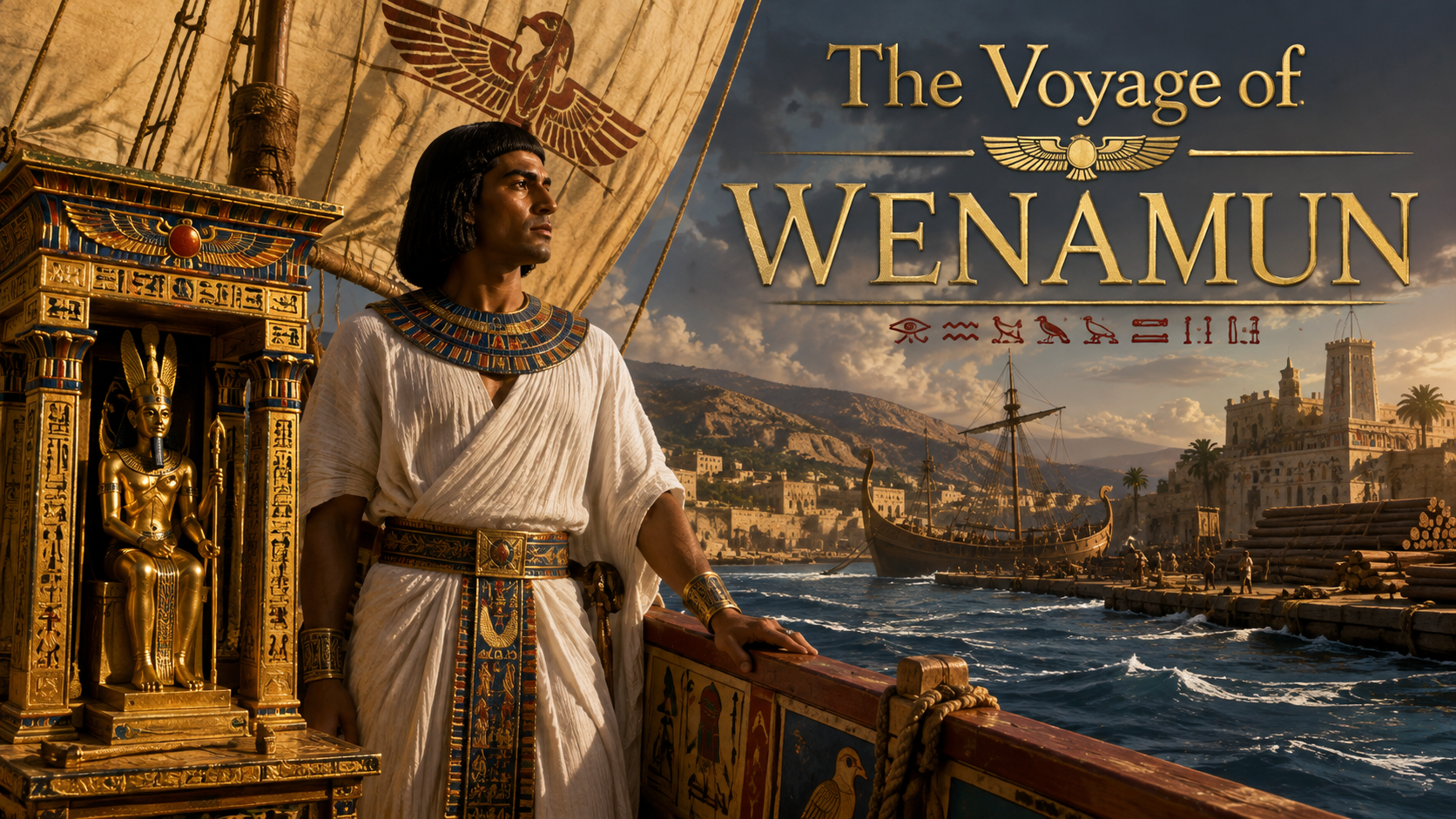
A surviving Egyptian manuscript tells of a priest named Wenamun who was sent from Thebes to Byblos in Lebanon to obtain cedarwood for the sacred boat of Amun.
Whether the account records an actual journey or is a literary story based upon real conditions remains uncertain. Either way, it provides a vivid picture of a world in which Egypt’s ancient prestige could no longer guarantee obedience.
A New Sacred Boat for Amun
Each year, the sacred image of Amun-Ra, King of the Gods, left his temple at Karnak and traveled across the Nile to the western side of Thebes.
The god was carried in a magnificent ceremonial boat during festivals and processions. Over time, however, the vessel had become old and fragile.
Herihor decided that a new sacred boat must be constructed.
Egypt possessed many useful trees, but few provided the long, strong timbers required for such an important vessel. The famous cedars of Lebanon were considered ideal.
Herihor therefore chose Wenamun, an official of Amun’s temple, to travel to Byblos and obtain the timber.
A small image of Amun-of-the-Road was placed inside a gilded shrine and entrusted to him. The divine image would accompany Wenamun, protect him during the journey, and represent the authority of Amun.
Wenamun left Thebes and traveled north along the Nile.
When he reached Tanis, he presented himself before Smendes and Tentamun.
He delivered letters from Herihor explaining the mission.
“We are servants of Amun, King of the Gods,” Smendes and Tentamun declared.
They promised to provide Wenamun with a ship and assist him in every way they could. Yet nearly two months passed before a suitable vessel was found.
At last, during the fourth month of summer, Wenamun boarded a ship commanded by a Syrian captain named Mengebet. The vessel sailed northward along the Mediterranean coast.
The Theft at Dor
Wenamun’s ship eventually entered the harbor of Dor.
The city had once stood within the Egyptian sphere of influence, but it was now ruled by the Tjeker, one of the peoples who had settled along the coast after the collapse of the old political order.
The ruler of Dor was a man named Beder.
Although Wenamun regarded the Tjeker with suspicion, he needed food, water, and safe passage through their territory.
Beder sent him fifty loaves of bread, a haunch of roasted ox, and a large jar of wine.
That evening Wenamun and his companions feasted upon the deck.
The wine passed from hand to hand until many of the men fell asleep where they sat.
The following morning, someone discovered that one of the ship’s crew had vanished.
So had the gold and silver entrusted to Wenamun for the purchase of the cedarwood.
Wenamun was horrified.
How could he return to Egypt and confess that Amun’s treasure had been stolen while he lay sleeping after a feast?
He hurried to Beder’s palace.
“I have been robbed in your harbor,” he declared. “You are the ruler of this city and responsible for justice. Find the thief and return the gold and silver.
“The treasure belongs to Amun-Ra himself. If it is lost, Smendes, Herihor, and the rulers of Egypt will hold you responsible.”
Beder received the demand coldly.
“What right have you to enter my palace and give me orders?” he asked.
“If one of my people had robbed you, I would replace the treasure from my own storehouse and recover it from the thief later.
“But you say the thief belonged to your own ship. That is not my responsibility.
“Nevertheless, out of respect for Amun, I shall order a search. Remain in the harbor for several days and see whether the missing treasure is found.”
Wenamun returned to his ship and waited. Nine days passed. On the tenth, he stormed back into the palace and demanded an answer.
Beder merely advised him to wait longer.
Wenamun became convinced that the prince had no intention of helping him. He even wondered whether Beder had secretly arranged the theft.
Unable to endure another delay, he ordered Captain Mengebet to sail north.
Wenamun Seizes Tjeker Silver
As the ship passed Tyre and continued toward Byblos, Wenamun brooded over his failure.
Without the missing gold and silver, he had no way to pay for the cedarwood.
Partway between Tyre and Byblos, the Egyptians encountered another ship belonging to the Tjeker.
Desperation overcame Wenamun’s judgment.
He ordered his men to board the vessel and seize its valuables.
After a struggle, the smaller crew was overpowered. Wenamun took their silver, which came to almost the same value as the treasure stolen at Dor.
The furious Tjeker protested that they had done nothing to him.
“You and your ship are free to go,” Wenamun told them. “Return to Beder. When he finds the silver stolen from me, he may give it to you.”
Wenamun believed that justice had been restored.
The Tjeker undoubtedly saw the matter differently.
Rejected at Byblos
Wenamun eventually entered the harbor of Byblos.
He established a camp upon the shore and erected a special tent for the gilded shrine of Amun-of-the-Road.
Captain Mengebet had other business to conduct, so his ship continued its voyage. Wenamun sent word to Tjekerbaal, the ruler of Byblos, announcing that the envoy of Amun had arrived.
Soon the master of the harbor approached the Egyptian camp.
“How dare an unknown foreigner establish himself here?” he demanded. “The Prince of Byblos orders you to leave his harbor.”
“How can I leave?” Wenamun asked. “I have no ship.”
The harbor master returned to the palace. The prince’s answer was unchanged.
“Remove him from my harbor.”
Every day Wenamun requested an audience with Tjekerbaal. Every day he was refused.
“If the prince wants me to leave,” Wenamun said, “then he must provide a ship.”
Again the message returned. “Leave his harbor.”
This humiliation continued for nearly a month.
At last Wenamun learned that a Syrian ship was preparing to sail for Egypt. Convinced that his mission had failed, he ordered his servants to pack the camp.
By late afternoon, only the tent containing Amun-of-the-Road remained standing.
Wenamun did not want foreigners watching or mocking while the sacred shrine was carried aboard. He decided to wait until darkness before moving it.
The God Speaks at Byblos
That same afternoon, Tjekerbaal visited the principal temple of Byblos.
As the prince approached the altar carrying burning incense, one of his young attendants suddenly collapsed.
The boy’s body shook violently. His face lost its colour, and his head rolled from side to side.
Then he spoke in a voice that was not his own.
“Bring Amun-of-the-Road before the prince.
“Summon the envoy who travels with him.
“The King of the Gods has sent this man. See him and hear his words.”
The boy fell unconscious.
Priests and courtiers rushed forward to help him.
Tjekerbaal began to wonder whether he had made a serious mistake by ignoring the Egyptian envoy.
He knew Wenamun intended to leave that evening, so he sent a messenger running toward the harbor.
Just as Wenamun prepared to enter the sacred tent, the harbor master arrived.
“Do not leave,” he called. “The prince commands you to remain until morning.”
Wenamun stared at him suspiciously.
“Are you not the same man who has ordered me to leave every day for the past month?
“This is a trick. You want me to miss my only ship. Tomorrow you will return and order me away again.”
The harbor master insisted that the message was genuine, but Wenamun continued packing.
When Tjekerbaal learned that the Egyptian did not believe him, he ordered the Syrian ship to remain in port as proof of his good faith.
Reluctantly, Wenamun agreed to stay.
Wenamun Meets Tjekerbaal
The following morning, royal messengers escorted Wenamun through Byblos.
Before leaving the shore, he knelt before the shrine of Amun-of-the-Road and prayed for courage, wisdom, and an eloquent tongue.
Tjekerbaal received him in an upper chamber overlooking the harbour.
The prince sat upon an ivory chair with the sea visible through the window behind him. He wore a costly robe of purple cloth and golden rings upon his fingers.
Wenamun bowed.
“I bring you the blessing of Amun-Ra, King of the Gods.”
“When did you leave the sacred city of Amun?” asked Tjekerbaal.
“Five months ago,” Wenamun replied.
“If that is true, where is the letter from the High Priest proving your identity?”
“I carried such a letter,” Wenamun admitted, “but I gave it to Smendes.”
Tjekerbaal became angry.
“You come before me without a ship, without letters, and without the payment required for the timber.
“You do not even claim to have been sent by Pharaoh.
“Smendes placed you aboard a foreign ship and sent you away. Perhaps he hoped the captain would throw you into the sea.”
“It was not a foreign ship,” Wenamun protested. “Its captain and crew served Smendes.”
“What does that matter?” Tjekerbaal replied impatiently. “Tell me why you are here.”
Wenamun stepped closer.
“I have come for timber to rebuild the sacred boat of Amun.
“Your father and your father’s father provided cedarwood for Egypt. You must do the same.”
“I will provide timber when Egypt pays for it,” answered the prince.
“My ancestors traded with your kings, but they did not cut cedar until Egyptian ships had unloaded payment upon the quays of Byblos.
“If you doubt me, I shall show you the records.”
The Records of Byblos
Tjekerbaal summoned his scribes.
Three men entered carrying heavy rolls of documents. The prince selected an old account dating from the reign of his great-grandfather and read aloud the valuable goods Egypt had once delivered in exchange for timber.
Wenamun listened with growing discouragement.
“If the ruler of Egypt were my overlord,” Tjekerbaal continued, “he could command me to cut timber without payment.
“But he is not my master.
“I am not your servant, nor am I the servant of those who sent you.
“I am lord of Lebanon. When I speak, the cedar trees fall, and their trunks are carried to the shore.
“Where is your ship to carry the timber? Where are the ropes needed to secure it? Must I provide everything?
“It may be true that Amun created Egypt first and that wisdom once traveled from Egypt to Byblos. But that time has passed.
“Egypt commands no one here. Your journey has been pointless.”
The prince’s contempt made Wenamun bold.
“You are mistaken,” he declared.
“Every ship that sails upon river or sea belongs to Amun. The forests of Lebanon also belong to him. They are the source of timber for the sacred boat of the King of the Gods.
“How can you bargain over the property of Amun with the envoy of Amun?
“Earlier kings may have sent gold and silver, but I offer something greater. Obey the god, and he will grant you life, health, and prosperity.”
Wenamun saw that promises of divine favor had not persuaded the prince.
He changed his approach.
“Allow me to send a message to Smendes and Tentamun. They are faithful servants of Amun and will repay the entire expense of cutting and transporting the timber.”
This proposal interested Tjekerbaal.
His scribes came forward, and Wenamun dictated a letter requesting payment from Egypt.
Payment Arrives
Wenamun returned to the shore, rebuilt his camp, and waited. Months passed before messengers finally arrived from Egypt.
They brought gold and silver vessels, fine linen, hundreds of mats, coils of rope, ox hides, and other valuable goods for Tjekerbaal.
Tentamun also sent clothing, lentils, and baskets of dried fish for Wenamun. The prince was pleased with the payment. He assigned hundreds of workers to begin cutting cedar.
The great trees were felled and left to dry. Their branches were removed, the trunks were cut into logs, and teams of oxen dragged them from the mountains to the seashore.
When the last timber reached the harbor, Tjekerbaal summoned Wenamun.
The prince was walking through his gardens beneath a sunshade, surrounded by courtiers. Some were Egyptians who had left their homeland to seek wealth at the court of Byblos.
They laughed at Wenamun’s worn clothing and long misfortunes until Tjekerbaal silenced them.
“Your timber is ready,” the prince said. “I have also provided ships and sailors, although the payment from Egypt scarcely covers the expense.
“You should fear my anger more than a storm at sea. Depart at once.
“You should consider yourself fortunate. Earlier Egyptian envoys spent seventeen years waiting in Byblos and died here. Would you care to see their graves?”
“That will not be necessary,” Wenamun answered nervously. “Those envoys served mortal men. I am the envoy of a god.”
Then he gathered his courage.
“You should carve upon a stone for all future generations to read that you welcomed the envoy of Amun, gave him timber and ships, and sent him safely home.
“If you do this, I shall ask the god to add fifty years to your life.”
“Those are impressive words,” Tjekerbaal replied dryly.
“When I return,” said Wenamun, “I shall tell Amun and his high priest everything you have done. They will reward you as you deserve.”
Wenamun bowed and hurried toward the harbor, overjoyed that his mission was nearly complete.
The Tjeker Return
His relief disappeared when he saw several Tjeker ships anchored in the harbor.
A captain standing upon the quay recognized him.
“There is the Egyptian who stole our silver!” the man shouted. “Arrest him. Do not allow his ships to sail.”
Wenamun sat down and covered his face with his hands.
One of Tjekerbaal’s scribes approached.
“What has happened?”
Wenamun pointed toward a flock of birds flying south.
“Do you see those birds? They are leaving Byblos to spend the winter in Egypt.
“They will reach my homeland long before I do. Perhaps I shall never see Egypt again.
“The Tjeker have come to arrest me.”
The scribe hurried back to the palace.
Tjekerbaal was furious. He had completed the work, received the payment, and wanted the timber removed from his harbor.
“Tell the Tjeker and the Egyptian that I will judge between them tomorrow,” he ordered.
Secretly, however, he sent Wenamun a second message telling him not to despair.
With it came two jars of fine wine, a roasted sheep, and an Egyptian singer from the prince’s own household.
Wenamun tried to take comfort in the gifts.
He shared the food and wine while the singer played her instrument and performed songs from Egypt.
Wenamun sat beside the sea, staring toward the south and longing for home.
The Judgment of Tjekerbaal
The following morning, the Tjeker presented their case before Tjekerbaal.
“What do you ask me to do?” the prince said.
“Arrest the thief,” answered their captain. “Allow us to take him back to Dor for punishment.”
Tjekerbaal pretended to consider the demand.
“If this Egyptian were an ordinary man serving an earthly ruler, I would gladly surrender him.
“Unfortunately, he claims to be the envoy of Amun, King of the Gods.
“As a devout man, how could I commit the terrible offense of detaining a divine messenger?”
The Tjeker murmured angrily.
Tjekerbaal raised his hand.
“I offer this solution.
“The Egyptian shall board his ships and leave Byblos. Once he has sailed beyond my harbor, you may pursue him.
“If you capture him upon the open sea, that is no concern of mine. Neither Amun nor Egypt can blame me.”
The prince was pleased with his decision. The timber would be removed, Egypt could not demand repayment, and the dispute would no longer belong to Byblos.
The Tjeker accepted reluctantly.
Wenamun ran toward his ships.
The Storm at Sea
The Egyptians loaded the final supplies and sailed from the harbor as quickly as possible. Their vessels were heavy with cedarwood and far slower than the Tjeker ships.
Wenamun knelt upon the deck before the shrine of Amun-of-the-Road.
“O Amun, protect your timber and your servant. Do not allow your enemies to capture us.”
A strong wind rose behind the Egyptian ships and drove them southward. For a moment Wenamun believed the god had answered him.
The Tjeker sails appeared upon the horizon, but the favorable wind kept the Egyptians ahead.
Then the sky darkened.
The wind became violent. Lightning split the clouds, and rain swept across the sea.
Soon Wenamun had no time to worry about pursuit. The overloaded ships struggled simply to remain afloat. The storm continued throughout the night.
At dawn, the sailors saw land and turned toward the nearest harbor. They had escaped the Tjeker but had been driven far from the route to Egypt.
The captains believed they had reached Alashiya, a land usually identified with ancient Cyprus.
Wenamun Reaches Alashiya
The people gathering upon the quay did not appear friendly. They carried swords, spears, and bows.
Afraid they would attack the ships, Wenamun decided to go ashore and search for someone in authority.
Six strong sailors accompanied him.
As soon as they stepped from the gangplank, the crowd surrounded them. People shouted in a language the Egyptians could not understand.
Someone threw a stone.
Wenamun raised his arm to protect his face, but the crowd mistook the gesture for a threat.
The Egyptians drew their daggers and prepared to defend themselves.
At that moment, the ruler of the city appeared.
The surviving text calls her Hatiba.
Wenamun threw himself at her feet.
“Does anyone here understand the language of Egypt?” he cried.
One of her attendants stepped forward.
“I understand it.”
“Tell your lady that I am Wenamun, envoy of Amun. I come from Thebes, the sacred city of the King of the Gods.
“Even in Egypt, we have heard that Alashiya is a land of justice.
“But is it justice to attack a traveler driven into your harbor by a storm?
“The ships and sailors belong to the Prince of Byblos. If they are harmed, he will seek revenge.”
When the message had been translated, Hatiba ordered the crowd to lower its weapons.
She rebuked them for attacking strangers who had sought refuge from the sea.
Then she spoke to Wenamun through the interpreter. “My lady commands you to rest and be at peace.”
At this point, the surviving manuscript breaks off. The remainder of Wenamun’s journey has been lost, and the ancient text does not reveal whether he reached Egypt or what eventually happened to the cedarwood.
A Possible Ending
The following conclusion is a modern reconstruction based upon the mission described in the surviving story.
Hatiba welcomed Wenamun and his sailors into her city.
For several days, the Egyptians repaired their storm-damaged ships and replenished their supplies. The ruler of Alashiya provided fresh water, bread, fruit, oil, and timber for the necessary repairs.
Wenamun presented offerings before the shrine of Amun-of-the-Road and thanked the god for preserving him once again.
He remained anxious that the Tjeker might arrive, but no hostile ships appeared.
When the winds became favorable, Wenamun returned to the harbor.
Hatiba gave him gifts for Amun and ordered her people to escort the Egyptians safely to their ships.
Wenamun bowed before her.
“Your kindness will be remembered in the temple of Karnak. Amun will know that you protected his envoy when others sought to destroy him.”
The Egyptian ships sailed from Alashiya and followed a safer route toward the coast of Egypt.
Wenamun watched the horizon day and night, but no Tjeker sails appeared.
At last the sailors saw the low coastline of the Nile Delta.
They raised their hands and praised Amun.
The cedarwood was unloaded and transferred to river barges. Wenamun traveled to Tanis, where he thanked Smendes and Tentamun for the payment they had sent to Byblos.
Then he joined the barges for the long journey south.
When the timber reached Thebes, the priests and people rejoiced.
Herihor listened as Wenamun described the theft at Dor, his humiliating treatment at Byblos, the pursuit of the Tjeker, the storm, and his rescue in Alashiya.
Although the voyage had taken far longer than expected, the envoy had fulfilled his mission.
Craftsmen used the cedarwood to build a magnificent new ceremonial boat for Amun-Ra.
When the sacred vessel was completed, it was covered with gold, painted with divine images, and carried through Thebes during a great festival.
Wenamun stood among the priests and watched the image of Amun travel in splendor.
The god’s boat had been renewed, but the journey had revealed a painful truth.
Egypt still possessed ancient temples, sacred traditions, and powerful gods. Yet beyond the Nile Valley, its old commands no longer inspired automatic obedience.
Where Egyptian kings had once demanded tribute, Wenamun had been forced to bargain, plead, threaten, and pay.
His voyage was therefore more than an adventure.
It was the story of a man struggling to complete a sacred mission in a world where Egypt’s empire had vanished, and its former subjects had become independent rulers.
Wenamun returned with the cedarwood, but he also returned with proof that the age of unquestioned Egyptian power was over.