The Prince and the Sphinx
During the seventeenth century BC, Egypt was divided.
Foreign rulers controlled much of Lower Egypt, while Egyptian kings continued to govern from Thebes in the south. These foreign rulers became known as the Hyksos, a name derived from an Egyptian term meaning “rulers of foreign lands.”
People from western Asia had been settling in the Nile Delta for generations. Many arrived peacefully as traders, workers, or migrants. They brought new technologies and military practices, including improved bows, new types of weapons, horses, and horse-drawn chariots.
Over time, powerful foreign dynasties established themselves in the eastern Delta. Their capital was Avaris, a prosperous city connected to trade routes leading into Canaan and the wider Near East.
Although later Egyptian traditions portrayed the Hyksos as brutal invaders, the reality was more complicated. They adopted Egyptian titles, worshipped Egyptian gods, and ruled in many ways like Egyptian kings.
Nevertheless, Egypt was no longer united.
The Struggle Against the Hyksos
The rulers of Thebes controlled only part of Upper Egypt. To their south, the kingdom of Kush had become independent in Nubia. To their north lay the territory controlled by the Hyksos.
The Theban kings were at times forced to acknowledge the power of the Hyksos ruler in Avaris.
Eventually, a royal family in Thebes began fighting to reunite Egypt.
The struggle lasted across several reigns. King Seqenenre Tao appears to have died violently, possibly during the conflict. His successor, Kamose, campaigned northward against the Hyksos and attacked their territory.
The final victory belonged to Ahmose I.
Ahmose captured Avaris and drove the Hyksos from Egypt. He then pursued them into southern Canaan and laid siege to their stronghold at Sharuhen.
With Egypt reunited, Ahmose became the founder of the Eighteenth Dynasty and the first ruler of the New Kingdom.
The kings who followed him rebuilt Egypt’s military power. They strengthened control over Nubia and expanded Egyptian influence into Canaan and Syria.
Thutmose I sent Egyptian armies deep into Nubia and campaigned in the Near East. Several generations later, Thutmose III created the largest empire Egypt had yet possessed.
Egypt had entered an age of conquest, wealth, and monumental construction.
The Rise of Amun-Ra
The victories of the Theban kings increased the importance of their patron god, Amun. Amun had once been a relatively local deity associated with hidden and invisible power. As the rulers of Thebes became kings of all Egypt, their god also rose in status.
Amun became closely linked with Ra, the ancient solar creator. As Amun-Ra, he was worshipped as king of the gods, creator of the world, and divine protector of the pharaoh.
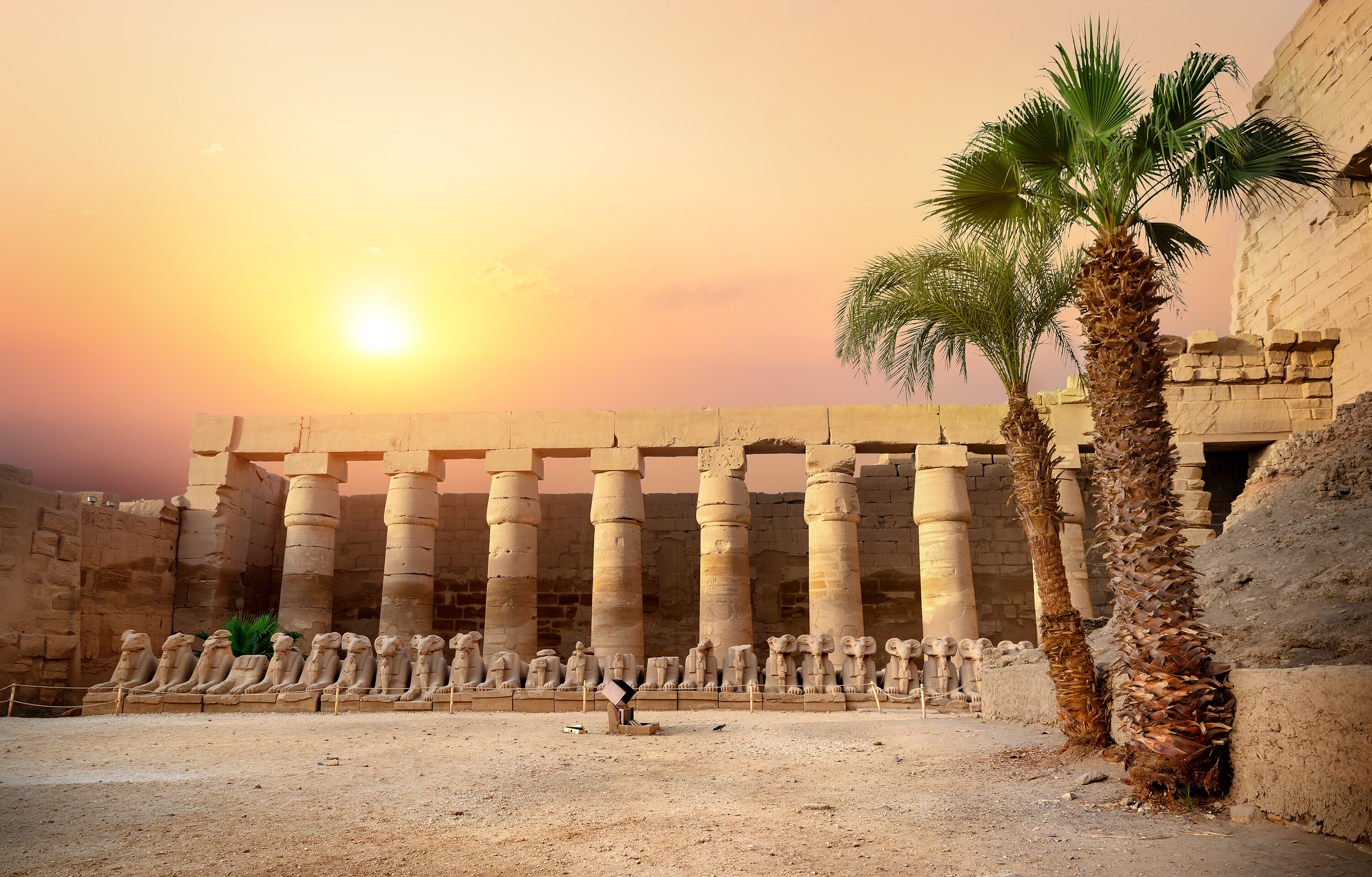
His principal temple stood at Karnak in eastern Thebes. There Amun was worshipped with his consort Mut and their son Khonsu.
New Kingdom kings enlarged Karnak with pylons, courtyards, obelisks, shrines, and enormous columned halls. They recorded military victories upon its walls and presented the god with wealth taken from conquered lands.
Gold, silver, precious stones, livestock, chariots, weapons, prisoners, and foreign tribute flowed into the temple.
The king’s military success proved that the gods supported him. In return, he rewarded the gods who had granted him victory.
The Warrior Princes
New Kingdom princes were trained to become soldiers, hunters, athletes, and charioteers.
They learned archery, wrestling, rowing, horse riding, and the use of weapons. A future king was expected to possess courage, physical strength, and skill in battle.
Amenhotep II, the son and successor of Thutmose III, was especially proud of his athletic ability.
Royal inscriptions praised him as an exceptional archer, oarsman, horseman, and chariot driver. One account claimed that he could shoot arrows through thick copper targets while driving a chariot at full speed.
Amenhotep II had several sons. Among them was a young prince named Thutmose.
Whether Thutmose was originally expected to inherit the throne is uncertain. The famous story preserved on the Dream Stele may suggest that he was not the first choice, although the inscription never says this directly.
It tells instead how a sleeping prince encountered a god beneath the shadow of the Great Sphinx.
The Great Sphinx of Giza
The Great Sphinx is one of the most famous monuments in Egypt.
Carved from the natural limestone of the Giza Plateau, it has the body of a reclining lion and the head of a king. Most Egyptologists associate its construction with King Khafre of the Fourth Dynasty, although questions about its precise origin remain.
The monument is approximately 73 meters, or 240 feet, long and about 20 meters, or 66 feet, high.
It lies near the pyramid complexes of Giza, facing east toward the rising sun. By the New Kingdom, the Sphinx was already more than a thousand years old.
The Egyptians worshipped it as a solar deity called Horemakhet, meaning “Horus in the Horizon.” The Greek form of this name is Harmachis.
A temple and cult developed around the monument, and New Kingdom rulers left offerings, inscriptions, and chapels in its honor.
The Sphinx was carved partly from layers of relatively soft limestone. Windblown desert sand repeatedly accumulated around its body.
At times, only its enormous head and upper back remained visible. Clearing the monument required immense labor, and the sands always threatened to return.
Prince Thutmose Goes Hunting
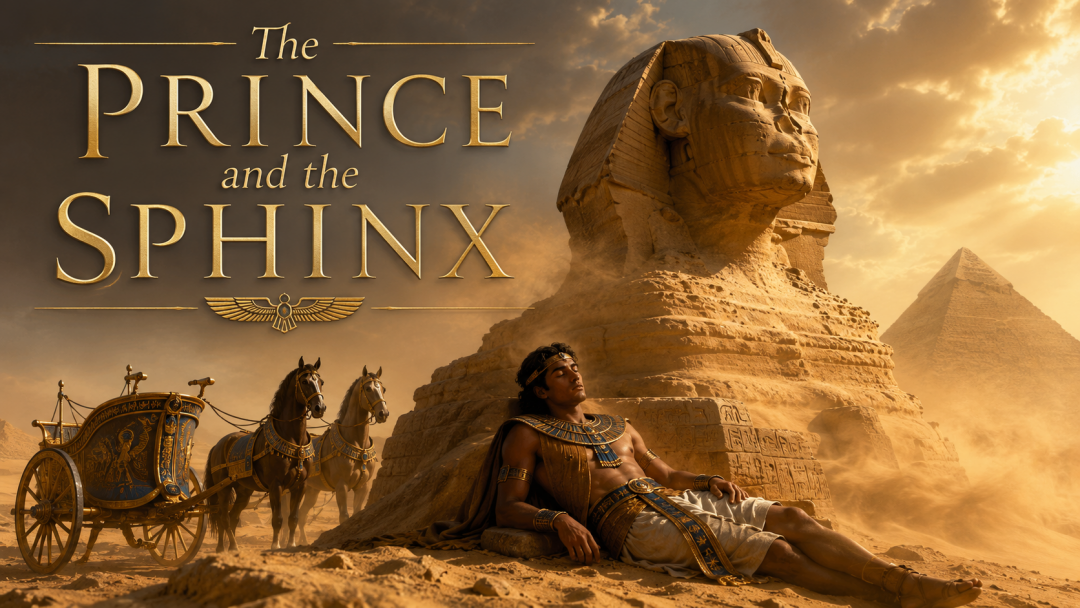
According to the story, Prince Thutmose enjoyed leaving the royal court to hunt and exercise upon the desert plateau near Giza.
He drove his chariot across the sand, hunted lions and gazelles, practiced archery, and raced with his companions.
One day, during the heat of noon, the prince stopped near the Great Sphinx.
Most of the monument lay buried beneath the desert. Only the head rose clearly above the drifts. The sun burned fiercely overhead.
Exhausted from hunting, Thutmose ordered his companions to rest. The horses were tethered, and the prince settled in the shadow cast by the Sphinx.
The air was still. The desert stretched silently around him. Thutmose leaned against the ancient stone and fell asleep.
The Dream of the Sphinx
As soon as he slept, the prince entered a vivid dream. He found himself standing between the enormous paws of the Sphinx. The buried monument was no longer silent.
A powerful voice rolled across the desert.
“Look upon me, my son Thutmose. I am your father, Horemakhet-Khepri-Ra-Atum.
“I shall give you my kingdom upon earth. You shall wear the White Crown of Upper Egypt and the Red Crown of Lower Egypt.
“You shall sit upon the throne of Geb, and the Two Lands shall belong to you. All that the sun encircles shall be placed beneath your authority.
“Riches and tribute shall come from every land, and you shall enjoy a long and glorious reign.
“My face is turned toward you, and my heart has chosen you.”
The prince listened in amazement. Then the Sphinx spoke of its suffering.
“The desert sand lies heavily upon me. It covers the body through which I exist.
“Come to me. Clear away the sand and free me.
“Do this, and I shall grant what I have promised. I know that you are my son and my protector.”
The divine voice faded. Thutmose awoke beneath the blazing sun.
The desert appeared unchanged, but the dream remained clear in his mind.
He believed the god had spoken directly to him.
Clearing the Great Sphinx
Thutmose returned to the royal residence and arranged for offerings to be made to Horemakhet. He then summoned laborers to clear the sand from around the Sphinx.
The workers came with baskets, ropes, wooden tools, and carrying poles. Day after day, they dug into the drifts and carried the sand away.
Slowly, the hidden body of the monument emerged.
First the great paws appeared. Then the lion’s chest, flanks, and tail were uncovered. Walls may also have been built to help protect the enclosure from returning sand.
Once the work was complete, the Sphinx stood revealed again beneath the Egyptian sun. Thutmose had fulfilled his side of the promise.
In time, he became king.
Thutmose IV Becomes Pharaoh
Thutmose IV succeeded Amenhotep II and ruled Egypt during the Eighteenth Dynasty.
The precise dates of his reign remain debated, but he probably ruled for roughly a decade in the early fourteenth century BC.
As king, he conducted campaigns in Nubia and maintained Egyptian power in the Near East. He also used diplomacy to strengthen relations with neighboring kingdoms.
Thutmose IV married several women, including a princess from Mitanni, one of Egypt’s major rivals in western Asia. This marriage helped establish a period of peace between the two powers.
His son Amenhotep III inherited a wealthy and secure empire and became one of Egypt’s most magnificent builders.
Thutmose IV never forgot the god who had spoken to him beneath the desert sands.
Between the paws of the Great Sphinx, he erected a tall granite monument now known as the Dream Stele.
The Dream Stele
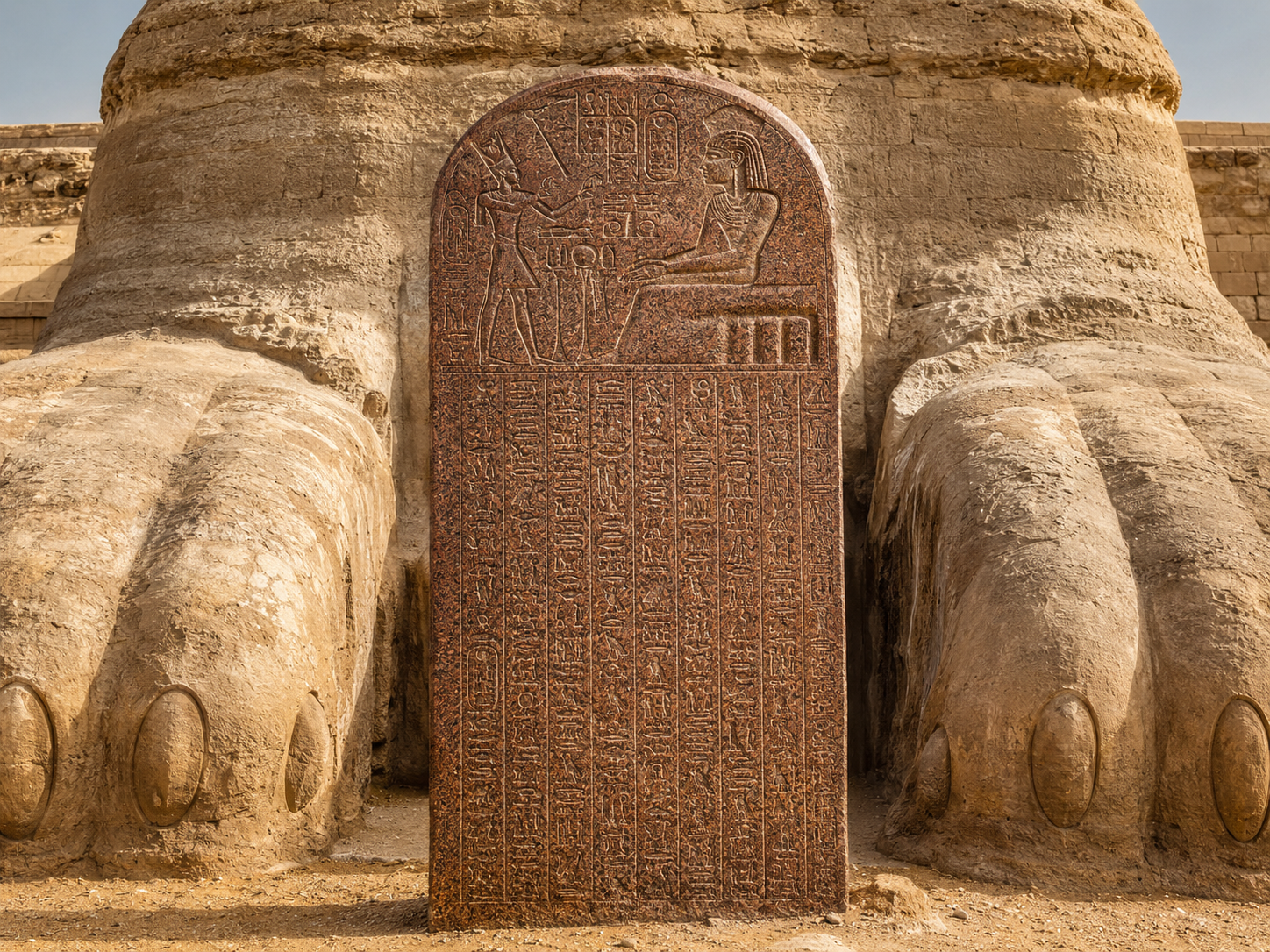
The Dream Stele records the prince’s encounter with the Sphinx and the promise that he would become king if he cleared away the sand.
At the top of the monument, Thutmose IV is shown presenting offerings to the Sphinx. Below is the inscription describing his dream.
The stele was erected during the first year of his reign, when the new king was establishing his authority and proclaiming his relationship with the gods.
The story served more than one purpose.
It honored Horemakhet and explained why Thutmose restored the Sphinx. It also declared that the Sun God himself had selected him to rule Egypt.
This has led some scholars to wonder whether Thutmose had not originally been the crown prince. Perhaps an older brother had been expected to inherit the throne. Perhaps Thutmose needed to strengthen his claim after an uncertain succession.
The stele never says that he seized the throne or displaced another heir. Its political meaning therefore remains uncertain.
Whatever the circumstances, the inscription made one message unmistakable.
Thutmose IV ruled because the god of the Great Sphinx had chosen him.
Rediscovering the Inscription
The Dream Stele remained between the paws of the Sphinx for more than three thousand years.
By the early nineteenth century, much of the monument was once again buried beneath sand.
Excavators clearing the area uncovered the granite stele in 1817 and 1818.
Although parts of its inscription had been damaged, enough survived for scholars to identify Thutmose IV and reconstruct the central story.
The stele became one of the most famous ancient Egyptian accounts of a royal dream.
Dreams held great significance in Egypt. They could be interpreted as messages from gods, warnings of danger, glimpses of the future, or commands requiring action.
A dream experienced near a sacred monument carried particular authority.
The prince had fallen asleep beside a buried image of the Sun God and awakened with a divine promise.
Legend, Religion, and Royal Power
The story of the prince and the Sphinx may preserve a genuine experience.
Thutmose could have rested beside the monument, dreamed of the god, and ordered the sand removed because he believed the dream was real.
It is also possible that royal officials shaped the account into a powerful political statement after he became king.
The two possibilities do not exclude each other.
For the ancient Egyptians, religion and kingship were inseparable. A ruler’s legitimacy came from the gods. Dreams, prophecies, rituals, and monuments all helped demonstrate that divine approval.
By restoring the Sphinx, Thutmose performed a sacred duty.
He rescued an ancient god from the desert, renewed a holy place, and presented himself as the chosen son of Ra.
In return, the Sphinx granted him the throne.
Whether the promise came before or after political events mattered less than the story’s meaning.
The king had acted for the god, and the god had acted through the king.
The Legacy of the Prince and the Sphinx
The Dream Stele transformed Thutmose IV from one of many royal sons into the prince personally chosen by the Sun God.
His reign was relatively short, and later kings built monuments far larger than his. Yet his story remains one of the most memorable royal legends from ancient Egypt.
It captures the timeless power of the Great Sphinx.
Even in the New Kingdom, the monument belonged to a distant and mysterious past. Its original builders had lived more than a thousand years before Thutmose.
The prince saw not merely an ancient statue but a living god buried beneath the sands.
The Sphinx spoke. The prince listened. He cleared away the desert and became pharaoh.
More than three thousand years later, the granite stele still stands between the monument’s paws, preserving the dream that joined an ambitious prince with one of Egypt’s oldest guardians.