The ancient Egyptian Book of the Dead was a collection of funerary compositions intended to help the deceased survive death, regain essential faculties, travel through the afterlife, and become an effective spirit among the gods. Book of the Dead Spell 22 addresses one of the most basic problems created by death: the deceased has become silent.
The spell restores the person’s mouth, allowing them to speak again before the gods of the underworld.
Its traditional title is:
Another formula for giving the mouth of a man to him in the underworld
Spell 22 is closely related to Spell 21, but it is not simply a duplicate. The deceased declares that they have emerged from a mysterious cosmic egg, received their mouth, gained the right to speak before the ruler of the underworld, and become impossible to reject before the divine tribunal.
The speaker then identifies directly with Osiris, Lord of Rosetau, enters a mysterious Island of Fire, and declares the ability to extinguish its flame.
In simple terms, Spell 22 says: My voice has returned. I can speak before the gods, stand before their tribunal without being rejected, enter the dangerous realm of Osiris, and overcome its fire.
What Is Book of the Dead Spell 22?
Book of the Dead Spell 22 is a short funerary formula that restores the mouth and speech of the deceased.
UCL Digital Egypt lists its purpose as another formula for giving a person their mouth in the underworld, immediately following Spell 21 and preceding Spell 23, which specifically concerns opening the mouth.
The sequence is important:
- Spell 21: Gives the deceased their mouth.
- Spell 22: Another formula for giving the mouth.
- Spell 23: Opens the restored mouth.
- Spell 24: Restores the deceased’s words of magical power.
- Spell 25: Restores memory.
- Spell 26: Restores the heart.
Together, these spells reconstruct the deceased as a functioning person.
Spell 22 therefore deals with far more than a physical body part. Restoring the mouth restores the ability to communicate, use sacred language, defend oneself, invoke gods, and exercise magical power.
The Traditional Title of Spell 22
Peter Le Page Renouf and Édouard Naville titled the composition: Another Chapter whereby the Mouth of a person is given to him in the Netherworld.
UCL renders the title more literally as a formula for giving the mouth of “the Osiris N” back to the deceased in the underworld. Here, N represents the deceased person’s name. A manuscript belonging to someone named Ani, for example, might refer to the deceased as the Osiris Ani.
A reader-friendly title would be:
A spell for restoring the deceased’s mouth and power of speech
English Translation of Book of the Dead Spell 22
The following is a reader-friendly translation based on the Egyptian text and the published translations of UCL Digital Egypt and Renouf and Naville.
Spell 22: Giving the Mouth to the Deceased
I have risen in brilliance
from the egg within the mysterious land.My mouth has been restored to me
so that I may speak
before the lord of the underworld.My hand shall not be turned away
before the tribunal of the Great God.I am Osiris,
Lord of Rosetau,the one who stands
upon the summit of the terrace.I have come.
I have accomplished
what my heart desired
upon the Island of Fire.I extinguish the flame.
The central meaning is remarkably clear despite some of the spell’s mysterious imagery. The deceased has regained speech, can appear successfully before a divine tribunal, identifies with Osiris, and possesses power over supernatural fire.
What Does Book of the Dead Spell 22 Mean?
Spell 22 restores agency to the deceased. Death has made the body motionless and silent. Spell 22 reverses those conditions.
The deceased can now:
- Speak
- Appear before the gods
- Present a case before a divine tribunal
- Avoid rejection
- Identify with Osiris
- Enter Rosetau
- Follow the desires of the heart
- Cross a dangerous fiery region
- Extinguish supernatural flame
The spell can be summarized as:
Death has not silenced me. My mouth is mine again, my words can be heard by the gods, and no divine court or fiery obstacle can prevent me from continuing through the afterlife.
Why Was Restoring the Mouth So Important?
The ancient Egyptian afterlife was not imagined as a place where the dead simply rested forever.
The deceased was expected to remain active.
A successful spirit might need to:
- Recite spells
- Name supernatural beings
- Answer gatekeepers
- Address gods
- Defend against accusations
- Request offerings
- Speak their own name
- Command hostile creatures
- Praise Ra and Osiris
- State magical identities
Without speech, many of the Book of the Dead’s other spells would be useless. A written formula might say: I am Horus. But the deceased needed the ability to say it. Spell 22 gives the speaker that power.
Why Are There Two Spells for Giving the Mouth?
Spell 21 and Spell 22 have almost identical titles, but they are different compositions. This is not unusual in the Book of the Dead. The collection was assembled from many independent funerary formulas accumulated over centuries. More than one spell could therefore solve the same problem.
Different manuscript owners or scribal workshops could select:
- One version
- Another version
- Both versions
- A related spell with a slightly different emphasis
The existence of multiple mouth spells shows how important speech was considered. Losing the ability to speak after death was apparently a danger worth protecting against more than once.
Spell 21 vs. Spell 22
Although the two spells serve the same broad purpose, their imagery is very different.
Spell 21
Spell 21 asks a mysterious divine master of light and darkness to give the deceased their mouth so they may speak, while also asking the heart for guidance during the dangerous hours of night.
Spell 22
Spell 22 is more assertive.
The deceased declares:
- They have emerged from a mysterious egg.
- Their mouth has already been given back.
- They can speak before the ruler of the underworld.
- They cannot be rejected by the divine tribunal.
- They are Osiris, Lord of Rosetau.
- They can extinguish the fire of a dangerous supernatural region.
Spell 21 focuses more directly on restoration and guidance.
Spell 22 expands that restoration into divine status and supernatural authority.
Spell 22 Has No Known Middle Kingdom Version
Spell 22 differs significantly from Spell 21 in its textual history. Spell 21 has an earlier Middle Kingdom predecessor in the Coffin Texts. Spell 22 does not.
UCL states that Spell 22 is not attested in the Middle Kingdom. Its earliest known appearance is among Book of the Dead compositions written on the coffin of the king’s wife Mentuhotep, dating to the Seventeenth Dynasty.
That makes Spell 22 particularly interesting for the development of the Book of the Dead. It appears to represent a composition that entered the funerary tradition later than its neighboring Spell 21.
The Coffin of Queen Mentuhotep
The earliest occurrence cited by UCL comes from the coffin of the king’s wife Mentuhotep of Egypt’s Seventeenth Dynasty. This period immediately preceded the New Kingdom, when the Book of the Dead became especially prominent on papyri. The evidence helps illustrate that the transition from Coffin Texts to the Book of the Dead did not happen overnight.
Different compositions:
- Continued from older traditions
- Were rewritten
- Were reorganized
- Appeared for the first time
- Circulated on coffins before becoming familiar on papyrus
Spell 22 belongs to that evolving funerary tradition.
The Book of the Dead of Nu
The UCL translation follows a partly damaged version of Spell 22 preserved in the Book of the Dead of Nu. Missing or damaged portions are supplemented using other manuscript evidence assembled by Édouard Naville. This matters because there was never one perfect master copy of the Book of the Dead.
Individual manuscripts could contain:
- Copying errors
- Damaged passages
- Different spell selections
- Alternative wording
- Different illustrations
- Local variants
Modern translations often compare several surviving witnesses when reconstructing a text.
“I Have Shone in the Egg”
Spell 22 begins with one of its most mysterious images. The deceased declares that they have emerged or shone forth: from the egg within the mysterious land. The egg was a powerful symbol of creation and emergence. Something living comes from what appears externally closed and motionless.
That makes the image especially appropriate to funerary religion.
The deceased had been:
- Wrapped
- Coffined
- Sealed within a tomb
- Removed from the visible world
Yet like life emerging from an egg, the transformed person could come forth again.
The Cosmic Egg in Ancient Egyptian Religion
Egg imagery could be associated with the beginning of creation. Different Egyptian creation traditions described the first life emerging from the primeval world in different ways. Some traditions included a cosmic egg from which a creator or solar deity emerged.
The exact mythological identification of the egg in Spell 22 is not stated explicitly in the short surviving text. It is safest to understand its symbolism broadly: The deceased emerges into renewed existence as divine life once emerged at creation.
The speaker is not merely waking up. The deceased is undergoing a new creation.
What Is the “Land of Mysteries”?
UCL translates the location of the egg as the land of mysteries. Renouf rendered it as an unseen or hidden world. This likely refers broadly to a hidden divine region rather than ordinary earthly geography.
The afterlife contained:
- Secret chambers
- Hidden roads
- Gates
- Caverns
- Divine sanctuaries
- Regions unavailable to the living
The deceased emerges from this concealed realm with restored powers.
The movement parallels the sun’s own transition from invisible nighttime existence into daylight.
“My Mouth Has Been Given to Me”
The central declaration of Spell 22 is that the deceased’s mouth has been restored. Notice the difference between a request and a declaration.
The speaker does not simply say: Please give me a mouth. Instead, the spell presents the desired condition as already achieved: My mouth has been given to me.
This is characteristic of Egyptian magical language. A spell often states the intended outcome as fact. The deceased does not hope to regain speech. The deceased has regained speech.
Why Does the Deceased Need to Speak Before the Lord of the Underworld?
Spell 22 explicitly links restoration of the mouth with speaking before the ruler of the underworld. The text does not name that ruler in this particular line, but the following identification with Osiris makes the Osirian setting unmistakable.
Speaking before the divine ruler could be necessary for:
- Recognition
- Judgment
- Self-identification
- Admission
- Vindication
- Praise
- Ritual participation
A silent deceased could not effectively present themselves. Spell 22 ensures that the speaker can appear before the highest divine authority with a functioning voice.
Who Is the Lord of the Underworld?
The phrase naturally evokes Osiris, who was ruler of the dead and central to the Book of the Dead’s funerary theology. However, the line itself uses a title rather than explicitly naming the deity.)
Immediately afterward, the deceased declares:
I am Osiris, Lord of Rosetau.
This connects the entire passage with Osirian resurrection. The deceased is not merely standing before Osiris. The person also participates in Osiris’s identity.
“My Hand Cannot Be Repelled”
The next statement says that the deceased’s hand cannot be rejected or driven back by the tribunal of the Great God. This is a difficult expression, but its broader implication is clear: The divine council cannot reject the deceased.
The restored person now possesses legitimate access.
The speaker may approach rather than being:
- Driven away
- Excluded
- Restrained
- Denied entry
- Rejected in judgment
The mouth supplies speech.
Divine status supplies acceptance.
What Is the Divine Tribunal?
The spell refers to a divine council or tribunal associated with the Great God.
Divine councils appear throughout the Book of the Dead.
They could function as:
- Courts
- Assemblies of gods
- Witnesses
- Judges
- Authorities confirming divine order
Spells 18 and 20, immediately preceding this section of the Book of the Dead, placed enormous emphasis on gaining vindication before such councils.
That makes Spell 22’s declaration especially meaningful.
The deceased has just moved from spells about winning the divine case to spells about regaining the faculties needed to function after that victory.
The Connection With Spells 18 Through 20
There is a striking progression across this part of the Book of the Dead.
Spell 18
Thoth vindicates the deceased before the divine councils.
Spell 19
The deceased receives the Crown of Triumph.
Spell 20
Vindication is reinforced before the councils.
Spell 21
The deceased receives their mouth.
Spell 22
The restored deceased speaks before the lord of the underworld and cannot be rejected by the tribunal.
The sequence suggests a transformation from legal acceptance to active participation.
The deceased has won the right to belong.
Now they acquire the faculties needed to exercise that right.
“I Am Osiris”
The most powerful statement in Spell 22 is: I am Osiris. Divine identification is common throughout the Book of the Dead. The deceased does not merely ask Osiris for protection. The speaker assumes his identity.
This allows the deceased to participate in the god’s successful fate:
- Osiris died.
- His body was preserved.
- He was restored.
- His enemies were defeated.
- He became ruler of the dead.
- His existence continued eternally.
By saying I am Osiris, the deceased declares:
What happened successfully to Osiris will also happen successfully to me.
Why Was Osiris the Perfect Model for the Deceased?
Osiris embodied the central hope of Egyptian funerary religion.
He had experienced death without being annihilated.
His mythology promised that:
- The body could be restored.
- Identity could survive death.
- Enemies could be defeated.
- Divine judgment could lead to vindication.
- Death could become another form of life.
The deceased therefore appears repeatedly as the Osiris [Name] in funerary manuscripts. Spell 22 takes this identification one step further by placing the declaration directly in the speaker’s mouth.
What Is Rosetau?
The deceased identifies as: Osiris, Lord of Rosetau.
Rosetau, also written Rosetjau or Rostau, was both a real and mythological location. It was associated with the Memphite necropolis and later became a name for regions of the underworld.
Rosetau was connected with:
- Tombs
- Necropolises
- Osiris
- Sokar
- Hidden roads
- Entrances to the Duat
- The realm beneath the earth
Spell 4, earlier in the Book of the Dead, is specifically concerned with traveling the upper road of Rosetau. Spell 22 now identifies the deceased with the divine ruler of this dangerous sacred landscape.
Spell 4 and Spell 22
In Spell 4, the deceased needs permission and magical ability to pass along the upper road of Rosetau. By Spell 22, the speaker declares: I am Osiris, Lord of Rosetau.
The traveler has moved from someone seeking passage through the region to someone identifying with its divine ruler. That is a dramatic increase in status.
What Is the “Staircase”?
Renouf’s historical translation describes Osiris as the one “at the head of the Staircase.” His commentary notes that the Staircase of the Great God at Abydos occurs frequently on funerary stelae.
UCL translates the corresponding expression as the one: on top of the terrace.
The difference illustrates the difficulty of translating ancient Egyptian topographical terms.
Rather than treating one English rendering as unquestionably correct, the safest interpretation is that Osiris occupies an elevated or prominent sacred position within the funerary landscape.
The Staircase of the Great God at Abydos
Abydos was one of the most important cult centers of Osiris. The idea of a sacred staircase may relate to:
- Processional movement
- A divine shrine
- Approach to Osiris
- Passage between different levels of sacred space
- Ascension or emergence
Renouf specifically connects the phrase with the “Staircase of the Great God” known from Abydos funerary monuments. The exact architectural or mythological reference remains less certain than the basic Osirian association.
“I Have Done What My Heart Desired”
The deceased says that they have come and accomplished: what my heart wished. This line is especially interesting because of the importance of the heart in Egyptian ideas of the person.
The heart represented:
- Thought
- Memory
- Intention
- Emotion
- Judgment
- Identity
Spell 21 asked the heart to guide the deceased through the dangerous hours of night. Spell 22 now declares that the speaker has successfully carried out what the heart desired.
Once again, the mouth and heart work together.
The Mouth and Heart as a Pair
Spell 22 reinforces an important Egyptian relationship. The heart forms intention. The mouth gives that intention expression. The deceased needs both. Without the heart, there is no guidance or purpose. Without the mouth, there is no effective speech.
This resembles broader Egyptian theological ideas in which divine thought and utterance work together to produce reality. Restoring the mouth is therefore part of restoring the deceased as an intelligent, purposeful being.
What Is the Island of Fire?
The deceased says that the desired action was accomplished on an Island of Fire.
This is one of Spell 22’s most mysterious locations.
The Egyptian afterlife contained several fiery regions.
Fire could represent:
- Danger
- Purification
- Solar power
- Punishment
- Protection
- Destruction of enemies
The Island of Fire appears to be a supernatural region that the deceased can enter successfully rather than a place in which the person is destroyed.
The final declaration makes that clear:
The deceased extinguishes the flame.
Fire in the Egyptian Afterlife
Fire was not automatically evil. For the gods and the justified deceased, it could be protective. For enemies and condemned beings, it could be destructive.
The same supernatural force might:
- Protect Ra
- Destroy Apep
- Guard a sacred gate
- Punish enemies of Osiris
- Threaten an unprepared deceased person
Success depended on the person’s status and magical knowledge. Spell 22 gives the deceased power over the flame rather than allowing the flame power over the deceased.
“I Extinguish the Flame”
The final line is strikingly confident.
The speaker does not say:
Protect me from the fire.
Instead:
I extinguish the flame.
The deceased has become the active force.
This is consistent with the progression of the spell:
- The deceased emerges from the mysterious egg.
- The mouth is restored.
- Speech becomes possible.
- The tribunal cannot reject the speaker.
- The deceased identifies with Osiris.
- The heart’s desire is accomplished.
- The supernatural fire is extinguished.
The person has moved completely from helplessness to agency.
A Possible Solar Meaning of the Flame
Renouf interpreted the flame in connection with the red glow of the sky surrounding sunrise. He suggested that the flame disappears once the sun has fully risen.
This interpretation fits the opening line.
The deceased begins by shining forth from an egg in the hidden world, imagery that can evoke solar emergence.
The composition may therefore connect:
- The deceased’s rebirth
- Solar emergence
- Disappearance of the fiery dawn glow
- Victory over darkness and danger
However, the text itself does not explicitly explain the flame, so the solar interpretation should be presented as Renouf’s commentary rather than as certain fact.
Creation, Speech, and Fire
Spell 22 compresses several powerful themes into only a few lines:
Creation:
The deceased emerges from the cosmic egg.
Restoration:
The mouth returns.
Speech:
The person can address the divine ruler.
Judgment:
The tribunal cannot reject the deceased.
Resurrection:
The speaker becomes Osiris.
Intention:
The heart’s desire is accomplished.
Power:
The flame is extinguished.
The spell reconstructs the deceased as a complete supernatural participant in the afterlife.
Spell 22 and the Opening of the Mouth Ceremony
Spell 22 should not be confused with the full Opening of the Mouth ceremony.
The ancient ritual was much larger and could involve:
- Touching the mouth with ritual instruments
- Purification
- Incense
- Offerings
- Animal sacrifice
- Ritual gestures
- Restoration of sight, hearing, breathing, and eating
Spell 22 deals specifically with giving the mouth back to the deceased.
The Book of the Dead spell specifically called the formula for opening the mouth is Spell 23.
Spell 22 vs. Spell 23
This distinction is valuable for SEO because people searching for Spell 22 may encounter information about the Opening of the Mouth ritual.
Spell 22
Purpose: Restore possession of the mouth.
The deceased declares that the mouth has been returned and can be used before the gods.
Spell 23
Purpose: Open and activate the mouth.
Renouf’s Spell 23 explicitly invokes Ptah to open the mouth and Thoth to remove restraints preventing speech.
The two spells complement one another:
Spell 22 gives the mouth. Spell 23 opens it.
Spell 23 and the Ritual Instrument
Spell 23 even refers to an instrument used by Ptah to open the mouths of the gods. Renouf translated its material as steel, while modern interpretation of the terminology is more complicated.
This connects Spell 23 much more explicitly with Opening of the Mouth ritual imagery.
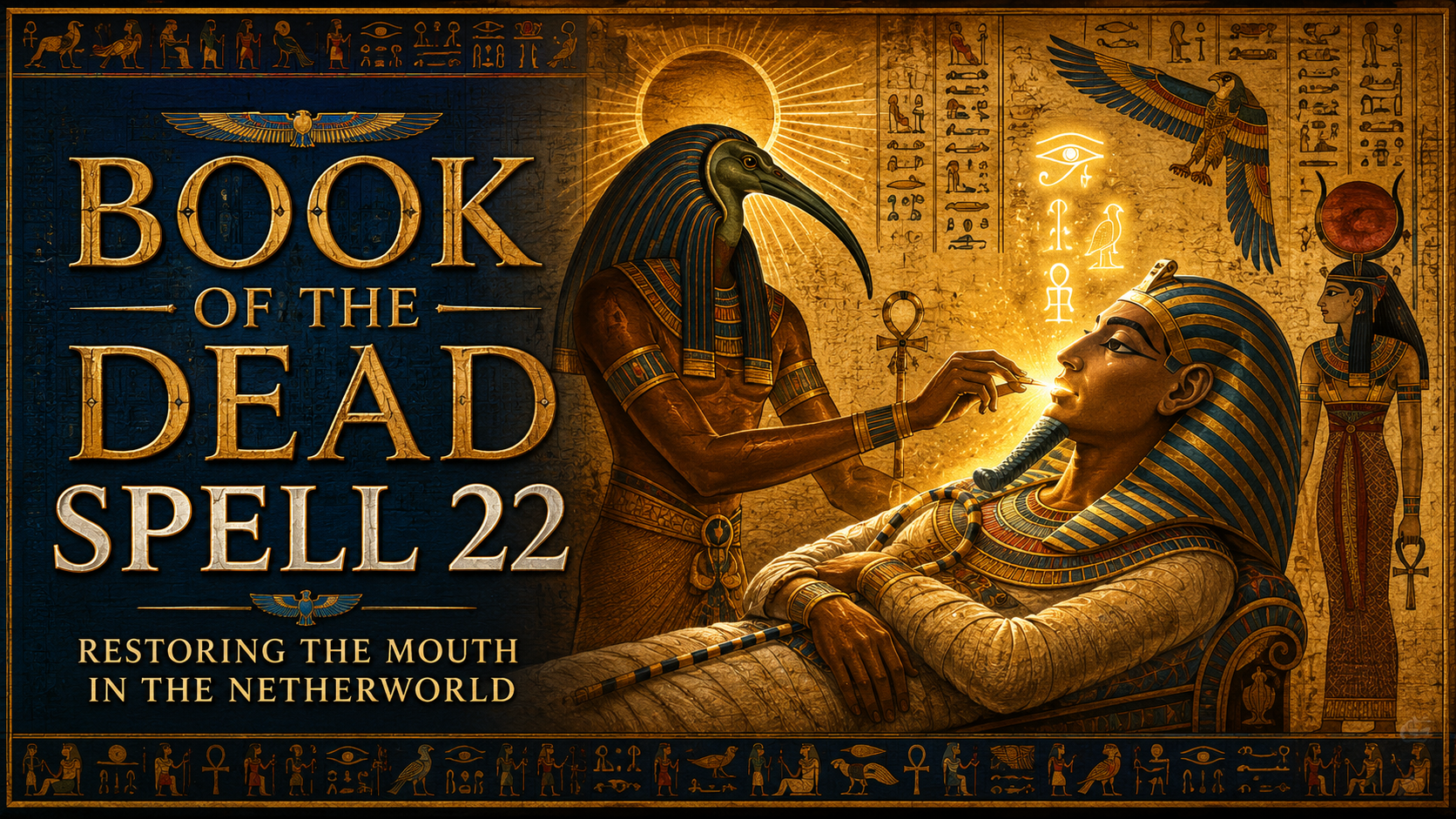
For that reason, if you use an illustration showing a priest touching the mummy’s mouth with a ritual tool, it is technically more representative of Spell 23 than Spell 22.
For Spell 22, imagery of the deceased speaking before Osiris or emerging from the hidden realm would be especially appropriate.
Did Spell 22 Have Illustrations?
Yes, surviving examples of Spell 22 were accompanied by imagery in some manuscripts and monuments.
Renouf and Naville’s plate index specifically lists Spell 22 illustrations from:
- The tomb of Bekenrenef
- The Papyrus of Ani
- The sarcophagus of Seti I
This gives Spell 22 a richer visual tradition than some earlier chapters that lack a regular vignette.
The illustrations were not necessarily identical in every manuscript.
Spell 22 in the Papyrus of Ani
Renouf and Naville’s plate index explicitly identifies an illustration for Chapter 22 from the Papyrus of Ani.
That makes the Papyrus of Ani a useful source when looking for authentic visual inspiration for a body image or feature image connected with this chapter.
The Book of the Dead of Ani dates to the Nineteenth Dynasty and is now in the British Museum, although its spells were not arranged in simple modern numerical order.
Spell 22 in the Tomb of Bekenrenef
The Renouf and Naville edition also reproduces Spell 22 imagery from the Tomb of Bekenrenef, citing Lepsius’s Denkmäler.
This demonstrates that Book of the Dead spells did not exist only on papyrus.
They could appear on:
- Tomb walls
- Coffins
- Sarcophagi
- Funerary linens
- Other burial objects
The words and images could continue working for the deceased regardless of medium.
Spell 22 on the Sarcophagus of Seti I
Spell 22 imagery is also listed from the sarcophagus of Seti I in the Renouf and Naville plates.
Again, this emphasizes that restoration of speech was not a minor or obscure concern.
The ability to speak after death was important enough to appear in elite royal funerary contexts as well as private Books of the Dead.
Why Speech Meant Survival
The logic of Spell 22 can be reduced to a simple principle:
A person who cannot speak cannot fully act.
The deceased needed a voice to negotiate the afterlife.
That voice enabled the person to:
- Claim identity
- Demonstrate knowledge
- Invoke divine precedent
- Demand protection
- Deny accusations
- Request passage
- Receive offerings
- Praise the gods
Speech is therefore closely tied to existence itself.
Speech and Magical Authority
The Egyptian concept often translated as heka, or magic, involved far more than incantations. Correct words could change reality because language participated in divine power. The Book of the Dead repeatedly relies on statements such as:
I am…
I know…
I have come…
Open for me…
My enemy shall fall…
The speaker does not merely describe reality. The words help establish it. Spell 22 restores the instrument required to pronounce those reality-shaping declarations.
The Deceased Is No Longer Passive
One of the strongest features of Spell 22 is its progression from restoration to mastery.
At first, the problem seems simple:
The deceased needs a mouth.
But by the end of the spell, the deceased:
- Speaks before the ruler of the Duat.
- Cannot be rejected by the gods.
- Becomes Osiris.
- Controls movement through Rosetau.
- Follows the heart successfully.
- Extinguishes supernatural fire.
Restoring speech ultimately restores authority.
The Meaning of Spell 22 in Simple Terms
Book of the Dead Spell 22 gives the deceased another magical guarantee that death cannot leave them silent. The speaker emerges from a mysterious egg, symbolizing renewed creation. The mouth has been restored, allowing the deceased to speak before the ruler of the underworld.
The divine tribunal cannot reject the person. The deceased identifies with Osiris, Lord of Rosetau, accomplishes the heart’s desire in a supernatural fiery region, and extinguishes the flame.
The spell’s message can be summarized as:
I have emerged from death renewed. My mouth and voice belong to me again. I can stand before the gods without being rejected, because I share in the power of Osiris. Even the fires of the underworld cannot prevent me from continuing my journey.
Spell 22 turns restored speech into divine authority.
Frequently Asked Questions About Book of the Dead Spell 22
What is Book of the Dead Spell 22?
Spell 22 is another funerary formula for restoring the deceased’s mouth so the person can speak in the underworld.
What is the title of Spell 22?
Renouf and Naville title it Another Chapter whereby the Mouth of a person is given to him in the Netherworld.
What does Spell 22 say?
The deceased emerges from an egg in a mysterious region, receives the mouth, speaks before the lord of the underworld, cannot be rejected by the divine tribunal, identifies with Osiris, and extinguishes a supernatural flame.
Why did the deceased need their mouth restored?
The mouth allowed the deceased to recite spells, identify themselves, address gods, answer challenges, defend against accusations, and use magical words.
How is Spell 22 different from Spell 21?
Both restore the mouth. Spell 21 emphasizes restoration and guidance by the heart, while Spell 22 adds imagery of the cosmic egg, divine judgment, Osiris, Rosetau, and the Island of Fire.
Is Spell 22 the Opening of the Mouth spell?
Not exactly. Spell 23 is specifically titled as a formula for opening the mouth in the underworld.
What is the egg in Spell 22?
The spell does not explicitly explain it. The egg most likely carries broader symbolism of creation, emergence, and renewed life.
Who is the Lord of the Underworld?
The line uses a title rather than a personal name. The surrounding Osirian context strongly connects the passage with Osiris, ruler of the dead.
What is Rosetau?
Rosetau was associated with the Memphite necropolis and developed into a mythological region of the underworld connected with Osiris, hidden roads, and funerary passage.
What is the Island of Fire?
It is a supernatural fiery region mentioned in the spell. Its precise geography is uncertain, but the deceased claims the ability to function there and extinguish its flame.
Why does the deceased say “I am Osiris”?
Identifying with Osiris allows the deceased to share in his successful resurrection, divine authority, and victory over death.
Is Spell 22 found in the Coffin Texts?
Unlike Spell 21, UCL states that Spell 22 is not attested in the Middle Kingdom. Its earliest known occurrence is on the coffin of the king’s wife Mentuhotep from the Seventeenth Dynasty.
Was Spell 22 in the Book of the Dead of Nu?
Yes. UCL’s published version follows the partly damaged text from Nu’s Book of the Dead, supplemented from other manuscripts.
Was Spell 22 in the Papyrus of Ani?
Renouf and Naville’s plate index includes an illustration for Chapter 22 from the Papyrus of Ani.
Did Spell 22 have illustrations?
Yes. Renouf and Naville list Spell 22 imagery from the Tomb of Bekenrenef, the Papyrus of Ani, and the sarcophagus of Seti I.
Book of the Dead Spell 22 begins with rebirth and ends with mastery. The deceased emerges from a mysterious egg as though entering existence again. The mouth has returned. Speech is possible. The gods cannot simply turn the speaker away.
The deceased takes the identity of Osiris, ruler of Rosetau, follows the intention of the heart, enters the Island of Fire, and extinguishes its flame. For the ancient Egyptians, restoring the mouth meant restoring much more than the ability to make sound. It restored the power to identify oneself, communicate with gods, speak magical words, defend against accusations, and shape one’s fate.
Death had silenced the body. Spell 22 gave the deceased a voice again. And that voice could command the afterlife.