We often hear about the amazing building accomplishments of the ancient Egyptians, but today we are also going to do a deep dive into an actual ancient construction disaster.
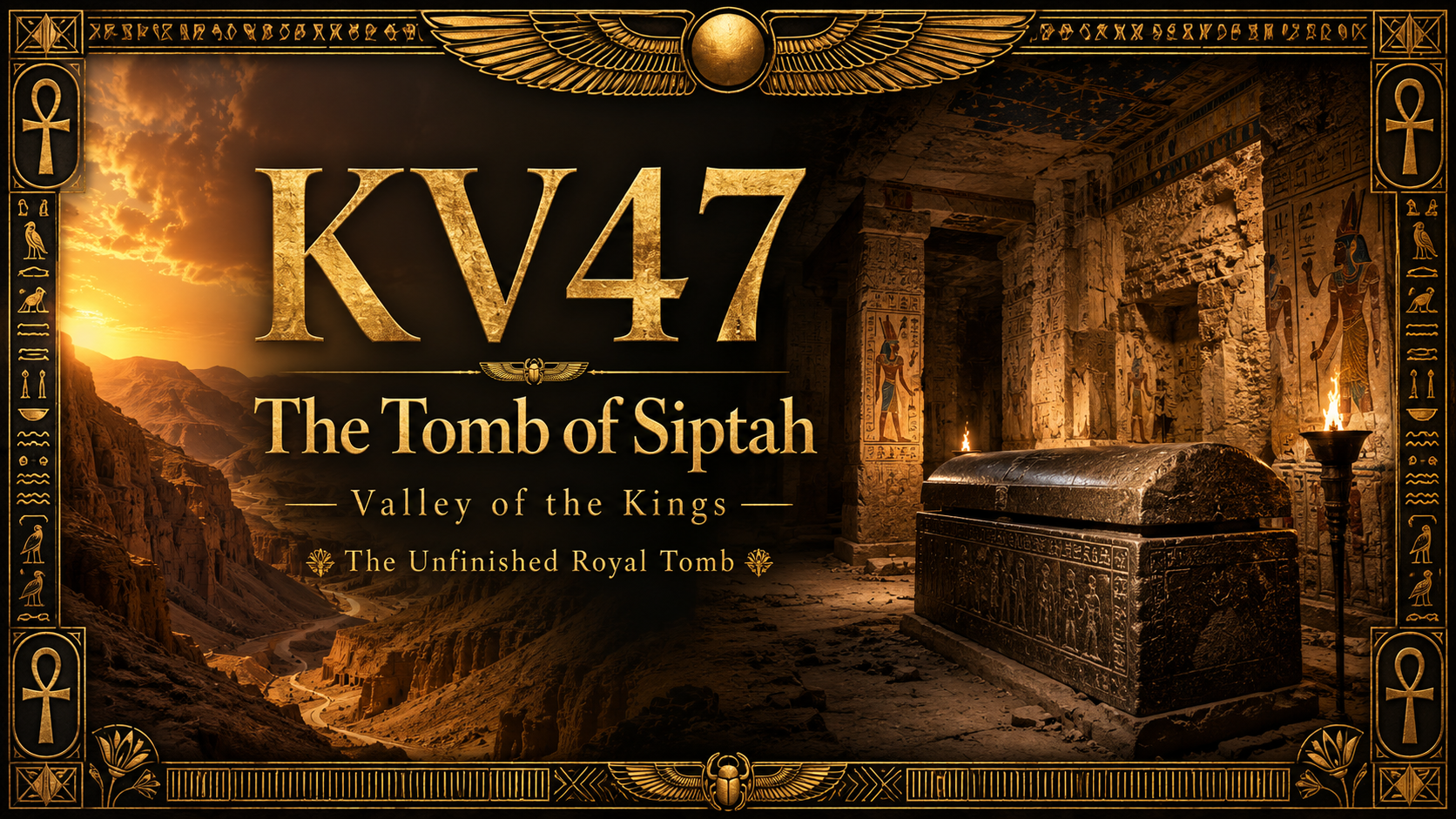
KV47 has one of the best stories in this stretch of the series because the tomb contains an actual ancient construction disaster. Siptah’s workmen accidentally broke into KV32, the much older tomb of Queen Tiaa, forcing them to abandon the planned burial chamber and extend KV47 deeper into the mountain. Siptah then died before the replacement burial chamber could be finished. Modern University of Basel excavations have confirmed the sequence and recovered additional fragments from both tombs.
- Structure: KV47
- Location: Valley of the Kings, East Valley, Thebes West Bank, Luxor
- Owner: Pharaoh Siptah
- Dynasty: Nineteenth Dynasty
- Date: Late thirteenth century BCE
- Site Type: Royal tomb
- Interior Layout: Entrance, corridors, chamber, pillared hall, additional corridors, antechamber, interrupted burial-chamber area, and unfinished final burial chamber
- Axis Type: Nearly straight
- Decoration: Litany of Ra, Amduat, Book of the Dead, Book of Gates, divine scenes, royal titulary, and astronomical ceiling elements
- Notable Feature: Ancient builders accidentally broke through into KV32, the tomb of Queen Tiaa
- Discovery: December 18, 1905
- Excavator: Edward R. Ayrton for Theodore M. Davis
- Later Excavation: Harry Burton, 1912–1913; MISR Project from 1999 onward
- Public Access: Access to Valley tombs changes periodically, so current availability should be checked before visiting
KV47 is the tomb of Pharaoh Siptah, one of the final rulers of Egypt’s Nineteenth Dynasty. Stretching roughly 100 meters into the limestone of the Valley of the Kings, it is an extraordinary monument not because it was completed perfectly, but because it preserves evidence of a major mistake made while it was being built.
Siptah’s architects originally planned his burial chamber farther up the tomb. As workers expanded that part of KV47, however, they unexpectedly broke through the rock and entered KV32, an Eighteenth Dynasty tomb excavated approximately two centuries earlier. Modern investigations by the University of Basel established that KV32 belonged to Queen Tiaa, wife of Amenhotep II and mother of Thutmose IV.
The accident forced the builders to change their plans.
Instead of completing the burial chamber where originally intended, they continued digging deeper into the mountain, creating an additional elongated room and constructing a replacement sarcophagus chamber beyond it. Siptah died before the new chamber could be finished. Only the front row of pillars was completed, while the rear pillars and portions of the architecture were never cut.
KV47 therefore preserves something unusually human within the carefully organized world of Egyptian royal tomb building: a mistake, an emergency redesign, and a race against time that the workmen ultimately lost.
The tomb also contains some remarkably preserved decoration. The upper corridors retain vivid scenes of Siptah before the gods, portions of the Litany of Ra, the Amduat, and the Book of the Dead. Farther inside, much of the decoration has been lost through flooding, collapsed ceilings, and deterioration, although modern conservation has revealed important surviving sections.
At the end of the monument stands Siptah’s enormous granite sarcophagus. His mummy, however, was long gone when the tomb was rediscovered. Ancient priests had transferred Siptah’s body to the royal mummy cache inside KV35, the tomb of Amenhotep II, where Victor Loret found it in 1898, seven years before KV47 itself was discovered.
Who Was Siptah?
Siptah ruled during the turbulent final years of Egypt’s Nineteenth Dynasty. The precise circumstances of his family background and accession remain debated. The University of Basel’s research describes him as a young ruler who probably came to the throne at about fourteen and ruled for roughly six years. He died while still a young man.
His reign followed that of Seti II and unfolded during a period marked by competition among powerful members of the royal court. Two people were especially important during Siptah’s reign: Queen Twosret, the widow of Seti II, and Bay, an extraordinarily powerful royal chancellor and treasurer.
Both initially exercised considerable influence around the young king. Bay achieved a level of status almost unprecedented for a non-royal official, even receiving permission to construct his own tomb, KV13, in the Valley of the Kings. The political situation changed dramatically near the end of Siptah’s reign. Evidence studied by the University of Basel indicates that Bay was executed during Siptah’s fifth regnal year. Siptah himself died less than a year later, after which Twosret ruled Egypt independently.
A Very Young Pharaoh
Siptah appears to have been exceptionally young when he became pharaoh. Modern examination of his mummy has generally placed him in his teens or around twenty at death. The University of Basel’s reconstruction suggests an accession age of approximately fourteen. His short life helps explain one of KV47’s defining characteristics.
Egyptian royal tomb construction normally began early in a king’s reign and continued while the pharaoh lived. A king with a long reign could receive an enormous and elaborately completed monument. A king who died unexpectedly could leave behind unfinished corridors, incomplete chambers, and hastily prepared burial spaces. Siptah belonged to the second category. Construction of KV47 began during his first regnal year, but his short reign gave builders only a few years to complete the project.
The accidental collision with KV32 made that already difficult schedule far worse.
Siptah’s Physical Condition
Siptah’s mummy preserves an obvious deformity of the left foot and shortening of the left leg. Early researchers frequently attributed the condition to poliomyelitis. Modern medical discussion has been more cautious about diagnosing a specific disease solely from the ancient remains, but the abnormality itself is clearly visible. The condition has made Siptah one of the more medically discussed royal mummies. Whatever caused it, the deformity apparently did not prevent him from becoming king. Egyptian kingship depended on divine and dynastic legitimacy rather than physical perfection in the modern medical sense.
Siptah’s Mother
The identity of Siptah’s mother is not completely secure.
Historical interpretations have connected him with a foreign, perhaps Syrian, maternal background. The University of Basel notes the possibility that he was a son of Merenptah by a Syrian concubine, but presents the reconstruction as part of an ongoing historical debate rather than an established certainty.
This uncertainty becomes especially important when studying objects discovered in KV47.
Excavators found funerary material belonging to a royal woman called Tiye or Tia, including part of a canopic chest. The Metropolitan Museum emphasizes that this queen has not been identified with certainty. She should not automatically be identified with Queen Tiaa of KV32 simply because the names appear similar. KV32 belonged to an Eighteenth Dynasty queen who lived centuries earlier.
Location
KV47 lies in the western portion of what is conventionally called the East Valley of the Kings. The tomb was excavated into a north-south tongue of rock separating a southern bay from the main Valley. Nearby Nineteenth Dynasty monuments include KV13, associated with Chancellor Bay, KV14, associated with Twosret and later Setnakhte, and KV15, the tomb of Seti II.
The location places several major personalities from the chaotic end of the Nineteenth Dynasty unusually close together.
The geography of this part of the Valley therefore mirrors the political world surrounding Siptah’s reign.
Discovery
KV47 was discovered on December 18, 1905, by archaeologist Edward Russell Ayrton while excavating for Theodore M. Davis. Ayrton had begun systematically digging trenches toward the rock faces in this area of the Valley. Workers eventually exposed the top of an ancient stairway.
The tomb entrance had been buried beneath several feet of limestone chips and excavation debris accumulated from the construction of nearby tombs. Once the doorway was cleared, inscriptions on the lintel revealed the cartouches of Siptah. This was an important identification. Before the discovery of KV47, Siptah had sometimes been associated more closely with Twosret’s KV14. The newly discovered inscriptions demonstrated that he possessed a substantial independent royal tomb.
Edward Ayrton
Edward Ayrton was one of the most productive archaeologists working for Theodore Davis in the Valley of the Kings. During only a few years of excavation, his discoveries included KV47, KV55, KV56, and KV57, the tomb of Horemheb. KV47 became one of his earliest major Valley discoveries.
However, clearing the tomb proved extremely difficult. The passages were filled with enormous quantities of debris, including sediment deposited by ancient floods. In some areas the wet material had hardened into a mass almost resembling natural rock.
A Tomb Filled With Flood Debris
KV47 had suffered severely from water penetration. Flash floods carried mud, stone, and debris into the entrance and down the sloping corridors. Ayrton recognized more than one layer of fill inside the upper passages, including material associated with earlier ancient entry and later flood deposits.
Farther inside, the problem became worse. Ceilings had collapsed. Debris reached considerable depths. Flood-borne sediment had hardened around the archaeological material. The lower tomb became dangerous enough that Ayrton eventually stopped excavation.
Ayrton Stops the Excavation
By 1907, Ayrton had reached deep portions of KV47 but had not completely cleared the burial chamber. The structural conditions were extremely dangerous. Large sections of ceiling had collapsed or appeared likely to collapse. Ayrton also knew that Siptah’s mummy had already been found in KV35, meaning the tomb had certainly been opened and emptied substantially in antiquity. He therefore concluded that the danger of continuing outweighed the likely archaeological reward. The unfinished excavation remained that way for several years.
Harry Burton Returns
In 1912, Harry Burton returned to KV47 on behalf of Theodore Davis. Enough time had passed without further major collapse that another attempt at clearance appeared possible. Burton’s workers faced extremely difficult conditions. The flood sediment was so compact that distinguishing it from the surrounding rock could be challenging.
The team gradually cleared the deeper corridors and chambers. In January 1913, they finally reached Siptah’s sarcophagus hall. There they discovered the monumental granite sarcophagus that confirmed the room’s intended royal function.
Description of KV47
KV47 extends approximately 100 meters through the rock, according to the University of Basel’s modern project description. Its main sequence includes:
- Entrance and stairway
- Corridor B
- Corridor C
- Corridor D
- Chamber E
- Pillared Hall F
- Corridor G
- Corridor H
- Antechamber I
- Elongated Chamber J1
- Side cutting J1a
- Burial Chamber J2
The Theban Mapping Project records the tomb’s principal axis at approximately 172° 02′ 10″. The overall plan is much straighter than the deeply bent royal tombs of the Eighteenth Dynasty. This reflects the architectural changes that occurred by the Ramesside Period.
The Entrance
The approach begins with a ramp and steps descending toward the first doorway. The doorway was plastered and decorated. The entrance immediately announces that this was a royal monument. Siptah’s royal names appeared prominently, while divine imagery established the transition from the ordinary world into the sacred realm of the royal dead.
Corridor B
Corridor B contains some of the finest surviving decoration in KV47. The University of Basel reports that decoration in Corridors B and C remains almost completely preserved and retains particularly fresh colors. One scene shows Siptah standing before the falcon-headed solar god Ra-Horakhty. The king receives divine life, power, and protection. Scenes from the Litany of Ra begin in this part of the tomb.
The Winged Ceiling
The ceiling of the first major corridor is particularly impressive. Winged protective beings extend across the ceiling above the king’s path. The upper decoration includes imagery connected with the royal goddesses Nekhbet and Wadjet, protectors associated with Upper and Lower Egypt. The imagery transformed the passage into a protected ceremonial route. As Siptah moved symbolically deeper into the underworld, divine wings stretched above him.
Corridor C
The Litany of Ra continues through Corridor C. The tomb’s decorative program also begins introducing portions of the Amduat, the great royal underworld composition describing the sun’s twelve-hour journey through the night. The University of Basel identifies material from the first three hours of the Amduat in this section of the monument. The ceiling includes a central religious inscription associated with the Litany of Ra.
Book of the Dead Spell 151
KV47 also contains material from the Book of the Dead. The University of Basel identifies Spell 151 appearing twice near the end of Corridor C. Spell 151 is strongly associated with the protection of the mummy and burial chamber. Its inclusion is significant because royal tomb decoration combined several different traditions. KV47 was not decorated with only one funerary book. It drew on the Litany of Ra, Amduat, Book of Gates, Book of the Dead, divine scenes, and royal imagery to create a complete magical environment for the king.
Corridor D
Much of the decoration begins to deteriorate from Corridor D onward. The University of Basel reports that most wall decoration from this point has been destroyed. Fragments nevertheless preserve parts of the fourth and fifth hours of the Amduat. Traces of a star ceiling also survive. The difference between the beautifully preserved upper corridors and the damaged lower tomb makes KV47 especially useful for understanding the destructive effects of water, rock collapse, and time.
The Amduat
The Amduat was one of ancient Egypt’s most important royal funerary compositions. It describes the sun god’s journey through twelve divisions of the underworld during the twelve hours of night. Ra enters the western horizon in the evening. He travels through dangerous regions filled with gods, spirits, gates, serpents, enemies, and regenerative powers. During the deepest part of the journey, the solar god unites with the forces of Osiris and is renewed. At dawn he emerges reborn in the eastern sky.
By decorating Siptah’s tomb with the Amduat, artists symbolically placed the deceased king inside that same cycle of regeneration. The University of Basel emphasizes this connection between royal tomb architecture, the solar cycle, and the deceased king’s hoped-for rebirth.
Chamber E
Chamber E formed another transitional stage in the descent. The University of Basel refers to this area as the “chess room” in its translated project text and notes striding divine figures within its decorative program. By this stage the king was moving from the upper solar sections of the tomb toward the deeper Osirian and underworld regions. The architecture and decoration were deliberately coordinated. Rooms were not simply empty spaces onto which artists placed unrelated pictures. Each stage corresponded with a particular phase of the king’s supernatural journey.
Pillared Hall F
Beyond Chamber E stands the pillared hall. This room marked an important symbolic transition. Above the exit toward the lower corridors, the decorative program included an Osiris shrine. The University of Basel interprets this as an important turning point in the tomb, where the dead king’s identity increasingly becomes associated with Osiris. The tomb therefore develops from solar imagery near the entrance toward deeper themes of death, Osirian regeneration, and eventual rebirth.
Corridor G and Corridor H
The lower corridors continue beyond the pillared hall. Their condition is substantially worse than the upper tomb. The University of Basel reports that ceilings in Corridors G and H and the following areas have broken away in a vault-like shape, leaving the surviving ceiling considerably higher than its original level. This damage can make the rooms look architecturally different today than they did when first excavated. The original ancient ceilings were lower. What visitors or archaeologists see now partly reflects later collapse.
Antechamber I
After the lower corridors comes Antechamber I. In a typical Ramesside royal tomb, the burial chamber would be expected relatively soon after this sequence. That did not happen in KV47. Instead, the builders encountered a problem that changed the entire lower plan. They had collided with another tomb.
The Great Construction Mistake
KV47’s most famous architectural feature is an accidental breakthrough into KV32. As Siptah’s workers excavated the area intended for his burial suite, they unexpectedly penetrated an existing underground chamber on the opposite side of the rock. That older monument had been forgotten. The workers had no detailed underground map showing where it lay. The breakthrough created an opening into a tomb constructed during the Eighteenth Dynasty. Modern excavations later identified the monument as KV32.
KV32 Belonged to Queen Tiaa
The University of Basel’s excavations established that KV32 belonged to Queen Tiaa, wife of Amenhotep II and mother of Thutmose IV. This corrected an older period in which KV32’s owner was uncertain. Tiaa had lived roughly two centuries before Siptah. By Siptah’s reign, the exact underground location and layout of her tomb had apparently been forgotten. The accidental collision demonstrates how much knowledge of older tombs could disappear even while the Valley of the Kings remained an active royal cemetery.
How Could Egyptian Tomb Builders Make This Mistake?
The collision is less surprising than it might initially appear. The Valley had been used for royal and elite tomb construction for hundreds of years. Many entrances were deliberately concealed. Some tombs were buried beneath spoil from later excavation.
Others had no visible surface monument marking their underground dimensions. Ancient builders did not possess a complete three-dimensional plan showing every corridor beneath the mountain. They knew where visible tombs were located, but that did not necessarily tell them where forgotten chambers extended underground. Siptah’s workers were therefore excavating through rock without realizing that Queen Tiaa’s burial complex lay ahead.
The Abandoned Cutting
The Theban Mapping Project plan identifies an abandoned cutting for the intended burial chamber near the breakthrough into KV32. Once the workers realized what had happened, they could not simply continue enlarging the planned chamber. Doing so would have destroyed more of the earlier royal tomb and created a structurally problematic connection between the two monuments. The architects therefore changed the design. They pushed Siptah’s tomb farther forward.
Chamber J1
The accident produced an unusual elongated room now designated J1. The University of Basel explains that this additional chamber accounts for much of the exceptional length of the lower portion of KV47. It exists because the burial chamber could not be built where originally planned. The architects instead converted the affected space into part of the extended approach and placed the replacement sarcophagus hall farther ahead.
Decoration in J1
Despite being created as part of the redesign, J1 received decoration. Modern conservation revealed surviving portions of the sixth and seventh hours of the Amduat. These scenes had partly disappeared beneath hardened debris. After cleaning and stabilization, researchers were able to identify more of the original program. This discovery corrected earlier assumptions that the lower part of KV47 had never been substantially decorated.
The Lower Tomb Was More Decorated Than Once Thought
University of Basel research emphasizes that the lower portion of KV47 had received more decoration than earlier publications suggested. The surviving fragments demonstrate that artists continued the underworld program well beyond the better-preserved upper corridors. The absence of decoration today therefore does not necessarily mean the walls were originally blank. Flooding, collapse, plaster loss, and ancient disturbance removed much of what once existed.
Burial Chamber J2
The replacement burial chamber is designated J2. This room was begun after the KV32 accident forced the architects to continue deeper into the mountain. Siptah died before J2 could be completed. The unfinished architecture is still obvious.
Only the front row of four pillars was completed. The planned rear row was never excavated. Wall benches were cut on three sides, and portions of the ceiling vault were finished, but the room remained incomplete. The burial chamber therefore preserves the state of construction at the moment the king’s death overtook the building project.
A Race Against Death
All Egyptian royal tomb construction contained an unavoidable deadline. The tomb needed to be ready when the king died. Siptah’s builders probably expected more time. Instead, his short reign ended unexpectedly. The collision with KV32 had already forced them to spend additional labor extending and redesigning the monument. When Siptah died, there was no longer time to execute the complete planned chamber. The unfinished architecture of J2 therefore records the consequences of both an engineering mistake and a young king’s early death.
Siptah’s Granite Sarcophagus
The dominant object within J2 is Siptah’s monumental granite sarcophagus. The University of Basel describes the box as decorated with imagery connected with the Book of the Earth, while the lid bears a raised or semi-sculpted figure of Siptah. Isis and Nephthys flank and protect the king.
The combination is deeply symbolic. Siptah lies in the position of Osiris while the two divine sisters who mourned and protected Osiris surround him. The sarcophagus therefore transformed the king’s stone coffin into a representation of divine death and resurrection.
The Sarcophagus Lid
When Harry Burton reached the chamber, the enormous lid was no longer sealing Siptah inside. It lay displaced beside the sarcophagus. The upper surface depicts the king in an Osirian form protected by Isis and Nephthys. This imagery expresses the central hope of royal Egyptian funerary religion. Siptah was not simply a dead king. Through ritual, text, image, and burial, he was intended to become an Osiris and participate in eternal regeneration.
Siptah Was No Longer Inside
Siptah’s mummy was not found in KV47. In fact, archaeologists already knew where it was before they discovered his tomb. Victor Loret had found the mummy in KV35, the tomb of Amenhotep II, in 1898. KV35 had been converted in antiquity into a cache containing several royal mummies removed from their original tombs. Priests evidently transferred Siptah there during the royal mummy rescue operations of the late New Kingdom or early Third Intermediate Period. His body therefore left KV47 long before Edward Ayrton arrived.
Bones Inside the Sarcophagus
Although Siptah’s mummy was absent, Harry Burton found some human bones inside the enormous sarcophagus. These did not belong to Siptah. They appear to have come from a later intrusive burial, probably dating to the Third Intermediate Period. The presence of later remains shows that even after Siptah’s mummy had been removed, the abandoned royal tomb could acquire new funerary use.
Siptah’s Mummy
Siptah’s mummy survived because ancient priests transferred it to KV35. The body retained enough identifying information for ancient necropolis officials to recognize it as belonging to the king. Modern examination revealed the king’s young age and abnormal left foot. In 2021, Siptah was among the royal mummies transferred from the Egyptian Museum in Tahrir to the National Museum of Egyptian Civilization during the Pharaohs’ Golden Parade. Today, his body survives while his original tomb remains empty.
Tomb Robbery
KV47 was extensively robbed in antiquity. The massive quantity of shattered funerary material recovered from the debris demonstrates how thoroughly the original burial equipment was broken apart. Thieves were primarily interested in portable valuables such as:
- Gold
- Silver
- Jewelry
- Precious stones
- Gilded fittings
- Metal coffin elements
- Amulets
- Valuable containers
Large stone objects such as the sarcophagus were difficult or impossible to remove and therefore remained.
Shabtis of Siptah
Hundreds of fragments of Egyptian alabaster were recovered during the Davis excavations. The Metropolitan Museum determined that many belonged to approximately 40 to 50 shabtis of Siptah. Shabtis were funerary figures designed to perform labor for the deceased in the afterlife.
A royal burial could contain numerous finely carved examples. Several surviving Siptah shabtis are now in the Metropolitan Museum of Art. The Met dates its example to the reign of Siptah and records it as coming from the Davis and Burton excavations of 1912–1913.
Reassembling a Shattered Burial
Modern University of Basel excavations have recovered additional fragments of Siptah’s funerary equipment both inside KV47 and in debris outside the tomb.
Researchers have even been able to join pieces discovered in completely different locations.
One particularly impressive calcite shabti was reconstructed from fragments scattered through separate deposits.
This reveals how dramatically ancient robbery and later excavation moved objects around the site.
An artifact originally placed intact beside the king could eventually become scattered across the tomb and surrounding valley.
At Least Three Sarcophagi?
The Metropolitan Museum reports that alabaster fragments from the Davis excavations represented not only shabtis and vessels but parts of at least three sarcophagi and two canopic chests.
One canopic chest belonged to Siptah.
Another belonged to a queen named Tiye whose exact identity remains uncertain.
These discoveries suggest that KV47’s funerary history may have involved more individuals and more burial equipment than the surviving architecture alone would imply.
The Mysterious Queen Tiye
One of KV47’s unresolved mysteries concerns the royal woman named on funerary fragments.
The Metropolitan Museum explicitly notes that the Queen Tiye associated with the second canopic chest has not been identified with certainty.
Older accounts sometimes tried to connect her directly with Siptah’s family.
That remains uncertain.
It is also important not to confuse her with the famous Eighteenth Dynasty Queen Tiye, wife of Amenhotep III, or Queen Tiaa of KV32.
Similar royal names occur in different periods.
Without stronger evidence, the safest description is simply an unidentified Queen Tiye associated with funerary material found in KV47.
Objects From KV32 Mixed With KV47
Modern excavations outside KV47 have also recovered objects belonging to Queen Tiaa of KV32.
This is exactly what might be expected following the accidental breakthrough.
Once the tombs became physically connected and were later robbed, flooded, and excavated, material could move between them.
The accident therefore created an archaeological problem lasting more than three thousand years.
Researchers must determine whether each fragment originally belonged to Siptah, Queen Tiaa, a later burial, or another disturbed context.
The Cartouches of Siptah Were Altered
Siptah’s tomb preserves evidence of political disturbance during his own reign.
The University of Basel reports that construction began in his first year and that his cartouches were at some stage erased and later restored.
Why this happened remains uncertain.
One possibility considered by researchers is that Chancellor Bay may have attempted to interfere with or usurp aspects of the king’s burial during the political conflicts of the period.
That interpretation remains hypothetical.
What can be established is that the royal names were damaged and subsequently restored.
Twosret and Siptah
Queen Twosret played a central role during Siptah’s reign.
She had been the wife of Seti II and became one of the dominant political figures surrounding the young Siptah.
Representations in KV14 once included Siptah, but his names were later altered as the complex political history of Twosret’s monument developed.
After Siptah died, Twosret ruled as pharaoh in her own right.
Her reign brought the Nineteenth Dynasty to its end.
Setnakhte subsequently founded the Twentieth Dynasty and appropriated portions of KV14 for his own burial.
Chancellor Bay
Bay is one of the most remarkable non-royal figures of the late Nineteenth Dynasty.
He became powerful enough to receive his own tomb in the Valley of the Kings, KV13.
The University of Basel describes him as treasurer of the entire country and one of the dominant figures surrounding Siptah’s accession.
Yet his career ended abruptly.
Evidence indicates that Siptah ordered Bay executed during his fifth regnal year.
The drama surrounding Bay, Twosret, and Siptah provides the political backdrop against which KV47 was being excavated.
The Litany of Ra
The Litany of Ra is one of the most important compositions decorating KV47.
It was a standard component of Ramesside royal funerary decoration.
Rather than simply narrating a journey, the text invokes numerous manifestations and names of the solar god.
By identifying the deceased king with these divine forms, the composition helped integrate him into the eternal solar cycle.
In KV47, large sections survive in Corridors B and C.
The Book of Gates
Fragments of the Book of Gates also formed part of the decorative program, particularly around the first pillared hall. The University of Basel identifies probable material from approximately the fifth and sixth hours, together with remains of an Osiris shrine.
The Book of Gates describes the nocturnal passage of the solar god through divisions of the underworld separated by guarded gates.
Knowing the names and identities associated with these supernatural barriers allowed the deceased king to pass safely through them.
Maat at the Doorways
The goddess Maat appears prominently at important transitions in KV47. At doorway areas, she is shown seated on a basket associated with the heraldic plants representing Upper and Lower Egypt. Maat represented truth, justice, balance, and cosmic order. Her presence was particularly appropriate for a king. The pharaoh’s fundamental earthly responsibility had been to maintain Maat against chaos. In death, the goddess helped guarantee the continuation of that order and protected the king’s entrance into the divine world.
Isis and Nephthys
Isis and Nephthys appear repeatedly within Egyptian funerary religion as protectors and mourners of Osiris. Their presence around Siptah’s sarcophagus associates him directly with the resurrected god. According to the University of Basel’s description, the two goddesses flank the royal figure on the sarcophagus lid. The message is clear. Just as Isis and Nephthys protected Osiris and enabled his regeneration, they would protect Siptah.
Architecture as a Map of the Afterlife
KV47 demonstrates that Egyptian tomb architecture and decoration were designed together.
The corridors were not simply practical routes to the burial chamber.
The University of Basel’s interpretation emphasizes that the architectural sequence represented the realms of the underworld through which the king and solar god traveled.
As the visitor moves deeper into KV47, the religious program develops.
The king encounters Ra-Horakhty.
The Litany of Ra identifies him with solar forms.
The Amduat carries him into the twelve hours of night.
Anubis protects the embalming process.
Osirian imagery marks his transformation.
The sarcophagus finally becomes the place of regeneration.
The entire tomb functioned like a three-dimensional sacred text.
The Tomb as the Night Journey of the Sun
The University of Basel compares the conceptual sequence to a clock carved into stone.
The twelve hours of night unfold through the royal monument as the aged sun enters darkness, becomes rejuvenated, and emerges again at dawn.
Siptah’s survival depended on joining that cycle.
Each sunset demonstrated that light could disappear.
Each sunrise demonstrated that disappearance was not permanent.
Royal funerary religion transformed this daily event into a promise of eternal resurrection.
Howard Carter at KV47
Howard Carter also worked around KV47 in 1922. His clearance of the surrounding area recovered ostraca and additional small finds associated with the tomb and the ancient workers who constructed it. That year would become famous for another reason. Later in 1922, Carter discovered the entrance to Tutankhamun’s KV62. KV47 therefore forms part of the long sequence of Valley work immediately preceding archaeology’s most famous tomb discovery.
Ostraca
Ostraca are pieces of limestone or broken pottery used as convenient writing surfaces. Workers could use them for:
- Notes
- Sketches
- Administrative records
- Measurements
- Work assignments
- Accounts
- Letters
Such fragments provide a very different type of information from monumental royal inscriptions. Royal tomb walls tell us how the pharaoh wanted eternity represented. Ostraca can tell us how workers actually organized the construction.
The MISR Project
A major modern research program returned to KV47 beginning in 1999. The University of Basel’s MISR: Mission Siptah-Ramses X project has documented and partially re-excavated the tomb while also investigating KV32 and the surrounding archaeological landscape. This work has significantly improved understanding of both KV47’s architecture and its decoration. It also provided definitive archaeological evidence for the identity of neighboring KV32.
Modern Excavation of the Lower Tomb
In 2004, researchers temporarily removed the modern floor covering in portions of the lower tomb. This allowed them to excavate remaining ancient debris and complete more precise documentation. Additional fragments of Siptah’s burial equipment were recovered. Small pieces of the granite sarcophagus were also found. Even after Ayrton and Burton had excavated KV47 nearly a century earlier, important archaeological evidence remained beneath their working surfaces.
Excavating Outside KV47
The modern project also investigated the enormous spoil deposits outside the tomb. In some areas the archaeological debris reached heights of approximately five meters. These deposits contain material removed during ancient tomb construction as well as objects displaced by later activity. Excavation revealed traces of a Nineteenth Dynasty workers’ camp. Researchers also recovered pottery and funerary fragments connected with both Siptah and Queen Tiaa.
The Workers Who Built KV47
The traces outside KV47 remind us that a royal tomb was not created by a single architect. Large teams were required.
They included:
- Quarrymen
- Stonecutters
- Plasterers
- Draftsmen
- Painters
- Scribes
- Foremen
- Laborers
- Supply personnel
Workers needed food, water, tools, lighting, and temporary shelter. The archaeological remains of their activity provide another layer of information beyond the king’s burial itself.
Conservation
KV47 presents major conservation challenges.
The tomb has suffered from:
- Flash flooding
- Water infiltration
- Hardened sediment
- Ceiling collapse
- Loss of plaster
- Loss of paint
- Ancient robbery
- Early excavation
- Structural instability
The difference between the upper and lower tomb is dramatic. Corridors B and C retain remarkably fresh paintings. Farther inside, large portions of the original decoration have vanished.
Cleaning the Amduat
Modern conservation work in J1 removed hardened deposits that concealed surviving wall decoration. After cleaning, archaeologists could identify portions of the sixth and seventh hours of the Amduat. This illustrates an important conservation principle. A wall that appears undecorated today may actually preserve ancient paint beneath dirt, mineral deposits, or flood sediment. Cleaning must therefore be performed extremely carefully. Removing the deposit too aggressively could remove the original ancient surface with it.
Structural Problems
The ceilings of the lower tomb remain one of the monument’s greatest problems. Several original ceilings collapsed long ago. When Burton cleared the sarcophagus chamber, parts of the roof were considered so unstable that temporary structural support became necessary. The surviving room shape therefore reflects both ancient excavation and later geological destruction. KV47 is not simply an unfinished tomb. It is an unfinished tomb that has also been physically transformed by more than three thousand years of rock failure and flooding.
Objects Recovered
Archaeological material associated with KV47 includes:
- Monumental granite sarcophagus of Siptah
- Granite sarcophagus fragments
- Approximately 40 to 50 calcite or travertine shabtis of Siptah
- Additional shabti fragments
- Stone funerary vessels
- Canopic chest fragments belonging to Siptah
- Canopic equipment associated with an unidentified Queen Tiye
- Fragments from at least three sarcophagi
- Pottery
- Ostraca
- Funerary fragments
- Material connected with Queen Tiaa of KV32
- Later human remains from an intrusive burial
The Metropolitan Museum holds several objects recovered during the Davis and Burton excavations, including a fine travertine shabti of Siptah.
Noteworthy Features
KV47 is notable because it preserves an unusually detailed record of royal tomb construction, failure, redesign, and unfinished work.
Siptah’s builders accidentally cut into Queen Tiaa’s KV32. The intended burial chamber had to be abandoned, an additional room was created, and a new sarcophagus hall was begun farther inside the mountain. Siptah died before the new chamber could be completed.
The tomb also preserves major portions of the Ramesside royal funerary program, including the Litany of Ra, Amduat, Book of the Dead, Book of Gates, Maat imagery, royal encounters with gods, winged ceiling figures, and traces of astronomical decoration.
Its granite sarcophagus remains in the unfinished burial chamber, while Siptah’s mummy survives from the royal cache in KV35.
Dating
KV47 belongs to the final decades of Egypt’s Nineteenth Dynasty.
Its major historical phases include:
- Siptah’s first regnal year: Construction of the tomb began.
- Siptah’s reign: Workers accidentally broke into the older KV32 and redesigned the lower tomb.
- Death of Siptah: The replacement burial chamber remained unfinished.
- Later New Kingdom: KV47 was robbed and disturbed.
- Twenty-first Dynasty: Siptah’s mummy was removed and transferred to the royal cache in KV35.
1898: Victor Loret discovered Siptah’s mummy in KV35.
December 18, 1905: Edward Ayrton discovered KV47.
1905–1907: Ayrton partially cleared the monument.
1912–1913: Harry Burton completed major clearance of the lower tomb and reached the sarcophagus chamber.
1922: Howard Carter worked around KV47 and recovered additional archaeological material.
1999 onward: The MISR Mission Siptah-Ramses X began renewed archaeological investigation and conservation.
2004: Lower-floor clearance recovered additional burial equipment and sarcophagus fragments.
History of Exploration
Edward Ayrton, 1905–1907
Ayrton discovered the tomb while excavating for Theodore Davis. He cleared the entrance and much of the upper monument but eventually abandoned work because collapsing ceilings and hardened flood deposits made the lower chambers dangerously unstable.
Harry Burton, 1912–1913
Burton resumed excavation and successfully reached the burial chamber. His team uncovered the monumental granite sarcophagus and recovered large quantities of fragmented funerary equipment.
Howard Carter, 1922
Carter investigated the area around KV47 and recovered ostraca and other small objects associated with ancient activity around the tomb.
MISR Project, 1999 onward
Modern research by the University of Basel has transformed understanding of KV47. The project has documented the architecture and decoration, cleaned surviving Amduat scenes, re-excavated parts of the lower monument and surrounding spoil, recovered additional burial equipment, and investigated the accidental connection with KV32.
The KV32 Breakthrough Changed Two Tombs
The collision between KV47 and KV32 did more than alter Siptah’s burial plan. It also damaged Queen Tiaa’s much older tomb. The Theban Mapping Project plan clearly marks the breakthrough between the two monuments.
Modern archaeologists have therefore had to study KV32 and KV47 together. Objects could move between them. Robbers could use one tomb to access another. Flood sediment could travel through the opening. The mistake made by Siptah’s builders permanently joined the archaeological histories of two royal tombs separated by roughly two centuries.
Why KV47 Matters
KV47 is one of the best monuments in the Valley of the Kings for understanding that royal tomb building was a real construction process carried out by human beings under practical limitations. Egyptian royal tombs can appear so carefully planned that it is easy to imagine their builders possessed perfect knowledge of the mountain.
KV47 proves otherwise. The workmen cut through the limestone. They decorated the corridors. They followed an established plan. Then they suddenly broke into a forgotten queen’s tomb. The project had to change immediately. The original burial chamber was abandoned. The tomb was pushed deeper underground. A replacement sarcophagus hall was begun.
Then Siptah died. The workers had run out of time. The rear pillars were never cut. The new burial chamber remained unfinished. The king was nevertheless buried inside his enormous granite sarcophagus, surrounded by expensive funerary equipment and a religious landscape designed to unite him with Ra and Osiris.
Centuries later, tomb robbers dismantled much of that burial. Priests rescued Siptah’s mummy and moved it to KV35. Floods poured through the empty corridors. Ceilings collapsed. Paint vanished. Then archaeologists arrived. Ayrton discovered the entrance in 1905. Burton fought his way through hardened debris to the sarcophagus chamber. Modern archaeologists returned almost a century later and discovered that even those early excavations had left important evidence untouched.
KV47 therefore records almost every major chapter in the history of the Valley of the Kings: royal construction, religious decoration, engineering error, unfinished work, burial, robbery, mummy rescue, flooding, rediscovery, early archaeology, and modern conservation.
Its accidental collision with KV32 makes the tomb particularly valuable. Few monuments show more clearly that the Valley of the Kings is not a collection of isolated tombs. It is a three-dimensional archaeological landscape in which generations of Egyptians cut, forgot, damaged, reused, protected, and rediscovered the monuments of those who came before them.
Interesting Facts About KV47
- KV47 is the tomb of Pharaoh Siptah.
- Siptah was one of the final kings of Egypt’s Nineteenth Dynasty.
- He probably became king while still a teenager.
- Construction began during his first regnal year.
- The tomb extends roughly 100 meters underground.
- Edward Ayrton discovered KV47 on December 18, 1905.
- Harry Burton reached the sarcophagus chamber during the 1912–1913 excavation.
- Siptah’s builders accidentally broke into KV32.
- KV32 belonged to Queen Tiaa, wife of Amenhotep II and mother of Thutmose IV.
- Queen Tiaa had lived roughly two centuries before Siptah.
- The breakthrough forced KV47’s architects to abandon their intended burial chamber.
- They extended the tomb deeper into the mountain.
- An unusual elongated room, J1, resulted from the redesign.
- Siptah died before the replacement burial chamber could be completed.
- Only the front row of four pillars was finished.
- The rear row of pillars was never cut.
- Siptah’s massive granite sarcophagus remains in the unfinished chamber.
- Isis and Nephthys protect the king on the sarcophagus lid.
- The upper corridors contain exceptionally well-preserved paintings.
- KV47 includes scenes from the Litany of Ra.
- Portions of the Amduat appear throughout the tomb.
- Book of the Dead Spell 151 appears in Corridor C.
- Fragments of the Book of Gates also survive.
- Maat appears at important doorways.
- Winged protective figures decorate an upper corridor ceiling.
- Modern conservation uncovered portions of the sixth and seventh hours of the Amduat in J1.
- Ancient robbers stripped the tomb of most valuables.
- Between approximately 40 and 50 calcite shabtis of Siptah are represented among surviving fragments.
- Funerary fragments indicate at least three sarcophagi and two canopic chests.
- One canopic chest belonged to Siptah.
- Another belonged to an unidentified Queen Tiye.
- Siptah’s mummy was not found in KV47.
- Ancient priests transferred it to KV35.
- Victor Loret discovered the mummy in KV35 in 1898.
- Siptah’s mummy preserves a severely abnormal left foot.
- The mummy was transferred to the National Museum of Egyptian Civilization in 2021.
- Flooding caused enormous damage inside KV47.
- Several ceilings collapsed.
- Edward Ayrton abandoned his original excavation because conditions became too dangerous.
- Modern University of Basel excavations began renewed work on KV47 in 1999.
- Archaeologists have reconstructed funerary objects from fragments found in widely separated parts of the site.
- KV47 is one of the clearest examples of an ancient Egyptian tomb whose architecture had to be redesigned because its builders accidentally collided with another tomb.