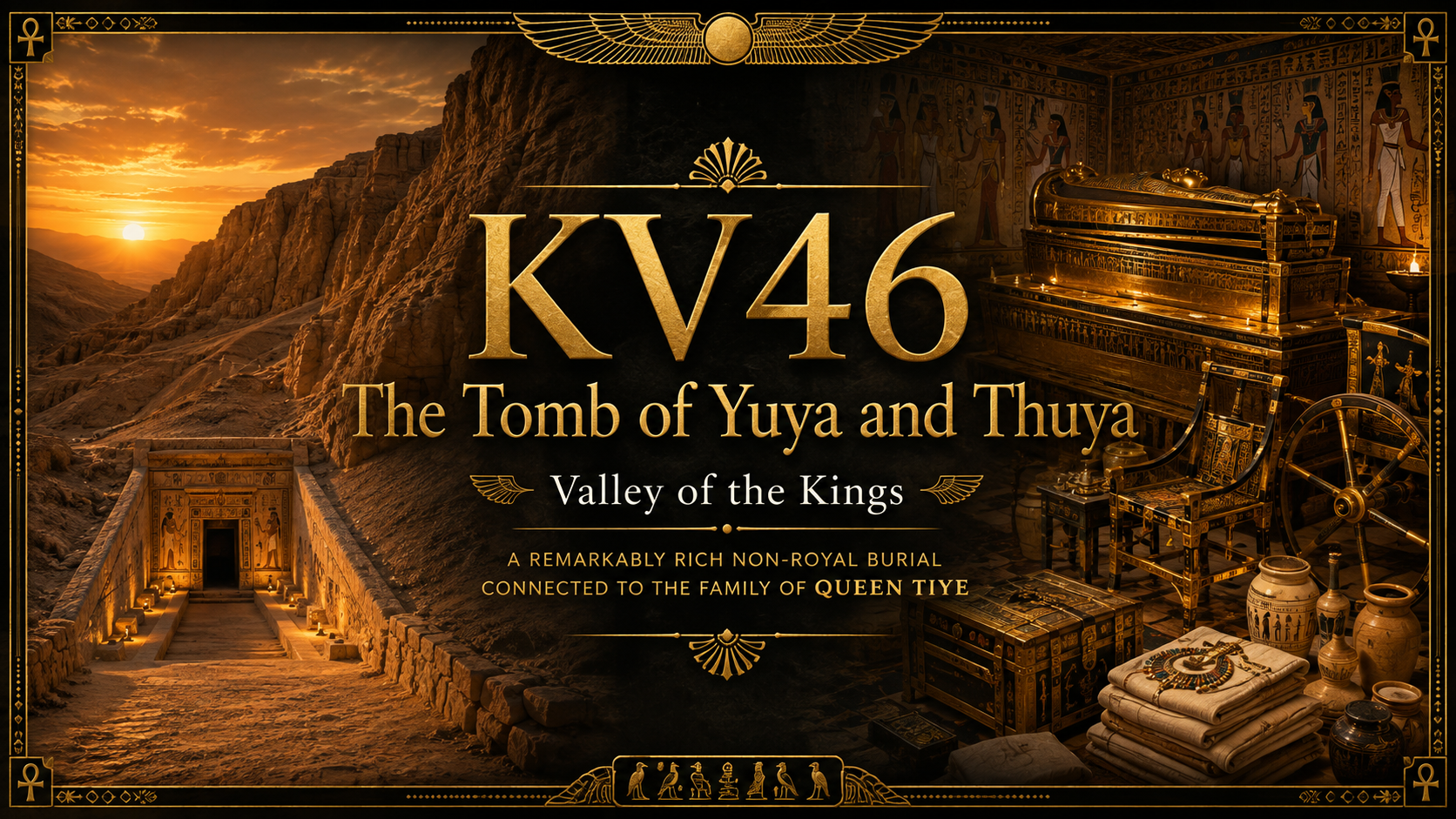
KV46 is one of the greatest archaeological discoveries ever made in the Valley of the Kings.
The tomb belonged not to a pharaoh, but to Yuya and Thuya, the parents of Queen Tiye, Great Royal Wife of Amenhotep III. Their daughter became one of the most influential queens of the Eighteenth Dynasty, making Yuya and Thuya the maternal grandparents of Akhenaten and ancestors of Tutankhamun.
When archaeologists entered KV46 in 1905, they discovered an extraordinary collection of funerary equipment still inside. Although ancient robbers had entered the tomb and disturbed the coffins, they left most of its contents behind. Large gilded coffin sets, funerary masks, furniture, beds, chairs, a chariot, clothing, sandals, food, pottery, shabtis, canopic equipment, jewelry containers, and the remarkably well-preserved mummies of Yuya and Thuya remained in the burial chamber. The Metropolitan Museum of Art describes KV46 as an intact tomb containing the burials of the couple, while modern accounts generally qualify it as nearly intact because ancient thieves had clearly entered and disturbed portions of the burial.
Before Howard Carter discovered Tutankhamun’s KV62 in 1922, KV46 was widely regarded as one of the most spectacular discoveries ever made in the Valley of the Kings. Yet the importance of KV46 goes far beyond the quantity of objects recovered. The tomb provides an exceptionally detailed picture of how members of Egypt’s highest elite were prepared for eternity during the reign of Amenhotep III. It also reveals how close Yuya and Thuya stood to the royal family, despite not being king and queen themselves.
- Structure: KV46
- Location: Valley of the Kings, East Valley, Thebes West Bank, Luxor
- Owners: Yuya and Thuya
- Dynasty: Eighteenth Dynasty
- Reign: Amenhotep III
- Approximate Date: Fourteenth century BCE
- Site Type: Elite non-royal tomb
- Decoration: None
- Interior Layout: Stairways, descending corridors, and a single burial chamber
- Notable Discovery: Nearly intact burial assemblage with both mummies, nested coffins, funerary masks, furniture, chariot, shabtis, food, clothing, and other equipment
- Discovered: 1905
- Excavator: James E. Quibell, working under Theodore M. Davis
- Public Access: Closed
Yuya and Thuya were one of the most influential couples of the Eighteenth Dynasty. They lived during the reign of Amenhotep III, when Egypt was at the height of its wealth and international power. Their importance came partly from their own positions within Egyptian society and partly from their children. Their daughter Tiye became the Great Royal Wife of Amenhotep III. Through Tiye, Yuya and Thuya became grandparents of several royal children, including the future king Akhenaten.
Their descendants therefore stood at the center of one of the most dramatic periods in Egyptian history. The family eventually became connected with Tutankhamun as well. The Metropolitan Museum identifies Yuya and Tjuyu, another common spelling of Thuya, as the parents of Queen Tiye, mother of Akhenaten and grandmother of Tutankhamun.
Who Was Yuya?
Yuya was an extremely important court official. His titles connected him with both the royal court and the military establishment. Among the titles attributed to him were:
- King’s Lieutenant
- Master of the Horse
- God’s Father
- Overseer of the Cattle of Min
- Priest or official associated with the god Min
The title Master of the Horse is particularly significant. During the Eighteenth Dynasty, horses and chariots were closely associated with the military and royal elite. Chariot warfare had become an essential feature of New Kingdom armies, and the men who commanded or supervised royal horses occupied prestigious positions.
The Metropolitan Museum describes chariot warriors as members of Egypt’s upper classes and notes that the chariot corps functioned as an elite military unit. Yuya’s responsibility for horses therefore placed him close to one of the most important symbols of royal and military power.
The Meaning of “God’s Father”
One of Yuya’s most intriguing titles was God’s Father. The precise meaning of this title varied according to period and context.
It could indicate a priestly function, a close relationship with the king, or a special position within the royal household. Because Yuya was the father of Queen Tiye, some scholars have also considered whether the title reflected his relationship with Amenhotep III. Whatever its precise meaning in Yuya’s case, it reinforces the extraordinary status he enjoyed at court. He was not simply the father of the queen. He was already a major figure within the royal administration.
Yuya and Akhmim
Yuya is strongly associated with Akhmim, an important city in Upper Egypt. Akhmim was a major cult center of the fertility god Min. Yuya’s titles involving Min and livestock fit naturally within this regional religious environment. His family may have belonged to an influential provincial elite before becoming closely integrated into the royal court. The rise of his daughter Tiye dramatically elevated the family’s position.
Who Was Thuya?
Thuya, whose name is also written Tjuyu, Tuya, or Thuya in modern sources, was Yuya’s wife and the mother of Queen Tiye. She held important religious titles of her own. These included positions associated with the cults of:
- Hathor
- Amun
- Min
She is frequently described as a Chantress of Hathor and as an official associated with the temple music or religious ceremonies of Amun and Min. Like many elite Egyptian women, Thuya participated directly in temple religion rather than being known only through her husband. Her status increased even further after Tiye became queen.
The Egyptian Museum in Cairo identifies Thuya as Yuya’s wife, mother of Queen Tiye, and an ancestor of Tutankhamun. Her spectacular funerary mask remains one of the museum’s important Eighteenth Dynasty objects.
Parents of Queen Tiye
Yuya and Thuya’s most important dynastic connection came through their daughter Tiye. Tiye became the principal wife of Amenhotep III. Unlike many royal wives who appear primarily in ceremonial scenes, Tiye played a highly visible role throughout her husband’s reign. Her name appeared beside the king’s on monuments.
She participated in diplomatic and religious life. Foreign rulers knew her name. She remained influential after the death of Amenhotep III and into the reign of her son Akhenaten. Yuya and Thuya therefore became the parents of one of the most powerful royal women in Egyptian history.
Why Were Yuya and Thuya Buried in the Valley of the Kings?
KV46 presents an obvious question. Why were two people who were not pharaohs buried inside the Valley of the Kings? The answer reflects their extraordinary relationship with the royal family. Burial within the Valley was normally reserved for kings and selected members of the royal household.
A small number of exceptional non-royal individuals were nevertheless granted tombs there. Yuya and Thuya belonged to the immediate family of the Great Royal Wife. Their daughter was married to the king. Their grandchildren belonged to the royal dynasty. Their burial inside the royal cemetery therefore represents an extraordinary privilege probably granted by Amenhotep III.
Location
KV46 lies in the East Valley of the Kings in a side area between KV3 and KV4. The location was not particularly conspicuous. When excavators began investigating the area in 1905, it was covered by a substantial accumulation of limestone chips and debris. James Quibell recognized that the artificial mound might conceal an earlier tomb entrance. Theodore Davis later described the location as initially appearing extremely unpromising. That apparent insignificance helped preserve one of the richest tombs in the Valley.
Description
KV46 is architecturally modest compared with the royal tombs surrounding it.
The tomb consists of:
- An entrance staircase
- A descending corridor
- Additional short steps
- A second descending passage
- A single large rectangular burial chamber
There are no pillared halls. There is no well chamber. There are no painted corridors. There are no subsidiary storerooms. There is no monumental decorated burial suite. The tomb’s importance came from what was placed inside rather than from its architecture.
Entrance Staircase
A staircase of approximately fifteen steps begins the descent into KV46. The steps lead into a descending corridor approximately 1.76 meters wide and 2.05 meters high. Additional steps lead farther downward before the route reaches a second corridor. This lower passage contains niches and has a vaulted ceiling. The simple descending arrangement is typical of elite burial architecture during the Eighteenth Dynasty.
The Burial Chamber
The passages terminate in one large rectangular room. The western third of the chamber lies approximately one meter lower than the rest of the floor. This lower section provided additional space for burial equipment. When the tomb was discovered, nearly every available area was occupied. Large wooden sarcophagus cases stood against the walls. Beds, chairs, boxes, jars, baskets, food, clothing, funerary equipment, and other objects filled the remaining spaces. The chamber essentially functioned as both burial room and storeroom.
No Wall Decoration
KV46 is completely undecorated. The limestone walls were not even fully smoothed, probably because of the poor quality of the surrounding rock. Small black dots approximately 40 centimeters apart appear on some smoother surfaces and may represent ancient mason’s marks. There are no painted gods. There are no scenes from the Amduat. There are no royal cartouches on the walls. There are no astronomical ceilings. The contrast with the nearby royal tombs is dramatic.
Portable Religion Instead of Painted Walls
The absence of wall decoration did not mean Yuya and Thuya lacked religious protection. Instead, their funerary beliefs were expressed through portable objects.
These included:
- Coffins
- Funerary masks
- Shabtis
- Canopic equipment
- Amulets
- Funerary papyri
- Inscribed objects
- Ritual furniture
For a private or elite burial, these objects could create the religious environment needed for resurrection without requiring painted tomb chambers. Yuya’s Book of the Dead was especially important in providing the spells and knowledge required for the afterlife.
Yuya’s Book of the Dead
One of the most important textual objects associated with KV46 is the funerary papyrus of Yuya. The Book of the Dead contained spells intended to guide and protect the deceased through the afterlife.
Its texts could help the dead:
- Pass through gates
- Avoid supernatural dangers
- Preserve the body
- Transform into different forms
- Receive food
- Join the gods
- Survive judgment
- Enter the Field of Reeds
Illustrated vignettes from Yuya’s papyrus depict the couple within this sacred funerary world.
The papyrus provides the religious content that the undecorated walls of KV46 lack.
Discovery in 1905
KV46 was discovered during excavations financed by American businessman and lawyer Theodore M. Davis. James E. Quibell was supervising excavation work in the Valley. The Metropolitan Museum records the discovery of KV46 on February 5, 1905, during the Davis and Quibell excavations. Work had begun in the area in late January. The excavators removed a large accumulation of limestone chips covering the hillside. Gradually, the top of an ancient staircase emerged.
Exposing the Entrance
By February 12, the doorway had been fully exposed. The entrance was blocked with stones set in mud plaster, but a gap existed near the top of the blocking. That gap immediately revealed that the tomb had been entered previously. Davis and Arthur Weigall looked through the opening and saw the steep descending corridor beyond. A cane could be seen lying inside. According to the excavation account, a small boy was sent through the opening to retrieve it. He returned not only with the cane but also with a gilded scarab and part of a chariot yoke. Those objects made it obvious that something extraordinary lay below.
The First Modern Entry
Gaston Maspero, head of the Egyptian Antiquities Service, was informed of the discovery. The tomb was formally entered shortly afterward. What the archaeologists encountered was astonishing. The chamber was filled with enormous gilded coffins, furniture, vessels, and burial equipment. Although ancient robbers had disturbed portions of the tomb, the overwhelming majority of its contents remained. This made KV46 the richest burial discovered in the Valley up to that time.
Evidence of Ancient Robbery
KV46 was not completely untouched. Ancient thieves had entered the tomb. Yuya’s large outer sarcophagus had been broken into. The lids of his nested coffins had been removed. His mummy wrappings had been torn as robbers searched the body for valuables. Thuya’s coffin ensemble had also been disturbed. Her large outer sarcophagus had been partly dismantled, and sections were moved around the chamber. Yet the robbers appear to have been interested primarily in portable objects of precious material. Much of the furniture, pottery, coffins, food, textiles, and funerary equipment was left behind.
Why Did So Much Survive?
Several explanations are possible. The thieves may have been interrupted. They may have returned only once. They may have focused on gold, jewelry, precious metals, oils, and compact valuables that were easy to carry. Large furniture and enormous wooden coffin cases would have been difficult to remove through the narrow corridors. Whatever happened, the thieves abandoned an enormous quantity of archaeological material. Their incomplete robbery ultimately preserved KV46 as one of the richest surviving burials from ancient Egypt.
The Mummy of Yuya
Yuya’s mummy was still inside his coffin ensemble. Ancient thieves had torn away much of the wrapping, apparently searching for jewelry and amulets. Despite this disturbance, the body survived in remarkable condition. Yuya’s face remains strikingly recognizable. His hair, facial features, and skin are unusually well preserved. The mummy has become one of the most famous surviving human remains from ancient Egypt.
The Mummy of Thuya
Thuya’s mummy also survived. Her burial had been disturbed, but her body remained inside its inner coffin. Like Yuya, she was preserved well enough that modern researchers can examine facial features, age-related characteristics, embalming techniques, and physical condition. The survival of both husband and wife provides a rare opportunity to study a named elite couple from the Eighteenth Dynasty.
The Funerary Mask of Thuya
One of the most spectacular objects from KV46 is Thuya’s funerary mask. The Egyptian Museum in Cairo lists it as being made from cartonnage formed from linen and stucco, decorated with gold leaf, glass paste, and alabaster. It measures approximately 77 centimeters high. The mask transformed the mummy into an idealized divine form. Gold was associated with the flesh of the gods because it did not tarnish or decay. By surrounding the deceased with a golden face, Egyptian funerary art expressed the hope that the body would become eternal and incorruptible.
Yuya’s Coffins
Yuya was buried within an elaborate sequence of protective containers. His mummy lay within nested anthropoid coffins placed inside an enormous rectangular wooden sarcophagus case. The coffins were gilded and decorated with religious inscriptions and divine imagery. The large outer structure occupied much of the northern side of the chamber. When excavators entered, the coffin lids had been moved by robbers. Two had been stacked partly above one another, while another lay separately nearby. Despite the chaos, the ensemble remained sufficiently complete to reconstruct the original arrangement.
Thuya’s Coffins
Thuya received an equally impressive burial. Her large outer sarcophagus stood along the southern side of the chamber. Ancient robbers had partly dismantled it. One side had been removed. The lid was placed over one of the beds. Her nested anthropoid coffins were also disturbed. The inner coffin, however, remained closed. Inside lay Thuya’s mummy.
Why Such Enormous Coffins?
The outer wooden sarcophagi were so large that archaeologists believe they may have been assembled or completed inside the tomb itself. Getting fully assembled structures of that size down KV46’s narrow corridors would have been extremely difficult. Craftsmen could instead carry individual wooden components into the chamber and assemble them around the coffin sets. The surviving gilded surfaces show no obvious breaks corresponding to later dismantling for transport. This offers fascinating evidence about how funerary equipment was installed inside elite tombs.
The Chariot
Among the most spectacular finds was Yuya’s chariot. The vehicle was extraordinarily well preserved. Its wooden body was decorated with gilded plaster designs, including a tree-of-life motif flanked by browsing goats, rosettes, spirals, and lotus imagery. Leather panels decorated portions of the body. The wheels had six spokes. Silver foil covered parts of the axle. The pole was decorated with bands of gold foil and finished with silver. The Metropolitan Museum notes that the original KV46 chariot was approximately 245 centimeters, slightly more than eight feet, long and was probably too lightly constructed for actual combat.
Was the Chariot Used in Life?
The chariot may have served ceremonial or funerary purposes rather than battlefield use. Its wheels showed very little wear. The delicate construction and gilded decoration would also have made rough military use impractical. It could have been produced specifically for ceremonial display or the funeral procession. Another possibility is that it represented Yuya’s elite status as Master of the Horse. The chariot would then become both a personal symbol and a vehicle for eternal use.
Furniture
KV46 contained an exceptional collection of furniture. Among the objects were:
- Beds
- Chairs
- Stools
- Boxes
- Chests
- Baskets
- Containers
- Decorative furniture elements
Many pieces were functional objects rather than miniature funerary models. The wear visible on some surfaces suggests that at least some had been used during life before being placed in the tomb. This makes the KV46 furniture particularly valuable for understanding daily life among Egypt’s elite.
The Chair of Princess Sitamun
One of the most fascinating pieces of furniture was associated with Princess Sitamun, a daughter of Amenhotep III and Queen Tiye. The chair appears to have been used during life. Its presence within the tomb demonstrates how funerary equipment could include objects associated with younger generations of the royal family. Sitamun was Yuya and Thuya’s granddaughter. A chair connected with her inside her grandparents’ tomb therefore creates an unusually personal family connection.
Beds
Several beds were placed within KV46. Beds in Egyptian tombs were not simply household furniture. Sleep provided a natural metaphor for death and awakening. A bed could therefore symbolize the place from which the deceased would awaken into renewed existence. Some beds also incorporated protective divine imagery. One gilded bedstead element from KV46 represented the protective god Bes. Bes protected households, women, children, childbirth, and sleep. His presence on funerary furniture extended that protection into the afterlife.
The Ibex Chair
Another remarkable object from KV46 is sometimes called the ibex chair because of its decorative elements. Furniture decorated with animals, plants, and divine imagery transformed ordinary household objects into symbolic funerary equipment. The exceptional craftsmanship of the KV46 furniture demonstrates the resources available to Yuya and Thuya. Their burial furnishings were appropriate for people whose daughter was Egypt’s Great Royal Wife.
Jewelry Casket
Thuya possessed an exceptionally fine jewelry or storage casket. The wooden box was decorated with costly materials including gold leaf, faience, ivory, ebony, and colored inlays. Royal names connected with Amenhotep III appear on objects associated with the burial. Such items reinforced the relationship between Yuya and Thuya and the royal household. The box would also have served as a container for valuable personal possessions or funerary objects.
Sandals
Pairs of sandals were placed in KV46. The Metropolitan Museum holds an especially fine pair from the tomb. Footwear carried practical and symbolic meaning. The deceased needed clothing in the afterlife just as in life. Sandals also allowed the deceased to move safely through the world beyond death. Their presence among the burial equipment reflects the Egyptian belief that eternal life required the continuation of ordinary human needs.
Clothing and Textiles
Large quantities of textiles survived.
These included:
- Linen
- Clothing
- Mummy wrappings
- Bedding
- Mats
- Baskets containing textile material
Some garments may have belonged to Yuya or Thuya during life. Others were produced specifically for burial. Because organic materials rarely survive in such abundance, KV46 provides an invaluable record of textile production, clothing, and elite funerary preparation during the Eighteenth Dynasty.
Food for Eternity
The western portion of the burial chamber contained large quantities of food. Eighteen boxes of dried provisions were recorded in the tomb. Storage vessels contained additional food products. Egyptians believed the deceased required nourishment in the afterlife. The tomb therefore functioned partly as an eternal household stocked with everything Yuya and Thuya might need.
Natron Jars
Approximately 52 large vessels containing natron occupied part of the lower western floor of the burial chamber. Natron was a naturally occurring salt mixture essential to Egyptian mummification. It was used to dry the body and remove moisture during embalming. The presence of large amounts of natron-related material within KV46 may represent the burial or ritual disposal of substances used during preparation of the bodies. Rather than discarding everything connected with embalming, Egyptians could treat such materials as ritually connected with the deceased.
Sealed Storage Jars
Some storage vessels remained sealed. The Metropolitan Museum received two large sealed jars from the KV46 excavation through the division of finds associated with Theodore Davis. The survival of sealed vessels allows researchers to investigate ancient food storage, funerary provisioning, pottery production, and sometimes residues from their original contents. These objects may be less spectacular than gilded coffins, but they preserve direct evidence of the practical preparations made for eternity.
Shabtis
Yuya and Thuya received numerous shabti figures. Shabtis were magical workers intended to perform agricultural labor for the deceased in the afterlife. If the dead were summoned to work in the fields of Osiris, the shabti could answer in their place. The figures from KV46 were produced in several materials. Some were wood. Others were stone or faience. Several received gilding or precious metal decoration.
Thuya’s Shabtis
Thuya’s shabtis were particularly elaborate. Some were covered with silver leaf and decorated with gold details. Others were gilded. Silver was exceptionally valuable in ancient Egypt because local supplies were limited. Its use on funerary figures demonstrates the extraordinary expense of Thuya’s burial.
Yuya’s Shabtis
Yuya also possessed finely crafted shabtis. The Metropolitan Museum holds examples made of cedar with gold and painted decoration. One unusual figure consisted of copper sheet placed over a wooden core. Many carried the text now known as Spell 6 of the Book of the Dead, commanding the shabti to perform work required of the deceased.
Shabti Boxes and Tools
The shabtis were accompanied by miniature tools. The Metropolitan Museum records shabti boxes and implements including:
- A model hoe
- Yokes
- Baskets
from the tomb of Yuya and Tjuyu. These miniature tools completed the magical labor system. The shabti was not simply expected to appear. It was provided with the equipment necessary to perform its work.
Canopic Equipment
Both Yuya and Thuya received canopic equipment. During mummification, internal organs were removed and preserved separately. Canopic containers protected these organs under the guardianship of the Four Sons of Horus. The presence of complete or substantial canopic equipment inside KV46 reflects the elaborate embalming treatment afforded to the couple. Even the internal organs received carefully constructed protective containers.
Mummified Organs
Some preserved internal organs remained within the tomb. These could be wrapped individually and supplied with small masks or other protective elements. The treatment demonstrates the Egyptian concern with preserving every important component of the body. Physical completeness was closely tied to eternal survival.
Personal Possessions
KV46 contained many objects that seem to bridge the boundary between burial equipment and personal belongings.
These included:
- Furniture
- Clothing
- Sandals
- Chariot equipment
- Canes
- Jewelry containers
- Baskets
- Household objects
Rather than creating an entirely artificial funerary world, the tomb incorporated things associated with ordinary elite life. The afterlife was imagined as a continuation of existence, transformed but still requiring familiar possessions.
Two Lives Preserved Underground
One of the most remarkable characteristics of KV46 is that Yuya and Thuya were buried together with so much material connected with their identities. Yuya’s military and administrative position is reflected in the chariot and prestigious equipment. Thuya’s religious and familial status appears through her elaborate coffins, jewelry container, and expensive funerary figures. Together, their burial provides a far richer picture of an elite married couple than surviving monuments alone could offer.
Connection With Amenhotep III
The reign of Amenhotep III appears repeatedly throughout the burial assemblage. Yuya and Thuya were the king’s parents-in-law. Their daughter Tiye stood beside him as Great Royal Wife. Royal cartouches and objects connected with Amenhotep III reinforce that relationship. The extraordinary generosity of the burial may itself have resulted from royal patronage. Few non-royal individuals in Egyptian history received funerary equipment of comparable quality.
Connection With Akhenaten
Through Tiye, Yuya and Thuya became maternal grandparents of Akhenaten. Akhenaten later transformed Egyptian religion by elevating the Aten and establishing a new royal capital at Akhetaten. KV46 therefore preserves the burials of the grandparents of the king responsible for one of the most radical religious experiments in ancient Egyptian history. The tomb predates the Amarna revolution and instead reflects the traditional religious world from which Akhenaten emerged.
Connection With Tutankhamun
Yuya and Thuya also belonged to the ancestry of Tutankhamun. This creates one of the great archaeological coincidences of the Valley of the Kings. In 1905, archaeologists discovered the extraordinarily rich tomb of Tutankhamun’s ancestors. Seventeen years later, Howard Carter discovered Tutankhamun’s own burial. Both tombs contained large quantities of original funerary equipment. Both transformed modern understanding of Eighteenth Dynasty royal and elite life.
KV46 Before Tutankhamun
Before KV62, no discovery in the Valley had produced such a complete picture of a New Kingdom burial.
KV46 contained:
- Both named mummies
- Major coffin ensembles
- Funerary masks
- Furniture
- A chariot
- Food
- Clothing
- Shabtis
- Storage containers
- Religious texts
- Household possessions
The tomb therefore became the standard against which later Valley discoveries were measured. Tutankhamun eventually surpassed it in fame and quantity of royal treasure, but KV46 remains one of the most archaeologically informative tombs ever found.
The Division of Finds
Archaeological practice in the early twentieth century permitted divisions of excavated objects between Egypt and foreign excavators or institutions under certain circumstances. Theodore Davis therefore received a selection of objects from KV46. The Metropolitan Museum records that Davis received:
- Two sealed storage jars
- A pair of sandals
- Two shabti boxes
- Three high-quality shabtis
- Shabti tools
Some were later given or bequeathed to the Met. Most of the major burial equipment remained in Egypt.
The Egyptian Museum Collection
Many of the most important objects from KV46 became part of the Egyptian Museum collection in Cairo. The museum continues to list Thuya’s funerary mask among its masterpieces, identifying its discovery in KV46 in 1905. The survival of such a large assemblage allows researchers to study the tomb not simply as individual masterpieces but as one connected funerary collection.
Archaeological Importance of an Assemblage
A complete or nearly complete tomb assemblage provides information that isolated museum objects cannot.
Researchers can examine:
- Which objects accompanied men versus women
- How furniture was arranged
- Which foods were included
- How many shabtis were supplied
- What kinds of clothing were buried
- Which objects had been used during life
- How coffin sets were constructed
- How embalming materials were disposed of
KV46 therefore acts almost like a time capsule of elite Eighteenth Dynasty funerary practice.
Measurements
KV46 is relatively compact compared with royal tombs. The architecture consists principally of descending passages leading to one chamber. The entrance corridor measures approximately 1.76 meters wide and 2.05 meters high. The burial chamber is much larger than the access corridors because it had to accommodate two monumental coffin ensembles and an enormous quantity of funerary equipment. The western third of the chamber lies approximately one meter below the eastern portion.
Why the Burial Chamber Has Two Levels
The lower western section significantly increased the usable storage space. Large jars, food containers, furniture, and other objects could be arranged at a lower elevation while the enormous coffin ensembles occupied the primary floor. The difference in level may also have helped organize the burial assemblage into functional zones. Unlike royal tombs where floor changes could carry stronger symbolic architectural meaning, the KV46 arrangement may have been largely practical.
Site Condition
KV46 remains closed to ordinary tourists. The tomb itself has little wall decoration to attract visitors because its primary importance lay in the objects removed during the excavation. The chambers remain archaeologically significant, but most of the famous material is preserved in museums. Protecting the undecorated limestone surfaces and the tomb’s archaeological context remains important even without painted scenes.
Objects Recovered
The surviving KV46 assemblage includes an extraordinary range of objects:
- Mummy of Yuya
- Mummy of Thuya
- Yuya’s nested coffins
- Thuya’s nested coffins
- Large wooden outer sarcophagus cases
- Funerary masks
- Canopic equipment
- Mummified internal organs
- Book of the Dead papyrus
- Chariot
- Beds
- Chairs
- Stools
- Jewelry casket
- Storage boxes
- Sandals
- Clothing
- Linen
- Walking sticks
- Shabtis
- Shabti boxes
- Shabti tools
- Pottery
- Sealed storage jars
- Food
- Natron vessels
- Baskets
- Mats
- Hunting or equestrian equipment
- Personal possessions
- Objects bearing royal names
Few non-royal tombs from ancient Egypt preserve such a complete funerary assemblage.
Noteworthy Features
KV46 is notable for several reasons:
- It belonged to Yuya and Thuya.
- They were the parents of Queen Tiye.
- They were the parents-in-law of Amenhotep III.
- They were grandparents of Akhenaten.
- They belonged to the ancestry of Tutankhamun.
- Yuya held the title Master of the Horse.
- Thuya held important religious titles.
- Their burial inside the Valley of the Kings represented an extraordinary privilege.
- James Quibell discovered KV46 during Theodore Davis’s excavations in 1905.
- Ancient robbers entered the tomb but removed only part of its contents.
- Both mummies remained inside.
- Their elaborate coffin ensembles survived.
- Thuya’s gold-covered funerary mask survived.
- Yuya’s chariot was found in excellent condition.
- Numerous beds and chairs remained.
- The tomb contained personal clothing and sandals.
- Large quantities of food survived.
- Fifty-two large vessels associated with natron were recorded.
- Eighteen boxes contained dried provisions.
- Numerous shabtis survived.
- Some of Thuya’s shabtis were covered in silver and gold.
- Yuya possessed elaborate wooden and metal-covered shabtis.
- The tomb contained a Book of the Dead papyrus.
- Before Tutankhamun, KV46 was one of the richest tomb discoveries in the Valley of the Kings.
Dating
KV46 belongs primarily to the Eighteenth Dynasty during the reign of Amenhotep III, approximately the fourteenth century BCE. The Metropolitan Museum dates objects from the tomb to the reign of Amenhotep III, approximately 1390 to 1352 BCE in its current chronology.
The major phases of the tomb’s history include:
- Eighteenth Dynasty: Construction and burial of Yuya and Thuya.
- Ancient period: Robbers penetrated the tomb and disturbed both coffin ensembles.
- Later antiquity: The entrance became concealed beneath accumulated limestone debris.
- 1905: James E. Quibell discovered KV46 during excavations sponsored by Theodore M. Davis.
- 1908: James Quibell and Grafton Elliot Smith published a major account of the tomb and its occupants.
- Twentieth and twenty-first centuries: The mummies, furniture, coffins, textiles, and funerary objects have continued to be studied using increasingly sophisticated archaeological, medical, and conservation methods.
History of Exploration
Theodore M. Davis
Theodore Davis financed the excavations that led to the discovery of KV46. His sponsorship contributed to numerous discoveries throughout the Valley of the Kings during the early twentieth century.
James E. Quibell
James Quibell supervised the archaeological work that located the tomb. The Metropolitan Museum credits the Davis and Quibell excavations with the discovery of KV46 in 1905.
Arthur Weigall
Arthur Weigall, then associated with the Egyptian Antiquities Service, participated in the early investigation and entry into the tomb.
Gaston Maspero
Gaston Maspero attended the opening and represented the Egyptian Antiquities Service. The discovery immediately attracted considerable archaeological attention because of the quality and quantity of objects visible inside.
Grafton Elliot Smith
Anatomist Grafton Elliot Smith later examined and published the mummies of Yuya and Thuya as part of broader research into Egyptian mummification. Their remarkable state of preservation made them particularly valuable for early mummy studies.
Why KV46 Matters
KV46 is important because it preserves something exceptionally rare: a nearly complete funerary world belonging to two named people who stood immediately beside the royal family. Yuya and Thuya were not kings. They did not possess a monumental decorated royal tomb. Their burial chamber was architecturally simple and completely undecorated. Yet almost everything placed within that chamber reflected extraordinary wealth and privilege. Their coffins were monumental.
Their masks were gilded. Their furniture was finely crafted. A chariot accompanied them. Their clothing and sandals were packed for eternity. Food filled boxes and jars. Shabtis waited to work for them. Canopic containers protected their organs. Religious texts guided them through the afterlife. Their actual bodies survived within the same room.
KV46 therefore allows us to reconstruct not simply Egyptian belief but an Egyptian funeral. It shows the enormous amount of preparation required to bury two members of the highest elite. The tomb is equally important for understanding the royal family. Yuya and Thuya stood at the beginning of a remarkable dynastic chain. Their daughter Tiye married Amenhotep III. Their grandson Akhenaten changed Egyptian religion.
Their descendants included Tutankhamun. The family would become central to some of the most famous events and archaeological discoveries in ancient Egyptian history. Yet in 1905, before the world had ever heard of Tutankhamun’s golden burial, archaeologists entered a small undecorated chamber and discovered his ancestors surrounded by their possessions. KV46 demonstrated that a tomb did not need painted walls, enormous corridors, or a royal occupant to become one of the greatest discoveries in the Valley of the Kings.
Interesting Facts About KV46
- KV46 belonged to Yuya and Thuya.
- Yuya and Thuya were husband and wife.
- Their daughter was Queen Tiye.
- Tiye married Amenhotep III.
- Yuya and Thuya were grandparents of Akhenaten.
- They belonged to the ancestry of Tutankhamun.
- Yuya was Master of the Horse.
- He also held religious and administrative titles.
- Thuya held important temple titles connected with Hathor, Amun, and Min.
- Their burial inside the Valley of the Kings was an exceptional non-royal privilege.
- KV46 is completely undecorated.
- The tomb contains only descending passages and one main burial chamber.
- The western section of the burial chamber is approximately one meter lower than the rest.
- James Quibell discovered the tomb in 1905 during excavations financed by Theodore Davis.
- Ancient thieves had already entered the burial.
- Yuya’s mummy wrappings were torn by robbers.
- Thuya’s coffin ensemble was also disturbed.
- Most of the funerary equipment nevertheless remained.
- Both mummies survived.
- Thuya’s spectacular gilded funerary mask survived.
- Yuya’s chariot was found in remarkably good condition.
- The original chariot measured a little over eight feet long.
- Beds, chairs, storage boxes, and other furniture filled the tomb.
- A chair associated with Princess Sitamun was found inside.
- Sandals and clothing survived.
- Large quantities of food were buried with the couple.
- Eighteen boxes of dried provisions were recorded.
- Fifty-two large vessels containing or associated with natron were found in the lower area.
- Yuya possessed elaborate shabtis.
- Some of Thuya’s shabtis were decorated with silver and gold.
- Shabti tools, including miniature hoes and baskets, were included.
- Yuya’s Book of the Dead accompanied the burial.
- Before Tutankhamun’s KV62, KV46 was one of the most spectacular tomb discoveries ever made in the Valley of the Kings.
- Objects from KV46 are preserved in the Egyptian Museum in Cairo and the Metropolitan Museum of Art.
- The Egyptian Museum currently lists Thuya’s funerary mask in its collection galleries.