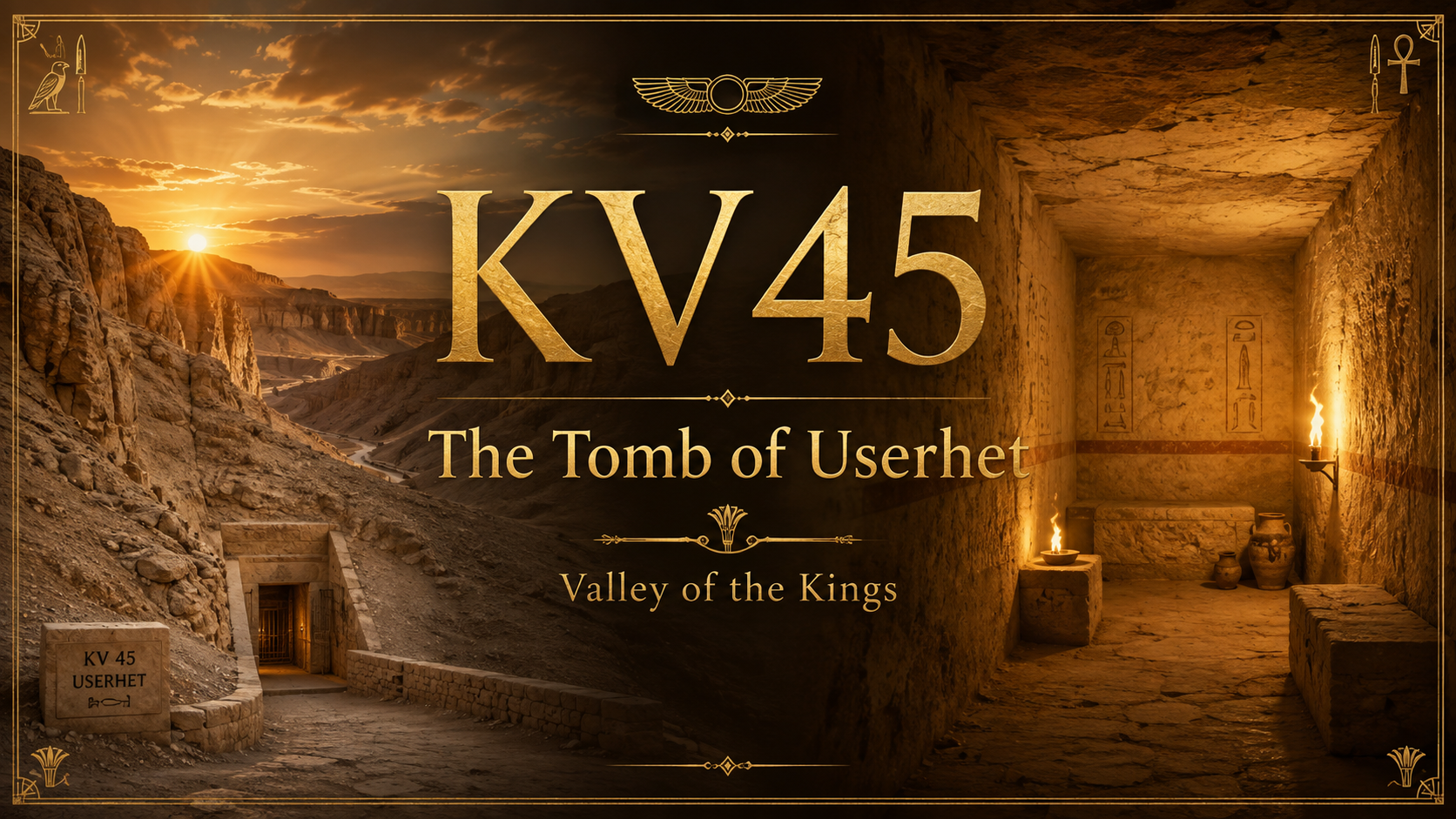
KV45 is a small but historically revealing tomb in the Valley of the Kings. It was originally created during the Eighteenth Dynasty for an official named Userhet, who held the title Overseer of the Fields of Amun. Centuries later, the tomb was reopened and reused for two new burials belonging to the Twenty-second Dynasty.
Howard Carter discovered KV45 in February 1902 while excavating in a small side valley for Theodore M. Davis. When Carter opened the burial on February 25, he encountered two badly damaged mummies, each lying within nested wooden coffins. Nearby were boxes containing clay shabtis and traces of funerary wreaths.
These people, however, were not the tomb’s original occupants.
The later male burial belonged to Merenkhons, who carried the title Doorkeeper of the House of Amun. His identity survived because of a small black stone heart scarab found with the burial. The woman buried beside him could not be identified by name.
Beneath those later burials were traces of a much older interment. Fragments of alabaster canopic jars carried the name and title of Userhet, confirming that KV45 had originally belonged to him.
The tomb therefore preserves two distinct worlds separated by centuries: the elite court and temple society of the Eighteenth Dynasty, and the priestly community of Thebes during the Third Intermediate Period.
- Structure: KV45
- Location: Valley of the Kings, East Valley, Thebes West Bank, Luxor
- Original Owner: Userhet
- Title: Overseer of the Fields of Amun
- Original Date: Eighteenth Dynasty, probably around the reign of Thutmose IV or early Amenhotep III
- Later Occupants: Merenkhons and an unidentified woman
- Later Date: Twenty-second Dynasty
- Site Type: Shaft tomb with a single burial chamber
- Decoration: None
- Public Access: Closed
KV45 lies in a small side wadi branching eastward from the main Valley of the Kings.
It is immediately associated geographically with KV44, another small shaft tomb that followed a strikingly similar history. Both monuments were originally constructed during the Eighteenth Dynasty, and both were later reused for burials during the Twenty-second Dynasty.
Nearby tombs include:
- KV44, an anonymous Eighteenth Dynasty tomb later reused for three Twenty-second Dynasty burials
- KV28, another unidentified Eighteenth Dynasty shaft tomb
- Other small elite burials scattered throughout the side wadi
The location shows that the Valley of the Kings was not reserved exclusively for reigning pharaohs.
Selected officials and members of the wider royal or temple establishment could also receive burial places within the royal necropolis.
Description
KV45 is architecturally extremely simple. The tomb consists of:
- A vertical entrance shaft
- A single small burial chamber
The shaft descends approximately 3 meters before opening into the chamber. There are no corridors. There is no antechamber. There are no pillars. There is no well chamber. There are no subsidiary storerooms. There is no painted decoration. The entire monument is essentially a vertical entrance leading directly into one underground burial room.
The Shaft
The entrance shaft provided both access and security. During the original funeral, the coffin and burial equipment would have been lowered down the shaft and transferred into the chamber.
Afterward, the doorway or shaft could be blocked. This simple architecture was common among elite Eighteenth Dynasty burials. Unlike the enormous royal tombs whose corridors penetrated deep into the mountains, private individuals did not require elaborate symbolic underground landscapes.
A concealed chamber could provide sufficient space for the deceased, coffin, canopic equipment, food, clothing, shabtis, and other funerary objects.
The Burial Chamber
At the bottom of the shaft lies a small rectangular room. When Carter entered KV45, approximately one-third of the chamber was filled with debris. The two later coffins rested above this accumulated material.
That position provided an immediate clue. The Twenty-second Dynasty burials could not have been the original occupants because the chamber had already accumulated substantial debris before their coffins were deposited.
The tomb therefore clearly had an earlier history.
Water Damage
KV45 had suffered severe water penetration even before Carter discovered it. Carter described the tomb as having been badly damaged by rainwater, and the wooden coffins were already in extremely poor condition when found.
Water is particularly destructive inside shaft tombs. The shaft can act like a funnel, channeling runoff directly into the burial chamber.
Once inside, water can damage:
- Coffins
- Mummies
- Linen
- Cartonnage
- Wooden shabti boxes
- Pottery
- Organic material
It can also move archaeological objects from their original positions. The effects of flooding became important again during the modern history of KV45.
No Decoration
KV45 contains no painted or carved wall decoration. There are no funerary books, divine figures, hieroglyphic spells, or astronomical ceilings. This is entirely consistent with an elite rather than royal Eighteenth Dynasty burial.
The religious equipment needed for the afterlife would instead have been carried into the tomb through portable objects such as:
- Coffins
- Shabtis
- Canopic vessels
- Amulets
- Heart scarabs
- Funerary papyri
- Food offerings
Most of Userhet’s original equipment disappeared long before modern discovery.
Who Was Userhet?
Userhet was an Egyptian official who held the title Overseer of the Fields of Amun. The title connected him with the enormous agricultural wealth belonging to the Temple of Amun. Amun’s religious institutions controlled extensive land holdings during the New Kingdom.
These estates produced:
- Grain
- Vegetables
- Fruit
- Flax
- Livestock
- Wine
- Oils
- Other agricultural goods
Managing those resources required a sophisticated administrative bureaucracy. Userhet therefore occupied an important economic position within the temple establishment.
Overseer of the Fields of Amun
The title may sound agricultural, but it represented considerable authority. Temple estates depended on agricultural production for food offerings, wages, taxation, and institutional wealth.
An Overseer of the Fields could have responsibility for:
- Agricultural estates
- Cultivation
- Harvests
- Field workers
- Storage
- Accounting
- Transportation of produce
- Temple deliveries
Amun’s temples became some of the wealthiest institutions in Egypt during the Eighteenth Dynasty. An official responsible for their fields was therefore part of an important administrative hierarchy.
When Did Userhet Live?
Pottery recovered during Donald Ryan’s later investigation has been dated around the reign of Thutmose IV or the early reign of Amenhotep III.
Other studies place Userhet within the general period of Amenhotep III. The safest conclusion is that Userhet probably lived during the middle Eighteenth Dynasty, approximately around the transition from Thutmose IV to Amenhotep III.
That dating places him within one of the wealthiest and most politically powerful periods of New Kingdom Egypt.
The Court of Amenhotep III
If Userhet lived during the reign of Amenhotep III, he belonged to the administrative world supporting one of Egypt’s greatest royal courts. Amenhotep III ruled during a period of immense prosperity.
Egypt controlled vast territories and trade networks. Royal building programs transformed Thebes. Amun’s temple at Karnak became increasingly powerful.
Officials connected with the temple administration could accumulate substantial prestige and wealth. KV45’s position within the Valley of the Kings may reflect Userhet’s elevated status within that system.
Why Was Userhet Buried in the Valley of the Kings?
Most Egyptian officials were buried in the private cemeteries surrounding Thebes rather than inside the Valley of the Kings. Receiving a tomb within the royal cemetery was therefore an unusual privilege. Userhet may have earned this privilege through his relationship with:
- The king
- Amun’s temple
- The royal administration
- Other powerful officials
Other non-royal individuals buried within the Valley include Maiherpri in KV36, Amenemopet called Pairy in KV48, and Yuya and Thuya in KV46. These burials demonstrate that exceptionally favored people could enter the sacred royal necropolis.
The Canopic Jars of Userhet
The most important evidence identifying KV45’s original owner came from fragments of alabaster canopic jars. The pieces preserved Userhet’s name and title. Canopic jars held internal organs removed during mummification.
Traditionally, the organs were associated with the Four Sons of Horus and placed under divine protection. A complete canopic set represented an essential component of elite burial equipment.
Even though Userhet’s jars had been shattered, their inscriptions preserved the identity of a man whose coffin and mummy no longer survived intact.
Why the Canopic Fragments Matter
Without these fragments, KV45 would probably remain anonymous. The walls are undecorated. There are no foundation deposits securely identifying the tomb. The later occupants belonged to a completely different period.
Userhet’s name survived only because pieces of his burial equipment remained mixed among the debris. This illustrates why fragments can be more historically valuable than spectacular intact objects. A broken alabaster jar restored the identity of the tomb’s original owner after more than three thousand years.
What Happened to Userhet’s Burial?
Userhet’s original burial was heavily disturbed. By the time Carter entered KV45, no intact Eighteenth Dynasty coffin belonging to Userhet remained. His mummy could not be securely identified. His burial furniture had disappeared. Only fragments of equipment survived. Ancient robbery is the most likely explanation.
Thieves searching for valuable objects may have removed:
- Jewelry
- Gold
- Amulets
- Metal fittings
- Valuable vessels
- Coffin decoration
The body and less valuable equipment may then have been displaced or destroyed.
Were Other People Buried With Userhet?
Donald Ryan’s later excavations recovered additional human remains. Ultimately, the team distinguished the remains of five adults within KV45. Two relatively complete skeletons, one male and one female, probably represented the Twenty-second Dynasty burials Carter had encountered.
That leaves additional human material that could belong to the earlier phase. The evidence raises the possibility that Userhet was not the only Eighteenth Dynasty person buried inside KV45.
Whether these individuals were relatives, secondary burials, or later intrusions cannot be established securely from the surviving evidence.
The Twenty-Second Dynasty Reuse
Several centuries after Userhet’s funeral, KV45 was opened again. The tomb was reused during the Twenty-second Dynasty.
Two people were placed inside:
- Merenkhons
- An unidentified woman
Each was buried within a set of nested wooden coffins. Their coffins were placed above the accumulated debris rather than directly on the original chamber floor.
This demonstrates that the people responsible for the later burials did not completely clear Userhet’s tomb before using it.
Why Reuse an Ancient Tomb?
By the Twenty-second Dynasty, the Valley of the Kings was no longer serving as Egypt’s principal royal cemetery. Many of the tombs had already been robbed or abandoned. Yet they remained valuable underground spaces. Reusing an existing tomb had practical advantages.
It was already excavated. It could be sealed. It existed within a sacred funerary landscape. During the Third Intermediate Period, a number of Valley tombs were reused for private burials. KV44 and KV45 provide a particularly striking pair because neighboring Eighteenth Dynasty shaft tombs were both recycled during the same general period.
Merenkhons
The later male occupant was identified as Merenkhons. His title was: Doorkeeper of the House of Amun. Like Userhet centuries earlier, Merenkhons therefore belonged to the institutional world of the god Amun.
This creates an intriguing continuity. KV45’s original owner worked for Amun’s estates. Its later occupant worked within the House of Amun. The tomb therefore became associated with servants of the same great Theban god in two completely different periods.
Doorkeeper of the House of Amun
A doorkeeper was more than someone who simply opened and closed a door. Access to major temple complexes was carefully controlled. Temple institutions contained sacred areas, storerooms, administrative offices, treasuries, workshops, and restricted ritual spaces.
Officials responsible for gateways participated in regulating who could enter those spaces. Merenkhons therefore held a formal position within the Amun establishment.
The Heart Scarab
Merenkhons was identified through a small black stone heart scarab found with his burial. Heart scarabs were among the most important funerary amulets. They were placed near or over the heart of the mummy.
The heart played a central role in Egyptian beliefs about judgment after death. In the famous weighing of the heart, the deceased’s heart was measured against the feather of Ma’at, representing truth and cosmic order.
A funerary spell asked the heart not to testify against its owner. The heart scarab therefore served as both protection and insurance during divine judgment.
Why the Heart Scarab Is So Important
Merenkhons’ coffins were badly damaged by water. Much of their decoration could not be preserved. Without the scarab, his identity might have disappeared just like that of the woman beside him.
Instead, one small object preserved both his name and his occupation. The contrast with Userhet is striking. Userhet was identified through broken canopic jars. Merenkhons was identified through a heart scarab.
KV45 therefore demonstrates how personal identity can survive on tiny funerary objects even when entire coffins and bodies deteriorate.
The Unidentified Woman
A woman was buried beside Merenkhons. She also lay within nested wooden coffins. Unlike Merenkhons, however, no surviving object securely preserved her name.
She may have been:
- His wife
- A relative
- A member of the same household
- Another member of Amun’s temple community
Their burial together makes some relationship very likely, but the precise connection remains unknown.
Two Sets of Nested Coffins
Both Twenty-second Dynasty occupants had two coffins. Nested coffins provided multiple layers of physical and magical protection. The outer coffin protected the inner coffin.
The inner coffin surrounded the mummy. Each surface could carry religious imagery and inscriptions designed to transform and protect the deceased.
By the Third Intermediate Period, coffins had become especially important because many burials were placed in undecorated or reused tombs.
The religious program that earlier periods might have painted on tomb walls could instead surround the deceased directly on the coffin.
Damage to the Coffins
Unfortunately, the KV45 coffins had suffered catastrophic water damage. Carter wrote that rainwater had essentially destroyed them. The wood deteriorated badly. Painted surfaces separated. Sections collapsed.
Of Merenkhons’ coffin, Carter was able to preserve mainly the face. The remaining coffin fragments were left within the tomb. Decades later, Donald Ryan’s team returned to recover and document what remained.
Shabti Boxes
Two boxes containing clay shabtis accompanied the later burials. Shabtis were small funerary figures intended to perform labor for the deceased in the afterlife.
Egyptians believed that people might be called upon to cultivate fields, move earth, or perform other agricultural duties in the next world.
The shabti could magically answer instead. By the Third Intermediate Period, elite burials could contain large numbers of these figures.
Eighty-Eight Shabti Fragments
During Ryan’s re-excavation, the team recovered 88 shabti fragments. Many were crudely manufactured clay figures. Their condition reflected both the original inexpensive material and centuries of water damage.
Despite their simplicity, the shabtis provide important evidence for the Twenty-second Dynasty burial assemblage. They show that Merenkhons and his companion received standard funerary provisions even though they were buried inside a reused tomb.
Floral Wreaths
Carter also found traces of floral wreaths scattered around the later burials. Flowers carried strong symbolic meaning in Egyptian funerary religion.
They represented:
- Life
- Regeneration
- Fertility
- Renewal
- Rebirth
Placing flowers around coffins transformed the funeral into a visual statement that death would be followed by renewed existence.
KV44, discovered nearby shortly before KV45, also preserved floral wreaths around its Twenty-second Dynasty coffins.
The similarity suggests shared funerary customs among the later Theban burial community.
KV44 and KV45
Few pairs of tombs illustrate archaeological reuse as clearly as KV44 and KV45.
Both were:
- Small Eighteenth Dynasty shaft tombs
- Located beside one another
- Undecorated
- Disturbed before later reuse
- Reused during the Twenty-second Dynasty
- Excavated by Howard Carter
- Reexamined by Donald Ryan
- Damaged by water
The crucial difference is identity.
KV44’s original owner remains unknown.
KV45’s original owner can be identified as Userhet because of the inscribed canopic fragments.
An Entirely Different Cemetery Centuries Later
The reuse of KV44 and KV45 suggests that this side wadi acquired a new funerary function during the Third Intermediate Period. The people burying Merenkhons and the others probably knew they were entering ancient tombs.
They may not have known the names of the original Eighteenth Dynasty occupants. To them, these chambers were ancient sacred spaces available for reuse. This represents a dramatic transformation in the Valley’s history.
A cemetery created around kings and the New Kingdom court had become, centuries later, a burial ground used by priests and officials connected with Amun.
Howard Carter Discovers KV45
Howard Carter discovered KV45 in February 1902 while working as Chief Inspector of Antiquities in Upper Egypt. The excavations were financially supported by Theodore M. Davis.
Carter and Gaston Maspero had identified several areas in the Valley where tomb entrances might remain concealed. Excavators dug a trench across the side valley and gradually cleared the area. Near KV28 and beside KV44, workers uncovered the entrance to KV45.
February 25, 1902
The burial was formally opened on February 25, 1902, when Theodore Davis returned from Aswan. The discovery did not produce royal gold or an untouched pharaoh. Instead, Carter found a modest chamber containing two badly damaged later burials. Yet the tomb eventually proved archaeologically much more complicated than it first appeared. Fragments beneath the later coffins revealed an earlier Eighteenth Dynasty history.
Carter’s Report
Carter published the discovery in his report on archaeological work carried out in Upper Egypt during 1902–1903. He described the tomb as belonging originally to an Eighteenth Dynasty noble and recorded the later burials and water destruction.
Carter recovered the most obvious identifiable material, including Merenkhons’ heart scarab and part of his coffin. Much of the remaining debris was left inside. That decision later allowed Donald Ryan to reexamine the archaeological context.
Donald Ryan Returns
In 1991, Donald P. Ryan and the Pacific Lutheran University Valley of the Kings Project systematically reexamined KV45. Ryan’s project specialized in small and undecorated tombs that previous expeditions had largely overlooked.
KV45 was an ideal candidate. Although Carter had discovered it nearly ninety years earlier, substantial archaeological material remained.
Recovering the Coffins
Ryan’s team discovered that Carter had left most of the decayed coffin fragments where they had fallen. The archaeologists carefully recovered the surviving pieces. They even found the face belonging to the unidentified woman’s coffin.
This allowed the team to reconstruct more of the Twenty-second Dynasty burial assemblage than Carter had been able or willing to document.
Five Adults
The re-excavation ultimately distinguished human remains belonging to five adults. Two relatively complete skeletons, one male and one female, probably corresponded to Merenkhons and his unidentified companion.
Additional human remains likely belonged to earlier individuals. This suggests that Userhet’s original burial may not have been the only Eighteenth Dynasty interment in KV45. Unfortunately, the disturbance prevents secure identification.
The 1994 Flood
KV45 remained vulnerable even after Ryan’s modern excavation. Severe flash floods struck the Valley of the Kings in 1994. Later investigation showed that water had again penetrated KV45. Protective diversion walls constructed around the site appear to have reduced the amount of water entering the tomb. Without those measures, the damage might have been considerably worse.
Flood Protection
The experience of KV45 demonstrates why even undecorated tombs require conservation planning. Floods can destroy archaeological information just as effectively as they destroy paintings.
Water can:
- Separate bones
- Carry pottery away
- Dissolve organic materials
- Destroy coffin fragments
- Mix archaeological layers
- Introduce salts
- Deposit new sediment
Because the entire history of KV45 depends on understanding the relationship between different layers and burial phases, protecting those deposits is essential.
The 2005 Field Season
The Valley of the Kings Project returned to KV45 in 2005. The team assessed the effects of water penetration and continued conservation and documentation. Most portable artifacts from KV44 and KV45 were subsequently transferred to KV21 for safer archaeological storage. Pottery and human remains were handled separately. The relocation reflected concern that future flooding could further damage fragile materials.
Protecting the Entrance
After the modern clearance, a wooden covering was placed over KV45’s entrance to help protect it from rubbish and debris being thrown or washed into the shaft. Modern tomb protection often requires surprisingly practical solutions.
An open shaft can quickly become filled with:
- Windblown sand
- Stones
- Tourist rubbish
- Excavation debris
- Flood deposits
Keeping that material out reduces both structural and archaeological damage.
Objects Recovered
Material associated with KV45 includes:
- Alabaster canopic jar fragments naming Userhet
- Two Twenty-second Dynasty mummy burials
- Nested wooden coffins
- Black stone heart scarab of Merenkhons
- Coffin face of Merenkhons
- Coffin face of the unidentified woman
- Two shabti boxes
- At least 88 shabti fragments
- Floral wreath remains
- Pottery
- Clay funerary figures
- Human skeletal and mummy remains
- Additional coffin fragments
The assemblage represents both the original Eighteenth Dynasty burial and the much later reuse of the tomb.
Noteworthy Features
KV45 is notable for several reasons:
- It was originally the tomb of Userhet.
- Userhet was Overseer of the Fields of Amun.
- The tomb dates to the middle Eighteenth Dynasty.
- Pottery suggests approximately the reign of Thutmose IV or early Amenhotep III.
- KV45 contains only a shaft and one chamber.
- The shaft is approximately three meters deep.
- The tomb is completely undecorated.
- Userhet was identified from inscribed canopic jar fragments.
- His original burial was badly disturbed.
- KV45 was reused during the Twenty-second Dynasty.
- The later occupants were Merenkhons and an unidentified woman.
- Merenkhons was Doorkeeper of the House of Amun.
- He was identified by a black stone heart scarab.
- Both later occupants had nested coffins.
- Two boxes of clay shabtis accompanied them.
- At least 88 shabti fragments were recovered.
- Floral wreaths accompanied the later burials.
- Carter discovered the tomb in February 1902.
- Donald Ryan reexamined KV45 in 1991.
- At least five adults were eventually identified among its human remains.
- Water damage severely affected the tomb.
- Flooding entered KV45 again in the modern period.
- Its archaeological material was later moved to safer storage.
- KV45 and neighboring KV44 provide exceptional evidence for Twenty-second Dynasty reuse of the Valley.
Dating
KV45 experienced several major phases:
Middle Eighteenth Dynasty:
Construction and original use by Userhet, probably around the reign of Thutmose IV or early Amenhotep III.
Later New Kingdom:
Robbery or disturbance of Userhet’s burial.
Twenty-second Dynasty:
Reuse by Merenkhons and an unidentified woman.
February 1902:
Discovery and excavation by Howard Carter.
1991:
Systematic re-excavation by Donald Ryan.
1994:
Major flooding in the Valley.
2005:
Further investigation and conservation work by Ryan’s Valley of the Kings Project.
History of Exploration
Howard Carter, 1902
Howard Carter discovered KV45 during excavation sponsored by Theodore M. Davis.
The tomb was opened on February 25, 1902.
Carter documented the two later burials and recognized fragments belonging to an earlier Eighteenth Dynasty interment.
Donald P. Ryan, 1991
Donald Ryan returned to KV45 nearly ninety years later. His team systematically excavated the remaining deposits and recovered coffin fragments, human remains, shabtis, pottery, and other material. The work demonstrated how much information could remain in a tomb long after an earlier excavation.
Donald P. Ryan, 2005
Ryan’s project returned again to evaluate the effects of flooding and complete additional conservation and documentation. Because water remained an ongoing threat, portable artifacts were moved to a safer location.
Site Condition
KV45 is closed to ordinary visitors. The tomb has no wall decoration and consists only of a vertical shaft and small chamber. Its primary importance lies in its archaeological contents rather than visual appearance. Water remains one of the most serious threats.
The original coffins were severely damaged by moisture before Carter arrived, and modern flooding demonstrated that the problem continues.
Protective measures around the entrance are therefore essential.
Why KV45 Matters
KV45 tells an unusually complete story despite being one of the simplest tombs in the Valley of the Kings. The tomb began with Userhet. He was not a pharaoh, prince, or general. He was an official who administered the agricultural resources of Amun.
Yet he received the extraordinary privilege of burial within the royal cemetery.
His coffin disappeared. His mummy was disturbed. Most of his funerary equipment was stolen. Only fragments of his canopic jars remained to tell us his name. Centuries later, another servant of Amun entered the same tomb.
Merenkhons lived in a completely different Egypt during the Twenty-second Dynasty, yet his occupation still connected him with the same temple institution that had employed Userhet.
Userhet had been Overseer of the Fields of Amun. Merenkhons was Doorkeeper of the House of Amun. The connection may be accidental, but it creates a remarkable historical symmetry.
Two men separated by centuries served the same god and ultimately shared the same underground chamber. KV45 therefore records something larger than a single burial.
It documents the extraordinary longevity of Amun’s religious institutions and the changing meaning of the Valley of the Kings. During the Eighteenth Dynasty, burial there represented exceptional royal favor. During the Twenty-second Dynasty, an abandoned ancient tomb could be reclaimed by members of Thebes’ priestly community.
Then, thousands of years later, Howard Carter and Donald Ryan entered the same chamber and reconstructed both stories from broken jars, damaged coffins, bones, shabtis, and one small black heart scarab.
Interesting Facts About KV45
- KV45 originally belonged to Userhet.
- Userhet was Overseer of the Fields of Amun.
- His identity survived on fragments of alabaster canopic jars.
- The tomb probably dates to the reign of Thutmose IV or early Amenhotep III.
- KV45 contains only one burial chamber.
- The chamber is reached through a roughly three-meter shaft.
- The tomb is undecorated.
- Userhet’s original burial was severely disturbed.
- KV45 was reused hundreds of years later.
- The later burials date to the Twenty-second Dynasty.
- One later occupant was named Merenkhons.
- Merenkhons was Doorkeeper of the House of Amun.
- A black heart scarab preserved his identity.
- An unidentified woman was buried beside him.
- Both were placed inside nested coffins.
- Their coffins were severely damaged by rainwater.
- Two boxes of clay shabtis accompanied the burials.
- Donald Ryan recovered 88 shabti fragments.
- Floral wreath remains survived.
- Howard Carter discovered KV45 in February 1902.
- Donald Ryan reexcavated the tomb in 1991.
- Human remains from at least five adults were eventually distinguished.
- Severe flooding threatened the tomb again during the modern period.
- KV45 sits directly beside KV44, which was also reused during the Twenty-second Dynasty.
- Both Userhet and Merenkhons were connected with the religious institution of Amun.