
KV39 is one of the strangest and most controversial tombs in the Valley of the Kings. Located high above the better-known royal cemetery, the monument has an unusual multi-axis design that appears to have developed through several separate phases of construction. Its original owner remains unknown, yet for more than a century KV39 has been repeatedly proposed as the lost tomb of Pharaoh Amenhotep I.
That identification is far from certain. Archaeological evidence indicates that at least part of KV39 may instead have been constructed for an early Eighteenth Dynasty royal woman, possibly Queen Ahmose-Inhapy. The tomb was later expanded dramatically, creating long descending passages in two different directions. Its mixture of architecture, pottery, coffin fragments, linen, and human remains suggests that it may have been used and reused several times.
The Amenhotep I connection remains especially fascinating because ancient records describe his burial but do not tell us its modern location. The Abbott Papyrus, now in the British Museum, records an official inspection of royal tombs during the Twentieth Dynasty and states that Amenhotep I’s tomb was found intact. The geographical clues preserved in that document have been used to argue both for and against KV39.
KV39 may therefore represent several different chapters of royal burial history at once: an early Eighteenth Dynasty burial, an expanded royal-family tomb, and perhaps a temporary hiding place for some of Egypt’s most famous royal mummies.
- Structure: KV39
- Location: Valley of the Kings, East Valley, Thebes West Bank, Luxor
- Owner: Unknown
- Possible Associations: Amenhotep I, Queen Ahmose-Inhapy, and possibly other early Eighteenth Dynasty royals
- Dynasty: Eighteenth Dynasty
- Site Type: Royal or royal-family tomb, later possibly used as a royal reburial cache
- Decoration: None
- Interior Layout: Multiple corridors, stairways, chambers, and two major branching axes
- Public Access: Closed
KV39 occupies one of the most unusual locations associated with the Valley of the Kings.
Rather than lying on the floor of the main wadi, the tomb is positioned high in the cliffs south of the central Valley. It lies near the head of a narrow side wadi on the eastern side of el-Qurn, the mountain overlooking the royal cemetery. Above it is the ridge leading toward the workmen’s village of Deir el-Medina.
This elevated position is important because the earliest Eighteenth Dynasty royal burials often favored remote, difficult-to-reach locations rather than the more accessible valley-floor entrances seen in later periods.
KV39’s placement high in the mountain would have offered concealment and a degree of natural protection. It may also explain why the monument’s relationship to the main Valley of the Kings has always seemed unusual.
One of the Earliest Tombs in the Valley?
KV39 may belong to the formative period when the Valley of the Kings was first becoming a royal necropolis.
Its east-facing entrance, remote cliffside location, and early architectural features resemble royal and elite tombs dating from the end of the Seventeenth Dynasty and beginning of the Eighteenth Dynasty. The tomb also lacks the well chamber that became an important feature in later Eighteenth Dynasty royal tombs such as KV34 and KV35.
This has led several scholars to suggest that at least the earliest portion of KV39 predates Thutmose III.
If so, the tomb could preserve evidence from the generations immediately following the expulsion of the Hyksos and the creation of Egypt’s New Kingdom.
Description
KV39 has one of the most complicated plans among the early tombs of the Valley of the Kings. The entrance begins with a steep staircase descending approximately seven meters. A corridor continues from the bottom of the steps into a roughly square chamber.
Beyond this area, the architecture becomes much more unusual. One passage continues toward a rectangular chamber associated with the earliest portion of the monument. From the central area, two major later extensions descend in different directions.
One runs toward the east. The other extends toward the south. The resulting tomb does not follow the simple single-axis plan familiar from most Egyptian tombs. Instead, it resembles several monuments joined together.
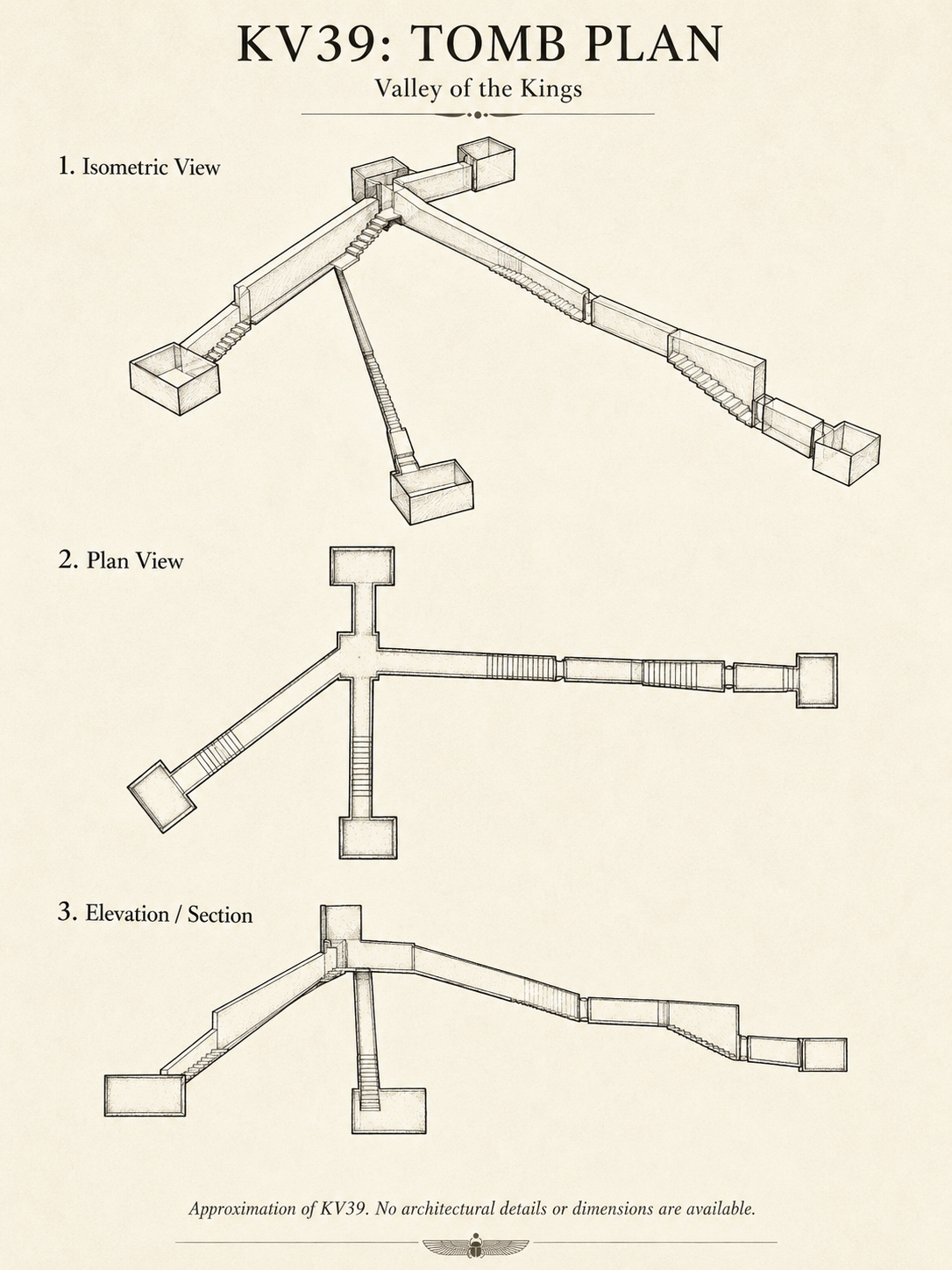
The Multiple Axes of KV39
The unusual plan of KV39 is one of the strongest indications that the monument was constructed in several stages. The eastern passage turns almost completely back from the direction of the entrance. It descends through a sequence of corridors and staircases for approximately 38 meters before reaching another rectangular chamber.
The southern passage branches from the central area at roughly a right angle. It descends steeply for approximately 25 meters, although parts of this section remain incompletely cleared because of debris and structural instability.
These extensions transformed what may originally have been a relatively modest tomb into a monument extending more than 100 meters underground.
Three Construction Phases
Most interpretations of KV39 recognize several construction phases, although scholars disagree about their exact order. The earliest phase appears to have consisted of the entrance, initial passage, central area, and a relatively small rectangular chamber.
Later workers dramatically enlarged the tomb.
David Aston argues that the southern extension represents a second phase whose architecture resembles other early Eighteenth Dynasty royal women’s tombs, particularly TT358 and TT320. He suggests that this stage may have been created for Queen Ahmose-Inhapy. A later eastern extension may then have been excavated during the middle Eighteenth Dynasty.
Other researchers have reversed parts of this sequence or interpreted the southern extension as an unfinished annex or later royal cache.
The important point is that KV39 was almost certainly not created according to one uninterrupted architectural plan.
Could KV39 Have Been a Queen’s Tomb?
One of the strongest modern alternatives to the Amenhotep I theory is that KV39 was originally intended for an early Eighteenth Dynasty queen.
David Aston compared part of KV39 with TT358 and TT320. TT358 securely belonged to Queen Ahmose-Meryetamun, while he argues that TT320 was originally constructed for Queen Ahmose-Nefertari before later becoming the famous Deir el-Bahari royal cache.
The architectural similarities led Aston to suggest that KV39 may have been designed for another important royal woman, possibly Queen Ahmose-Inhapy.
Ahmose-Inhapy belonged to the royal family that bridged the Seventeenth and Eighteenth Dynasties. Her mummy was eventually found among the royal remains associated with the Deir el-Bahari cache.
If KV39 originally belonged to her, its later connection with Amenhotep I becomes even more interesting.
Queen Ahmose-Inhapy
Ahmose-Inhapy was a royal woman from the generation surrounding the beginning of the New Kingdom. Her precise family relationships are not completely certain, but she belonged to the Theban royal house responsible for defeating the Hyksos and establishing the Eighteenth Dynasty.
Her mummy was eventually gathered with other royal bodies during the reburial operations conducted by priests near the end of the New Kingdom and beginning of the Third Intermediate Period.
The possibility that KV39 was her original tomb is important because ancient coffin inscriptions mention a place associated with Inhapy where Amenhotep I later rested.
This connection may explain why two separate historical identities have become associated with KV39.
The Amenhotep I Theory
KV39 became famous primarily because of the theory that it was the lost tomb of Amenhotep I.
Egyptologist Arthur Weigall proposed the identification in 1911. His argument relied heavily on the description of Amenhotep I’s tomb preserved in the Abbott Papyrus.
The document describes the tomb of Amenhotep I using measurements and landmarks that were meaningful to ancient inspectors but are difficult to identify today.
Weigall believed that those geographical clues corresponded with the location of KV39.
Since then, the identification has appeared in guidebooks, maps, databases, and tomb lists. Some references simply label KV39 “Amenhotep I,” even though the attribution remains hypothetical.
Who Was Amenhotep I?
Amenhotep I was one of the earliest pharaohs of the Eighteenth Dynasty and the son of Ahmose I, the king who completed the expulsion of the Hyksos and reunited Egypt.
Amenhotep I continued the consolidation of the new dynasty and sponsored major religious and building projects.
After his death, he became particularly important within the Theban necropolis. Amenhotep I and his mother Ahmose-Nefertari were eventually worshipped as divine patrons associated especially closely with the communities of workers who constructed and decorated royal tombs. Later evidence shows their cult remained important for centuries.
Ironically, despite Amenhotep I’s lasting importance to the people who worked in the royal cemetery, archaeologists still cannot say with certainty where he was originally buried.
The Abbott Papyrus
The most important ancient document in the search for Amenhotep I’s tomb is the Abbott Papyrus.
The papyrus dates to the Twentieth Dynasty and records an official investigation into tomb robbery around Thebes. The surviving document is now held by the British Museum as EA10221.
Inspectors examined several royal and private tombs to determine whether thieves had broken into them.
Amenhotep I’s tomb was among those inspected.
According to the ancient report, his burial was still intact at that time.
The text also gives geographical information intended to identify its location, including a measurement of 120 cubits and references to nearby landmarks. Unfortunately, the meanings and modern locations of some of those landmarks remain uncertain.
This uncertainty is why the Abbott Papyrus has not solved the mystery.
The Problem With the 120 Cubits
The Abbott Papyrus says that Amenhotep I’s tomb lay 120 cubits from a particular geographical marker. A royal cubit was roughly 52 centimeters, making 120 cubits approximately 63 meters.
That sounds precise, but the measurement is useful only if archaeologists can securely identify the ancient starting point.
One term describing the landmark has been interpreted in different ways, including a high place, stela, or prominent feature. Another reference mentions the “house of Amenhotep of the Garden.” Scholars have not identified either landmark with complete certainty.
Depending on how scholars interpret these expressions, the ancient description can favor different tomb locations.
Tomb ANB: The Other Major Candidate
KV39 is not the only monument proposed as Amenhotep I’s tomb.
Another important candidate is Tomb ANB at Dra’ Abu el-Naga, outside the Valley of the Kings.
Howard Carter investigated ANB during the early twentieth century and recovered material associated with Amenhotep I and members of his family. That evidence has convinced a number of Egyptologists that ANB may be a stronger candidate for the king’s original burial.
The debate therefore involves an important distinction.
KV39 may have contained Amenhotep I at some stage without necessarily being the tomb originally constructed for him.
This possibility becomes especially important when the evidence from the royal mummy caches is considered.
Could Amenhotep I Have Been Moved Into KV39?
A growing interpretation of the evidence separates Amenhotep I’s original tomb from a later resting place in KV39.
Ancient priests moved royal mummies repeatedly as tomb robbery became increasingly severe near the end of the New Kingdom.
In some cases, kings were transferred several times before reaching the caches in which archaeologists eventually found them.
A study of Twenty-first Dynasty coffin dockets reconstructs one stage in which Amenhotep I was resting in a place called the qAy of Inhapy. Some researchers identify this place with KV39.
If that reconstruction is correct, Amenhotep I may indeed have occupied KV39, but only during a later reburial operation.
That would explain why ancient and archaeological evidence can connect him with KV39 even if the monument was originally built for someone else.
Three Ramesside Kings May Have Been Brought to KV39
The royal-cache evidence makes the history of KV39 even more remarkable.
Coffin dockets record that in Year 10 of King Siamun, the mummies of Ramesses I, Seti I, and Ramesses II were moved from the tomb of Seti I to a place described as the qAy of Inhapy, in which Amenhotep I lies.
Some scholars identify this temporary location with KV39. Under that reconstruction, KV39 briefly held at least four famous kings: Amenhotep I, Ramesses I, Seti I, and Ramesses II.
Only three days later, the Ramesside kings were moved again. The complicated sequence demonstrates that the royal caches were not created in a single operation. Royal bodies could be transferred from tomb to tomb over many years.
A Temporary Royal Cache?
If the qAy of Inhapy was KV39, then one of the tomb’s most important phases may have occurred more than four centuries after it was first excavated. Priests could have used the deep, secluded monument as a temporary royal cache while reorganizing vulnerable royal burials.
This possibility could help explain the tomb’s unusual southern extension and evidence of multiple burials. It would also fit KV39 into a larger network of royal hiding places that eventually included TT320 at Deir el-Bahari and KV35, the tomb of Amenhotep II.
The hypothesis remains debated, but it offers a compelling explanation for why the tomb seems to contain evidence from different periods and different royal individuals.
The Foundation Deposit Near the Entrance
John Rose’s excavations uncovered an especially puzzling group of objects near the entrance. Approximately one meter from the tomb, archaeologists found a pit containing miniature vessels and objects bearing royal names. These included cartouches associated with Thutmose I, Thutmose II, and Amenhotep II.
Foundation deposits were ceremonial groups of objects placed during the construction or dedication of important monuments. Normally, a royal name within such a deposit can provide crucial evidence for dating a tomb.
KV39’s group is much more complicated because the names belong to kings from different generations. Rather than identifying a single owner, the assemblage reinforces the impression that the site had a long and complicated history.
Why the Royal Names Do Not Solve the Mystery
The presence of multiple royal names might initially seem to provide an easy solution to the ownership problem. Instead, it complicates the situation.
Thutmose I, Thutmose II, and Amenhotep II could not all have commissioned the same original tomb at the same time. The objects may relate to separate construction phases, later activity, disturbed deposits, or material gathered during one of the tomb’s reuse phases.
For that reason, the deposit cannot be treated as straightforward evidence that KV39 belonged to any one of those kings.
Red Mason’s Marks
KV39 contains no finished painted decoration, but ancient workmen left numerous red marks on its ceilings and walls. These marks were used while laying out and cutting the monument.
Similar red construction marks occur in other Eighteenth Dynasty royal tombs, including KV34, the tomb of Thutmose III, and KV35, the tomb of Amenhotep II.
The marks provide direct evidence of the tomb-building process.
Before artists could decorate a royal burial, workmen had to determine passage directions, chamber dimensions, slopes, and levels. Red guidelines allowed the quarrymen to follow the intended architectural plan.
KV39 is unusual because those construction traces survive while virtually no finished decorative program was ever applied.
Decoration
KV39 is completely undecorated. No surviving painted religious scenes, carved funerary texts, royal cartouches, astronomical ceilings, or divine images cover its walls.
This absence makes the tomb very different from KV34, KV35, and the later royal monuments in the Valley. However, undecorated walls do not necessarily indicate a low-status burial.
Several tombs belonging to Eighteenth Dynasty royal women and members of the royal household were also undecorated. Religious texts and protective imagery could instead appear on coffins, papyri, canopic equipment, amulets, and other portable funerary objects.
Pottery
Pottery recovered from KV39 spans more than one period within the Eighteenth Dynasty. The assemblage contains both earlier and later forms, supporting the architectural evidence that the tomb experienced multiple construction or use phases.
This mixed chronology is important because it argues against treating KV39 as a simple, untouched burial created for one person.
Instead, the archaeological record appears to reflect a monument that changed through time.
Evidence of Actual Burials
KV39 was not merely an abandoned construction project.
Excavators recovered human remains, coffin fragments, linen, pottery, and other funerary material from the passages and chambers. The entrance to the eastern extension also showed evidence of mud plaster that may once have helped seal a burial area.
The mummified material was particularly significant.
Researchers noted sophisticated embalming techniques, including padding placed beneath the skin and the use of fine-quality textile wrappings. These features indicate that at least some of the people buried or temporarily deposited inside KV39 received high-status mummification.
The identities of those individuals remain unknown.
Could Several People Have Been Buried Here?
The architecture and surviving human remains make multiple burials highly plausible.
KV39 contains widely separated chambers reached through different passages. If its extensions were built at different times, each could have served a separate occupant or phase of burial activity.
Possible scenarios include an original royal woman’s burial followed by later members of the royal family, or an early burial followed centuries later by royal mummies being temporarily cached within the monument.
The evidence cannot currently distinguish all of these phases with certainty.
That uncertainty is part of what makes KV39 so important.
Discovery
Even the modern discovery of KV39 is somewhat uncertain. The tomb is usually said to have been discovered around 1899 or 1900. Victor Loret is sometimes credited with its discovery in 1899, while other accounts attribute the initial discovery to Egyptian excavators Macarious and Andraos around 1900.
The monument received limited attention during the early twentieth century.
Arthur Weigall visited the tomb and published a description in 1911, the same year in which he argued that it might be the burial place of Amenhotep I.
Elizabeth Thomas
American Egyptologist Elizabeth Thomas studied the royal tombs of Thebes extensively during the twentieth century. In 1966, she attempted to document KV39 but found the entrance obstructed by a massive boulder.
Thomas was therefore unable to enter the monument, although she produced a plan using the information then available. By that point, KV39 had again become difficult to access, illustrating how quickly tomb entrances can disappear beneath rockfall and debris.
John Rose’s Excavations
The first major modern excavation of KV39 was conducted by Egyptologist John Rose between 1989 and 1994. Rose removed the large rock blocking the staircase and began systematically clearing the passages.
His work revealed the tomb’s extraordinary multiple-axis plan and recovered pottery, burial remains, construction evidence, and the unusual deposit of miniature vessels near the entrance.
The excavation demonstrated that KV39 was far larger and more complicated than earlier visitors had realized.
Rose’s research helped transform KV39 from a vaguely documented candidate for Amenhotep I into one of the most intriguing archaeological problems in the Valley.
The 1994 Flood
KV39 suffered a major setback almost immediately after Rose’s excavation. In 1994, severe flash flooding struck the Valley of the Kings.
Water carried sediment, stone, and debris into the newly cleared tomb. Areas that had taken years to excavate were partly filled again, while unstable rock layers were further weakened.
Flooding has always been one of the greatest natural threats to the Valley of the Kings.
The steep passages of KV39 act like channels, allowing water and debris entering the tomb to accelerate toward the lower chambers.
The 2002 Expedition
Ian Buckley, Peter Buckley, and Ashley Cooke returned to KV39 in 2002.
Their project included a detailed architectural survey, planning the monument, studying and sorting pottery, examining skeletal and organic remains, continuing to sieve old excavation debris, photographing, and recording new finds.
The team documented how extensively the 1994 flood had affected the tomb.
The southern extension could not be completely excavated because parts of the ceiling were unstable or collapsed and flood debris continued to fill the passage.
The 2002 expedition therefore improved the plan dramatically without solving every question about the monument.
Modern Human Activity Inside KV39
Archaeological evidence also shows that KV39 was entered and used relatively recently. Soot on ceilings indicates fires had been lit inside portions of the tomb, while modern rubbish, including paper and other debris, was recovered during clearance.
These traces show that remote ancient tombs did not always remain sealed between archaeological expeditions. They could become temporary shelters, storage spaces, or places visited by local residents and travelers.
Such activity further complicates the archaeological deposits.
Protection of the Entrance
At the end of the 2002 work, archaeologists took steps to protect KV39 from further damage.
Steel mesh was installed across the entrance, and stone walls were constructed to help divert floodwater and prevent additional debris from entering the monument.
These protective measures were especially important because KV39 lies within a natural drainage area.
Without barriers, another major storm could once again send large quantities of stone and sediment down the stairway.
Measurements
Published measurements describe KV39 as a surprisingly large monument.
- Maximum Height: Approximately 4.94 m
- Maximum Width: Approximately 3.92 m
- Total Length: Approximately 101.09 m
- Total Area: Approximately 193.69 m²
- Total Volume: Approximately 445.1 m³
The total length is especially impressive for an early Eighteenth Dynasty tomb. However, the figure reflects the combined passages created during several construction phases rather than a single long royal corridor.
The Tomb of Amenhotep I or Not?
At present, KV39 should not simply be described as the confirmed tomb of Amenhotep I. There is substantial evidence connecting Amenhotep I with the monument’s later history, and some reconstructions of the royal mummy dockets identify KV39 as the qAy of Inhapy where the king temporarily rested.
But that is not the same as proving that Amenhotep I commissioned KV39 as his original burial place.
Other evidence favors Tomb ANB or another monument as the king’s original tomb, while architectural research suggests at least part of KV39 may have been designed for an early Eighteenth Dynasty queen.
The most historically responsible description is therefore: KV39 is an early Eighteenth Dynasty royal or royal-family tomb of uncertain ownership that may later have been used to house Amenhotep I and other royal mummies.
What Happened to Amenhotep I’s Mummy?
Amenhotep I’s mummy eventually reached the great royal cache at Deir el-Bahari, known as TT320 or DB320.
The coffin in which he was found dates from the Twenty-first Dynasty reburial operations and survives with the king’s identity preserved.
Amenhotep I’s mummy is especially famous because early Egyptologists chose not to unwrap it physically. Its elaborate floral garlands and funerary mask were left in place.
Modern researchers later examined the body using CT scanning, allowing them to study the king without disturbing the wrappings.
Whatever his original tomb may have been, Amenhotep I clearly experienced a long series of posthumous moves before reaching the cache where his mummy was eventually discovered.
Why Were Royal Mummies Moved?
By the end of the New Kingdom, royal tomb robbery had become a serious problem.
Priests began removing royal mummies from vulnerable tombs, repairing damaged bodies, rewrapping them, replacing coffins when necessary, and moving them to more secure locations.
These transfers did not necessarily happen only once.
The documentary evidence shows that some kings were moved repeatedly between different tombs and caches. The reburial sequence reconstructed for Ramesses I, Seti I, Ramesses II, and Amenhotep I demonstrates just how complicated this process could become.
KV39 may have participated directly in this extraordinary program of royal preservation.
Site Condition
KV39 has suffered from a combination of geological instability, ancient disturbance, flash flooding, modern intrusion, and incomplete excavation.
Some ceilings and passages remain unstable. The southern extension has never been completely cleared, while flood-borne sediment continues to complicate parts of the monument.
The tomb contains no surviving decorative program requiring the same conservation approach as the painted royal tombs, but its architecture and archaeological deposits remain fragile.
KV39 is closed to ordinary visitors.
Objects and Materials Recovered
The finds from KV39 reflect several different phases of use rather than one intact burial assemblage. Archaeologists have recovered:
- Human and mummified remains
- Fine linen and mummy wrappings
- Wooden coffin fragments
- Large quantities of pottery
- Miniature vessels
- Objects bearing royal cartouches
- Red mason’s marks
- Mud-plaster remains from ancient sealing
- Organic funerary material
- Evidence of both early and middle Eighteenth Dynasty activity
- Modern debris from later human use
Together, these finds confirm that KV39 was used for burial while also demonstrating how thoroughly its original archaeological context was disturbed.
Noteworthy Features
KV39 is one of the most unusual tombs in the Valley of the Kings because its original owner remains unknown despite more than a century of investigation. It may be one of the earliest tombs associated with the royal Valley, contains multiple architectural phases and branching axes, preserves evidence of high-status burials, and has long been proposed as the tomb of Amenhotep I.
The monument may originally have belonged to Queen Ahmose-Inhapy, while later evidence suggests Amenhotep I could have rested there during the Twenty-first Dynasty reburial operations. Some reconstructions even place Ramesses I, Seti I, and Ramesses II temporarily inside the same monument.
Its unusual architecture, mixed pottery, royal-name deposits, human remains, and complex reuse make KV39 less like a single tomb and more like an archaeological record of several generations of royal burial history.
Dating
KV39 appears to have experienced several phases of construction and use.
The earliest architecture probably belongs to the early Eighteenth Dynasty, perhaps even before the reign of Thutmose III. A later construction phase appears to belong to the middle Eighteenth Dynasty, while the monument may have been reused during the Twenty-first Dynasty as part of the royal mummy reburial program.
The site was subsequently entered during both ancient and modern periods before systematic archaeological excavation began.
History of Exploration
KV39 was probably discovered around 1899 or 1900, either by Victor Loret’s work or by the Egyptian excavators Macarious and Andraos. Arthur Weigall examined the monument and proposed the connection with Amenhotep I in 1911. Elizabeth Thomas attempted to document it in 1966 but found the entrance blocked by a large boulder.
John Rose conducted the first major modern excavation between 1989 and 1994, uncovering much of the architecture and recovering important archaeological material. A devastating flood struck shortly afterward in 1994 and partly refilled the monument.
Ian Buckley, Peter Buckley, and Ashley Cooke returned in 2002 to conduct a detailed architectural survey, pottery study, examination of human and organic remains, and continued analysis of earlier excavation deposits.
Why KV39 Matters
KV39 is important precisely because it refuses to provide a simple answer.
It may preserve evidence from the earliest period of royal tomb building in the Valley of the Kings. Its architecture shows that underground monuments could be enlarged and transformed across generations rather than constructed according to one immutable design.
The tomb also challenges how archaeologists assign ownership. Finding the name of a king in or near a tomb does not necessarily mean the monument was built for him. A mummy could be moved there centuries later, funerary equipment could be transferred, and priests could transform an old family burial into a temporary royal cache.
KV39 may have begun as a queen’s tomb, later received new corridors, eventually housed Amenhotep I, and perhaps briefly sheltered three of the greatest Ramesside kings before they were moved again.
That possibility makes KV39 one of the Valley of the Kings’ most fascinating monuments. It may not be the lost original tomb of Amenhotep I, but its history could be even more remarkable.
Interesting Facts About KV39
KV39 may be one of the earliest tombs associated with the Valley of the Kings. Its entrance lies high above the main royal cemetery, and its unusual plan contains passages extending in more than one direction.
Scholars have proposed the tomb as belonging to Amenhotep I, Queen Ahmose-Inhapy, and even Thutmose I, although none of these identifications is fully proven. Archaeological evidence confirms that the monument was used for high-status burial and that its architecture developed in several stages.
If the identification of KV39 with the ancient qAy of Inhapy is correct, Amenhotep I rested there during the Twenty-first Dynasty. For a brief period, Ramesses I, Seti I, and Ramesses II may also have been placed there with him before being moved again.
KV39 was substantially excavated only in the late twentieth century, then dramatically affected by the 1994 Valley flood. Parts of the monument remain incompletely explored today.
Meta Description