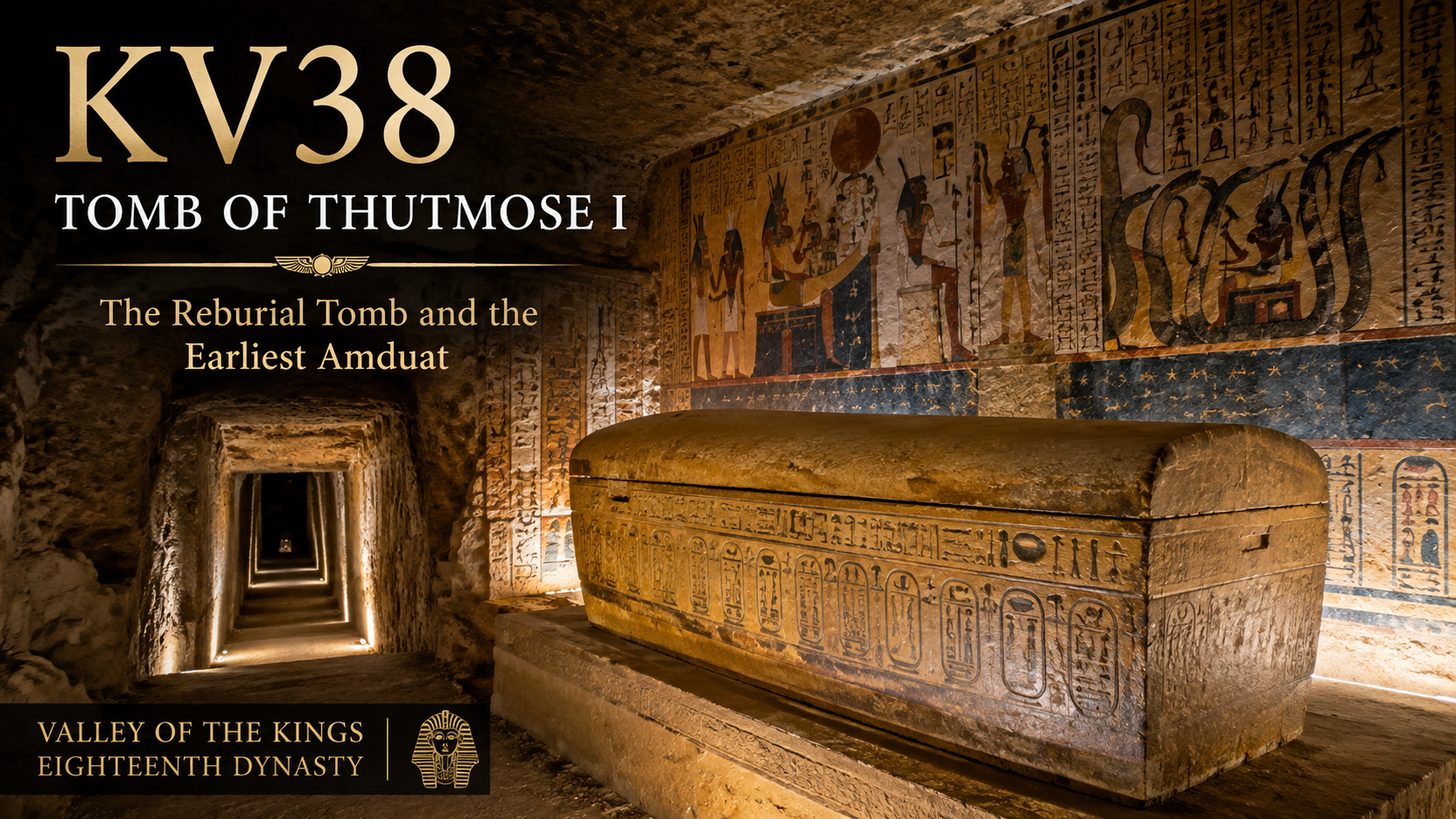
KV38 is the tomb associated with Pharaoh Thutmose I, one of the earliest rulers of Egypt’s Eighteenth Dynasty to be buried within the landscape that became the Valley of the Kings. Yet KV38 is not simply another royal tomb. It stands at the center of a long-running archaeological debate over where Thutmose I was originally buried, how many times his mummy was moved, and when the first royal underworld texts appeared in New Kingdom tombs.
Victor Loret discovered KV38 in 1899. Inside, archaeologists found a yellow quartzite sarcophagus inscribed for Thutmose I, fragments of royal funerary equipment, stone vessels bearing his name, and pieces of limestone decorated with portions of the Amduat, the sacred text describing the sun god’s twelve-hour journey through the underworld.
For much of the twentieth century, KV38 was sometimes described as Thutmose I’s original tomb. Later architectural studies challenged that interpretation. The tomb resembles KV34, the burial place of Thutmose III, leading many Egyptologists to conclude that Thutmose III probably commissioned KV38 after Hatshepsut’s death and transferred his grandfather there from KV20.
Recent discoveries have added another layer to the story. Archaeologist Khaled Abdel Ghany and a team supported by the American Research Center in Egypt and the University of Göttingen recovered additional Amduat fragments from KV38 beginning in 2016 and during further work in 2023. Their study argues that the material represents an archaic version dating to Thutmose I and forms the earliest known royal version of the Amduat in the New Kingdom.
KV38 therefore preserves more than the story of a king’s burial. It documents the emergence of the Valley of the Kings itself, changing royal burial practices, the complex relationship between Thutmose I, Hatshepsut, and Thutmose III, and one of the earliest surviving attempts to map the Egyptian underworld.
- Structure: KV38
- Location: Valley of the Kings, East Valley, Thebes West Bank, Luxor
- Owner: Thutmose I
- Dynasty: Eighteenth Dynasty
- Probable Function: Royal reburial tomb
- Site Type: Royal tomb
- Interior Layout: Corridors, intermediate chamber, burial chamber, and side chamber
- Axis Type: Bent
- Axis Orientation: West
- Decoration: Amduat in the burial chamber
- Public Access: Closed
Who Was Thutmose I?
Thutmose I was the third king of Egypt’s Eighteenth Dynasty. He succeeded Amenhotep I even though he was not his biological son. His mother was a woman named Seniseneb, while his exact paternal ancestry remains uncertain.
Thutmose I helped transform the young Eighteenth Dynasty into an expanding imperial power. His military campaigns extended Egyptian influence deep into Nubia, while Egyptian forces also campaigned into the Near East.
He was also an important builder. At Karnak, Thutmose I expanded the Temple of Amun with new pylons, a hypostyle hall, an enclosure wall, and a pair of monumental obelisks. His daughter Hatshepsut later emphasized her relationship with him as part of the justification for her own kingship.
Thutmose I’s descendants included some of the most famous rulers of ancient Egypt. His daughter Hatshepsut became pharaoh, while his grandson Thutmose III became one of Egypt’s greatest military kings.
The movements of Thutmose I’s body after his death became inseparable from the political and family history of those later rulers.
Location
KV38 lies in the southwestern branch of the East Valley of the Kings, at the base of a cliff near the area traditionally known as el-Qurn, the distinctive mountain peak overlooking the royal necropolis.
Nearby royal tombs include:
- KV14, used by Twosret and later Setnakhte
- KV15, the tomb of Seti II
- KV20, associated with Hatshepsut and Thutmose I
- KV34, the tomb of Thutmose III
The entrance to KV38 is relatively inconspicuous and lies at the base of a natural break in the cliff. The surrounding rock above it was smoothed rather than given a monumental façade, helping the tomb blend into its surroundings.
The tomb’s axis runs generally westward at approximately 284 degrees.
Description
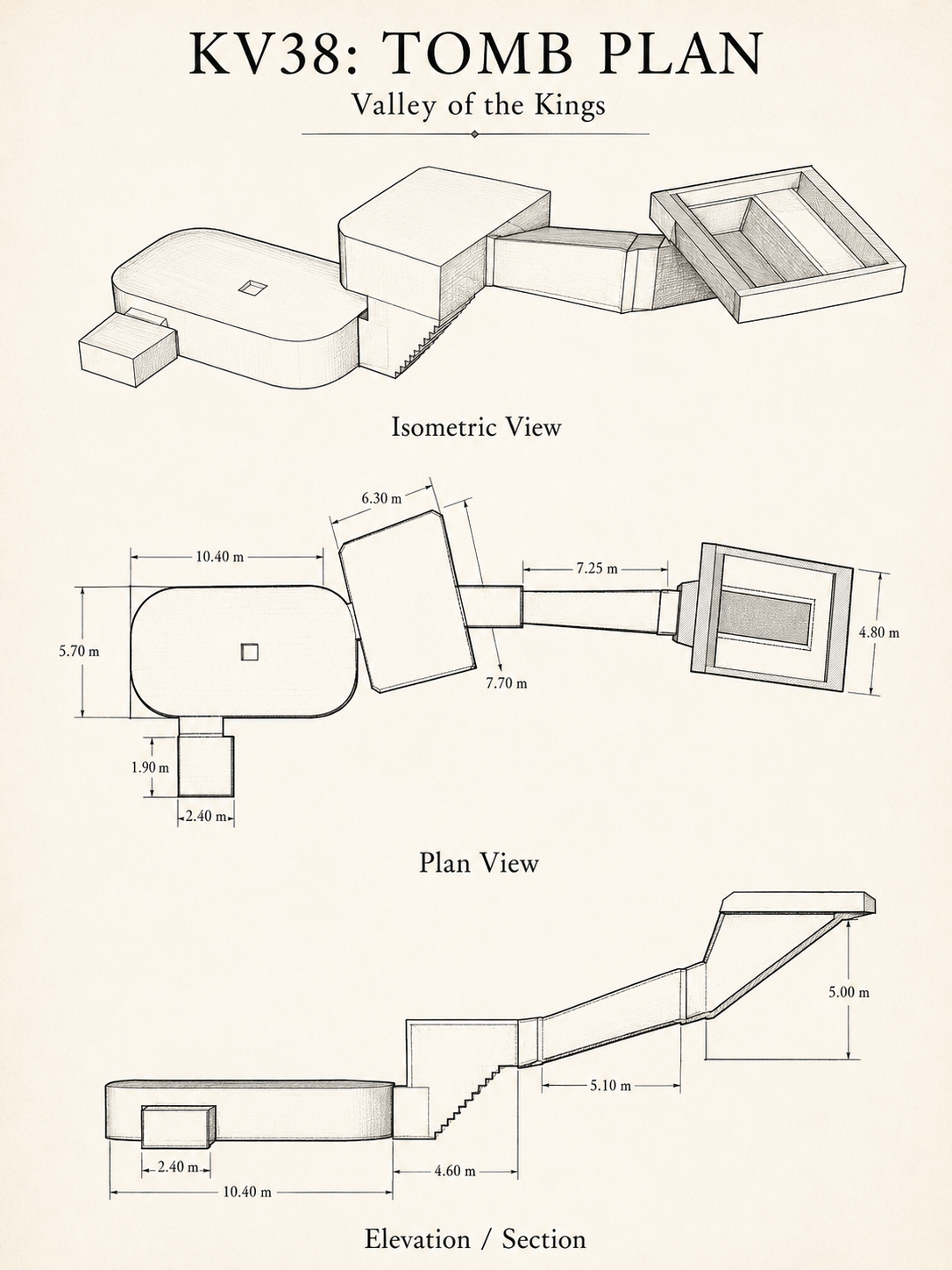
KV38 follows a relatively compact bent-axis plan. The tomb consists of:
- Entryway A
- Descending Corridor B
- Irregular Chamber C
- A steep central descent
- Burial Chamber J
- Side Chamber Ja
The route descends from the entrance through a corridor whose walls are somewhat irregular. Corridor B gradually curves toward the left before reaching Chamber C.
Chamber C is wider than it is long and was roughly excavated. A steep staircase cuts downward through the center of its floor. Near the bottom, the staircase becomes a sharply sloping ramp leading toward the burial chamber.
At the bottom lies the large royal burial chamber, designated J. A small side chamber, Ja, opens from its southern wall.
The layout is much simpler than the increasingly elaborate royal tombs built later in the Eighteenth Dynasty, but several architectural features anticipate developments visible in KV34 and other royal monuments.
Measurements
- Maximum Height: 2.64 m
- Minimum Width: 1.22 m
- Maximum Width: 5.78 m
- Total Length: 37.31 m
- Total Area: 133.16 m²
- Total Volume: 207.77 m³
- Axis: Approximately 284.07°
- Axis Orientation: West
These dimensions emphasize how compact KV38 is compared with later royal tombs. Despite its modest overall length, the burial chamber is disproportionately large and forms the monument’s architectural focus.
The Burial Chamber
The burial chamber is the most important room in KV38. It measures approximately 10.47 meters long, 5.43 meters wide, and 2.64 meters high. Its outline has rounded ends, giving it the form commonly described as cartouche-shaped.
A royal cartouche was the elongated oval used to surround and protect the names of kings. Similar rounded burial chambers appear in other early Eighteenth Dynasty royal tombs, including KV34. Victor Loret recorded a single square pillar standing near the center of the burial chamber. The pillar has since disappeared, leaving little visible trace, but the original excavation records document its existence.
At the far end stood Thutmose I’s quartzite sarcophagus. His canopic chest was positioned nearby.
The arrangement established the burial chamber as a carefully organized sacred space centered on the king’s body and the equipment required for his transformation in the afterlife.
Side Chamber Ja
A single small side chamber opens from the southern wall of the burial chamber. Chamber Ja is roughly trapezoidal and measures approximately 2.47 meters wide, 1.99 meters long, and 1.47 meters high.
The chamber probably held funerary equipment, storage vessels, provisions, or other objects accompanying Thutmose I’s reburial.
Eighteenth Dynasty pottery fragments were found scattered across its floor.
The room has suffered severe structural damage. Flooding and water infiltration weakened the walls and ceiling, and portions of the doorway and surrounding rock have collapsed.
The Sarcophagus of Thutmose I
One of the most important discoveries inside KV38 was a yellow quartzite sarcophagus bearing the name of Thutmose I. Its presence securely connects the tomb to the king, whether KV38 was his first burial place or a later reburial tomb.
The sarcophagus found in KV38 should not be confused with another sarcophagus associated with Thutmose I from KV20.
Hatshepsut originally commissioned that earlier quartzite sarcophagus for herself. She later had its inscriptions altered so that it could be used for her father. The existence of two sarcophagi for Thutmose I is one of the strongest pieces of evidence that his body was moved between tombs.
The sarcophagus from KV38 appears to belong to a later phase of Thutmose I’s burial history, probably connected with his reinterment by Thutmose III.
New Sarcophagus Fragments Found in KV38
Modern excavations have produced additional evidence directly connecting Thutmose I with the burial chamber. During recent debris clearance from the floor, Khaled Abdel Ghany’s team discovered two quartzite fragments inscribed with Thutmose I’s throne name, Aakheperkare, enclosed within a cartouche.
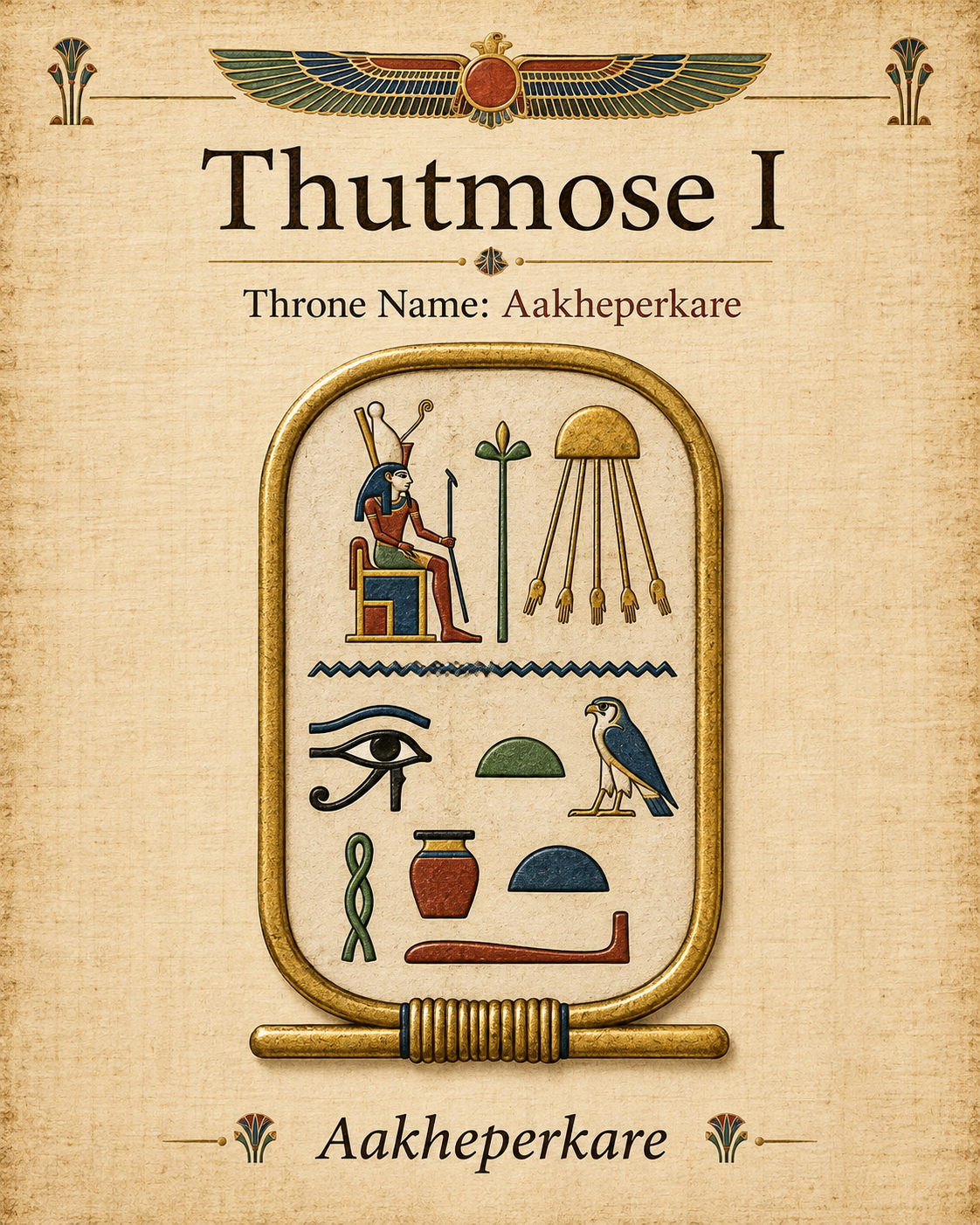
The researchers believe these pieces probably belonged to the king’s original sarcophagus in KV38. Their survival beneath the accumulated rubble demonstrates that KV38 still contains archaeological evidence overlooked during earlier excavations.
The discovery also highlights why renewed investigation of tombs excavated more than a century ago can still produce important results.
Canopic Equipment
Fragments associated with royal canopic equipment were also discovered in KV38. Among the finds was an alabaster canopic-jar lid carved in the form of a royal head. A broken uraeus originally decorated the forehead. The lid measures approximately 12 centimeters in diameter and 13.5 centimeters high.
Canopic vessels held internal organs removed during mummification and placed under divine protection.
A canopic chest was also associated with Thutmose I’s burial in KV38. Together with the sarcophagus, these objects demonstrate that KV38 received genuine royal funerary equipment rather than simply functioning as a symbolic memorial.
Stone and Glass Vessels
Other objects recovered from KV38 included a fragmentary alabaster vessel bearing the cartouches of Thutmose I. Researchers also found fragments of dark blue and pale blue glass vessels. Its presence among royal funerary equipment reflects the resources available to the court. Most original burial furnishings were removed or destroyed by ancient robbers, so these surviving fragments represent only a small portion of what once filled the tomb.
Decoration
Unlike the richly painted royal tombs of later periods, very little decoration remains attached to the walls of KV38. The burial chamber preserves traces of discolored plaster and remnants of a decorative kheker frieze close to the ceiling. More importantly, fragments discovered within the tomb preserve scenes and texts from the Amduat.
The surviving evidence now indicates that KV38 originally contained a much more substantial religious decorative program than the damaged walls might suggest today. Water infiltration, flooding, salt, bats, collapse, ancient robbery, and early excavation all contributed to the destruction and dispersal of that decoration.
What Is the Amduat?
The Amduat, meaning approximately “That Which Is in the Underworld,” is one of the most important royal funerary compositions of the New Kingdom.
It describes the sun god Ra’s twelve-hour nighttime journey through the underworld. Each hour corresponds to a different region populated by gods, spirits, serpents, gates, mysterious beings, enemies, and divine powers.
During the night, the sun god enters the western horizon, travels through darkness, encounters Osiris and the underworld’s regenerative forces, defeats the forces of chaos, and finally emerges reborn in the east at dawn.
For a deceased pharaoh, the text offered both knowledge and participation. By knowing the geography and inhabitants of the underworld, the king could accompany Ra and share in his eternal cycle of death and rebirth.
KV38 is now central to understanding how this tradition began.
The Limestone Amduat Slabs
When Victor Loret cleared KV38 in 1899, workers discovered fragments of limestone slabs inscribed and illustrated with portions of the Amduat.
Workers removed the surviving pieces from the tomb, and they eventually entered the Egyptian Museum in Cairo. Researchers reconstructed portions of the composition from 17 limestone slabs.
The slabs were in poor condition after prolonged exposure to salt, dirt, bat habitation, urine, and other contaminants. Recent conservation work cleaned the surfaces and allowed researchers to reconstruct the fragments in the correct sequence.
For decades, Egyptologists debated whether all of these fragments truly belonged to KV38 or whether some had originally come from KV20. Recent archaeological work has significantly changed that discussion.
The 2016 Discovery
In 2016, Khaled Abdel Ghany discovered another group of Amduat fragments inside the burial chamber of KV38. Unlike the limestone slabs removed by Loret, these scenes were painted on fragments of mud plaster that had once formed part of the decorated walls of the burial chamber.
The fragments demonstrated that the Amduat was not represented only on movable limestone panels. Portions of the composition had also decorated the actual walls of KV38.
The fragments were heavily damaged by rainwater entering the tomb. Many were covered with dirt and mineral deposits, making their scenes difficult to recognize before conservation.
Researchers gradually cleaned and reassembled them, revealing additional portions of the ancient composition.
The 2023 Discoveries
Further excavation and conservation work in early 2023 produced still more Amduat fragments. Conservators were able to join small pieces and reconstruct imagery belonging to the eighth hour of the Amduat.
Another major discovery occurred on the northern side of the burial chamber, where archaeologists recovered a large limestone funerary slab measuring approximately 45 by 38 centimeters.
The slab preserves part of the second hour of the Amduat. Researchers determined that it joins material originally recovered by Victor Loret more than a century earlier and now held in Cairo.
This archaeological connection provided important evidence for reconstructing the original location and sequence of the fragments.
The Oldest Known Royal Amduat
A comparative study of the KV38 material with the more complete Amduat in KV34, the tomb of Thutmose III, revealed significant differences in iconography and writing. According to Khaled Abdel Ghany’s research, the KV38 version preserves archaic characteristics that precede the version used by Thutmose III. The study identifies it as the oldest known version of royal Amduat funerary literature from the New Kingdom.
This is particularly important because KV34 was long famous for containing the earliest complete version of the Amduat. KV38 now provides evidence for an earlier stage in the development of the text.
Rather than presenting a fully standardized composition, the surviving fragments allow Egyptologists to see how one of ancient Egypt’s greatest funerary books developed before reaching the form preserved under Thutmose III.
Did the Amduat Come From KV20 or KV38?
This question has generated considerable scholarly debate.
Fragments resembling the KV38 limestone panels were also associated with KV20, the tomb shared by Hatshepsut and Thutmose I. Because Thutmose I’s burial equipment had been moved, scholars questioned whether the panels originally belonged to KV20 and were later transferred, or whether fragments from multiple periods had become mixed.
Recent research argues that the Amduat fragments under investigation originate from a single burial tradition associated with Thutmose I and KV38.
The newly recovered second-hour slab physically corresponds with pieces excavated by Loret in KV38. Combined with the plaster fragments still within the tomb, researchers concluded that the Amduat was already known in Thutmose I’s time and that the material represents one early royal version rather than unrelated compositions from two different reigns.
The broader question of KV20 and KV38’s architectural sequence remains more complicated.
KV20 Versus KV38
Few tombs in the Valley of the Kings have generated as much disagreement over ownership and chronology as KV20 and KV38. Both contain evidence associated with Thutmose I.
KV20 also contains material belonging to Hatshepsut, while KV38 contains a sarcophagus and funerary equipment naming Thutmose I.
Earlier interpretations sometimes suggested that Thutmose I was originally buried in KV38, moved into KV20 by Hatshepsut, and then returned to KV38 by Thutmose III.
Architectural research later challenged that sequence. John Romer’s influential study argued that KV38 resembles the tomb of Thutmose III closely enough that it probably dates to Thutmose III’s reign. Under this interpretation, KV38 did not yet exist when Thutmose I died.
Was KV20 Thutmose I’s First Tomb?
One widely accepted reconstruction proposes that Thutmose I was originally buried in KV20.
Hatshepsut later enlarged KV20 to create a burial complex that could accommodate both herself and her father. She commissioned new funerary equipment for him, including the repurposed quartzite sarcophagus bearing her dedication.
After Hatshepsut died and Thutmose III became sole ruler, Thutmose I was removed from KV20 and reburied in KV38.
In this interpretation, KV38 was deliberately created or completed as a separate resting place for Thutmose III’s grandfather.
There is still scholarly disagreement over aspects of this reconstruction, especially concerning Thutmose I’s earliest burial. Some researchers have proposed that an even earlier tomb commissioned by the official Ineni may remain undiscovered.
Why Would Thutmose III Move His Grandfather?
If Thutmose III commissioned KV38 specifically for Thutmose I, the transfer was unlikely to have been a casual decision. Thutmose I was an important dynastic ancestor. Both Hatshepsut and Thutmose III derived legitimacy from their connection with him.
Separating Thutmose I from Hatshepsut’s burial could have emphasized Thutmose III’s own relationship with his grandfather and restored the older king to an independent royal tomb. The architectural similarities between KV38 and Thutmose III’s KV34 may reflect that relationship.
However, political interpretations must remain cautious. The transfer could also have been motivated by practical concerns, religious beliefs, security, or the desire to give Thutmose I a more appropriate independent royal burial.
The Architecture and KV34
KV38 and KV34 share several architectural characteristics. Both use:
- A bent underground route
- An intermediate chamber
- A steep descent
- A large royal burial chamber
- Cartouche-like burial chamber forms
- Amduat decoration
The similarities are one reason scholars have argued that KV38 was constructed or substantially remodeled during Thutmose III’s reign rather than during the earlier reign of Thutmose I.
KV38, however, is smaller and considerably rougher than KV34.
Whether this reflects rushed construction, difficult geology, adaptation of an existing tomb, or its function as a reburial monument remains uncertain.
Ancient Robbery
KV38 was robbed in antiquity. Thieves broke into the burial and removed valuable funerary equipment, jewelry, precious metals, and other objects. The king’s sarcophagus was damaged, while portable burial goods disappeared. By the time the tomb was discovered in modern times, Thutmose I’s mummy was no longer present.
The widespread robbery of royal tombs near the end of the New Kingdom eventually led Egyptian priests to remove many royal bodies from their original tombs and hide them elsewhere for protection.
What Happened to Thutmose I’s Mummy?
Thutmose I’s body did not remain permanently in KV38. During the late New Kingdom or early Third Intermediate Period, priests removed royal mummies from vulnerable tombs and reorganized their burials.
A mummy traditionally identified as Thutmose I was eventually discovered in the great royal cache at Deir el-Bahari, DB320, which was officially revealed in 1881. However, the identification of that anonymous mummy as Thutmose I has been questioned, and the king’s body cannot currently be considered identified with complete certainty.
This means that Thutmose I’s burial history may have involved several moves:
- An original burial, possibly in KV20 or another early tomb
- Burial or reburial with Hatshepsut in KV20
- Reburial in KV38
- Removal from KV38 during the royal mummy rescue operations
- Transfer to a protective cache
Few Egyptian kings illustrate the complicated afterlife of royal mummies more clearly.
Discovery by Victor Loret
Victor Loret discovered KV38 in 1899 while serving as director of Egypt’s Antiquities Service. John Gardner Wilkinson had already suggested as early as 1835 that a tomb might exist in this part of the Valley, but Loret was the first modern excavator to enter and clear it.
Loret’s excavations revealed:
- The quartzite sarcophagus of Thutmose I
- Canopic equipment
- Stone vessels
- Glass fragments
- Eighteenth Dynasty pottery
- Limestone slabs containing portions of the Amduat
- Remains of wall decoration
The discovery added another major royal tomb to Loret’s remarkable series of late nineteenth-century finds in the Valley of the Kings.
Howard Carter’s Work in 1919
Howard Carter returned to KV38 in 1919. His work concentrated partly on the area surrounding the entrance. Carter recovered uninscribed foundation deposits outside the tomb.
Foundation deposits were ceremonial groups of objects placed during the construction of important monuments. When inscribed, they can provide exceptionally useful evidence for identifying the person who commissioned a tomb.
Unfortunately, the KV38 deposits carried no royal name, so they did not settle the debate over exactly when or for whom construction began.
Modern Rediscovery Inside an Already Excavated Tomb
One of the most remarkable aspects of KV38 is that major discoveries have continued more than a century after Loret and Carter. In 2016, researchers found previously undocumented Amduat plaster fragments.
Additional excavation between 2022 and 2023 recovered:
- More painted plaster fragments
- Amduat imagery from the eighth hour
- Two quartzite fragments bearing Thutmose I’s throne name
- A major limestone Amduat slab from the second hour
These finds show that “excavated” does not necessarily mean “completely understood.”
Modern excavation methods allow researchers to recover information from small fragments, deposits, and archaeological relationships that early explorers could easily overlook.
Conservation of the Amduat Fragments
A major recent conservation project has focused on the fragile Amduat material from KV38.
The limestone panels suffered from:
- Salt efflorescence
- Dirt deposits
- Bat habitation
- Bat urine
- Bird excrement
- Moisture
- Surface deterioration
Conservators cleaned the surfaces and reassembled fragments so that portions of the Amduat could once again be read in their correct order.
The mud-plaster fragments discovered inside KV38 presented different challenges. Rainwater had deposited layers of sediment across their surfaces and weakened the plaster. Careful cleaning and reconstruction revealed scenes that had been invisible beneath centuries of contamination.
Recent Research and the 2026 Update
Research into KV38 remains active.
The University of Göttingen reports that the conservation project investigating the earliest Amduat specimens has continued beyond the initial 2022–2023 work. The project reconstructed and conserved major portions of the early funerary texts while refining the chronology of KV20 and KV38.
As of 2026, a second phase focusing on the conservation and publication of funerary objects from Thutmose I’s KV38 held in the Egyptian Museum at Tahrir Square is being prepared.
This means KV38 is not simply an old archaeological discovery. It remains an active research site whose evidence is continuing to reshape our understanding of early royal burial practices.
Flooding and Water Damage
Water has caused extensive damage inside KV38. The entrance now lies substantially below the surrounding ground level, allowing rainwater to enter more easily.
Infiltrating water has affected:
- Burial chamber plaster
- Amduat fragments
- Walls and ceilings
- Side Chamber Ja
- Doorways
- Rock surfaces
The major floods of 1994 worsened structural damage around the entrance to Side Chamber Ja, where parts of the lintel and door jambs collapsed. The tomb’s current appearance therefore reflects not only ancient construction and robbery but also centuries of environmental deterioration.
Site Condition
KV38 is in relatively poor condition compared with several better-preserved royal tombs. The passages are roughly cut, portions of ceilings have collapsed, and water damage has severely affected the burial chamber. Very little original decoration remains attached to the walls. However, the tomb continues to produce important archaeological material from deposits beneath rubble and from fragments that can now be reconstructed using modern conservation techniques. The tomb is not normally open to visitors.
Objects Recovered
Objects and archaeological material associated with KV38 include:
- Yellow quartzite sarcophagus of Thutmose I
- Quartzite sarcophagus fragments bearing his throne name
- Canopic chest
- Royal canopic-jar lid
- Alabaster vessel fragments
- Vessel bearing Thutmose I’s cartouches
- Dark and pale blue glass fragments
- Eighteenth Dynasty pottery
- Limestone Amduat slabs
- Painted mud-plaster Amduat fragments
- Foundation deposits
- Fragments of original wall decoration
The survival of both funerary equipment and religious texts securely establishes KV38 as a royal burial associated with Thutmose I.
Noteworthy Features
KV38 is notable for several reasons:
- It was used for the burial or reburial of Thutmose I.
- Victor Loret discovered it in 1899.
- Howard Carter investigated the tomb in 1919.
- The tomb has a bent-axis plan.
- Its burial chamber has a cartouche-like form.
- A single pillar originally stood in the burial chamber.
- The yellow quartzite sarcophagus bears Thutmose I’s name.
- Canopic equipment and vessels belonging to the king were recovered.
- The burial chamber contained portions of the Amduat.
- New Amduat plaster fragments were discovered in 2016.
- Additional fragments were recovered during work in 2023.
- The Amduat material appears older than the version in Thutmose III’s KV34.
- Researchers describe it as the oldest known royal Amduat version of the New Kingdom.
- Two newly recovered quartzite fragments bear Thutmose I’s throne name.
- The relationship between KV38 and KV20 remains a major Egyptological question.
- KV38 was probably used to reinter Thutmose I after his removal from KV20.
- The tomb has suffered severe water and flood damage.
- Modern conservation and archaeological work is still continuing.
Additional Tomb Information
Owner Type: King
Owner: Thutmose I
Entrance Type: Descending passage
Interior Layout: Corridors, chamber, steep descent, burial chamber, and side room
Axis Type: Bent
Axis: Approximately 284.07°
Axis Orientation: West
Decoration: Amduat and kheker frieze in the burial chamber
Principal Period: Eighteenth Dynasty
Public Access: Closed
Dating
KV38 is associated with several stages of the Eighteenth Dynasty burial history:
- Reign of Thutmose I: Earliest funerary material and Amduat tradition
- Reign of Hatshepsut: Thutmose I associated with the expanded burial in KV20
- Reign of Thutmose III: Probable construction, enlargement, or use of KV38 for the reburial of Thutmose I
- Late New Kingdom: Robbery and disturbance
- Third Intermediate Period: Probable removal of Thutmose I’s mummy for protection
- 1899: Discovery and excavation by Victor Loret
- 1919: Excavation by Howard Carter
- 2016: Discovery of additional Amduat plaster fragments
- 2022–2023: Renewed excavation and conservation
- 2026: Further conservation and publication work in preparation
The exact architectural sequence remains debated, especially when distinguishing the date of Thutmose I’s funerary material from the date when KV38 itself was cut or completed.
History of Exploration
- John Gardner Wilkinson, 1835: Suggested that a tomb existed in the area
- Victor Loret, 1899: Discovery and excavation
- Georges Daressy, early twentieth century: Publication and cataloguing of finds
- Howard Carter, 1919: Further excavation and discovery of uninscribed foundation deposits
- Khaled Abdel Ghany, 2016: Discovery of previously undocumented Amduat plaster fragments
- ARCE and University of Göttingen project, 2022–2023: Conservation, archaeological investigation, and reconstruction
- 2023: Discovery of additional Amduat and quartzite fragments
- 2026: Further conservation and publication phase being prepared
Why KV38 Matters
KV38 sits at the beginning of one of the most important traditions in Egyptian royal burial.
The monument belongs to the period when the early Eighteenth Dynasty kings were developing a completely new way of imagining and constructing the royal afterlife. The king was no longer buried beneath a giant pyramid visible for miles. His body was hidden within the cliffs, while the underground chambers themselves became a sacred model of the world beyond death.
KV38 also preserves the beginnings of the great royal underworld books. Its Amduat fragments show that the detailed twelve-hour journey of the sun through the night was already developing in the time of Thutmose I. Later kings would expand this tradition until entire royal tombs were covered with elaborate maps, divine figures, gates, caverns, serpents, solar boats, and texts describing the mysteries of rebirth.
The tomb is equally important for understanding the Thutmosid royal family. Thutmose I’s body appears to have become part of a complicated sequence of burials and reburials involving his daughter Hatshepsut and grandson Thutmose III. His physical remains, sarcophagi, canopic equipment, and funerary texts were moved and renewed as later generations reinterpreted his place within the dynasty.
More than 125 years after Victor Loret entered KV38, archaeologists are still finding pieces of that story.
Interesting Facts About KV38
- KV38 belonged to Thutmose I.
- It was discovered by Victor Loret in 1899.
- The tomb contains a bent-axis plan.
- Its burial chamber is approximately cartouche-shaped.
- A single pillar originally stood in the burial chamber.
- Thutmose I’s quartzite sarcophagus was found inside.
- The tomb also contained royal canopic equipment.
- Fragments of blue glass vessels survived.
- The Amduat decorated the burial chamber.
- Seventeen limestone Amduat slabs have been studied and conserved.
- Previously unknown plaster fragments were discovered in 2016.
- Additional Amduat fragments were discovered in 2023.
- Some of the newly reconstructed material belongs to the eighth hour of the Amduat.
- A newly found limestone slab preserves part of the second hour.
- Two quartzite fragments bearing Thutmose I’s throne name were recovered beneath the burial chamber debris.
- Recent research identifies the KV38 Amduat as the oldest known royal version from the New Kingdom.
- KV38 may have been constructed by Thutmose III specifically to rebury his grandfather.
- Thutmose I had at least one other sarcophagus associated with KV20.
- The exact sequence of his burials continues to be debated.
- KV38 remains an active subject of archaeological and conservation research.
