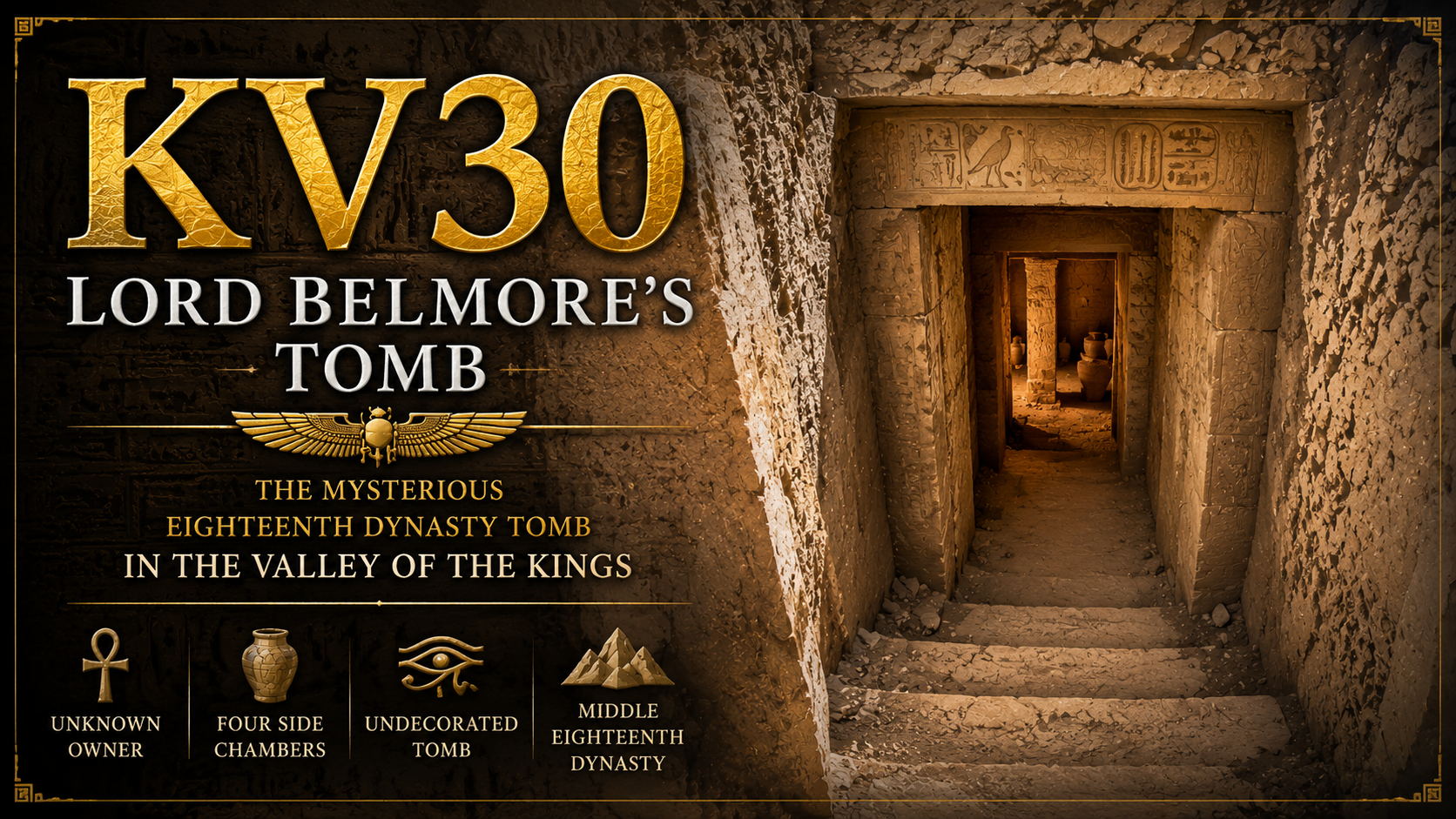
KV30 is one of the Valley of the Kings’ most mysterious non-royal tombs. Located in a side valley leading toward the tomb of Thutmose III, it consists of a deep entrance shaft, a corridor, a central chamber, and four surrounding side rooms.
No inscriptions, cartouches, or surviving funerary objects identify the person or people for whom the tomb was constructed. Its location and architectural style suggest it dates to the middle of the Eighteenth Dynasty, when members of the royal family, court officials, nurses, attendants, and other favored individuals were sometimes granted burial in the Valley of the Kings.
KV30 is also known as Lord Belmore’s Tomb because it was probably discovered in 1817 by Giovanni Battista Belzoni while he was working for Somerset Lowry-Corry, the second Earl Belmore. The tomb may have been the source of a stone sarcophagus later presented to the British Museum, although that connection cannot be proven and the sarcophagus may instead have come from nearby KV31.
Unlike many minor tombs that consist of a shaft and a single room, KV30 contains a relatively elaborate group of chambers. Its unusual plan suggests that it may have accommodated several burials, perhaps belonging to members of the same royal or elite household.
Structure: KV30
Location: Valley of the Kings, East Valley, Thebes West Bank, Luxor
Owner: Unknown
Other Designation: Lord Belmore’s Tomb
Probable Date: Middle Eighteenth Dynasty
Site Type: Undecorated shaft tomb
Public Access: Closed
KV30 lies in a small side valley that leads toward KV34, the tomb of Thutmose III. It is situated near several other tombs associated with the Middle Eighteenth Dynasty, including:
- KV26, an undecorated elite shaft tomb
- KV31, which contained the remains of five mummified individuals
- KV32, the tomb of Queen Tiaa
- KV34, the tomb of Thutmose III
- KV40, a large burial complex used by members of the royal household
- KV42, a royal-scale tomb associated with women and officials of the Thutmosid court
This concentration of royal and elite burials suggests that the area served as an important cemetery for people closely connected with the kings of the Eighteenth Dynasty.

KV30 begins with a vertical entrance shaft cut into the hillside.
At the bottom of the shaft, a short passage leads into Corridor B. This corridor runs approximately westward before opening into a broad, irregularly shaped central chamber designated Chamber C.
Four side chambers open from Chamber C:
- Chamber Ca, on the northern side
- Chamber Cb, also on the northern side
- Chamber Cc, on the western side
- Chamber Cd, on the southern side
This arrangement gives the tomb a roughly cross-shaped or radial plan, with burial rooms branching from a central space.
The architecture is irregular. The chambers are not perfectly rectangular, and several walls follow natural weaknesses or fault lines in the surrounding bedrock. The tomb plan records that part of a wall has fallen away along geological faults, while some elevations could not be determined.
The Entrance Shaft
The entrance to KV30 is a vertical shaft rather than a staircase.
Vertical shafts were frequently used for non-royal and elite burials during the Eighteenth Dynasty. Once the funeral was completed, the shaft could be filled or covered, concealing the entrance and making the underground chambers more difficult to reach.
The shaft descends to a level corridor rather than opening directly into the central chamber. This additional passage gave the tomb a more developed plan than many simpler shaft burials.
The eastern end of Corridor B includes an area marked as an unexcavated doorway on the surviving archaeological plan. This raises the possibility that an incompletely explored or blocked feature remains near the entrance, although it may simply represent an unfinished architectural element.
Chamber C
Chamber C forms the center of the tomb.
Rather than serving as the sole burial chamber, it acted as a connecting room from which four separate side chambers could be reached. This design may have allowed the tomb to receive multiple coffins and sets of funerary equipment.
The chamber is broad but irregular, with walls that curve or change direction slightly rather than forming a perfect rectangle.
No surviving decoration identifies how the room was used. It may have served as:
- An antechamber
- A shared burial space
- A location for funerary offerings
- A distribution point leading to separate burial rooms
Its central position suggests it played an important role in organizing the tomb.
The four subsidiary rooms are the most distinctive feature of KV30.
Chamber Ca
Chamber Ca opens from the northern side of Chamber C. It is roughly rectangular but slightly irregular in orientation. It may have contained a coffin, burial equipment, or an individual interment.
Chamber Cb
Chamber Cb lies beside Ca and also opens from the northern side of the central room. The presence of two adjacent chambers on this side may indicate that the tomb was enlarged as additional burial space became necessary.
Chamber Cc
Chamber Cc extends westward from Chamber C and lies approximately opposite the entrance corridor. Its position at the end of the tomb’s primary axis may have made it the principal burial chamber, although no surviving evidence confirms this interpretation.
Chamber Cd
Chamber Cd opens from the southern side of Chamber C. The archaeological plan shows a circular feature in the floor of this room. Its exact purpose is uncertain. It could represent a depression, a pit, a later disturbance, or an architectural feature recorded during mapping.
Because the tomb has not yielded a securely documented intact burial, the original functions of the four chambers remain unknown.
Was KV30 a Family Tomb?
KV30 may have been designed for multiple burials.
The central chamber and four surrounding rooms would have provided enough space for several coffins, funerary goods, and offerings. This suggests that KV30 served as a family tomb for members of the same elite household.
Possible occupants might have included:
- Royal relatives
- Princes or princesses
- Secondary royal wives
- Nurses of royal children
- High-ranking court officials
- Palace attendants
- Members of an official’s family
This interpretation is strengthened by the nearby discovery of collective elite burials in tombs such as KV31 and KV40. However, no inscription or securely associated artifact identifies anyone buried in KV30, so its original occupants remain entirely unknown.
Decoration
KV30 is undecorated. Its walls contain no surviving:
- Painted scenes
- Carved reliefs
- Funerary texts
- Cartouches
- Offering formulas
- Images of the deceased
- Representations of Egyptian gods
The absence of decoration was common in many elite shaft tombs within the Valley of the Kings. Religious protection could instead be provided through coffins, papyri, amulets, canopic equipment, statues, and other portable funerary objects.
Unfortunately, nearly all of KV30’s original contents were removed or destroyed before the tomb was properly documented.
Dating KV30
KV30 probably dates to the middle of the Eighteenth Dynasty. Its proposed date is based primarily on:
- Its location near tombs of the Thutmosid royal family
- Similarities to other elite shaft tombs
- Its multi-chamber architectural plan
- A pottery fragment reportedly dating to the Eighteenth Dynasty
The tomb is often associated broadly with the period between Thutmose III and Amenhotep III. No royal name or securely dated burial assemblage allows it to be assigned to a particular reign.
Discovery by Giovanni Battista Belzoni
KV30 was probably discovered in 1817 by Giovanni Battista Belzoni.
Belzoni was then working for Somerset Lowry-Corry, the second Earl Belmore. This association led to the tomb becoming known as Lord Belmore’s Tomb or Earl Belmore’s Tomb.
Belzoni was one of the most famous early explorers of the Valley of the Kings. In the same year, he discovered KV17, the magnificent tomb of Seti I.
Unfortunately, no detailed archaeological record of his work in KV30 survives. It is unclear how much of the tomb was excavated, what objects were found, or whether any human remains were encountered.
The absence of reliable records has made later interpretation extremely difficult.
The Belmore Sarcophagus
Lord Belmore acquired a stone sarcophagus, which he later presented to the British Museum. Some have suggested that this sarcophagus came from KV30, which would explain why the monument became so closely associated with Belmore. However, nearby KV31 has also been proposed as its place of discovery.
The original archaeological context was not clearly recorded, so it is unclear which tomb it belonged to.
This uncertainty matters because the sarcophagus could provide evidence about the tomb’s occupant’s status or identity. Without a secure provenance, however, it cannot be used confidently to identify KV30’s owner.
James Burton and Victor Loret
James Burton visited KV30 during the nineteenth century and prepared one of the early records of its architecture.
Victor Loret later surveyed the tomb during his work in the Valley of the Kings in 1898. Loret assigned numbers to many monuments that had been known earlier but lacked standardized designations.
These early plans helped preserve information about KV30, but neither investigator conducted a fully documented archaeological excavation.
The Theban Mapping Project later recorded the tomb’s layout, including the corridor, central chamber, four side rooms, axis, elevation, and visible structural damage.
University of Basel Investigation
The University of Basel Kings’ Valley Project examined KV30 during its work in the area in 2009 and 2010.
The project photographed and documented the tomb, which had received very little modern archaeological attention. KV30 was considered one of two tombs, along with KV31, possibly explored by Belzoni on behalf of Lord Belmore.
The work improved the monument’s archaeological record, but it did not reveal the owner’s name or provide a complete reconstruction of its original burials.
Objects Recovered
Very little securely documented material is associated with KV30. Reported finds include:
- A pottery fragment dating to the Eighteenth Dynasty
- Possible burial debris
- Material left from early excavation
- Architectural debris
- Limestone fragments
No securely recorded coffins, human remains, jewelry, canopic vessels, or inscribed objects can be assigned confidently to the tomb.
The scarcity of finds may result from:
- Ancient robbery
- Removal by early explorers
- Poor nineteenth-century documentation
- Flood damage
- Incomplete modern excavation
Ancient Robbery
KV30 was probably robbed in antiquity. The open chambers contained no intact burial assemblage when modern explorers recorded them. Coffins, mummies, jewelry, amulets, vessels, and other valuable objects had either been removed or destroyed.
If the tomb contained multiple burials, ancient thieves may have entered repeatedly and stripped each interment of valuables.
The lack of surviving human remains may also reflect early modern excavation, during which mummies and bones were sometimes removed without detailed documentation.
Flooding and Geological Damage
KV30 has experienced significant natural deterioration.
The tomb lies in a side wadi where rainwater can gather during rare but violent storms. Floodwater may have entered through the shaft, carrying mud, stones, and debris into the underground rooms.
The archaeological plan records that part of the structure has fallen away along natural fault lines. Several walls are irregular, and some elevation data could not be recorded due to damage.
Geological weaknesses may also explain why the chambers were left rough or irregular. Ancient builders often adjusted tomb plans when they encountered fractured or unstable stone.
Noteworthy Features
KV30 is notable for several reasons:
- Its original owner remains unknown.
- It is also called Lord Belmore’s Tomb.
- It was probably discovered by Belzoni in 1817.
- It likely dates to the Middle Eighteenth Dynasty.
- A vertical shaft leads to a corridor and central chamber.
- Four side chambers open from the central room.
- Its plan may indicate that it was intended for multiple burials.
- No wall decoration survives.
- The source of the so-called Belmore sarcophagus remains uncertain.
- The tomb has been damaged along geological fault lines.
- An unexcavated doorway or unfinished feature is marked near its entrance.
- The University of Basel documented the tomb in 2009 and 2010.
Site Information
- Structure: KV30
- Owner: Unknown
- Location: East Valley of the Kings
- Probable Period: New Kingdom, Eighteenth Dynasty
- Entrance Type: Vertical shaft
- Interior Layout: Shaft, corridor, central chamber, and four side chambers
- Axis: 261° 33′ 07″
- Axis Orientation: West
- Elevation: 186.690 m above sea level
- North: 99,389.758
- East: 94,056.741
- Decoration: None
- Public Access: Closed
These measurements and coordinates are shown on the Theban Mapping Project plan for KV28, KV29, and KV30.
Dating
KV30 was probably used during the following periods:
- New Kingdom, Middle Eighteenth Dynasty: Construction and original burial use
- Ancient period: Robbery and possible disturbance
- Nineteenth century: Discovery and early exploration
- Modern period: Mapping, photography, and archaeological documentation
History of Exploration
- Giovanni Battista Belzoni, 1817: Probable discovery and excavation for the second Earl Belmore
- James Burton, 1825: Visit and architectural recording
- Victor Loret, 1898: Survey and documentation
- Theban Mapping Project: Modern planning and structural recording
- University of Basel Kings’ Valley Project, 2009–2010: Photographic and archaeological documentation
Conservation History
Modern work has focused on recording the tomb’s architecture and assessing its condition. Because KV30 contains no surviving wall paintings, conservation priorities center on:
- Stabilizing weakened rock
- Monitoring faults and cracks
- Protecting the entrance shaft
- Preventing unauthorized entry
- Limiting future flood damage
- Preserving any remaining archaeological deposits
Site Condition
KV30 has been affected by ancient robbery, geological faults, natural deterioration, and poorly documented early exploration.
Some walls and sections of the tomb have collapsed or fallen away. The chambers remain identifiable, but their rough surfaces and irregular outlines reflect both ancient construction and later damage.
The tomb is closed to the public.
Why KV30 Matters
KV30 provides important evidence that the Valley of the Kings was not reserved exclusively for reigning pharaohs.
Its relatively elaborate multi-chamber plan suggests that its owner possessed considerable wealth and status. The monument may have accommodated several related individuals, creating a small family mausoleum within the royal necropolis.
KV30 also illustrates the difficulties created by early archaeology. Because Belzoni’s work was poorly recorded, objects possibly removed from the tomb can no longer be connected securely with it. The debated origin of the Belmore sarcophagus is a clear example of how missing archaeological context can prevent confident identification.
Although KV30 contains no famous mummy, treasure, or painted decoration, its anonymous chambers preserve the story of people important enough to rest among Egypt’s kings but whose names have disappeared from history.
Interesting Facts About KV30
- KV30 is commonly called Lord Belmore’s Tomb.
- It was probably discovered by Giovanni Belzoni in 1817.
- Its original owner remains unidentified.
- It may have been a collective or family burial.
- The tomb contains four side chambers surrounding a central room.
- No wall decoration or identifying inscription survives.
- It probably dates to the Middle Eighteenth Dynasty.
- A sarcophagus presented to the British Museum may have come from KV30 or KV31.
- Part of the tomb has collapsed along geological fault lines.
- An unexcavated doorway is marked near its entrance.
- The tomb was documented by the University of Basel in 2009 and 2010.
- It remains closed to visitors.