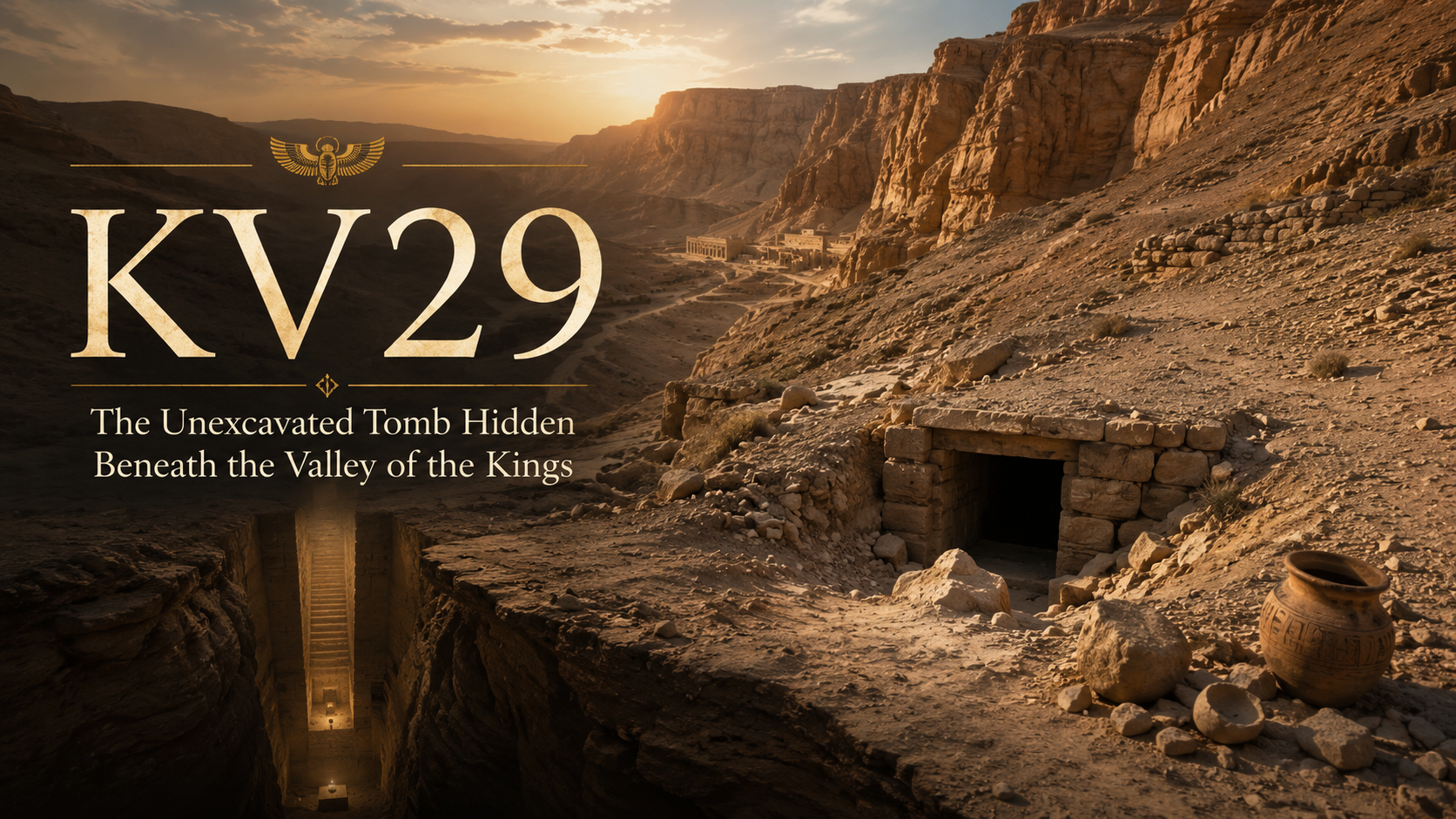
KV29 is one of the least understood tombs in the Valley of the Kings. Known to early Egyptologists since the nineteenth century, the monument remained almost entirely unexplored until archaeologists from the University of Basel began excavating its entrance shaft in 2011.
The tomb consists of a deep vertical shaft leading to at least one underground chamber. However, that room remains packed with debris, preventing archaeologists from determining its complete dimensions or discovering whether additional chambers lie beyond it. No inscriptions have been found to identify the owner, and it remains uncertain whether KV29 ever received a burial.
Its location near several tombs associated with the middle of the Eighteenth Dynasty suggests that it may have been constructed for a member of the royal family or another highly privileged person connected with the court. Nearby monuments include KV34, the tomb of Thutmose III; KV32, the tomb of Queen Tiaa; and KV42, which was associated with royal women and later funerary equipment belonging to court officials.
KV29 therefore represents a rare archaeological mystery within the Valley of the Kings: a numbered tomb whose interior plan, original date, owner, and contents remain almost completely unknown.
- Structure: KV29
- Location: Valley of the Kings, East Valley, Thebes West Bank, Luxor
- Owner: Unknown
- Possible Date: Middle Eighteenth Dynasty
- Site Type: Shaft tomb
- Decoration: Unknown
- Public Access: Closed
KV29 lies in a small side valley leading toward KV34, the tomb of Thutmose III. It is situated among a group of tombs generally associated with the royal family and court of the Middle Eighteenth Dynasty.
Nearby tombs include:
- KV30, an undecorated shaft tomb probably dating to the Eighteenth Dynasty
- KV31, which contained the remains of five elite individuals
- KV32, the tomb of Queen Tiaa
- KV34, the tomb of Thutmose III
- KV42, a royal-scale tomb later associated with Sennefer and Senetnay
This concentration of royal and elite burials suggests that the side valley served as an important cemetery during the Thutmosid Period.
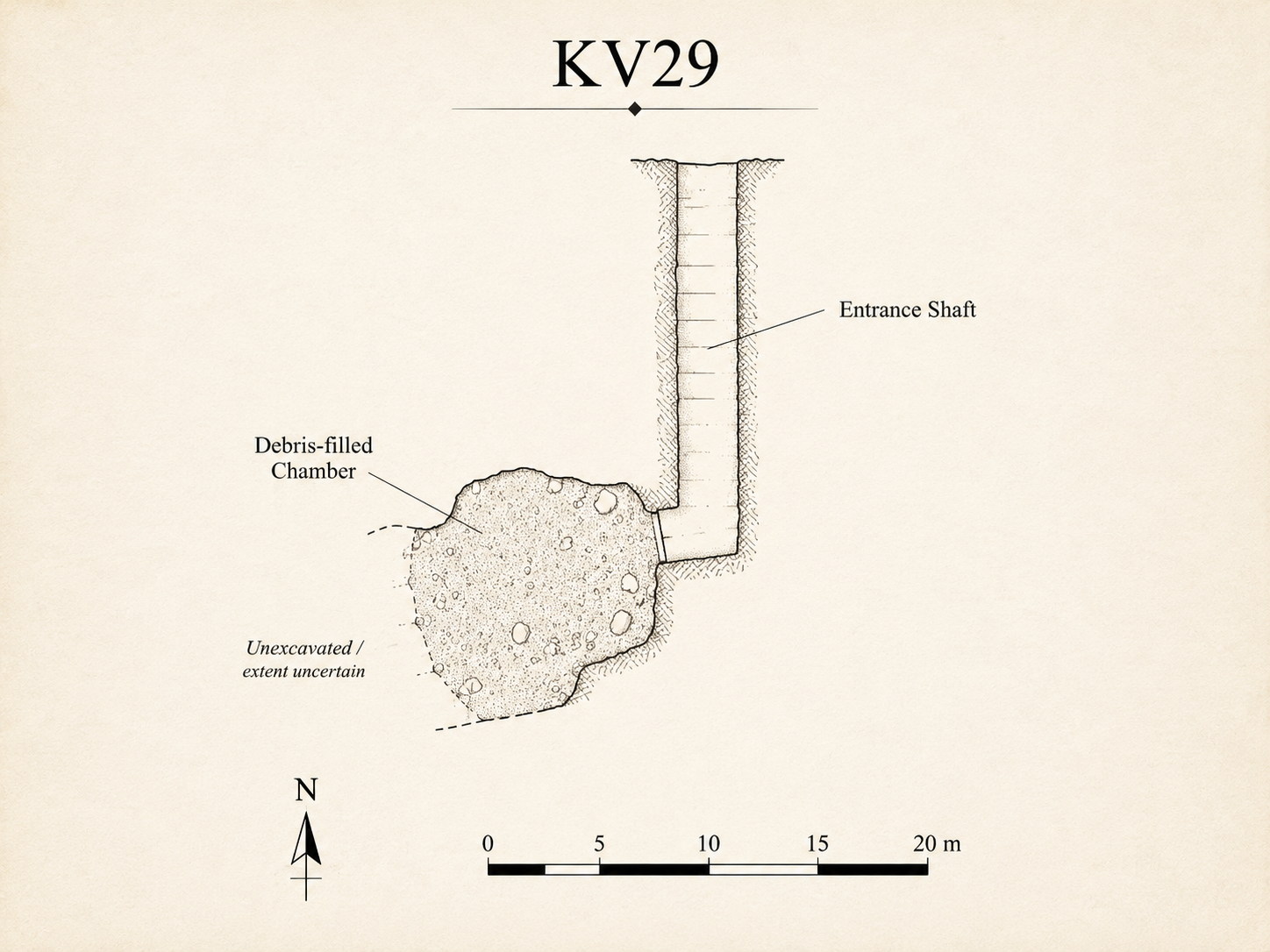
Only a small part of KV29 has been explored.
The tomb begins with a vertical shaft approximately nine meters, or 30 feet, deep. At the bottom, the shaft opens westward into an underground room. That chamber remains almost completely filled with debris.
Because the debris rises high inside the room, archaeologists have not yet been able to determine:
- The chamber’s full dimensions
- Whether it was finished
- Whether side rooms open from it
- Whether a burial was ever placed inside
- Whether decoration or inscriptions survive beneath the fill
- Whether the tomb extends farther into the hillside
A telescoping camera and flashlights were used to inspect the chamber during the 2016 excavation season, but debris concealed the lower walls and any possible doorways.
The Entrance Shaft
The entrance to KV29 is a vertical shaft cut directly into the bedrock.
When excavation began in 2011, approximately half of the shaft was filled with modern material and sediment deposited during the severe 1994 floods. Deeper layers contained clean debris washed into the tomb during earlier flood events.
The lowest three meters of the shaft were packed with hardened limestone chips. This material may have originated from ancient tomb cutting, later clearing operations, or debris carried into the opening after it was abandoned.
The shaft’s depth indicates that KV29 was more than a simple surface pit. Its builders intended to create a protected underground burial space similar to other elite shaft tombs of the Eighteenth Dynasty.
What Lies Beneath the Debris?
The greatest mystery of KV29 is the chamber at the bottom of the shaft.
Archaeologists know that the shaft opens into a room on its western side, but the interior remains too full of debris for complete excavation or mapping. The chamber may be a single burial room similar to other small tombs in the area, or it may provide access to a more extensive complex.
Several possibilities remain:
- KV29 may contain one simple burial chamber.
- Additional side chambers may be hidden behind the debris.
- The tomb may have been abandoned before construction was completed.
- The chamber may contain disturbed funerary material or human remains.
- The tomb may never have been used for burial.
Until the underground room is cleared, the true plan of KV29 will remain unknown.
Was KV29 Ever Completed?
There is currently no conclusive evidence that KV29 was completed or occupied.
Only a few archaeological objects have been recovered from the shaft, and none names an owner. The limited finds do not prove whether the chamber below once contained a coffin or mummy.
The monument may have been abandoned because:
- Its intended owner died before construction progressed
- The burial was transferred to another tomb
- Workmen encountered unsuitable rock
- Political or administrative changes interrupted construction
- The tomb was cleared or robbed before surviving records were made
The monument’s rough, debris-filled state prevents archaeologists from distinguishing among these possibilities.
Dating KV29
KV29 has not been securely dated through inscriptions or diagnostic burial equipment.
Its likely date is based mainly on its position among tombs associated with the Middle Eighteenth Dynasty. These include monuments connected with Thutmose III, Amenhotep II, Thutmose IV, and members of their royal household.
The Theban Mapping Project groups KV28, KV29, and KV30 with Dynasty XVIII monuments, although its published plan notes that KV29 was not fully surveyed and that its dimensions remain approximate.
The most cautious description is therefore:
KV29 probably dates to the middle Eighteenth Dynasty, but its exact construction date remains unknown.
Who Might Have Owned KV29?
No inscription, coffin fragment, foundation deposit, or funerary object has revealed the tomb’s owner.
Because KV29 lies within the royal necropolis, its intended occupant was probably someone closely connected with the pharaoh. Possibilities include:
- A prince or princess
- A queen or secondary royal wife
- A royal nurse
- A high-ranking court official
- A trusted palace attendant
- Another member of the extended royal household
However, none of these possibilities can currently be proven.
The tomb should not be assigned to a specific historical person unless new archaeological evidence is found.
Objects Recovered
Only a small number of objects were recovered during the shaft clearing.
Finds included:
- Fragmentary pottery
- Four pieces of a calcite or alabaster vessel
- Limestone chips
- Flood deposits
- Modern rubbish
The vessel fragments may have belonged to funerary equipment, but their original context is unclear because the shaft had been repeatedly disturbed by flooding.
No securely identified human remains, coffins, jewelry, inscriptions, or royal names have yet been reported from KV29.
Known Since the Nineteenth Century
KV29 was already known during the early nineteenth century.
James Burton and John Gardner Wilkinson recorded its location during the 1830s, although no surviving report describes a complete excavation. Eugène Lefébure mentioned the tomb later in the nineteenth century. It received the official designation KV29 in 1899.
The absence of an early excavation record creates several uncertainties. It is possible that explorers entered only the upper shaft, or that they never reached the underground room.
Unlike many famous tombs in the Valley, KV29 did not attract sustained attention because its shaft was filled and no visible decoration or artifacts promised an immediate discovery.
Theban Mapping Project Survey
The Theban Mapping Project documented the entrance shaft during the 1990s. At that time, the tomb had not been fully excavated, so only approximate coordinates and dimensions could be recorded. The project’s published plan identifies KV29 as a shaft tomb but notes that it was not completely surveyed.
This early mapping helped preserve the monument’s location and provided a basis for the later excavation by the University of Basel.
University of Basel Excavation
The first documented archaeological excavation of KV29 began in January 2011 as part of the University of Basel’s Kings’ Valley Project.
The team gradually removed layers of:
- Modern rubbish
- Material deposited during the 1994 flood
- Earlier flood sediment
- Compacted limestone chips
By the end of the season, the shaft had been cleared to its base. An iron door was installed over the opening to secure the tomb and protect it from further contamination.
Excavation resumed in 2016. Archaeologists confirmed that the shaft opened westward into a room, but the chamber remained too full of debris for complete exploration. A telescoping camera allowed them to inspect part of the interior without entering the unstable fill.
Flood Damage
KV29 has been repeatedly affected by flash floods. Because the tomb begins with an open vertical shaft, water and debris could fall directly into it. Over centuries, floods deposited:
- Sand
- Mud
- Limestone fragments
- Modern rubbish
- Large quantities of compacted fill
The 1994 flood contributed significantly to the material found in the upper shaft. Earlier floods created deeper layers of clean sediment and stone.
Flooding may also have damaged or buried any archaeological remains in the chamber below.
Why Excavation Is Difficult
Clearing KV29 is more complicated than simply removing debris. Excavators must consider:
- The stability of the shaft walls
- The possibility of loose rock or collapsing fill
- Fragile objects hidden within the debris
- Human remains that may be present
- Potential doorways concealed behind sediment
- The risk of losing archaeological context
- Restricted movement inside the narrow underground chamber
Every layer must be carefully recorded so archaeologists can distinguish ancient construction material, flood deposits, burial debris, and modern contamination.
Noteworthy Features
KV29 is notable for several reasons:
- Its original owner is unknown.
- Its exact date remains uncertain.
- The tomb begins with a shaft approximately nine meters deep.
- At least one underground chamber opens from the shaft.
- The chamber remains filled with debris.
- Its complete plan is still unknown.
- It may date to the Middle Eighteenth Dynasty.
- No inscriptions or human remains have yet been identified, so an occupant has not yet been identified.
- James Burton and John Gardner Wilkinson recorded it during the nineteenth century.
- The University of Basel began its first documented excavation in 2011.
- Excavation resumed in 2016.
- The tomb has suffered repeated flood damage.
- KV29 may still contain unexplored rooms or archaeological remains.
Site Information
- Axis orientation: Approximately west
- Axis: Approximately 265 degrees
- Entrance type: Vertical shaft
- Interior layout: Shaft leading to at least one chamber
- Decoration: Unknown
- Owner type: Unknown
- Public access: Closed
- Survey status: Incomplete
The published Theban Mapping Project plan gives approximate coordinates and measurements because KV29 had not been fully surveyed.
Dating
KV29 may have been used during:
- New Kingdom, middle Eighteenth Dynasty: Probable construction period
- Nineteenth century: Early recording by European Egyptologists
- Modern period: Archaeological excavation and documentation
There is currently no secure evidence of later reuse or intrusive burials.
History of Exploration
- James Burton, before 1832: Recorded the location
- John Gardner Wilkinson, early nineteenth century: Recorded or visited the tomb
- Eugène Lefébure, 1880s: Mentioned the monument
- 1899: Assigned the designation KV29
- Theban Mapping Project, 1990s: Surveyed the visible shaft
- University of Basel Kings’ Valley Project, 2011: First documented excavation of the shaft
- University of Basel Kings’ Valley Project, 2016: Confirmed the underground chamber and inspected it using a camera
Conservation History
After the 2011 excavation, the entrance was protected with an iron door.
This barrier helps prevent:
- Accidental falls into the deep shaft
- Unauthorized entry
- Disposal of rubbish
- Damage by visitors or animals
- Additional contamination of archaeological layers
Site Condition
The shaft has been excavated, but the underground chamber remains largely filled.
The tomb has suffered from repeated flooding, modern rubbish disposal, and natural accumulation of debris. Its complete condition cannot be assessed until the lower chamber is cleared.
KV29 is not open to visitors.
Why KV29 Matters
KV29 demonstrates how much remains unknown even within one of the world’s most extensively studied archaeological landscapes.
While nearby tombs have revealed queens, princes, pharaohs, and elite courtiers, KV29 remains almost entirely sealed by debris. Its unidentified chamber may preserve evidence of another privileged member of the Eighteenth Dynasty court, or it may prove to be an unfinished tomb that was never used.
Either possibility would be important.
If it contains a burial, the tomb could reveal a previously unknown individual connected with the Thutmosid royal family. If it was abandoned, it could provide valuable evidence about how tomb sites were selected, excavated, and sometimes rejected.
For now, KV29 remains one of the Valley of the Kings’ quietest mysteries, known from its deep shaft but still hiding almost everything below.
Interesting Facts About KV29
- KV29 was known to Egyptologists by the 1830s.
- It was not properly excavated until 2011.
- Its entrance shaft is approximately nine meters deep.
- The shaft opens into an underground room on its western side.
- That chamber remains filled with debris.
- Archaeologists used a telescoping camera to inspect the room.
- No owner’s name has been discovered.
- Its complete architectural plan remains unknown.
- It probably dates to the Middle Eighteenth Dynasty.
- Only pottery fragments and pieces of a calcite vessel have been recovered.
- Flood deposits filled much of the entrance shaft.
- KV29 may conceal additional chambers that have not yet been identified.