In the fifth century BC, the Greek historian Herodotus traveled through Egypt collecting stories about its history and traditions. Among the tales he recorded was the remarkable story of Pharaoh Rhampsinitus and the ingenious thief who repeatedly outwitted him.
Rhampsinitus is usually identified with Pharaoh Ramesses III, who ruled Egypt during the twelfth century BC, although historians debate whether the story contains any historical truth. Herodotus himself is often called the “Father of History,” but his critics have long preferred another title: the “Father of Lies.”
According to the tale, Rhampsinitus was the wealthiest of all the pharaohs. To protect his immense fortune, he ordered the royal architect to construct a treasury beside the palace.
The room was built without windows and had only a single entrance. Its walls, floor, and roof were formed from enormous blocks of stone. When it was complete, Pharaoh filled it with silver, gold, jewels, perfumes, and countless other treasures. Armed guards stood watch outside the only door, and Rhampsinitus believed his wealth was perfectly secure.
Years later, the royal architect fell gravely ill. Knowing he would soon die, he summoned his wife and two sons.
“Pharaoh has never rewarded my service generously,” he told them. “But I have prepared a future for you.”
He explained that although every stone in the treasury wall appeared identical, one massive block had been carefully designed so that two strong men could remove it.
“It will lead directly into the treasury,” he whispered.
With his final breath, he warned them.
“Take only what you truly need. Greed destroys even the cleverest men.”
After their father was buried, the brothers wasted no time.
Under cover of darkness, they located the hidden stone, eased it from the wall, and slipped inside before replacing it behind them.
By the light of their torches they stood speechless. The treasury overflowed with unimaginable riches.
For nearly an hour they wandered through the chamber, admiring golden statues, breathing the fragrance of costly perfumes, and trying on magnificent jeweled collars.
Finally they remembered the approaching dawn. Each brother gathered only a few handfuls of silver before slipping safely home.
Over the following months they returned again and again. At first they stole only small amounts that would scarcely be noticed. As their confidence grew, so did their greed.
Soon they were carrying away sacks of silver and priceless jewels. Their mother possessed ornaments fit for a queen, though she dared not wear them.
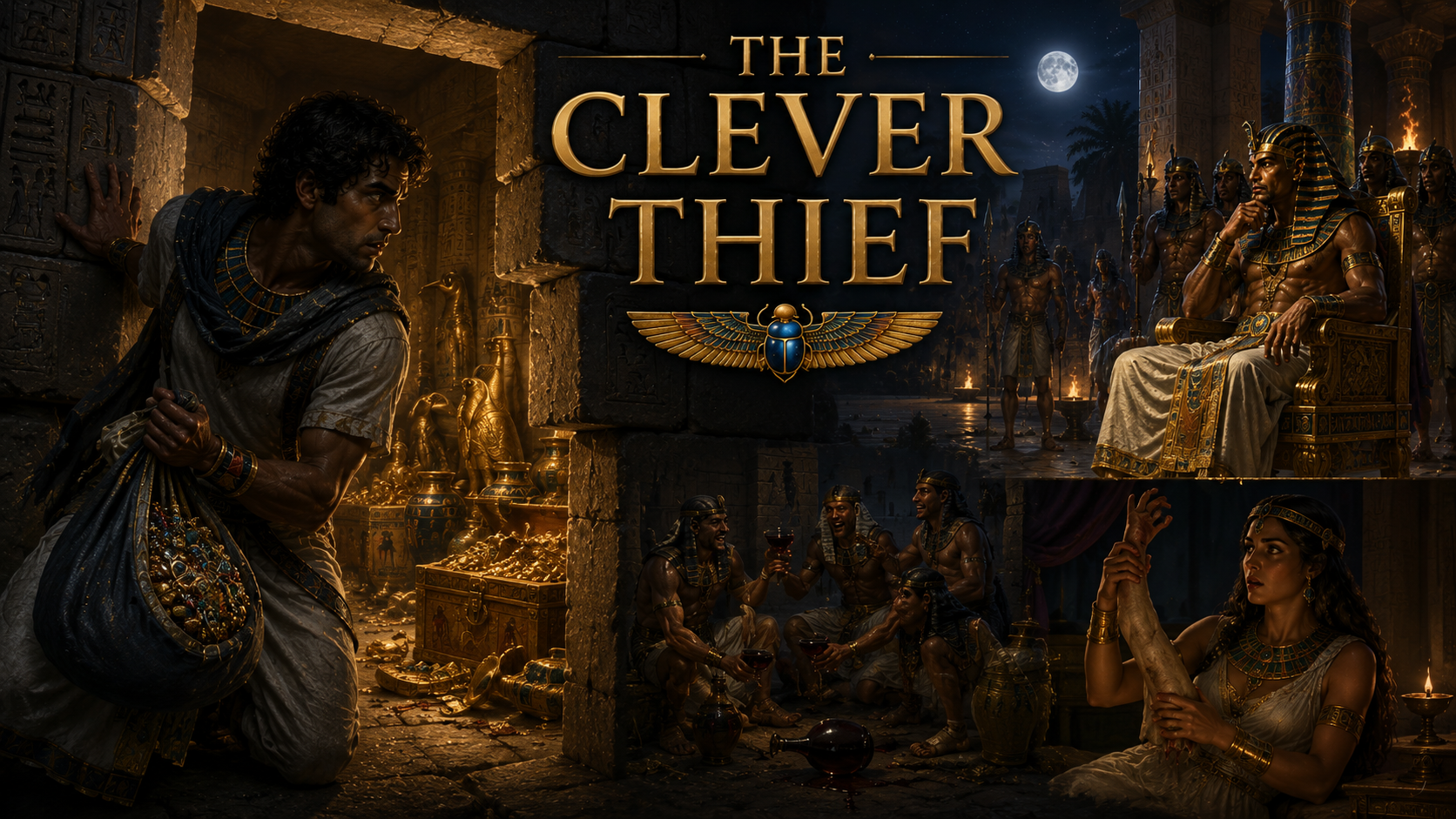
One day Pharaoh visited his treasury. The guards stood alert. The seals remained unbroken. Yet inside, several of his favorite treasures had vanished.
Jars once filled to the brim with silver were now only half full.
Rhampsinitus was furious. There were no broken doors, no windows, and no sign that anyone had entered.
Unable to solve the mystery, Pharaoh doubled the guard and resealed the entrance. The following morning, even more treasure had disappeared.
At last he ordered hidden traps to be placed throughout the treasury. That very night the two brothers returned. The elder hurried eagerly toward the silver jars.
Without warning, a concealed trap snapped shut around his legs, crushing them. He struggled desperately, but every movement drove the iron teeth deeper into his flesh.
His brother pulled with all his strength but could not free him. As dawn approached, the trapped man understood his fate.
“Brother,” he whispered, “I shall either bleed to death or be captured when the guards arrive. If they recognize me, our entire family will perish.
“You must cut off my head.”
His younger brother recoiled in horror. Yet he knew there was no other way.
With tears in his eyes, he granted his brother a swift death, severed the head with a single stroke, concealed it beneath his cloak, and escaped through the secret entrance.
The next morning Pharaoh discovered the headless body. Once again there was no sign of how the thief had entered or escaped.
Certain that an accomplice remained at large, Rhampsinitus ordered the body hung from the palace wall.
Ten soldiers were assigned to guard it.
“If anyone weeps at the sight of the body,” Pharaoh commanded, “arrest them immediately.”
When the dead man’s mother learned what had happened, she was overcome with grief.
“Your brother cannot enter the blessed afterlife while his head and body lie apart,” she cried.
“You must bring him home.”
When her surviving son hesitated, she threatened to reveal his crimes to Pharaoh. Realizing he had no choice, the young thief devised another daring plan.
The following afternoon, he disguised himself as a wine merchant. Two donkeys carried enormous wineskins along the road beside the palace.
As he approached the guards, he secretly loosened the stoppers on two of the skins. Wine poured across the road.
Pretending to panic, he rushed from one donkey to the other, shouting in frustration. The thirsty guards eagerly helped themselves to the spilled wine, filling bowls and flasks.
The merchant cursed them loudly before gradually pretending to calm down.
At last he laughed. “You may as well keep one of the wineskins,” he said.
The delighted guards invited him to join them. Throughout the afternoon they drank together. The young thief merely pretended to drink while constantly refilling the soldiers’ cups.
Before sunset, every guard lay snoring in a drunken sleep. The thief quietly cut down his brother’s body, laid it across one of the donkeys, covered it with his cloak, and rode safely home.
His mother wept with relief. At last the body and head were buried together in the same tomb.
When the guards awoke the following morning, their pounding headaches were nothing compared with the terror that awaited them.
The body had vanished. Although Pharaoh punished them severely, he secretly admired the thief’s remarkable ingenuity.
Still determined to catch him, Rhampsinitus devised one final trap. He ordered his daughter to receive any man who claimed he had committed both a wicked deed and a clever one.
Whoever told the most remarkable story would spend the night with the princess. Hidden soldiers waited nearby. If any visitor confessed to robbing the royal treasury, she was to call for them immediately.
News of the beautiful princess spread throughout Egypt. The younger brother could not resist the challenge. Before visiting her, however, he stole the severed arm of a dead man from the embalmers and concealed it beneath his cloak.
That evening he entered the princess’s chamber. She welcomed him warmly.
“Tell me,” she said, “what is the wickedest thing you have ever done? And what is the cleverest?”
“The wickedest thing,” he replied, “was cutting off my own brother’s head after he was caught in Pharaoh’s treasury.
“The cleverest was stealing back his body by making Pharaoh’s guards drunk.”
The princess realized at once that she had found the elusive thief.
She reached out to seize his hand while crying for the soldiers. But instead of grasping the young man, she found herself clutching the dead man’s arm. The thief had slipped away into the darkness.
When the soldiers burst into the room, they found only the fainting princess and the severed arm lying upon the floor.
By then the clever thief had disappeared once again. When Pharaoh heard what had happened, he laughed.
At last he admitted that such intelligence deserved admiration rather than punishment. He proclaimed a full pardon and promised great rewards if the thief would present himself at court.
Trusting Pharaoh’s word, the young man came willingly before the throne and confessed everything. Far from condemning him, Rhampsinitus praised his wit and courage.
The king gave him his daughter’s hand in marriage and appointed him as one of his chief advisers.
From that day onward, the clever thief had no further need to steal. Instead, he devoted all his remarkable ingenuity to serving the very king he had once outwitted.