When King Thutmose III (1479 to 1425 BC) came to the throne of Egypt during the fifteenth century BC, he spent campaign after campaign fighting in Syria and Canaan to expand the Egyptian Empire. The princes of cities conquered by Egypt were usually allowed to remain in power as long as they acknowledged Thutmose’s authority and paid tribute to him.
A story preserved in a damaged Egyptian manuscript recounts how the Canaanite prince of Joppa, the city now known as Jaffa, rebelled against Egyptian rule.
The beginning of the tale has been lost, but it is clear that news of the rebellion reached Thutmose III, who was determined to crush it before other cities joined the revolt. Unable to leave Egypt immediately, he entrusted the campaign to one of his finest generals, Djehuty.
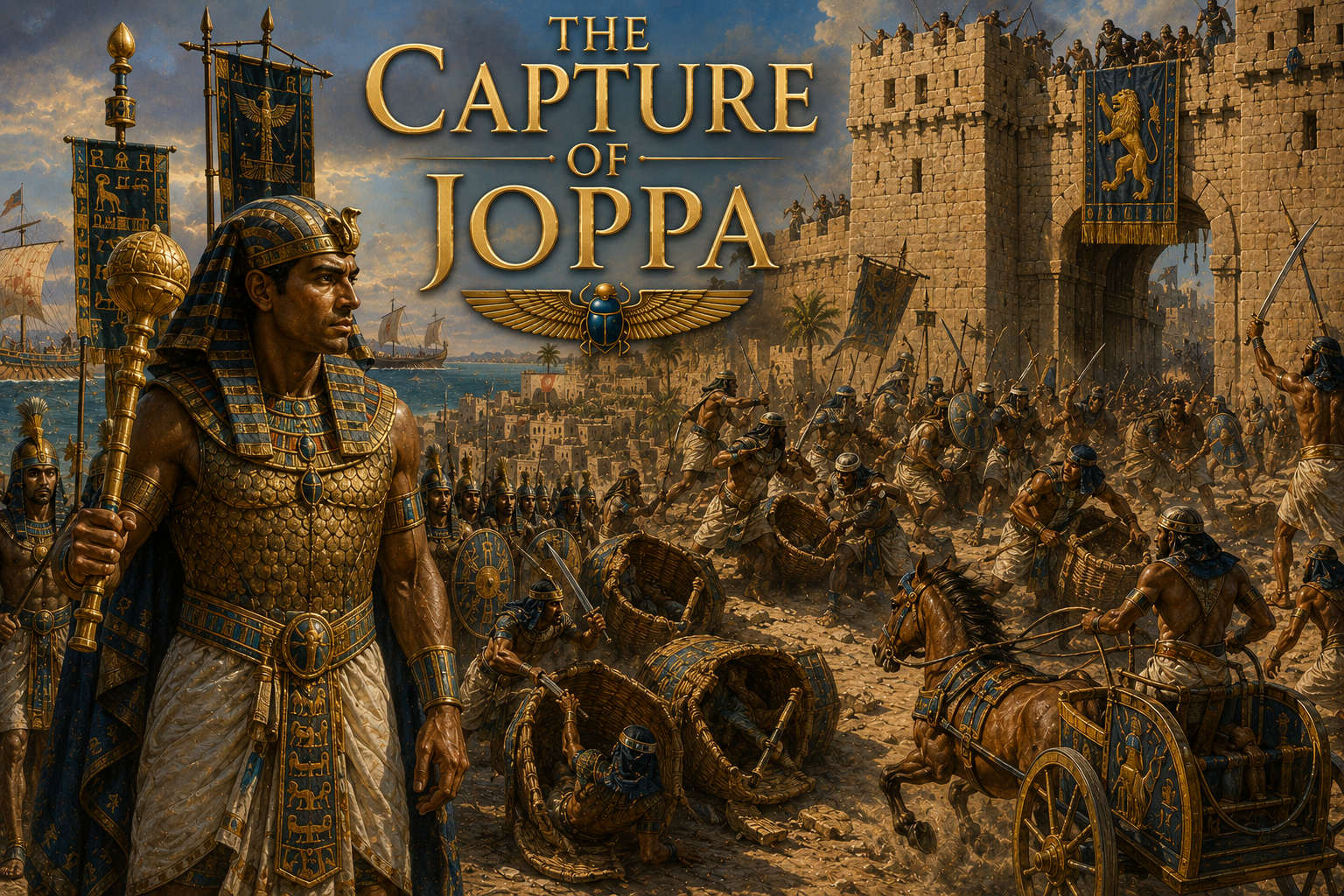
To show that Djehuty spoke with the king’s own authority, Thutmose presented him with his personal mace of gold and ebony.
Djehuty and his army sailed north from the eastern Delta along the coast of Canaan until they reached Joppa.
The city was protected by massive stone walls, and its only gate was flanked by tall towers crowded with archers.
Djehuty sent a herald before the gate to deliver the king’s challenge.
“Prince of Joppa, surrender to the Son of Ra, the Golden Horus, the Strong Bull Arisen in Thebes, the Lord of the Two Lands, the King of Upper and Lower Egypt, Thutmose, may he live forever. Submit now, or come out and fight.”
The answer came swiftly. The prince refused to surrender, yet he would not risk open battle against the Egyptian army. Seeing no alternative, Djehuty ordered an assault.
Protected by shields raised above their heads against the rain of arrows, Egyptian soldiers advanced toward the walls. Ladders were raised against the battlements, while wooden siege towers rolled forward.
The defenders fought fiercely. They hurled stones upon the attackers, knocked soldiers from their ladders, and set the siege towers ablaze with flaming arrows.
After hours of desperate fighting, Djehuty reluctantly ordered a retreat.
The Egyptians had suffered heavy losses, while the defenders remained firmly in control of the city.
That night Djehuty sat alone in his tent.
A direct assault had failed, and a lengthy siege could take years. Only cunning remained.
At dawn he sent another message to the prince. Most of the letter was another demand for surrender, but at the bottom Djehuty had added a secret note in his own hand.
He claimed he feared Thutmose III’s anger and was willing to betray Egypt in exchange for wealth and protection. If the prince agreed, they could discuss the terms face-to-face.
The prince eagerly accepted. A truce was declared, and the meeting was arranged on the open ground between the city and the Egyptian camp.
Shortly after midday, the great gates of Joppa opened. The prince emerged in his chariot, accompanied by twenty of his finest officers.
Behind them, the gates were immediately barred once more.
Djehuty approached with twenty Egyptian officers. They carried no visible weapons. The two groups sat together beneath a canopy while servants poured generous cups of wine.
Djehuty played his part perfectly.
“My wife and children are still in my camp,” he said. “Tonight I shall send them into your city as hostages to prove my loyalty. Tomorrow my army will serve you instead of Egypt. Let us drink to the freedom of Joppa.”
The prince smiled, and the wine continued to flow.
Soon both the Canaanite officers and the Egyptian nobles were laughing together like old friends.
Only Djehuty drank sparingly.
When everyone else had become thoroughly intoxicated, he made another suggestion.
“Send a messenger to your city with the good news. Meanwhile, your horses have stood too long in the heat. Let them be unyoked and cared for in my camp.”
The prince readily agreed. Then he accepted Djehuty’s invitation to inspect the famous royal mace of Thutmose III.
Inside the general’s tent stood an ornate sandalwood chest. Djehuty lifted the lid and carefully removed the magnificent weapon.
The prince leaned forward to admire it. Without warning, Djehuty swung the mace with all his strength.
“Here is the mace of King Thutmose, beloved of Sekhmet!”
The blow struck the prince upon the head and knocked him unconscious.
Djehuty immediately bound him with leather thongs weighted with copper.
Next he summoned the prince’s own charioteer.
“My master has prepared gifts for the people of Joppa,” Djehuty announced. “Your prince commands that you escort them into the city. Tell everyone that he has accepted Egypt’s friendship and that these gifts celebrate our new alliance.”
Believing every word, the charioteer obeyed.
He drove the prince’s golden chariot toward the city gates. Behind him marched two hundred gift bearers carrying enormous baskets suspended from poles.
The guards upon the walls saw the prince’s own chariot and heard the familiar charioteer’s voice.
Everything appeared normal. The baskets looked far too heavy to contain anything more dangerous than tribute.
Satisfied, the guards opened the gates, and the procession entered the city. As the last baskets passed beneath the gateway, the bearers suddenly lowered them to the ground.
Their lids flew open. Inside every basket crouched a fully armed Egyptian soldier. Each warrior leapt out with a drawn sword. The bearers seized the extra weapons concealed beside them.
Before the guards could react, the gateway was under Egyptian control. The alarm spread through the city, but it was too late.
Outside the walls, Djehuty had already captured the prince’s drunken officers.
Now the Egyptian army surged through the open gates. Street by street, the defenders were overwhelmed. Before long, Joppa surrendered.
The surviving inhabitants were taken prisoner, and the city’s treasures became the spoils of Egypt.
The following day, a ship sailed south carrying gold, silver, weapons, and other riches, together with the defeated prince and his family in chains.
When Thutmose III heard how Djehuty had captured Joppa without a prolonged siege, he praised both the gods and his brilliant general.
The clever stratagem became one of the most famous military tales preserved from ancient Egypt, demonstrating that wisdom and deception could sometimes achieve what even the strongest army could not.