Min was one of the oldest gods worshipped in Ancient Egypt. He was the god of fertility, male virility, reproduction, agriculture, and the harvest, and his cult can be traced back to the earliest periods of Egyptian civilization.
Unlike many Egyptian gods whose roles changed dramatically over time, Min remained strongly associated with fertility throughout thousands of years of Egyptian history. His power represented far more than human sexuality. To the ancient Egyptians, fertility included the growth of crops, the reproduction of animals, the continuation of the royal family, and the annual regeneration of the land.
Min was also closely associated with Egypt’s Eastern Desert, where travelers, miners, traders, and expeditions sought his protection before venturing into dangerous territory.
Because of these many roles, Min became a god of creation, abundance, strength, and the continuation of life itself.
One of Egypt’s Oldest Gods
Min appears extremely early in Egyptian history.
Evidence for his worship dates back to the Predynastic Period, before the unification of Egypt around 3100 BC. Images resembling Min appear on some of the earliest ritual objects associated with Egyptian religion.
This makes Min older, at least in terms of surviving evidence, than many of the better-known gods who later dominated Egyptian mythology.
His cult remained active for more than three thousand years, continuing through the Pharaonic, Ptolemaic, and Roman periods. Few Egyptian deities can claim such an extraordinarily long history of continuous worship.
What Does the Name Min Mean?
The original meaning of Min’s name is uncertain.
Egyptologists usually render his Egyptian name as Min, although the precise ancient pronunciation cannot be reconstructed because Egyptian hieroglyphs generally did not record vowels.
Ancient texts gave Min numerous titles reflecting his powers.
Among these were titles connecting him with:
- Fertility
- Generation
- The harvest
- The Eastern Desert
- Royal strength
- Sexual potency
- Abundance
One of his important epithets was “Min, Lord of Coptos,” referring to one of his principal cult centers.
Min like all Egyptian Gods and goddesses had many names. Here are some of them: Min, Menu, Minu, Mnw, 𓋉𓊾, Min-Amun, Mnw-Jmn, Amun-Min, Min-Horus, Horus-Min, Min-Kamutef, Kamutef, Lord of Coptos, Foremost of Coptos, Lord of Akhmim, Lord of the Eastern Desert, Lord of Foreign Lands, Great of Love, He Whose Arm Is Raised.
He could also be called a powerful or victorious bull, an image commonly associated with masculine strength and fertility in Egyptian religion.
Min as the God of Fertility
Min’s primary role was the preservation and renewal of fertility. For the Egyptians, fertility was essential to the survival of society.
Families needed children. Herds needed to reproduce. Fields needed to produce grain. Fruit trees needed to bear crops. The Nile Valley needed to renew itself after each agricultural cycle.
Min embodied the power that allowed these processes to continue.
People could therefore invoke him when seeking:
- Children
- Successful pregnancies
- Sexual potency
- Healthy livestock
- Productive fields
- Abundant harvests
His reproductive symbolism was directly connected to the larger Egyptian idea of regeneration.
The same force that produced children also caused seeds buried beneath the soil to emerge as new plants.
Why Is Min Depicted With an Erect Penis?
Min possesses one of the most distinctive appearances of any Egyptian god.
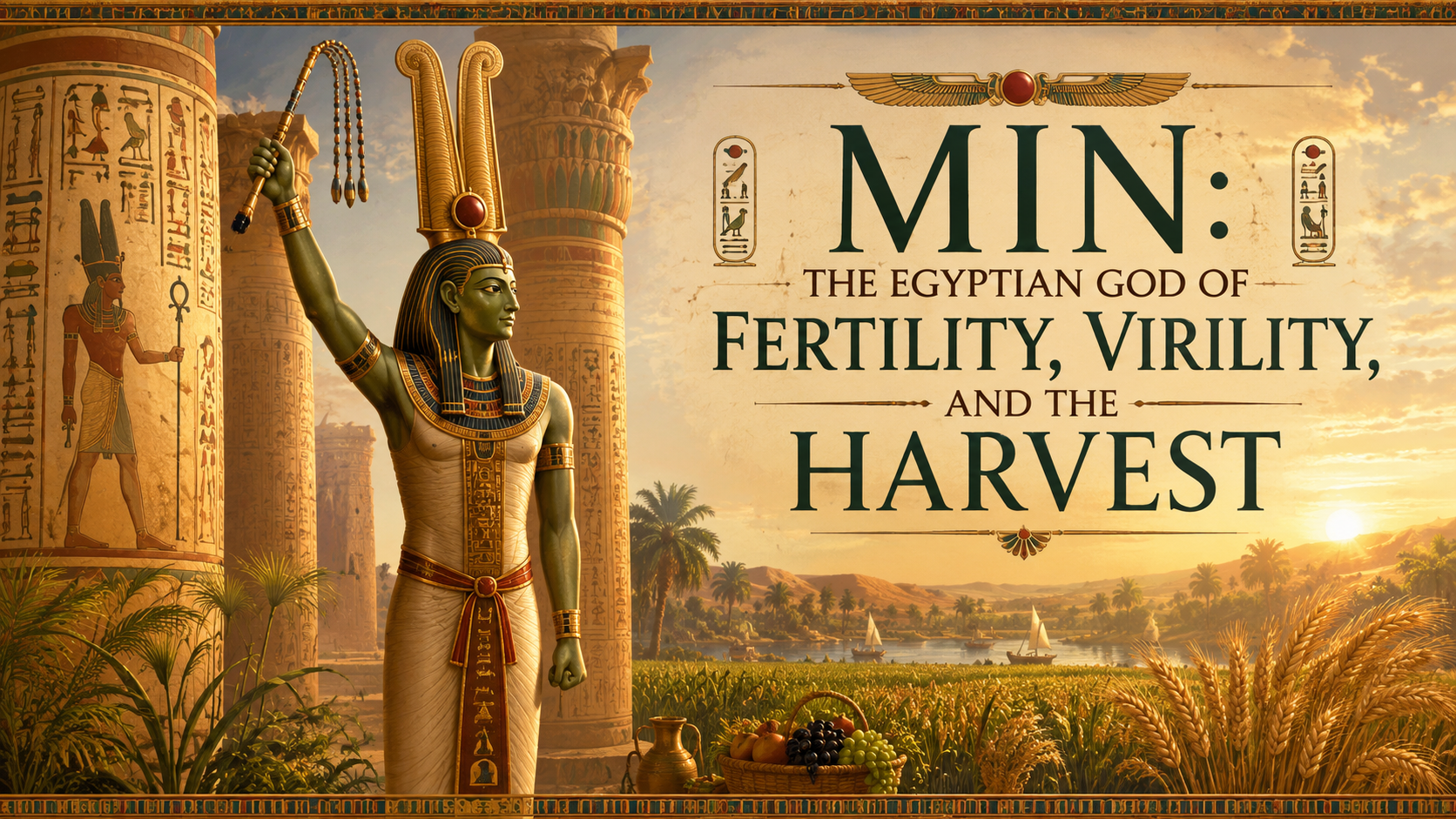
He was normally depicted as a mummiform man with one arm raised above his body. Most famously, he was shown with an erect penis.
To modern viewers, this image can appear unusually explicit. To the ancient Egyptians, however, the erect phallus was primarily a symbol of fertility, generative power, and the ability to produce life.
Min represented the male creative force in its most direct form.
His depiction should therefore be understood within the religious symbolism of Ancient Egypt rather than through modern ideas about erotic imagery.
Sexuality, reproduction, birth, agriculture, and regeneration were closely interconnected concepts within Egyptian religious thought.
Min’s Appearance
Min was usually depicted in a highly recognizable form.
He commonly appeared as:
- A mummiform male figure
- With an erect penis
- One arm raised
- A ceremonial flail held above him
- A tall crown topped with two long feathers
- Ribbons hanging from his crown
His body was frequently painted black.
Black had powerful symbolic meaning in Egyptian religion. It represented the rich, fertile soil deposited by the Nile and therefore carried associations with fertility, regeneration, and rebirth.
This was the same symbolism that could cause Osiris to be depicted with black or dark skin.
Min’s black coloring was therefore closely connected with his role as a god of agricultural fertility.
Why Does Min Hold His Arm in the Air?
Min’s raised arm is one of the defining elements of his iconography.
The exact meaning of the gesture is still debated, but it clearly emphasized his power and authority.
In many depictions, Min holds a flail in his raised hand.
The flail was an important Egyptian symbol associated with kingship, fertility, agriculture, and authority. It also appeared among the royal insignia carried by Osiris and Egyptian pharaohs.
Min’s raised arm and flail may therefore have connected his generative strength with royal power and agricultural prosperity.
Min and the Harvest
Min was closely associated with Egyptian agriculture.
One of the most important festivals dedicated to him celebrated the harvest and renewal of royal power.
During these ceremonies, the pharaoh participated in rituals connecting his own strength with Min’s fertility.
One famous element involved the king ceremonially cutting a sheaf of grain.
This simple agricultural act carried enormous symbolic meaning.
The harvest demonstrated that Ma’at had been maintained, the Nile had provided its waters, the gods had blessed Egypt, and the land had once again produced enough food to sustain its people.
By participating in the ritual, the pharaoh showed that his reign possessed the divine fertility necessary to keep Egypt prosperous.
The Festival of Min
The Festival of the Coming Forth of Min was one of the major celebrations associated with the god.
During the festival, Min’s cult image was removed from its sanctuary and carried outside the temple in procession.
Priests, officials, musicians, soldiers, and members of the royal court participated in the ceremonies.
The festival celebrated:
- Fertility
- Agricultural abundance
- Royal power
- The harvest
- Regeneration
The pharaoh played an important role in these rituals.
By appearing before Min and participating in agricultural ceremonies, the ruler demonstrated that the fertility of the king and the fertility of Egypt were connected.
A strong king meant a strong land.
Min and the Pharaoh
Min became closely associated with royal power. The pharaoh was responsible for maintaining Ma’at and ensuring the prosperity of Egypt. Fertility was a crucial part of that responsibility.
A successful king was expected to produce both political stability and abundance. Min represented the divine force behind that abundance.
Egyptian kings were therefore sometimes shown standing before Min or presenting offerings to him. Royal inscriptions could associate the pharaoh’s strength and sexual potency with the god.
This symbolism extended beyond personal virility.
The king’s reproductive power represented the continuation of the royal dynasty, while his agricultural power represented the continued prosperity of Egypt.
Min and Lettuce
One of the most unusual symbols associated with Min was lettuce. Egyptian artists frequently depicted tall lettuce plants near his shrine or during rituals performed in his honor.
The variety of lettuce cultivated in Ancient Egypt grew upright and produced a milky white sap when cut. Because of its appearance and sap, Egyptians connected the plant with male fertility and sexual potency.
Lettuce therefore became a sacred plant of Min.
Offerings of lettuce were presented to the god, and plants sometimes appear immediately behind or beside him in temple scenes.
This association demonstrates how Egyptian religion connected ordinary elements of nature with broader ideas about fertility and divine power.
Min and the Eastern Desert
Min was not only a fertility god.
He was also an important protector of Egypt’s Eastern Desert.
This vast region between the Nile Valley and the Red Sea contained valuable resources, including:
- Gold
- Stone
- Minerals
- Precious materials
- Trade routes
Egyptian expeditions regularly crossed the desert to reach mines, quarries, ports, and foreign trading routes.
These journeys were dangerous.
Travelers faced extreme heat, difficult terrain, lack of water, wild animals, and the possibility of attack.
Min became the divine protector of these expeditions.
Officials and travelers offered prayers to him before entering the desert, asking the god to guide them safely and help them return with valuable resources.
Min and Coptos
One of Min’s most important cult centers was the ancient city of Coptos, known to the Egyptians as Gebtu and today as Qift.
Coptos stood near routes leading from the Nile Valley into the Eastern Desert and toward the Red Sea.
Its location made the city extremely important for trade and mining expeditions.
Because Min protected travelers moving through these regions, his cult became deeply associated with Coptos.
Expeditions departing for the desert could invoke Min before beginning their journeys.
The city remained one of the major centers of his worship for thousands of years.
Min and Akhmim
Another major cult center was Akhmim in Upper Egypt. The ancient Egyptian city was known as Ipu or Khent-Min and became one of the principal centers of Min’s worship.
During the Greco-Roman Period, the Greeks associated Min with their god Pan. Because of this identification, Akhmim became known to the Greeks as Panopolis, meaning “City of Pan.”
The association made sense to Greek visitors because both Min and Pan possessed strong connections with fertility and sexual power.
However, Min retained a distinctly Egyptian identity despite his later association with the Greek god.
Min and Amun
As Egyptian religious traditions developed, Min became closely associated with Amun. The two gods were eventually combined into a deity known as Amun-Min or Min-Amun.
Both possessed connections with fertility and creative power. Amun represented hidden divine creation, while Min represented visible generative strength.
Their combination produced a powerful creator and fertility deity. Amun-Min became particularly important during the New Kingdom, when Amun was Egypt’s supreme state god.
Even after this merger, Min continued to be worshipped independently.
Min and Horus
Min was also associated with Horus. A combined deity called Min-Horus or Horus-Min developed in some regions and traditions. Horus represented kingship and royal authority, while Min embodied fertility and generative power.
Bringing the two together strengthened the connection between royal authority and the fertility of Egypt. The association also demonstrates a common feature of Egyptian religion.
Gods did not have to lose their individual identities when they were combined. Min could simultaneously exist as an independent god while also appearing as Min-Amun or Min-Horus.
Min and Isis
Min also developed connections with Isis in later Egyptian religion. At some cult centers, Isis could appear as a mother figure within religious traditions involving Min.
These relationships varied considerably depending upon the period and location. Egyptian divine families were often flexible. A deity could have different parents, partners, or children in different temple traditions.
Rather than viewing these variations as contradictions, Egyptians could accept several theological relationships simultaneously.
Min and the Desert God
Min’s fertility symbolism may initially seem strange beside his connection with the barren desert. However, the contrast actually suited Egyptian religious thought.
The desert contained valuable materials necessary for Egyptian civilization, even though it appeared lifeless compared with the Nile Valley.
Gold, precious stone, minerals, and trade goods emerged from these harsh regions.
Min therefore represented the productive potential hidden within apparently barren landscapes.
His ability to generate abundance extended from cultivated fields to the remote desert.
Worship of Min
Min was worshipped throughout much of Egyptian history.
His cult was particularly strong in Upper Egypt, especially at Coptos and Akhmim.
Worship included:
- Temple offerings
- Processions
- Harvest festivals
- Royal ceremonies
- Prayers for fertility
- Prayers for protection during travel
- Agricultural rituals
Ordinary Egyptians could call upon Min for personal fertility, while kings invoked him for the fertility and prosperity of the entire kingdom.
His ability to operate on both personal and national levels helped his cult remain relevant for thousands of years.
Min in Egyptian Temples
Images of Min appeared in numerous Egyptian temples. He can be seen standing before pharaohs who present offerings or participate in fertility rituals.
His unusual appearance makes him particularly easy to identify.
Even when portions of reliefs have been damaged, his raised arm, tall feathered crown, mummiform body, and distinctive fertility symbolism often reveal his identity.
Unfortunately, some early modern drawings, publications, and museum displays censored or modified depictions of Min because Victorian and later audiences considered his imagery inappropriate.
The Egyptians themselves displayed his fertility symbolism openly within sacred religious contexts.
Was Min a Sex God?
Min is sometimes casually described as the Egyptian “god of sex.” This description is incomplete.
Sexual potency was certainly an important part of Min’s identity, but his powers encompassed a much broader concept of fertility.
He represented the reproductive force responsible for:
- Human conception
- Animal reproduction
- Plant growth
- Successful harvests
- Royal succession
- Regeneration of the land
To reduce Min entirely to sexuality misses much of his religious significance.
For the Egyptians, the ability to reproduce and create new life was a sacred force upon which civilization depended.
Min and Regeneration
Min’s reproductive symbolism also connected him with regeneration. Ancient Egyptian religion repeatedly emphasized cycles of renewal.
The Nile flooded and withdrew. Crops grew, were harvested, and were planted again. The sun disappeared each evening and returned each morning. Humans died but hoped to be reborn in the afterlife.
Min represented the force that allowed life to continue through these cycles.
His fertility was therefore not merely about producing new life. It also expressed the renewal of life after periods of apparent death or inactivity.
Why Was Min Important?
Modern audiences sometimes overlook Min because he does not dominate famous myths in the same way as Isis, Osiris, Horus, or Set.
However, mythology was only one part of Egyptian religion. Min governed forces that directly affected everyday survival.
Without fertility there would be:
- No children
- No livestock
- No crops
- No harvest
- No continuing royal dynasty
For an agricultural civilization dependent upon the Nile, these concerns were fundamental. Min’s extraordinary longevity as a deity shows how important his powers remained to generations of Egyptians.
Legacy of Min
Min was worshipped for more than three thousand years and remained an important deity into the Greco-Roman Period.
He began as one of Egypt’s earliest known gods and eventually became associated with some of the most powerful deities in the pantheon.
Throughout that enormous span of history, Min remained:
- God of fertility
- God of male virility
- Protector of the harvest
- Guardian of desert travelers
- Patron of agricultural abundance
- Protector of mining and trading expeditions
- A symbol of royal strength
- A divine force of regeneration
His unmistakable image expressed one of the most fundamental ideas in Egyptian religion: life must continually renew itself.
For the ancient Egyptians, Min’s power could be seen whenever seeds emerged from the soil, animals produced offspring, children were born, and another successful harvest sustained the people of the Nile Valley.