The ancient Egyptian Book of the Dead was a collection of funerary compositions meant to help the deceased survive judgment, preserve the body’s parts, and continue living as an effective spirit in the afterlife.
Book of the Dead Spell 30 is one of the most famous heart spells in the entire collection. Its central concern is simple but profound: The deceased’s own heart must not turn against them. This makes Spell 30 different from the preceding heart spells. Spells 27 through 29 protect the heart from being:
- Taken away
- Torn out
- Reshaped
- Carried off by supernatural beings
Spell 30 introduces a new danger. The heart itself could potentially become a witness against its owner.
The deceased therefore asks the heart not to accuse them, not to create a case against them before the gods, and not to cause the scales of judgment to turn against them. UCL’s translation of Spell 30A explicitly asks the heart not to “stand against me as witness” or make a case beside the great god.
There is, however, an important complication: Spell 30 survives in two major versions, usually called Spell 30A and Spell 30B.
Renouf and Naville explain that the two versions share the same opening and then diverge after the reference to the balance. Spell 30B became especially famous because versions of it were inscribed on heart scarabs, amulets placed over the heart of the deceased.
In simple terms, Spell 30 says:
My heart has been with me throughout my life. Do not testify against me now. Do not accuse me before the gods, do not make the scales turn against me, and do not prevent me from reaching the blessed afterlife.
What Is Book of the Dead Spell 30?
Book of the Dead Spell 30 is a funerary formula designed to keep the deceased’s heart from becoming an obstacle during divine judgment.
The traditional numbering is slightly complicated because modern Egyptologists distinguish two principal forms:
- Spell 30A
- Spell 30B
Renouf and Naville state that these represent two major textual branches of the same basic heart formula. The versions begin similarly but diverge after mentioning the balance used in judgment.
UCL describes Spell 30A as:
Formula for not allowing the heart of N to be removed from him.
Spell 30B is the better-known version today because it became closely associated with the heart scarab. The British Museum describes Spell 30B as the formula that prevented the heart from testifying against the deceased at the judgment of the dead.
Spell 30A and Spell 30B
For an SEO article titled simply Book of the Dead Spell 30, I would cover both versions. That is more accurate than pretending there was only one fixed text.
Spell 30A
Spell 30A asks that the heart:
- Not testify against the deceased
- Not accuse the deceased based on past actions
- Not create a legal case before the great god
- Not cause the balance to turn against the deceased
- Help secure recognition before Ra and Nehebkau
Spell 30B
Spell 30B begins with the same basic concern but develops it differently. The deceased addresses the heart as something that has accompanied them throughout life, asks it not to oppose them at the balance, and urges it not to allow divine officials to damage the deceased’s name based on the course of their earthly life. The spell ends by celebrating favorable judgment and rejecting false accusations before the Lord of the West. Spell 30B became the version most strongly associated with heart scarabs.
English Translation of Book of the Dead Spell 30A
The following is a reader-friendly translation based closely on the Eighteenth Dynasty version published by UCL.
Spell 30A: Do Not Let My Heart Oppose Me
My heart of my mother,
my heart of my mother,my heart of my earthly existence,
do not stand against me
as a witnessbeside the lords of judgment.
Do not say concerning me:
“He did this,”
because of the things
I have done.Do not make a case against me
before the Great God.Hail to you, my heart.
Hail to you, my heart.
Hail to you, my inner being.
Hail to those gods
who stand at the forefront,whose hair is bound
and who rest upon their scepters.Speak well of me to Ra.
Deliver me to Nehebkau.
May I endure upon the earth.
May I not die in the West,
but become there
an effective and blessed spirit.
This closely follows the UCL text, which explicitly says the heart must not stand against the deceased as a witness, accuse the deceased concerning past actions, or make a case before the great god.
English Translation of Book of the Dead Spell 30B
The following reader-friendly translation is based on the version presented by Renouf and Naville.
Spell 30B: My Heart, Do Not Testify Against Me
My heart of my mother,
my heart belonging to my birth,
do not stand against me
as evidence.Do not oppose me
before the divine council.Do not fall against me
before the one who is at the balance.You are my spiritual companion,
the power that has been with me,
the maker who has kept
my limbs sound.Come forth with me
toward the blessed place
to which we are going.Do not let those divine officials
who judge a person
according to the course of lifemake my name offensive.
May judgment be favorable to us.
May the hearing of the case
bring joy.Let no falsehood be spoken
before the Great God,Lord of the West.
How great you are
as one who is vindicated and triumphant.
Renouf and Naville’s text specifically asks the heart not to oppose the deceased before the balance and not to allow divine ministers, who deal with a person according to the course of life, to bring disgrace upon the deceased’s name.
What Does Book of the Dead Spell 30 Mean?
Spell 30 protects the deceased from a uniquely dangerous possibility: The heart knows the truth about the person. The heart had accompanied the deceased throughout life.
It therefore symbolically knew:
- What the person had done
- What the person had intended
- What the person had experienced
- What the person remembered
- What the person truly was
If that heart spoke against its owner before the gods, the consequences could be disastrous.
Spell 30 asks it to remain loyal.
The meaning can be summarized as:
You have been my heart throughout my life. Do not become my accuser after death. Do not reveal anything that would condemn me, and do not allow the divine scales to turn against me. Remain with me so that together we may reach the blessed afterlife.
Why Could the Heart Testify Against the Deceased?
The ancient Egyptian heart was much more than a physical pump in funerary theology. It was closely associated with the inner person and could function as a record of someone’s life and conduct. That is why Spell 30 repeatedly uses courtroom-like language:
- Witness
- Evidence
- Case
- Divine council
- Balance
- Judgment
UCL’s Spell 30A specifically says:
Do not stand against me as witness.
and:
Do not make a case against me beside the great god.
The heart is therefore treated almost like the one witness the deceased cannot easily deceive.
“My Heart of My Mother”
One of the most famous lines of Spell 30 is its opening: My heart of my mother. The expression appears in both major recensions. The precise nuance is difficult to reproduce naturally in English, but the phrase emphasizes the heart as something belonging to the deceased from the beginning of life. The heart is not a foreign object. It has accompanied the person since birth. This makes the appeal especially personal: You have been mine from the beginning. Do not betray me now.
Why Is the Mother Mentioned?
The reference to the mother emphasizes birth and bodily origin. Spell 30B follows it with another description: Whole Heart mine which is that of my birth. The heart has been present from the deceased’s entry into earthly life.
That creates a direct connection between:
- Birth
- Life
- Death
- Judgment
The same heart that experienced life now accompanies the person into the divine tribunal.
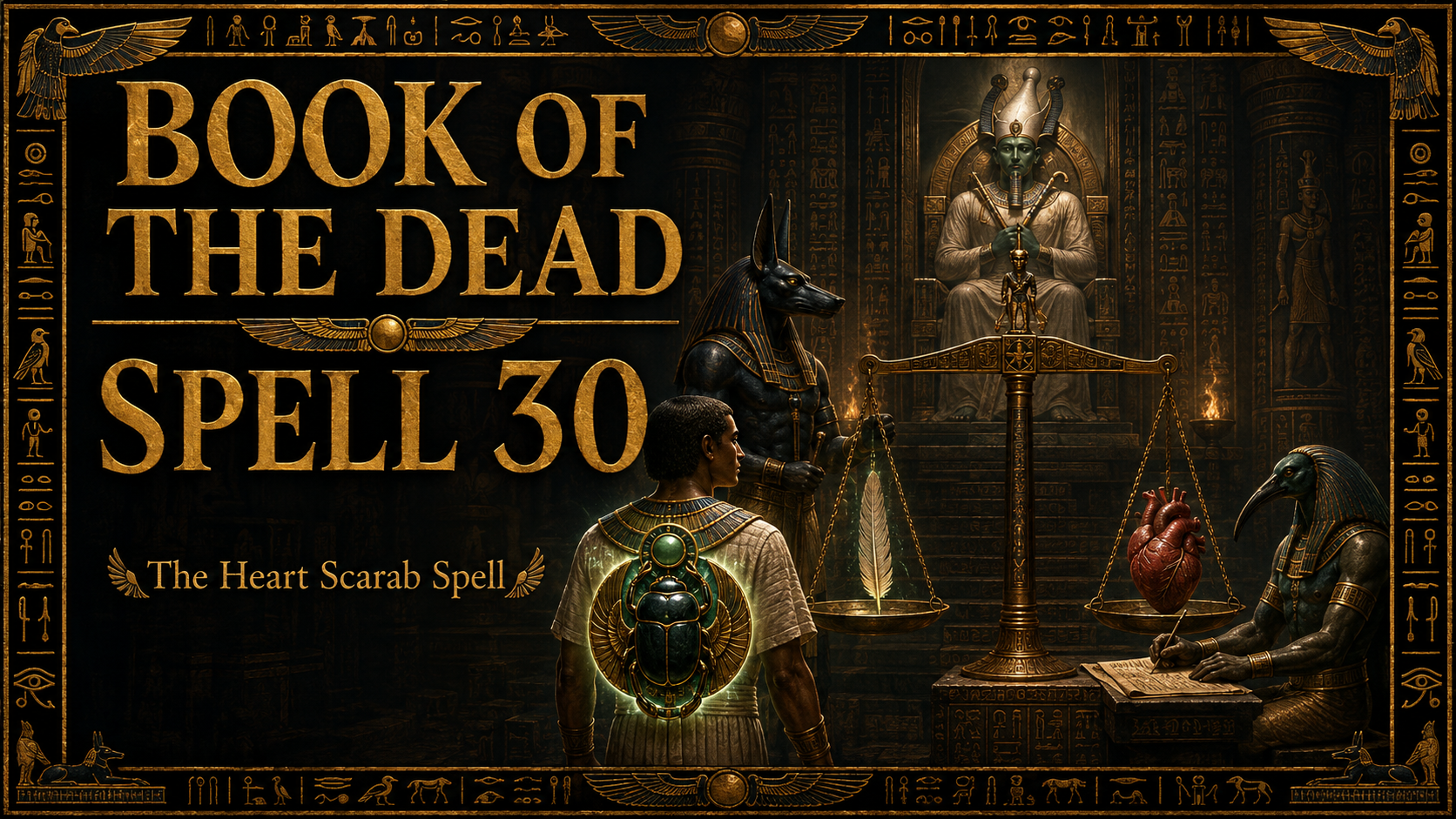
Spell 30 and the Weighing of the Heart
Spell 30 is much more closely connected with judgment than Spells 27 through 29. Both Spell 30A and 30B explicitly mention the balance. Renouf’s Spell 30A says: there must not be a “fall of the scale” against the deceased before the great god, Lord of Amenta. Spell 30B similarly tells the heart: fall thou not against me in presence of him who is at the Balance. This is why Spell 30 has become so strongly associated with the famous Egyptian judgment of the dead.
Is Spell 30 the Weighing of the Heart Scene?
It is directly connected with the concept, but the distinction needs to be clear. Spell 30 protects the heart during judgment.
The elaborate judgment scene with:
- Osiris
- Anubis
- Thoth
- The balance
- Ma’at
- Ammit
- The Negative Confession
belongs especially to Spell 125 in Book of the Dead manuscripts. Spell 30 functions as a protective heart formula that helps prevent the judgment from going badly. A good way to explain the relationship is: Spell 30 tells the heart how to behave when it reaches the kind of divine judgment later dramatized so famously in Spell 125.
“Do Not Stand Against Me as Witness”
This may be the clearest statement of Spell 30’s purpose. UCL translates Spell 30A: Do not stand against me as witness beside the lords of the ritual. The legal imagery is unmistakable. The heart could potentially become:
- A witness
- Evidence
- An accuser
The deceased wants it instead to become an ally.
“Do Not Say, He Did It”
The next line makes the danger even more explicit.
UCL translates:
Do not say against me, he did do it, about my actions.
In other words:
Do not report my deeds against me.
This makes Spell 30 one of the most psychologically fascinating chapters in the Book of the Dead. The deceased is not merely protecting the heart from external enemies. The deceased is protecting against the heart’s own knowledge.
Does Spell 30 Ask the Heart to Lie?
That is a tempting modern interpretation, but it oversimplifies the text.
The spell certainly asks the heart not to present damaging testimony.
However, Spell 30B also says:
Let not lies be uttered in presence of the great god.
So the text is not simply saying:
Lie for me.
Instead, it seeks a favorable relationship between the deceased, the heart, and divine judgment.
The speaker wants:
- No hostile testimony
- No false accusations
- No adverse movement of the scales
- Recognition as justified
The goal is successful vindication.
The Heart as Witness and Companion
Spell 30B contains an especially interesting shift. After telling the heart not to oppose the deceased, the speaker addresses it as a companion who has been present throughout life and says, in effect: Come forth with me toward the blessed place where we are going.
Renouf notes that the deceased is speaking directly to the heart and then changes into the first-person plural:
we
meaning:
you and I.
This is a powerful idea.
The heart and the deceased must go forward together.
The Heart Is Not the Enemy
Spell 30 does not ultimately seek to destroy or silence the heart. The deceased needs it. The ideal outcome is reconciliation:
The heart remains loyal.
The deceased retains the heart.
Together they proceed into the blessed afterlife.
This continues the logic of the preceding heart spells. The heart is dangerous only if separated from or turned against its owner.
The Divine Council
Both versions refer to a divine assembly. UCL’s Spell 30A says the heart must not make a case against the deceased beside the Great God. Renouf’s versions refer to the Divine Circle, a council of divine beings involved in the deceased’s case. The deceased therefore imagines judgment as a formal proceeding.
There are:
- Judges
- Evidence
- Witnesses
- A balance
- A verdict
The heart is at the center of that process.
Who Is the Great God?
Renouf calls him: the great god, Lord of Amenta. Within this funerary judgment context, that title refers naturally to Osiris, ruler of the western realm and chief authority over the dead. Spell 30B ends by saying that falsehood must not be spoken before: the great god, Lord of the Amenta. The judgment therefore occurs within an Osirian framework.
What Is Amenta?
Amenta, or Amenti, is an older Egyptological rendering for the western realm associated with the dead. The west was where the sun set.
It therefore became closely associated with:
- Tombs
- Necropolises
- Osiris
- Entry into the afterlife
Calling Osiris the Lord of Amenta identifies him as the ruler of this western funerary realm.
What Does “Fall of the Scale” Mean?
Renouf specifically explains the phrase as the fall of the scale. The imagery is straightforward. If the scale tips the wrong way, the judgment has gone against the deceased. Spell 30A therefore asks: Let there not be a fall of the scale against me. This is among the earliest passages in the numerical sequence where the balance becomes explicit.
Spell 30 and Ma’at
Spell 30 itself does not need to mention the feather of Ma’at in order to belong to the theology of divine judgment. The balance symbolizes the assessment of the deceased. Later judgment scenes make this symbolism visually explicit by showing the heart weighed in relation to Ma’at, the principle of truth, justice, and cosmic order. Spell 30 concerns the same fundamental problem: Will the deceased be vindicated or condemned?
Who Are the “Lords of the Ritual”?
UCL’s Spell 30A refers to beings translated as the lords of the ritual. Renouf uses related terminology involving the Divine Circle and divine officials. These figures belong to the judicial and ritual environment surrounding the deceased. The important point is that the heart might become evidence before divine authorities.
The Divine Officials of Spell 30B
Spell 30B refers to beings Renouf calls the Ministrants. He explains that the same term had been used for high officials in the Egyptian court but here describes beings serving Osiris in the Netherworld. Renouf further suggests they are probably related to the gods of Spell 27 who reshape a person’s heart according to their deeds. This reinforces the legal imagery.
The judgment of the deceased resembles a cosmic court.
“According to the Course of His Life”
Spell 30B says these divine officials deal with a person according to the course of his life. Renouf explains that the wording refers to the duration or course of a person’s earthly existence. That means the judgment is connected with how the person actually lived. Spell 30 is not simply about possessing the right magical password. The deceased’s earthly life matters.
“Do Not Give a Bad Odor to My Name”
Renouf’s Spell 30B contains the unusual request that these divine officials not give a bad odour to my name. This is figurative language for damaging the deceased’s reputation. A modern paraphrase would be: Do not bring disgrace upon my name. The heart must not become the cause of shame before the divine court.
Why Is the Name Important Again?
Spell 25 had already ensured that the deceased remembered the personal name. Spell 30 now protects that name from disgrace. This creates a strong thematic link:
Spell 25
I remember my name.
Spell 30
Do not allow my name to become dishonored during judgment.
The Book of the Dead protects identity repeatedly, from several different angles.
“The Joy of the Weighing of the Words”
Renouf translates one line of Spell 30B as: Pleasant for us, pleasant for the listener, is the joy of the Weighing of the Words. The wording is difficult, but the broad sense is favorable. The judicial proceeding should end in joy, not condemnation. The speaker expects the hearing to produce vindication.
Weighing Words and Weighing Hearts
The phrase “Weighing of the Words” is intriguing because judgment in Egyptian religion involves both:
- What the deceased has done
- What the deceased says
The heart represents inner truth. Speech represents the formal defense. The divine court evaluates both. Spell 30 tries to align them so that neither becomes the cause of condemnation.
“Let No Lies Be Spoken”
Spell 30B says: Let not lies be uttered in presence of the great god, Lord of the Amenta.
This is an important counterbalance to the plea that the heart not accuse the deceased. The desired judgment is not framed simply as deception. The speaker seeks a court free from hostile or false speech. The ultimate goal is to emerge as maa-kheru, justified or true of voice.
Spell 30 and Maa-Kheru
Renouf’s final line refers to the deceased as: the Triumphant one. That language belongs to the wider Egyptian concept commonly rendered:
- True of voice
- Justified
- Vindicated
- Triumphant
A successful deceased person does not merely survive the trial. They emerge with a recognized divine status.
What Is a Heart Scarab?
The most famous material object connected with Spell 30 is the heart scarab. These were large scarab-shaped amulets placed with the deceased, often over the heart. UCL notes that Spell 30B was frequently inscribed on such amulets. The British Museum preserves numerous examples whose undersides carry versions of Spell 30B. The scarab was therefore not merely decorative. It could physically carry the protective text with the deceased.
Why a Scarab?
The scarab had strong associations with Khepri, the divine power of becoming, renewal, and the rising sun. This made the form especially appropriate for funerary regeneration. Placed over the heart, the scarab combined:
- Solar rebirth
- Heart protection
- Magical text
- Personal resurrection
The object became both symbol and spell.
Spell 30B and the Heart Scarab
The British Museum explicitly identifies Spell 30B as the heart scarab formula
and says its purpose was to prevent the heart from testifying against its owner at judgment. Another British Museum scarab is inscribed with Spell 30B and labeled: Spell for preventing the heart from opposing the deceased. This is why Spell 30B has become far more famous than Spell 30A.
How Old Are Heart Scarabs With Spell 30?
UCL states that the earliest heart scarabs inscribed with Chapter 30 date to the mid-Thirteenth Dynasty, and that the practice of placing large heart scarabs with the dead continued into the Ptolemaic era, at least as late as the third century BC. That represents an extraordinarily long tradition. Spell 30 was not a short-lived funerary fashion. Its central concern remained important for many centuries.
The Heart Scarab of Sobekemsaf
Renouf and Naville discuss what they regarded as the oldest inscribed heart scarab known to them, belonging to King Sobekemsaf, whom their older spelling renders Sebak-em-saf. They described it as a green jasper scarab mounted with gold and inscribed with the heart formula. The British Museum also holds an early heart scarab inscribed with Book of the Dead Spell 30. Historical dating and attribution have been refined since Renouf’s 1904 publication, so his specific chronology should be presented as reflecting the evidence and terminology of his period.
What Did the Heart Scarab Actually Do?
The heart scarab could act as a physical magical safeguard. Its role was to help ensure that the heart:
- Stayed with the deceased
- Did not oppose its owner
- Did not give damaging testimony
- Did not cause an unfavorable judgment
In effect, the scarab materialized Spell 30’s command. The deceased did not merely have the words written on a papyrus. The protection could be placed directly over the heart.
Were All Heart Scarabs Inscribed?
No. Heart scarabs vary considerably. Some bear long versions of Spell 30B. Others contain shorter texts. Some may be uninscribed. The British Museum’s collection includes examples in which the underside carries several lines of the Book of the Dead heart formula. The important point is that Spell 30B became a particularly common text for this class of amulet.
Did Heart Scarabs Use the Owner’s Name?
Often, yes. The spell could be personalized for the deceased. However, the British Museum has an example whose blank space for the owner’s name shows that it was apparently manufactured in advance and later sold as funerary equipment. This offers a fascinating glimpse into the funerary industry. Some heart scarabs were not custom-made from the beginning.
Spell 30 and the Funerary Industry
The blank-name scarab illustrates how Egyptian funerary equipment could be produced commercially. A workshop could prepare:
- The scarab
- The magical text
- A blank space for personalization
The eventual purchaser’s name could then be added, or in some cases apparently left blank. Spell 30 therefore existed not only as theology but as part of a practical funerary economy.
What Material Were Heart Scarabs Made From?
UCL describes heart scarabs as large scarab-shaped amulets often made from hard green-black stones and positioned over the heart.
Renouf notes a tradition associating Spell 30 with serpentine, while surviving examples are made from several stones and materials.
The dark green color was probably visually appropriate to ideas of regeneration and life, although specific material choices varied.
Spell 30 and Gold
A later ritual rubric preserved by Renouf says that a hard-stone scarab associated with the heart should be encircled or purified with gold and placed over the heart while words beginning “Heart mine of my mother” were recited.
Renouf notes that traces of gold survive on some scarabs, while in many cases it has disappeared.
This provides direct evidence connecting the spoken spell and the physical amulet.
Was Spell 30 Recited Over a Heart Scarab?
Yes, at least in one later ritual tradition.
Renouf quotes a rubric directing that a hard-stone scarab be placed at the position of the deceased’s heart and that the Words of Power from Chapter 30 beginning:
Heart mine of my mother
be recited.
This demonstrates that Spell 30 could operate through three things at once:
- Spoken words
- Written inscription
- Physical amulet
The Heart Scarab Was Not the Actual Heart
The scarab did not simply replace the heart anatomically. Its purpose was magical. It acted as a protective object associated with the deceased’s heart and judgment. The goal remained to preserve the proper relationship between:
- The deceased
- The heart
- The divine court
Spell 30A Is Less Common Than Spell 30B
UCL explicitly states that Spell 30A is less common than Spell 30B. This is useful to explain because readers may wonder why modern discussions of “Spell 30” usually quote language associated with 30B. Spell 30B achieved greater visibility partly because of its widespread use on heart scarabs.
Why Are They Called 30A and 30B?
The familiar numbering of Book of the Dead spells is modern rather than ancient. UCL explains that Richard Lepsius assigned numbers to the spells in the nineteenth century, and later Egyptologists extended and refined that system. The A and B labels distinguish related but different textual recensions. Renouf and Naville state that the main versions of Chapter 30 are represented by 30A and 30B and that they branch apart after the reference to the balance.
Did Ancient Egyptians Call It “Spell 30B”?
No. An ancient Egyptian would not have referred to the composition by the modern number 30B. The numbering is an Egyptological reference system. Ancient manuscripts generally identified compositions through headings describing their function, not through the modern chapter numbers familiar today. That distinction is worth mentioning whenever discussing Book of the Dead numbering.
Is Spell 30B Older Than Spell 30A?
The textual history is complicated. UCL says Spell 30A itself is not attested before the Book of the Dead and is less common than 30B, while heart scarabs bearing versions of Chapter 30 appear as early as the mid-Thirteenth Dynasty. Rather than saying simply that one version is “the original,” it is safer to describe them as related textual traditions whose surviving evidence differs in date and frequency.
Spell 30 and the Earlier Heart Spells
Spell 30 is best understood as the culmination of the heart-protection sequence that begins with Spell 26.
Spell 26
Give me my heart.
Spell 27
Do not take or reshape my heart.
Spell 28
Protect and return my heart.
Spell 29
Drive away the messenger trying to take my heart.
Spell 30
My heart, do not turn against me during judgment.
The danger has shifted. The earlier spells protect the heart from others. Spell 30 protects the deceased from the heart itself.
Why This Shift Matters
This is one of the most interesting developments in the sequence. At first, the heart is a victim.
Supernatural beings may:
- Seize it
- Remove it
- Alter it
By Spell 30, the heart becomes potentially powerful in its own right.
It can:
- Testify
- Provide evidence
- Affect the scales
- Damage the deceased’s name
The heart has gone from something needing protection to something whose cooperation is essential.
The Heart as the Deceased’s Memory
Spell 30’s logic makes sense if the heart is understood as containing knowledge of the person’s life. It has effectively been present for everything. The deceased cannot simply leave it behind. Nor can the deceased allow it to provide hostile evidence.
The heart is simultaneously:
- Part of the self
- Memory of the self
- Witness to the self
That is what makes Spell 30 so powerful.
The Heart and Moral Responsibility
Spell 30 also reveals that Egyptian funerary magic did not entirely erase the importance of earthly conduct. Spell 30B refers to divine officials who deal with a person according to the course of life. Spell 30A asks the heart not to accuse the deceased concerning my actions. The spell therefore assumes that what happened during life matters after death.
Magic and Morality in Spell 30
Modern readers sometimes imagine two extreme possibilities:
Either:
Egyptian judgment was purely moral.
Or:
Magical spells allowed anyone to cheat the judgment.
Spell 30 shows a more complicated picture.
It contains both:
- Concern about real earthly deeds
- Magical protection against adverse testimony
The deceased wants to be recognized as justified, and magical speech is part of securing that desired divine outcome.
Spell 30 and the Negative Confession
Spell 125 later contains the famous Negative Confession, in which the deceased denies a series of wrongful acts before divine assessors.
Spell 30 prepares for the same larger concern from another angle.
Spell 125 says:
I have not done these things.
Spell 30 says:
Heart, do not become evidence against me.
Together they show how seriously judgment was imagined.
Is the Heart Weighed Against a Feather in Spell 30?
The text mentions the balance, but Spell 30 itself does not provide the full iconic scene most people know from museum images. That visual scene becomes especially associated with Spell 125.
So for accuracy:
Correct:
Spell 30 protects the heart from opposing the deceased at judgment.
Too simplistic:
Spell 30 is the complete Weighing of the Heart ceremony.
The first statement is much more precise.
Who Is Nehebkau?
Spell 30A asks divine beings to announce the deceased’s goodness to Ra and deliver the person to Nehebkau. Nehebkau was a divine being associated with the afterlife and regenerative power. His appearance indicates that successful judgment leads beyond the court itself. The deceased must then be accepted into the continuing divine world.
Ra in Spell 30A
Spell 30A asks that the deceased’s goodness be proclaimed to Ra. This introduces a solar dimension alongside the Osirian judgment framework. As throughout the Book of the Dead, solar and Osirian concepts of the afterlife overlap rather than remaining completely separate.
The deceased wants acceptance both:
- Before Osiris in the West
- Within the divine solar order of Ra
“May I Endure on Earth”
UCL’s Spell 30A concludes: May I endure on earth, not die in the west, and be a blessed spirit there. This is one of the clearest statements of the spell’s desired result. The deceased does not want annihilation. They want to become an effective, blessed spirit in the afterlife. The heart’s cooperation makes that possible.
What Is an Akh?
The final phrase translated by UCL as blessed spirit corresponds broadly to the Egyptian concept of an effective transformed dead person, often discussed through the term akh. The goal of the funerary process was not merely to remain a corpse. The deceased hoped to become an effective being capable of participating in the divine world. Spell 30 protects the judgment necessary for that transformation.
Spell 30B and Triumph
Renouf’s 30B ends by praising the deceased as triumphant. This echoes earlier spells such as Spells 18 through 20, where the deceased seeks vindication before divine councils. The terminology of triumph links the heart judgment with the larger concept of maa-kheru: justified and true of voice. Spell 30 is therefore one more stage in the deceased’s legal victory.
Why Spell 30 Is One of the Most Important Heart Spells
The preceding chapters are about keeping possession of the heart. Spell 30 explains why possession is not enough. The heart has knowledge. The heart has a voice. The heart can influence judgment. The deceased therefore needs more than ownership. They need the heart’s loyalty. That makes Spell 30 psychologically deeper than the simple fear that someone might physically take the organ away.
The Meaning of Spell 30 in Simple Terms
Book of the Dead Spell 30 asks the deceased’s own heart not to become an accuser during divine judgment. The heart has been with the person since birth. It knows the person’s actions. It could potentially testify before the gods or cause the scales to turn against its owner.
The deceased therefore appeals directly to it:
Do not stand against me.
Do not accuse me.
Do not make a case against me.
Do not let the balance turn against me.
Spell 30B expands this plea into a request that divine officials not damage the deceased’s name and that no falsehood be spoken before the great god. The meaning can be summarized as:
My heart has known me from birth and has witnessed my entire life. Now that I stand before the gods, remain loyal to me. Do not reveal anything that will condemn me, do not make the scales turn against me, and come with me into the blessed afterlife.
Spell 30 is ultimately a spell for keeping the inner self from becoming the enemy of the self.
Frequently Asked Questions About Book of the Dead Spell 30
What is Book of the Dead Spell 30?
Spell 30 is a heart-protection formula designed to prevent the deceased’s heart from opposing or testifying against them during divine judgment.
Are there two versions of Spell 30?
Yes. The two principal textual forms are usually called Spell 30A and Spell 30B. Renouf and Naville say the versions share an opening and then diverge after the reference to the balance.
What is Spell 30A?
Spell 30A asks that the heart not stand against the deceased as a witness, accuse them concerning their actions, or make a case before the great god.
What is Spell 30B?
Spell 30B is the better-known heart formula. It asks the heart not to oppose the deceased before the balance and not to allow divine officials to damage the deceased’s name.
Which version is the heart scarab spell?
Spell 30B is the version commonly associated with heart scarabs. The British Museum explicitly calls it the heart scarab formula.
What is a heart scarab?
A heart scarab is a large scarab-shaped funerary amulet placed over the heart, often inscribed with Spell 30B.
Why did the heart need a spell?
The heart could symbolically act as evidence during divine judgment. Spell 30 asks it not to accuse or oppose the deceased.
What does “my heart of my mother” mean?
It emphasizes the heart as belonging to the deceased from birth and throughout earthly life. Both 30A and 30B begin with this highly personal address.
Does Spell 30 mention the scales?
Yes. Both major versions refer to the balance and ask that judgment not turn against the deceased.
Is Spell 30 the Weighing of the Heart spell?
It is closely connected with judgment of the heart, but the full famous judgment scene is especially associated with Spell 125. Spell 30 specifically protects the heart from becoming adverse evidence.
Why could the heart testify?
The heart was associated with the inner person and had symbolically accompanied the deceased throughout life. Spell 30 treats it as a potential witness regarding the person’s deeds.
Does Spell 30 ask the heart to lie?
Not simply. Spell 30 asks the heart not to provide damaging testimony, while 30B also explicitly rejects falsehood before the great god.
Who judges the deceased?
The spell refers to a divine council, the balance, and the great god or Lord of Amenta, within an Osirian judgment context.
Who is Nehebkau?
Spell 30A asks that the deceased’s goodness be proclaimed to Ra and that the person be handed over to Nehebkau.
How old are heart scarabs with Spell 30?
UCL states that the earliest heart scarabs inscribed with Chapter 30 date to the mid-Thirteenth Dynasty, with the custom continuing for many centuries.
Were heart scarabs personalized?
Often, but not always. A British Museum example has a blank space where the owner’s name should have been inserted, suggesting advance manufacture for later sale.
Was Spell 30 recited over the scarab?
A later rubric quoted by Renouf directs that a hard-stone scarab be placed over the heart and the words beginning “Heart mine of my mother” be recited.
How is Spell 30 different from Spell 29?
Spell 29 prevents a supernatural messenger from taking the heart away. Spell 30 prevents the heart itself from opposing the deceased during judgment.
Book of the Dead Spell 30 represents a turning point in the sequence of heart spells. The earlier chapters feared that someone else might take the heart. Spell 30 recognizes a more troubling possibility: The heart itself might speak. It had accompanied the person from birth. It knew the deceased’s life. It knew the person’s deeds. And when the divine scales were brought out, the heart could become evidence. The deceased therefore speaks directly to it:
Do not stand against me.
Do not accuse me.
Do not make the scales turn against me.
Spell 30B transformed this appeal into one of the most recognizable funerary traditions of ancient Egypt. Its words were written on heart scarabs and placed over the deceased’s heart so that the magical command remained physically present with the body. The goal was not to abandon the heart. The deceased needed it. The heart and its owner had to go forward together. Spell 30 therefore asks for something more powerful than simple protection: loyalty from one’s own inner self.