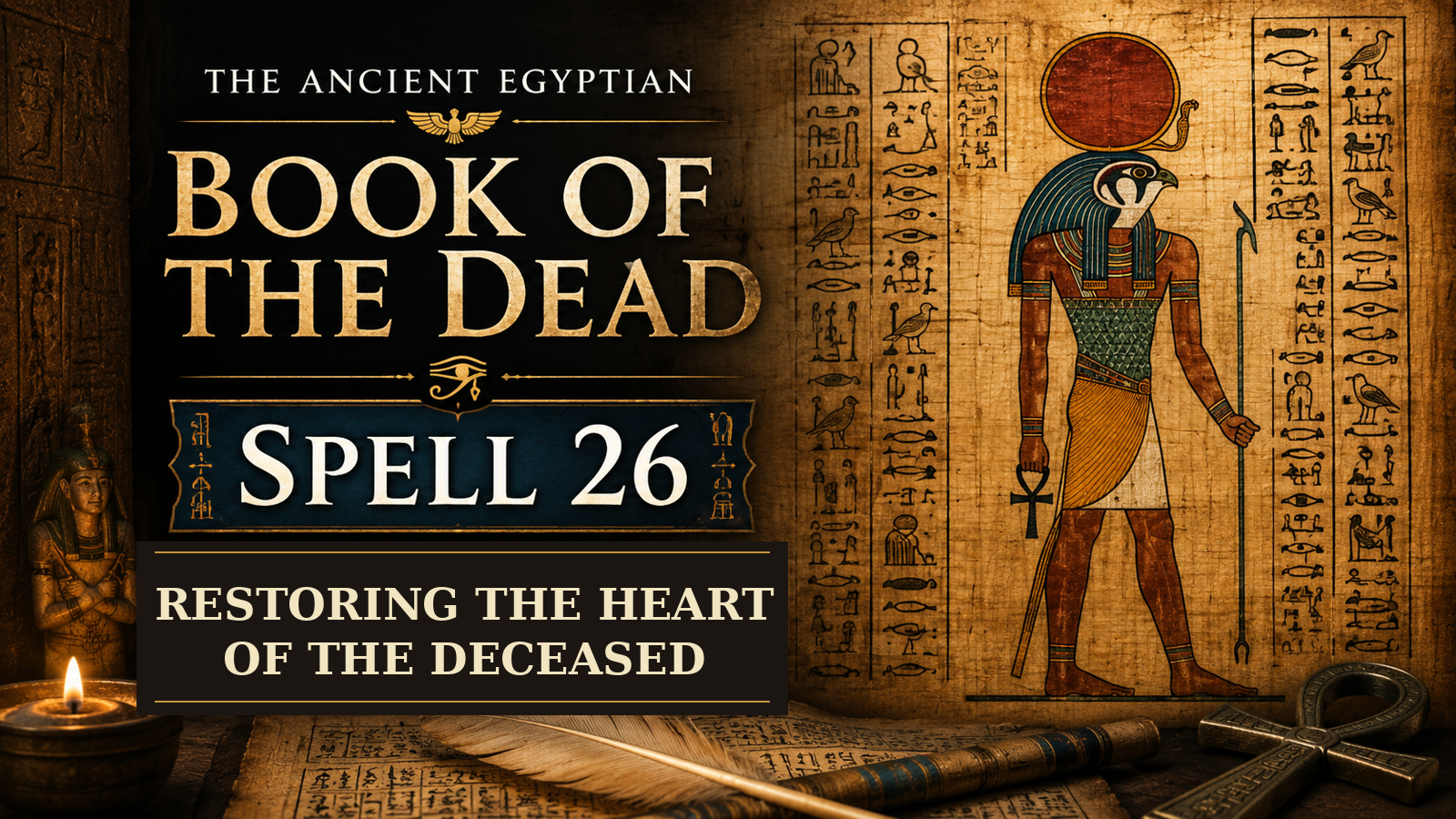
The ancient Egyptian Book of the Dead was a collection of funerary spells intended to help the deceased regain the body, identity, knowledge, and supernatural abilities required for eternal life.
Book of the Dead Spell 26 focuses on one of the most important parts of the ancient Egyptian person: the heart.
Its traditional title is:
Chapter whereby the Heart is given to a person in the Netherworld.
Spell 26 asks that the deceased regain both the heart and what Peter Le Page Renouf translated as the “Whole Heart.” Once the heart has been restored, the spell expands dramatically. The deceased asks for food from Osiris, boats for traveling upstream and downstream, a mouth for speaking, feet for walking, arms for defeating enemies, eyes that can open, hands that can move, and legs strong enough to stand.
The deceased ultimately declares:
I am in possession of my Heart.
Spell 26 is therefore much more than a spell about one organ. It is a formula for restoring the deceased as a complete, active, thinking, moving person.
In simple terms, its message is:
Give me back my heart, restore my body and abilities, and let me rise again as a complete being who can move, speak, eat, travel, and act in the afterlife.
What Is Book of the Dead Spell 26?
Book of the Dead Spell 26 is a funerary formula for giving the heart back to the deceased in the Netherworld.
Renouf and Naville list the chapter immediately after Spell 25, which allows the deceased to remember their name, and immediately before a sequence of spells designed to prevent the heart from being taken away.
The sequence is important:
- Spell 21: Gives back the mouth
- Spell 22: Another formula for restoring the mouth
- Spell 23: Opens the mouth
- Spell 24: Restores the Words of Power
- Spell 25: Restores memory of the name
- Spell 26: Gives back the heart
- Spells 27-30: Protect the heart from being removed, withheld, or opposing the deceased
The deceased is being gradually reconstructed. Spell 26 restores what Egyptians regarded as one of the principal centers of life, thought, intention, and identity.
English Translation of Book of the Dead Spell 26
The following is a reader-friendly translation based closely on the 1904 version published by Renouf and Naville.
Spell 26: Giving the Heart to the Deceased
My heart, come to me
in the place of hearts.My whole heart, come to me
in the place of whole hearts.Let me possess my heart
so that it may rest within me.Let me eat from the food of Osiris
on the eastern side
of the meadow of everlasting flowers.Let there be a boat for me
to travel downstream,and another boat
to travel upstream.I descend into the boat
in which you are.Let my mouth be given to me
so that I may speak.Let my feet be given to me
so that I may walk.Let me have my arms
so that I may overthrow my enemies.Let two hands from the earth
open my mouth.Let Geb,
the great one among the gods,
part my two jaws.Let him open my two eyes
that are closed.Let him give movement
to my powerless hands.Let Anubis give strength
to my legsso that I may rise upon them.
Let the divine Sekhmet lift me
so that I may rise into heavenand proclaim my commands in Memphis.
I possess my heart.
I possess my whole heart.
I possess my arms.
I possess my legs.
I do whatever my spirit desires,
and my ba shall not be bound
to my body at the gates of the West.
The final line in brackets appears only in some manuscripts and was identified by Renouf as an addition rather than part of the oldest form of the spell.
Historical Translation of Spell 26
Renouf and Naville begin:
“Heart mine to me, in the place of Hearts! Whole Heart mine to me, in the place of Whole Hearts!”
They continue:
“Let me have my Heart that it may rest within me…”
and later:
“Be there given to me my mouth wherewith to speak, and my feet for walking; and let me have my arms wherewith to overthrow my adversaries.”
The text culminates with the deceased declaring possession of the heart, whole heart, arms, and legs.
The spell therefore moves from a request:
Give me my heart
to a completed condition:
I possess my heart.
That shift is central to its magical purpose.
What Does Book of the Dead Spell 26 Mean?
Spell 26 restores the deceased’s heart and bodily agency after death. The speaker wants much more than anatomical preservation. Once the heart returns, the deceased becomes capable of:
- Eating
- Traveling
- Speaking
- Walking
- Seeing
- Moving the hands
- Standing
- Defeating enemies
- Rising toward heaven
- Issuing commands
The heart acts as the center around which the rest of the person becomes functional again.
The spell’s meaning can be summarized as:
My heart belongs to me and must remain within me. With it restored, I can speak, see, walk, travel, defend myself, eat with Osiris, and rise again as a complete being.
Why Was the Heart So Important in Ancient Egypt?
The heart played an unusually important role in ancient Egyptian concepts of the person. It was closely associated with:
- Thought
- Memory
- Emotion
- Intention
- Moral character
- Decision-making
- Personal identity
That helps explain why later Book of the Dead spells devote so much attention to protecting it. Spells 27 through 30 repeatedly prevent the heart from being taken, withheld, or speaking against the deceased.
The famous Weighing of the Heart in Spell 125 also places the heart at the center of divine judgment, where it is compared with Ma’at, the principle of truth and order.
Spell 26 comes before those protective and judgment texts. First, the deceased needs the heart back.
The Heart Was More Than a Physical Organ
Modern readers may instinctively associate thought with the brain. Ancient Egyptian religious texts gave the heart a much more central role.
The heart could represent the inner person.
It was connected with:
- What someone knew
- What someone desired
- What someone remembered
- What someone intended
- How someone behaved
That is why losing the heart would mean more than losing an organ. It could mean losing the internal center of the self. Spell 26 prevents that.
Two Egyptian Words for “Heart”
Renouf’s commentary notes that Egyptian texts could use two different terms that he translates as “heart” and “whole heart.” He transcribed them as ab and hatu and observed that they were often treated synonymously but could also be deliberately distinguished.
This distinction is one of the most interesting features of Spell 26. The opening does not simply say:
Give me my heart.
It effectively says:
Give me my heart and my whole heart.
The deceased wants complete restoration.
What Is the “Whole Heart”?
Renouf used “Whole Heart” as an English compromise because he believed the second Egyptian term could refer to the heart together with surrounding organs, particularly the lungs and related structures.
His interpretation reflects the anatomical and linguistic scholarship of his period, so it should not be treated as the only possible modern rendering.
For your article, the safest phrasing is:
Spell 26 distinguishes between two Egyptian terms for the heart, one of which Renouf translated as the “Whole Heart.” The precise anatomical or symbolic distinction remains debated.
This gives readers the important detail without overstating certainty.
“My Heart, Come to Me”
The opening is extremely personal: My heart, come to me.
Like several preceding spells, Spell 26 is about recovering something that rightfully belongs to the deceased.
Earlier chapters restore:
- My mouth
- My Words of Power
- My name
Now:
- My heart
The repetition across these spells makes death look like a process of separation. The funerary texts reverse that separation piece by piece.
The Heart Must “Rest Within Me”
The deceased asks: Let me have my heart so that it may rest within me. This shows that the goal is not merely temporary contact with the heart. It must return to its proper place.
The deceased wants:
- Reunion
- Stability
- Completeness
- Permanent possession
The heart is supposed to remain part of the person.
Why Might the Heart Be Separated From the Deceased?
The Book of the Dead repeatedly assumes that death creates a risk of fragmentation. The deceased may lose:
- Mouth
- Heart
- Name
- Memory
- Magical words
- Head
- Shadow
- Movement
That is why later spells explicitly say: Do not take my heart away. Spell 26 solves the problem from the opposite direction: Return it to me first.
Eating the Food of Osiris
Once the heart is restored, the deceased expects to feed upon the food of Osiris. This connects the heart with nourishment and participation in the Osirian afterlife.
Food in funerary religion was essential. The deceased hoped to receive:
- Bread
- Beer
- Water
- Meat
- Cakes
- Vegetables
- Other offerings
A successful afterlife required the ability to consume the provisions of the gods.
Why Is Osiris Mentioned?
Osiris was the central divine model of resurrection. He had:
- Died
- Been preserved
- Been restored
- Defeated enemies
- Become ruler of the dead
When Spell 26 says the deceased will eat the food of Osiris, it places the speaker within the god’s community. The restored heart makes the person capable of sharing in Osiris’s life rather than remaining an inert corpse.
The Meadow of Everlasting Flowers
Renouf translates the location as: the mead of amaranthine flowers.
He identifies the plant name with a term he connected to amaranth, while also noting botanical and geographical uncertainty in the manuscripts.
The exact plant identification is less important than the symbolism. The deceased eats in a fertile divine landscape filled with vegetation that suggests:
- Life
- Renewal
- Abundance
- Permanence
It is the opposite of the barren tomb.
Why Is the Eastern Side Mentioned?
The food of Osiris is located on the eastern side of this meadow. The east carried strong solar associations.
It was the region of:
- Sunrise
- Renewal
- Rebirth
- Emergence from darkness
Placing the deceased in an eastern afterlife landscape reinforces the larger resurrection theme.
The person has been restored internally and now participates in the same cycle of renewed life associated with the rising sun.
Two Boats for the Deceased
The speaker asks: Let me have a boat for traveling downstream and another for traveling upstream.
This is a distinctly Egyptian image. The Nile was the country’s principal transportation route. Traveling both directions required freedom of movement throughout the landscape.
In the afterlife, the request becomes supernatural. The deceased wants unrestricted travel.
Why Upstream and Downstream?
The Nile flows north, so ancient Egyptian travel was often described through the contrast between:
- Going downstream
- Going upstream
Possessing boats for both directions means that the deceased is not trapped. The speaker can travel wherever necessary.
That could symbolize:
- Freedom within the divine world
- Access to different sacred regions
- Movement toward gods
- Movement back toward the tomb or other destinations
Spell 26 restores mobility on both land and water.
“I Go Down Into the Boat Where You Are”
The spell then states: I go down into the boat in which you are.
The identity of the addressed being is not completely explicit in Renouf’s short translation.
Given the preceding reference to Osiris and the wider solar and funerary context, the boat participates in a divine journey. The important point is that the deceased can now board it. A restored person can travel.
Why Does Spell 26 Restore the Mouth Again?
Spell 26 asks: Give me my mouth so that I may speak.
That might seem repetitive because Spells 21 through 23 already dealt extensively with the mouth. But repetition is common in the Book of the Dead.
The deceased wanted multiple layers of protection against the same fundamental dangers. Spell 26 also integrates speech into a broader restoration of the whole body.
The speaker now possesses:
- Heart
- Mouth
- Feet
- Arms
- Eyes
- Hands
- Legs
The Heart and Mouth Work Together
In Egyptian thought, the heart and mouth could be closely linked.
The heart:
- Conceives
- Remembers
- Intends
The mouth:
- Speaks
- Commands
- Names
- Performs magical language
Spell 26 restores both faculties within the same composition.
The deceased can think and speak.
“My Feet for Walking”
Spell 26 asks for: my feet for walking. Death had made the body motionless.
The restored deceased must be able to move through:
- Tomb
- Duat
- Divine fields
- Gates
- Roads
- Boats
- Celestial regions
Walking is therefore one of the simplest proofs of restored life.
“My Arms to Overthrow My Enemies”
The speaker also asks for arms: wherewith to overthrow my adversaries. The body is restored not only for peaceful movement but for defense.
The deceased may encounter:
- Hostile spirits
- Supernatural executioners
- Enemies
- Serpents
- Forces of disorder
Arms provide the ability to resist.
Does Spell 26 Encourage Literal Violence?
The language belongs to the symbolic and magical worldview of Egyptian funerary literature. Similar texts repeatedly describe enemies as:
- Repelled
- Overthrown
- Bound
- Cut apart
- Burned
- Driven away
The purpose is to ensure that hostile supernatural forces cannot interfere with the deceased. The emphasis is on complete protection.
“Two Hands From the Earth Open My Mouth”
One of the stranger lines asks that two hands from the Earth open my mouth.
The image may connect the deceased with the earth god Geb, who appears immediately afterward. The body has been buried in the earth. Now forces associated with the earth help restore it. Burial is transformed from confinement into regeneration.
Who Is Geb in Spell 26?
Renouf’s older translation calls Geb Seb.
Spell 26 asks him to:
- Part the jaws
- Open the eyes
- Restore movement to the hands
Geb was the god of the earth. That makes his role especially appropriate. The deceased has been placed in the earth, but the earth now helps return life to the body.
Geb Opens the Jaws
The spell asks Geb to: part my two jaws. This continues the Opening of the Mouth theme found in Spell 23. The jaws must move so that the deceased can:
- Speak
- Eat
- Drink
Again, restoration is practical. A functioning afterlife requires actual faculties, not merely abstract spiritual survival.
Geb Opens the Eyes
The speaker also asks: Let him open my two eyes which are closed. This reverses another condition of death.
Closed eyes symbolize:
- Death
- Darkness
- Inactivity
Opening them restores:
- Sight
- Awareness
- Ability to recognize gods
- Ability to see Ra
- Participation in daylight
The deceased is awakening.
The Restoration of Sight
Seeing was essential throughout the Book of the Dead. The deceased repeatedly wants to:
- See Osiris
- Behold Ra
- Recognize divine beings
- Navigate sacred regions
- Observe the moon and stars
Spell 26 restores the physical and magical faculty necessary for those experiences.
The Powerless Hands Move Again
Geb is asked to give movement to my two hands, which are powerless. The line captures death as loss of agency. The hands cannot act. Spell 26 reverses that. Hands could be needed to:
- Hold objects
- Worship
- Row or travel
- Receive offerings
- Defeat enemies
- Perform rituals
Movement equals life.
What Does Anubis Do in Spell 26?
The spell asks:
Let Anubis give vigour to my legs, that I may raise myself up upon them.
Anubis was closely associated with:
- Mummification
- The necropolis
- Protection of the corpse
- Guidance of the dead
- Funerary ritual
Here, he helps the deceased stand again.
The god associated with the prepared corpse now helps transform that corpse into an active being.
Standing as a Sign of Resurrection
The ability to stand has profound symbolism. A corpse lies down. A living person stands.
The deceased who can stand has moved from:
- Stillness to movement
- Death to renewed agency
- Burial to resurrection
Spell 26 makes that change explicit.
Why Is Sekhmet Mentioned?
Renouf’s text calls upon Sechit, the older spelling of Sekhmet, to lift the deceased so that the person can rise into heaven. Sekhmet was the powerful lioness goddess associated with:
- Solar power
- Protection
- Destruction
- Healing
- Royal authority
Her appearance may initially seem surprising in a heart spell. But Sekhmet combines destructive and restorative power. She can raise and empower the deceased.
Sekhmet as a Healing Goddess
Sekhmet is famous for her fierce, destructive force, but she was also connected with healing. This dual role makes her appropriate in a spell of bodily restoration.
The same divine power capable of destroying enemies can restore the justified deceased.
In Spell 26, her role is unmistakably beneficial: She lifts the deceased upward.
Rising Into Heaven
Spell 26 asks that the deceased arise in Heaven. The progression through the spell is remarkable.
The person begins by asking for the heart.
Then:
- The heart returns.
- The deceased eats.
- Boats become available.
- The mouth speaks.
- Feet walk.
- Arms defend.
- Eyes open.
- Hands move.
- Legs stand.
- Sekhmet raises the person into heaven.
The heart’s restoration leads ultimately to celestial resurrection.
“Issue My Command in Memphis”
Renouf translates the next phrase as: issue my behest in Memphis.
Memphis was one of ancient Egypt’s major religious and political centers and was especially associated with Ptah. The line suggests that the deceased is no longer merely surviving. The speaker now has enough authority to command.
The progression has moved from helpless corpse to empowered divine participant.
Why Memphis?
Memphis was closely associated with:
- Ptah
- Kingship
- Creation theology
- Royal authority
The exact reason for the reference in Spell 26 is not explained in the short surviving text.
However, issuing a command at Memphis fits the wider theme of restored authority.
The deceased has regained the ability not only to speak but to speak effectively.
“I Am in Possession of My Heart”
The spell reaches its climax with the declaration: I am in possession of my Heart. The request has become reality. The deceased now possesses:
- Heart
- Whole Heart
- Arms
- Legs
The magical goal has been achieved.
Request Becomes Declaration
This transformation is common in Egyptian magical language. At the beginning: Give me my heart. At the end: I have my heart. The spell does not leave the result uncertain.
The desired outcome is stated as a completed fact. That declaration helps magically establish the condition.
“I Do Whatever My Genius Wills”
Some manuscripts add a final statement translated by Renouf as:
“I do whatsoever my Genius willeth…”
Renouf explicitly notes that this line is an addition found in some good manuscripts rather than part of the original form. The term translated as Genius reflects older Egyptological terminology and should not be interpreted in the modern sense of intellectual brilliance.
A safer modern paraphrase is: I may act according to the will of my spiritual being.
The Ba Is Not Bound to the Body
The added passage continues: my Soul is not bound to my body at the gates of Amenta.
The older translation’s “Soul” likely refers broadly to the deceased’s mobile spiritual component, often associated with the ba. This is a crucial idea.
Restoring the body does not mean trapping the deceased permanently inside it.
The person needs both:
- A preserved and functioning body
- Freedom of spiritual movement
What Is the Ba?
The ba was one component of the Egyptian person. It is often represented as a human-headed bird. The ba could:
- Leave the tomb
- Travel
- Visit the living world
- Join divine regions
- Return to the body
A successful afterlife depended partly on maintaining the relationship between the ba and the preserved body. Spell 26’s added line emphasizes that the restored body must not become a prison.
What Is Amenta?
Amenta or Amenti refers broadly to the western realm associated with:
- Sunset
- Burial
- Osiris
- The dead
- Entry into the hidden world
The added passage says that the deceased’s spirit must not remain bound at its gates. The body is restored precisely so that the person can exist more freely, not less.
Spell 26 and Spell 25
Spell 25 ensures that the deceased remembers the name. Spell 26 restores the heart. This sequence connects memory, identity, and the internal self.
The name answers: Who am I?
The heart provides: Thought, intention, feeling, and inner identity.
Together, they preserve the deceased as a recognizable individual.
Spell 26 and Spell 27
Spell 27 immediately changes from restoration to protection.
Renouf titles it:
Chapter whereby the Heart of a person is not taken from him in the Netherworld.
The logic is obvious:
Spell 26 gives the heart back. Spell 27 prevents anyone from taking it away again.
This makes a very strong internal link between the two articles.
Why Are There So Many Heart Spells?
Following Spell 26, the Book of the Dead contains a cluster of chapters devoted to the heart:
- Spell 27
- Spell 28
- Spell 29
- Spell 29B
- Spell 30A
- Spell 30B
The number of heart spells shows how serious the danger of losing or being betrayed by the heart was considered.
The heart needed to be:
- Returned
- Kept
- Protected
- Prevented from being withheld
- Prevented from testifying against the deceased
Spell 26 and the Heart Scarab
Spell 26 should not be confused with the famous heart scarab spell, usually associated with Spell 30B.
The British Museum explains that Spell 30B was used to prevent the heart from testifying against its owner during the judgment of the dead, and the words were often inscribed on heart scarabs.
The difference is important:
Spell 26
Restores the heart.
Spell 30B
Prevents the heart from opposing the deceased during judgment.
Spell 26 comes first because the heart must exist and belong to the deceased before it can be protected.
Spell 26 and the Weighing of the Heart
Spell 26 does not describe the Weighing of the Heart. That famous judgment scene is primarily associated with Spell 125, where the deceased’s heart is weighed against Ma’at.
Spell 26 has an earlier and more fundamental purpose:
Make sure the deceased has a heart at all.
That distinction is valuable for SEO because many readers searching “Egyptian heart spell” immediately encounter the Weighing of the Heart.
Spell 26 belongs to the restoration phase, not the final judgment scene.
Did Ancient Egyptians Remove the Heart During Mummification?
In most periods, the heart was normally considered important enough to remain within the body, although mummification practices varied.
That broader practice aligns with the religious importance of the heart, especially in texts dealing with resurrection and judgment.
However, Spell 26 is not simply a practical embalming instruction.
It operates within the magical afterlife. Even a physically preserved heart still requires successful spiritual restoration.
Heart Amulets and Heart Scarabs
Ancient Egyptians also used heart-shaped amulets and heart scarabs in funerary contexts.
The British Museum preserves multiple examples inscribed with Spell 30B, designed to prevent the heart from testifying against its owner.
These objects show how concerns about the heart extended beyond papyrus texts into physical funerary equipment.
Spell 26 belongs to the same broader religious concern with ensuring that the deceased’s heart remains helpful rather than dangerous.
How Old Is Spell 26?
Renouf notes textual variants of the heart terminology already occurring on the coffin of Amamu, which shows that the spell, or at least closely related heart-restoration traditions, were present in earlier funerary material.
The precise development of the chapter across Coffin Text and Book of the Dead traditions is complex, and the available Renouf source does not provide enough evidence to equate Book of the Dead Spell 26 directly with a particular numbered Coffin Text.
It is therefore better to say: Spell 26 preserves ancient funerary ideas about restoring the heart that predate the standardized Book of the Dead sequence.
Is Book of the Dead Spell 26 the Same as Coffin Text Spell 26?
No. Modern scholars numbered the Book of the Dead and the Coffin Texts independently.
Matching numbers do not indicate that the compositions are identical. The evidence Renouf cites shows older textual traditions behind Spell 26, but that does not mean it is equivalent to Coffin Text Spell 26.
Why Does Spell 26 Restore So Many Body Parts?
This is one of the chapter’s most important questions. If Spell 26 is a heart spell, why does it also restore:
- Mouth
- Eyes
- Hands
- Feet
- Arms
- Legs?
Because the heart represents more than one isolated organ. Its restoration becomes the center of a larger regeneration. The deceased is being transformed from: a corpse into a functioning person.
Spell 26 as a Resurrection Spell
Seen this way, Spell 26 could almost be called a resurrection spell. The progression includes every major sign of renewed life:
- The heart is present.
- The deceased eats.
- The deceased travels.
- The mouth speaks.
- The feet walk.
- The arms act.
- The eyes see.
- The hands move.
- The legs stand.
- The deceased rises into heaven.
That is a complete reversal of death.
The Difference Between Preservation and Restoration
Mummification preserves the body. Spell 26 activates it. That distinction is essential. A beautifully preserved mummy that cannot:
- See
- Speak
- Move
- Eat
- Travel
would still not possess the desired afterlife. The Book of the Dead therefore supplements physical preservation with magical restoration.
Why the Heart Comes Before the Limbs
The heart appears first because it represents the inner center of life and personhood. Once it is restored, the body can be reactivated outwardly. The sequence can be read symbolically:
- Heart: inner self
- Mouth: speech
- Eyes: perception
- Hands: action
- Legs: movement
Spell 26 rebuilds the deceased from the inside out.
The Heart as the Center of Agency
The spell ultimately says: I am in possession of my Heart. That possession allows the deceased to act. The person becomes:
- Self-directed
- Mobile
- Speaking
- Seeing
- Defended
- Nourished
The heart is therefore closely linked with agency.
The Meaning of Spell 26 in Simple Terms
Book of the Dead Spell 26 gives the deceased their heart again. But that is only the beginning.
Once the heart is restored, the deceased receives food from Osiris, travels by boat, regains the mouth, walks with the feet, fights with the arms, opens the eyes, moves the hands, and stands through the power of Anubis.
Sekhmet then lifts the restored person toward heaven. The spell ends not with a request but with a declaration: I possess my heart.
The meaning can be summarized as:
Death has taken away my ability to live and act, but my heart and body are restored to me. I can speak, see, walk, travel, defend myself, and rise again. I am whole.
Spell 26 is therefore not simply a spell for recovering an organ. It is a spell for recovering the self.
Frequently Asked Questions About Book of the Dead Spell 26
What is Book of the Dead Spell 26?
Spell 26 is a funerary formula for giving the deceased their heart in the Netherworld and restoring the bodily abilities needed for active life after death.
What is the traditional title of Spell 26?
Renouf and Naville call it:
Chapter whereby the Heart is given to a person in the Netherworld.
What does Spell 26 say?
The deceased asks for the heart and “whole heart” to return, then asks for food, boats, speech, movement, eyesight, strong limbs, and the ability to rise. The chapter ends with the deceased declaring possession of the heart, arms, and legs.
What is the “whole heart”?
Renouf used this translation for a second Egyptian term distinguished from the ordinary word for heart. He believed it could refer to the heart together with associated organs, though the exact distinction remains uncertain.
Why was the heart so important?
The heart was closely connected with the inner person and later became central to divine judgment, especially the Weighing of the Heart in Spell 125.
Is Spell 26 about the Weighing of the Heart?
No. Spell 26 restores the heart. Spell 125 contains the famous Weighing of the Heart scene.
Is Spell 26 the heart scarab spell?
No. The heart scarab formula is Spell 30B, which prevents the heart from opposing its owner during judgment.
Why does Spell 26 mention Osiris?
The deceased expects to eat the food of Osiris, linking bodily restoration with participation in the resurrected god’s afterlife community.
Why are boats mentioned?
The deceased asks for boats to travel both downstream and upstream, symbolizing freedom of movement rather than confinement.
Who opens the deceased’s eyes and mouth?
Spell 26 calls upon Geb to part the jaws, open the eyes, and restore motion to the hands.
What does Anubis do?
Anubis gives strength to the legs so the deceased can rise and stand.
What does Sekhmet do?
Sekhmet lifts the deceased so that the person may rise into heaven.
What is Spell 27 about?
Spell 27 prevents the heart from being taken away after it has been restored. (
Did Spell 26 have a vignette?
Yes. Renouf and Naville’s index associates Spell 26 with illustrated material on Plate XII.
Is Spell 26 the same as Coffin Text Spell 26?
No. The two collections use independently assigned numbering systems.
Book of the Dead Spell 26 begins with one urgent demand: Give me back my heart. From there, the entire deceased person comes back to life. The heart rests again within the body. The deceased eats the food of Osiris.
Boats carry the person in both directions. The mouth speaks. The eyes open. The hands move. The feet walk. The arms defeat enemies. Anubis strengthens the legs. Sekhmet lifts the person toward heaven. By the end of the spell, the speaker can declare: I am in possession of my Heart.
This makes Spell 26 one of the clearest expressions of bodily and personal regeneration in the early Book of the Dead. Ancient Egyptians did not hope only that some vague spirit would survive. The goal was for the person to remain whole, recognizable, mobile, conscious, powerful, and alive. Spell 26 gives the deceased their heart back. And with the heart comes the rest of the self.